
Gesamtpreis (1 Artikel Artikel):
Versandziel:

Georg Stuchs (27 Ergebnisse)
Stichwörter:
Georg Stuchs
Mit der Detailsuche verfeinern
Direkt zu den wichtigsten Suchergebnissen
Suchfilter
Produktart
- Alle Product Types
- Bücher (25)
- Magazine & Zeitschriften (Keine weiteren Ergebnisse entsprechen dieser Verfeinerung)
- Comics (Keine weiteren Ergebnisse entsprechen dieser Verfeinerung)
- Noten (Keine weiteren Ergebnisse entsprechen dieser Verfeinerung)
- Kunst, Grafik & Poster (2)
- Fotografien (Keine weiteren Ergebnisse entsprechen dieser Verfeinerung)
- Karten (Keine weiteren Ergebnisse entsprechen dieser Verfeinerung)
- Manuskripte & Papierantiquitäten (Keine weiteren Ergebnisse entsprechen dieser Verfeinerung)
Zustand Mehr dazu
- Neu (8)
- Wie Neu, Sehr Gut oder Gut Bis Sehr Gut (Keine weiteren Ergebnisse entsprechen dieser Verfeinerung)
- Gut oder Befriedigend (3)
- Ausreichend oder Schlecht (Keine weiteren Ergebnisse entsprechen dieser Verfeinerung)
- Wie beschrieben (16)
Einband
Weitere Eigenschaften
- Erstausgabe (4)
- Signiert (Keine weiteren Ergebnisse entsprechen dieser Verfeinerung)
- Schutzumschlag (Keine weiteren Ergebnisse entsprechen dieser Verfeinerung)
- Angebotsfoto (24)
- Keine Print-on-Demand Angebote (24)
Sprache (2)
Gratisversand
Land des Verkäufers
Verkäuferbewertung
-
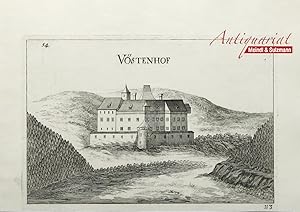
Topographia Austriae Inferioris: "Vöstenhof".
Verlag: Wien, 1920., 1920
Anbieter: Antiquariat MEINDL & SULZMANN OG, Wien - Vienna, Österreich
Verkäuferbewertung 5 von 5 Sternen

Bildausschnitt ca. 10 x 15,5 cm. NW 783.- Abgezogen von der Original-Kupferplatte der Ausgabe 1680.- Das Schloss Vöstenhof. wurde wahrscheinlich im 13. Jahrhundert erbaut. 1381 verkaufte Albero Stuchs von Trautmannsdorf das Schloss an Herzog Albrecht III. 1387 erhielt Johann von Liechtenstein die Herrschaft, die jedoch bald wieder von den landesfürstlichen Pflegern selbst verwaltet wurde. 1483 erhielt Martin Neidegger das Lehen und es blieb bis 1592 in der Familie. In dieser Zeit wurde die Feste als "Hoff zu Neydeckh" bezeichnet. 1592 kaufte Hieronymus Wurmbrandt, der Erbküchenmeister der Steiermark, die Burg. 1621 bis 1912 war das Schloss im Besitz der Grafen Hoyos. Im 19. Jahrhundert ließen sie den Bau stetig verfallen, bis 1894 mit der Restaurierung begonnen wurde. Dann kauften die Fürsten Schwarzenberg das Schloss und anschließend ging es in den Besitz der Familie Czernin über.
-
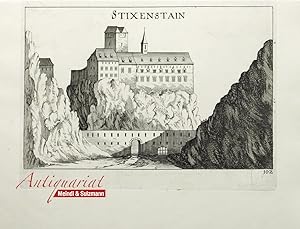
Topographia Austriae Inferioris: "Stixenstain".
Verlag: Wien, 1920., 1920
Anbieter: Antiquariat MEINDL & SULZMANN OG, Wien - Vienna, Österreich
Verkäuferbewertung 5 von 5 Sternen
Bildausschnitt ca. 10 x 15,5 cm. Abgezogen von der Original-Kupferplatte der Ausgabe 1680.- Die Burg Stixenstein ist eine mittelalterliche Höhenburganlage in Stixenstein, einer Rotte der Stadtgemeinde Ternitz, in Niederösterreich. Die Burg wurde wahrscheinlich im 12.Jahrhundert errichtet. Von hier stammten wohl die Stuchse (Stüchse, der alte Name ist Stuchsenstein), die ab dem späteren 12.Jahrhunderts Stuchs von Trautmannsdorf genannt wurden, da sie als Ministerialen der steirischen Markgrafen die Burg Trautmannsdorf besaßen. Am 28. November 1520 wurde die Burg von Kaiser Maximilian I. an Marx Treitzsaurwein übergeben. 1547 ging der Besitz auf die Hoyos über. Seit 1937 befindet sich die Burg im Eigentum der Gemeinde Wien. Sie wird heute als Veranstaltungsort genutzt.
-
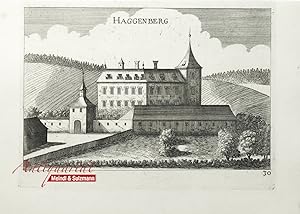
Topographia Austriae Inferioris: "Haggenberg".
Verlag: Wien, 1920., 1920
Anbieter: Antiquariat MEINDL & SULZMANN OG, Wien - Vienna, Österreich
Verkäuferbewertung 5 von 5 Sternen
Bildausschnitt ca. 10 x 15,5 cm. Abgezogen von der Original-Kupferplatte der Ausgabe 1680.- einrich von Hagenberg ist 1224-1264 urkundlich nachweisbar. Nach dem Tod des letzten Hagenbergers 1382 erbt Alber Stuchs von Trautmannsdorf den Besitz. 1403/14 gelangt die halbe Burg an die Liechtenstein. Ende des 17. Jahrhunderts erfolgen Wiederherstellungsarbeiten durch die Sinzendorf, da der Bau jedoch seiner Funktion verlustig geht, verwahrlost er zusehends.
-

Drucker
Verlag: Books LLC, Reference Series Okt 2014, 2014
ISBN 10: 1158796692 ISBN 13: 9781158796694
Anbieter: buchversandmimpf2000, Emtmannsberg, BAYE, Deutschland
Verkäuferbewertung 5 von 5 Sternen
Taschenbuch. Zustand: Neu. Neuware -Quelle: Wikipedia. Seiten: 42. Kapitel: Tintenstrahldrucker, Laserdrucker, Fernschreiber, Nadeldrucker, Fotodrucker, Matrixdrucker, Drucken im Netzwerk, Ludwig Hemmer, Kartendrucker, Kontoauszugsdrucker, Hellschreiber, Sebastian Gryphius, Johann Gymnich I., HP Indigo, André Le Breton, MPS 801, Zeilendrucker, Siemens PT80i, MPS-Serie, Brailledrucker, Dr.-Grauert-Brief, Georg Stuchs, Unihammer, Sharp CE-126P, Game Boy Printer, Zink-Drucktechnologie, Trommeldrucker, Johann Georg Schwab, Kettendrucker, PoGo, LED-Drucker, Siemens PT88, StyleWriter, Fixiereinheit, Entwicklereinheit, Impact-Drucker, MPS 1270, CBM 4022, Chronoprinter, Netzwerkdrucker, ASR-33, MPS 1000, MPS 1500C, Seitendrucker, Zeichendrucker. Auszug: Tintenstrahldrucker sind Matrixdrucker, bei denen durch den gezielten Abschuss oder das Ablenken kleiner Tintentröpfchen ein Druckbild erzeugt wird. Sie gehören zur Gruppe der Non-Impact-Drucker. Man unterscheidet zwei Geräteklassen: Die Geschichte des Tintenstrahldruckers begann in den 60er Jahren. Der Teletype Inktronic wurde zwischen 1963 und 1970 vom US-amerikanischen Unternehmen The Teletype Corp Inktronic entwickelt. Er gilt als erster Tintenstrahldrucker der Welt. Der Teletype Inktronic war jedoch kein Drucker im klassischen Sinn, sondern ein Ausgabegerät, das in Verbindung mit einem Monitor funktionierte. Die Druckleistung ließ sehr zu wünschen übrig. Es gelang den Entwicklern nicht, die Tinte präzise auf das Papier zu befördern. Diese Tatsache führte zu verschiedenen Problemen, unter anderem verschmutzte der Drucker viel zu schnell. Das führte zu einer mangelhaften Druckqualität. Weiters war das Gerät so groß, dass eine private Nutzung von vornherein ausgeschlossen werden konnte. Die ersten funktionsfähigen Tintenstrahl-Druckgeräte wurden Anfang der 70er von IBM auf den Markt gebracht. Sie druckten im Permanentbetrieb (Continuous drop) und waren deshalb nur für den Einsatz in der Industrie zu gebrauchen. Das Verfahren des kontinuierlichen Tintenstrahls wird in verbesserter Form jedoch bis heute bei einigen Tintenstrahldruckern angewandt. Letztendlich waren es die heute weltbekannten Konzerne HP und Canon, denen die technische Umsetzung gelang. Im Jahre 1979 reichten beide beinahe zeitgleich das Patent ein. Einer der ersten Tintenstrahldrucker für den End-Kundenmarkt war der HP ThinkJet aus dem Jahre 1984. Im selben Jahr kam das erste Serien-Modell der Piezo-Drucker auf den Markt: der Epson SQ 2000. 1987 brachte der HP PaintJet endlich Farbe ins Büro. Im Jahre 1990 erschien schließlich der erste Tintenstrahldrucker für den Massenmarkt, der HP Deskjet 500. Nachdem zum Jahrtausendwechsel die ersten Drucker erschienen, die mit Zusatzfarben wie Rot, Blau, Grün uBooks on Demand GmbH, Überseering 33, 22297 Hamburg 42 pp. Deutsch.
-
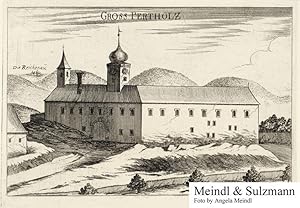
Topographia Austriae Inferioris: "Gross Pertholz".
Verlag: Wien, 1920., 1920
Anbieter: Antiquariat MEINDL & SULZMANN OG, Wien - Vienna, Österreich
Verkäuferbewertung 5 von 5 Sternen
Bildausschnitt ca. 10 x 15,5 cm. Abgezogen von der Original-Kupferplatte der Ausgabe 1680.- Das heutige Schloss Großpertholz besteht aus vier einstöckigen Trakten, die einen quadratischen Hof umgeben. Der Ministeriale Udalrich von Stiefern erhielt 1150 im Zuge einer Königsschenkung das Gebiet um den heutigen Markt Großpertholz. Auftragsgemäß begann er sofort mit der Rodung der sich hier erstreckenden dichten Wälder. Das Gut Großpertholz gelangte noch in der ersten Hälfte des 14. Jahrhunderts an die Familie Stuchs von Trautmannsdorf. 1351 verkaufte es Mert der Stuchs an Eberhard und Wolf von Dachsberg, die auf Rapottenstein saßen. Über einige Kurzzeiteigentümer, zu denen 1641 auch Ferdinand Rudolf von Leisser gehörte, gelangte Großpertholz gemeinsam mit einigen anderen Gütern an den General- und Reformationskommissar Joachim Enzmiller Reichsgraf von und zu Windhag. Dieser gehörte zu den schillerndsten Gestalten der Gegenreformation und hatte es zu großem Reichtum gebracht. Er ließ den alten Freihof in das mächtige vierflügelige Schloss umbauen, das auf dem Vischer-Stich von 1672 dargestellt ist.
-

Haus Liechtenstein
Sprache: Deutsch
Verlag: Books LLC, Reference Series Nov 2011, 2011
ISBN 10: 1159041725 ISBN 13: 9781159041724
Anbieter: buchversandmimpf2000, Emtmannsberg, BAYE, Deutschland
Verkäuferbewertung 5 von 5 Sternen
Taschenbuch. Zustand: Neu. Neuware -Quelle: Wikipedia. Seiten: 69. Kapitel: Stammliste von Liechtenstein, Hans-Adam II., Johann I. Josef, Franz Josef II., Gundaker von Liechtenstein, Johann II., Alois II., Vranov u Brna, Maximilian von Liechtenstein, Alois von Liechtenstein, Karl I., Josef Wenzel I., Anton Florian, Franz I., Karl Johann Anton von Liechtenstein, Alois von und zu Liechtenstein, Josefa zu Fürstenberg-Weitra, Moritz von Liechtenstein, Josef Johann Adam, Eleonore von Liechtenstein, Georgina von Wilczek, Wilhelm von und zu Liechtenstein, Heinrich I. von Liechtenstein, Maximilian von und zu Liechtenstein, Franz Josef I., Karl Eusebius, Johann Adam I. Andreas, Marie Kinsky von Wchinitz und Tettau, Nora von Liechtenstein, Johann Nepomuk Karl, Eleonore Barbara von Thun-Hohenstein, Leopoldine von Sternberg, Nikolaus von Liechtenstein, Elsa von Gutmann, Franziska Kinsky von Wchinitz und Tettau, Constantin von Liechtenstein, Karoline von Manderscheid-Blankenheim, Edmunda Maria Theresia von Dietrichstein-Nikolsburg, Johanna Beatrix von Dietrichstein-Nikolsburg, Rudolf von Liechtenstein, Maria Anna von Oettingen-Spielberg, Anna Maria von Liechtenstein, Alois I., Stefan von und zu Liechtenstein, Maria Josefa von Harrach, Maria Anna von Kottulinsky, Anna Maria Schembera von Czernahor von Boskowitz, Therese von Liechtenstein, Henriette von Liechtenstein, Gabriele von Liechtenstein, Aloysia von Liechtenstein. Auszug: Stammliste des Hauses Liechtenstein mit den in der Wikipedia vertretenen Personen und wichtigen Zwischengliedern. Heinrich I. von Liechtenstein (¿ 1265/6), Herr zu Nikolsburg, Liechtenstein und Petronell, 1260 Landeshauptmann von Steiermark, 8 Diemud N. 8 Mechthild N. (¿ nach 1265) Agnes (¿ um 1318) 8 N. von Plankenstein Hartneid (¿ 1277) Heinrich II., Herr zu Liechtenstein und Nikolsburg (¿ 13. April 1314) 8 Petrissa von Zelking (¿ 1318) GeorgBartholomäus (¿ nach 1386)Johann I., Herr zu Nikolsburg und Feldsberg (¿ 1397) 8 Agnes von Klingenberg (¿ vor 1387) 8 Katharina von Pottendorf 8 Elisabeth von Puechheim (¿ 1408) Hartneid III., 'der Ältere', (¿ 1376/7) 8 Anna von SternbergGeorg (¿ 1398) 8 Dorothea von Puchheim (¿ nach 1387)Hartneid IV., 'der Jüngere', Herr zu Rosenperg (¿ um 1395) 8 Afra von Walsee (¿ 1430), Tochter von Friedrich von Walsee Katharina 8 Ludwig von EckartsauHeinrich IV., der Jüngere (¿ 1383)Anna (¿ 13. Februar 1357) 8 Seyfried von Kranichsberg, Herr zu Steyregg (¿ 1342)Elisabeth 8 Dietmar von Losenstein (¿ 1358) 8 Gotthard von Neitperg 8 Weikard von WinkelKunigunde (¿ 1391/6) 8 Heinrich von Hackenberg (¿ um 1383) 8 Albert Stuchs von Trautmannsdorf (¿ 1403/4) Petrissa, Nonne Andrea/AndreasElisabeth (¿ nach 1314)Margaretha (¿ nach 1265) 8 Seifried Bais zu Baissenstein und ClemnitzDiemud (¿ nach 1265) 8 Otto III. von Liechtenstein-Murau (¿ 1311)Kunigunde (¿ um 1295) 8 Otto von GutradAlbert von Liechtenstein, Herr zu Petronell (¿ nach 1285) Albert, Herr zu Petronell (¿ vor 1291) 8 N. von Wildungsmauer (¿ nach 1295)Peter, Herr zu Petronell (¿ vor 1290)Albert (¿ 11. Juli 1190) 8 Kunigunde N. Luitgard von Matzen (¿ vor 1195) 8 Waldmann von Holnstein-PastbergRapoto (¿ nach 1196)Wirat, Nonne (¿ nach 1192)Tochter, Nonne in Klosterneuburg Ulrich (¿ um 1427) 8 Ursula von Stubenberg (¿ nach 1446) Margaretha 8 Albrecht von NeitpergHeinrich V. (¿ um 1418) 8 Dorothea von Eckartsau 8 Anna von Zelking (¿ 1441/8) Georg III., Herr zu Liechtenstein (¿ 1Books on Demand GmbH, Überseering 33, 22297 Hamburg 69 pp. Deutsch.
-

Haus Liechtenstein : Stammliste von Liechtenstein, Hans-Adam II., Johann I. Josef, Franz Josef II., Gundaker von Liechtenstein, Johann II., Alois II., Vranov u Brna, Maximilian von Liechtenstein, Alois von Liechtenstein, Karl I., Josef Wenzel I.
Sprache: Deutsch
Verlag: Books LLC, Reference Series, 2011
ISBN 10: 1159041725 ISBN 13: 9781159041724
Anbieter: AHA-BUCH GmbH, Einbeck, Deutschland
Verkäuferbewertung 5 von 5 Sternen
Zustand: Neu. Neu - Quelle: Wikipedia. Seiten: 69. Kapitel: Stammliste von Liechtenstein, Hans-Adam II., Johann I. Josef, Franz Josef II., Gundaker von Liechtenstein, Johann II., Alois II., Vranov u Brna, Maximilian von Liechtenstein, Alois von Liechtenstein, Karl I., Josef Wenzel I., Anton Florian, Franz I., Karl Johann Anton von Liechtenstein, Alois von und zu Liechtenstein, Josefa zu Fürstenberg-Weitra, Moritz von Liechtenstein, Josef Johann Adam, Eleonore von Liechtenstein, Georgina von Wilczek, Wilhelm von und zu Liechtenstein, Heinrich I. von Liechtenstein, Maximilian von und zu Liechtenstein, Franz Josef I., Karl Eusebius, Johann Adam I. Andreas, Marie Kinsky von Wchinitz und Tettau, Nora von Liechtenstein, Johann Nepomuk Karl, Eleonore Barbara von Thun-Hohenstein, Leopoldine von Sternberg, Nikolaus von Liechtenstein, Elsa von Gutmann, Franziska Kinsky von Wchinitz und Tettau, Constantin von Liechtenstein, Karoline von Manderscheid-Blankenheim, Edmunda Maria Theresia von Dietrichstein-Nikolsburg, Johanna Beatrix von Dietrichstein-Nikolsburg, Rudolf von Liechtenstein, Maria Anna von Oettingen-Spielberg, Anna Maria von Liechtenstein, Alois I., Stefan von und zu Liechtenstein, Maria Josefa von Harrach, Maria Anna von Kottulinsky, Anna Maria Schembera von Czernahor von Boskowitz, Therese von Liechtenstein, Henriette von Liechtenstein, Gabriele von Liechtenstein, Aloysia von Liechtenstein. Auszug: Stammliste des Hauses Liechtenstein mit den in der Wikipedia vertretenen Personen und wichtigen Zwischengliedern. Heinrich I. von Liechtenstein ( 1265/6), Herr zu Nikolsburg, Liechtenstein und Petronell, 1260 Landeshauptmann von Steiermark, 8 Diemud N. 8 Mechthild N. ( nach 1265) Agnes ( um 1318) 8 N. von Plankenstein Hartneid ( 1277) Heinrich II., Herr zu Liechtenstein und Nikolsburg ( 13. April 1314) 8 Petrissa von Zelking ( 1318) GeorgBartholomäus ( nach 1386)Johann I., Herr zu Nikolsburg und Feldsberg ( 1397) 8 Agnes von Klingenberg ( vor 1387) 8 Katharina von Pottendorf 8 Elisabeth von Puechheim ( 1408) Hartneid III., 'der Ältere', ( 1376/7) 8 Anna von SternbergGeorg ( 1398) 8 Dorothea von Puchheim ( nach 1387)Hartneid IV., 'der Jüngere', Herr zu Rosenperg ( um 1395) 8 Afra von Walsee ( 1430), Tochter von Friedrich von Walsee Katharina 8 Ludwig von EckartsauHeinrich IV., der Jüngere ( 1383)Anna ( 13. Februar 1357) 8 Seyfried von Kranichsberg, Herr zu Steyregg ( 1342)Elisabeth 8 Dietmar von Losenstein ( 1358) 8 Gotthard von Neitperg 8 Weikard von WinkelKunigunde ( 1391/6) 8 Heinrich von Hackenberg ( um 1383) 8 Albert Stuchs von Trautmannsdorf ( 1403/4) Petrissa, Nonne Andrea/AndreasElisabeth ( nach 1314)Margaretha ( nach 1265) 8 Seifried Bais zu Baissenstein und ClemnitzDiemud ( nach 1265) 8 Otto III. von Liechtenstein-Murau ( 1311)Kunigunde ( um 1295) 8 Otto von GutradAlbert von Liechtenstein, Herr zu Petronell ( nach 1285) Albert, Herr zu Petronell ( vor 1291) 8 N. von Wildungsmauer ( nach 1295)Peter, Herr zu Petronell ( vor 1290)Albert ( 11. Juli 1190) 8 Kunigunde N. Luitgard von Matzen ( vor 1195) 8 Waldmann von Holnstein-PastbergRapoto ( nach 1196)Wirat, Nonne ( nach 1192)Tochter, Nonne in Klosterneuburg Ulrich ( um 1427) 8 Ursula von Stubenberg ( nach 1446) Margaretha 8 Albrecht von NeitpergHeinrich V. ( um 1418) 8 Dorothea von Eckartsau 8 Anna von Zelking ( 1441/8) Georg III., Herr zu Liechtenstein ( 1.
-
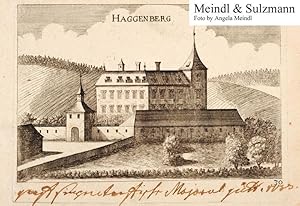
Topographia Austriae Inferioris: "Haggenberg".
Verlag: Wien, 1672., 1672
Anbieter: Antiquariat MEINDL & SULZMANN OG, Wien - Vienna, Österreich
Verkäuferbewertung 5 von 5 Sternen
Bildausschnitt ca. 10 x 15,5 cm. Guter Abdruck, unterhalb der Darstellung zeitgenöss. Vermerk.- Heinrich von Hagenberg ist 1224-1264 urkundlich nachweisbar. Nach dem Tod des letzten Hagenbergers 1382 erbt Alber Stuchs von Trautmannsdorf den Besitz. 1403/14 gelangt die halbe Burg an die Liechtenstein. Ende des 17. Jahrhunderts erfolgen Wiederherstellungsarbeiten durch die Sinzendorf, da der Bau jedoch seiner Funktion verlustig geht, verwahrlost er zusehends.
-
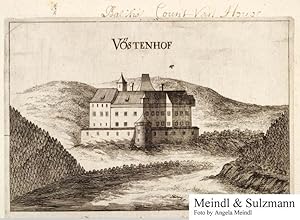
Topographia Austriae Inferioris: "Vöstenhof".
Verlag: Wien, 1672., 1672
Anbieter: Antiquariat MEINDL & SULZMANN OG, Wien - Vienna, Österreich
Verkäuferbewertung 5 von 5 Sternen
Bildausschnitt ca. 10 x 15,5 cm. Kräftiger Abdruck. Oberhalb der Darst. der damalige Besitzer von alter Hand eingetragen.- Das Schloss Vöstenhof. wurde wahrscheinlich im 13. Jahrhundert erbaut. 1381 verkaufte Albero Stuchs von Trautmannsdorf das Schloss an Herzog Albrecht III. 1387 erhielt Johann von Liechtenstein die Herrschaft, die jedoch bald wieder von den landesfürstlichen Pflegern selbst verwaltet wurde. 1483 erhielt Martin Neidegger das Lehen und es blieb bis 1592 in der Familie. In dieser Zeit wurde die Feste als "Hoff zu Neydeckh" bezeichnet. 1592 kaufte Hieronymus Wurmbrandt, der Erbküchenmeister der Steiermark, die Burg. 1621 bis 1912 war das Schloss im Besitz der Grafen Hoyos. Im 19. Jahrhundert ließen sie den Bau stetig verfallen, bis 1894 mit der Restaurierung begonnen wurde. Dann kauften die Fürsten Schwarzenberg das Schloss und anschließend ging es in den Besitz der Familie Czernin über.
-
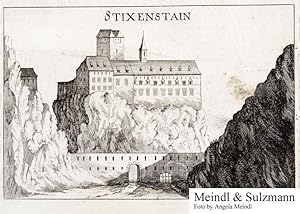
Topographia Austriae Inferioris: "Stixenstain".
Verlag: Wien, 1672., 1672
Anbieter: Antiquariat MEINDL & SULZMANN OG, Wien - Vienna, Österreich
Verkäuferbewertung 5 von 5 Sternen
Bildausschnitt ca. 10 x 15,5 cm. Leicht fleckig.- Die Burg Stixenstein ist eine mittelalterliche Höhenburganlage in Stixenstein, einer Rotte der Stadtgemeinde Ternitz, in Niederösterreich. Die Burg wurde wahrscheinlich im 12.Jahrhundert errichtet. Von hier stammten wohl die Stuchse (Stüchse, der alte Name ist Stuchsenstein), die ab dem späteren 12.Jahrhunderts Stuchs von Trautmannsdorf genannt wurden, da sie als Ministerialen der steirischen Markgrafen die Burg Trautmannsdorf besaßen. Am 28. November 1520 wurde die Burg von Kaiser Maximilian I. an Marx Treitzsaurwein übergeben. 1547 ging der Besitz auf die Hoyos über. Seit 1937 befindet sich die Burg im Eigentum der Gemeinde Wien. Sie wird heute als Veranstaltungsort genutzt.
-

Libri . de fide et legibus.
Verlag: Günther Zainer,, [Augsburg,, 1475
Anbieter: Antiquariaat FORUM BV, Houten, Niederlande
Verkäuferbewertung 5 von 5 Sternen
Erstausgabe
EUR 45.000,00
EUR 25,00 shipping
Versand von Niederlande nach USAAnzahl: 1 verfügbar
In den WarenkorbIncunable first edition of De fide et legibus (On faith and laws), one of the most important works of William of Auvergne (post 1180 - 1249) and the first of his works to be printed. It forms one of seven parts of his principal monumental work Magisterium divinale (The divine teaching), a compendium of philosophy and theology that attempts to explain the whole natural world. The parts were first printed as separate works and no more appeared in print until Georg Stuchs in Nürnberg published the second edition of De fide et legibus and two other parts in a collection of Auvergne's works in 1496, followed by three more parts in 1497. William of Auvergne was one of the most prominent French philosophers and theologians of the early 13th century. He was Bishop of Paris from 1228 until his death in 1249 and although he was in the very Christian position of bishop, he was one of the first Western scholars to try to integrate classical Greek, Arabic and Jewish philosophy, for example Aristotle, Solomon ibn Gabirol (Avicebron) and especially Ibn Sina (Avicenna), with Christian doctrine. These writings had recently become available in Latin translation. On the one hand this allowed William to oppose errors he considered dangerous for Christian beliefs, but on the other hand he found a large source of philosophical inspiration in these Greek, Arabic and Jewish texts.Although the book bear neither a year of publication nor the name of a printer or publisher, Günther Zainer (1430-1478) listed it in a 1476 advertisement and it is set in his type. Zainer established the first printing office in Augsburg. This beautiful incunable in chancery folio is not only a rich source for medieval philosophy and theology, but also - as Thorndike confirms - a picture of magic, superstition and idolatry in the first half of the 13th century.With a contemporary inscription: "Cart. in Buxheim. Contenta" and a small stamp of the "Bibl. Buxheim'" on the first page. The book therefore originally belonged to the Carthusians at Buxheim in Germany. The publisher Günther Zainer was known for his gifts to the Carthusian monastery in Buxheim and our copy of William of Auvergne's work was probably one of them. The monastery's library was sold in the 19th-century. Also with the bookplate of the library of George Dunn (1865-1912), an English bibliophile with an impressive library at Woolley Hall and a particular interest in paleography and early printing. Binding slightly stained and rubbed, first and last leaf somewhat loose, some water stains (especially at the end of the book), but still a beautiful copy in good condition.l BMC II 323; Goff G 711; GW 11863; Hain-Copinger 8317; IGI 4602; ISTC ig00711000; Oates 883; Polain 1807; Proctor 1556; for the author: Thorndike III, pp. 338-371. Contemporary, richly blind-tooled vellum over wooden boards, two brass clasps, blue edges, "Nr. 56" in red ink written at the foot of the spine. Set in a hybrid roman type with gothic elements (a single column of 43 lines per page plus running heads), with the first 3 lines, including the title, in a slightly larger rotunda gothic. With all initials supplied in manuscript in red, rubricated throughout. Pages: [139] ll.
-
Rare 1491 folio incunable Missale printed for the Augustinians in Nuremberg and illustrated with a large contemporary coloured woodcut of the passion likely the from the workshop of Michael Wolgemut
Verlag: Georg Stuchs, 1491
Anbieter: De Bry Rare Books, Oxford, Vereinigtes Königreich
Verbandsmitglied: PBFA
Verkäuferbewertung 4 von 5 Sternen

EUR 20.822,41
EUR 17,33 shipping
Versand von Vereinigtes Königreich nach USAAnzahl: 1 verfügbar
In den WarenkorbHardcover. Zustand: Very Good. Rare folio incunable Missale printed for the Augustinians in Nuremberg and illustrated with a large contemporary coloured woodcut of the passion likely the from the workshop of Michael Wolgemut -Large folio 33 x 26cm in 18 Century pig skin binding -Incomplete: 248 (of 256 pages) -Published in Nuremburg by Georg Stuchs - 1491 -[6],a-i10,k6,[6],l-q10,r8 (missing k3, 6 leaves in signature l and y1). Minor browning to sheets, repairs to several pages with losses replaced by ink on some pages. Minor worming. Trimming to 1st leaf (of calendar) and last leaf without loss of image. Old paper repairs to pages sometimes using old manuscript paper). Printed in black and red ink. Rubrication throughout and single large coloured initial <R= in blue, green, red and yellow ink (?inserted from another copy). Calendar on opening 6 leaves. This is an important Missale from the famous printing town of Nuremberg produced on the press of the predominantly religious printer Georg Stuchs. The Missale was commissioned by Andreas Proles (1429-1503), a provincial vicar of the Augustinian order in Germany who was an advocate for strict observance of the religious order s rules. The book contains a beautiful full page woodcut of the passion in contemporary colour. A second uncoloured woodcut on the final sheet depicts monks kneeling before St Augustinian. The woodcut of the passion is typical of the period and is similar to those produced in Nuremberg for indulgences, or for use in Missals. It is likely that the print is from the workshop of Michael Wolgemut, the foremost artist and woodblock print maker in Nuremburg at this time, who was most famous for his image of the Dance of Death produced for the 1493 Nuremburg chronicle. The woodcut is very similar to a painting from the Workshop of Wolgemut which survives in St Lorenz Church, Nuremberg which was dedicated to the vicar Georg Rayl who died in 1494. This woodcut of the passion clearly influenced later woodcuts produced by Durer, including a 1493 composition for a Missale by the Basel printer Gruninger (Meder abb 30, Kurth 85, Fischer 285), and a more elaborate woodcut of the crucifixion produced in Nuremberg in c1495 (Meder Abb 32, Kurth 88, Fischer 343). Durer (1471-1528) had finished his apprenticeship in Nuremberg in 1490, before leaving on his "wanderjahres". He was in Basel from 1491-93, so it is unlikely that he produced this image. This printed incunable Missale is rare, with only 20 examples known in institutions and none recorded outside of Europe GW M23973.
-
In hoc opere haec continentur Noua translatio primi libri Geographiae Cl. Ptolomaei
Verlag: Johann Stuchs, Nuremberg, 1514
Anbieter: SOPHIA RARE BOOKS, Koebenhavn V, Dänemark
Verkäuferbewertung 5 von 5 Sternen
Erstausgabe
Hardcover. First edition. THE WERNER MAP PROJECTION. First edition of Werner's "most famous work on astronomy and geography" (MacTutor), an extremely rare and highly influential work on cartography and navigation, notable for several 'firsts': it contains the first published direct translation of any part of Ptolemy's Geography from the original Greek; the first publication of the Werner map projection, which was widely used for world and continental maps through the sixteenth and seventeenth centuries, notably by Mercator, Oronce Finé and Ortelius; the invention of the lunar distance method of longitude determination, which was the principal method used by navigators until the second half of the 18th century; and the invention, and first illustration, of the cross-staff, an instrument designed to make the necessary astronomical observations at sea. "Werner's mathematical and astronomical work has been quite undeservedly neglected by historians" (North, p. 61). Werner was at the heart of a tight knit circle of mathematical practitioners in Nuremberg, Ingolstadt, Vienna and Tübingen who were largely responsible for establishing mathematics as a discipline in the central European universities. Werner's edition of the first and part of the seventh book of Ptolemy's Geography, the Nova translatio Primi Geographiae, was the first translation from the Greek since the original translation made by Jacobus Anglicus around 1406. Werner stated clearly that his rationale for the undertaking lay in the many errors contained in Anglicus's edition and in the succeeding ones, which were all based on Anglicus's rendering of the Greek text. Werner had access to the papers of Regiomontanus, which were part of the scientific library of his former mentor Bernhard Walther and had been inherited by Werner's friend and neighbour Albrecht Dürer who purchased the library, along with Walther's house, in 1509. These papers may have included Regiomontanus's notes for his own translation of the Geography which he had planned but failed to complete before his death in 1476. Werner's greatest personal input in this edition were his mathematical notes to the first book, where he criticized Ptolemy, often on the grounds that taking him literally would result in "deforming the earth's shape". Drawing inspiration from Ptolemy and from astronomical usage, Werner also made an original contribution to cartographical projections with his Libellus de quatuour terrarum orbis en plano figurationibus ab codem Ioanne Verneo novissime compertis et enarratis. Here Werner gave a theoretical discussion of two generalizations of Ptolemy's second conic projection. His Propositio IV modifies Ptolemy's methodology by requiring that lengths be preserved on all parallels, represented by concentric arcs, and on all radii. Werner further modified the projection in a way that makes the North Pole the centre of what in modern terms would be called a system of polar coordinates. In Propositio V he also requires that a quadrant of the equator have the same length as the radius between a pole and the equator. These modifications provided the first solution to the problem of representing the surface of a sphere within a finite area. OCLC locates only three copies in America (Folger, University of Illinois and John Carter Brown). No copies located in auction records since 1981 (and only 3 copies before). Provenance: A significant association copy linking two influential figures in the administration of Henry IV. The title page bears the contemporary presentation inscription: "D.[ono] dedit A. Le grand senator Regius / Lallier," recording the gift of this volume from Alexandre Le Grand to Jacques Lallier. Alexandre Le Grand, Seigneur de Saint-Jean-des-Troux (fl. 1573 1593), was a distinguished French magistrate who served as a Conseiller au Parlement de Paris. The son of Nicolas Le Grand, physician in ordinary to the King, Alexandre was deeply entrenched in the intellectual and political life of the late 16th century. His 1575 marriage to Suzanne Canaye connected him to one of the period's most prominent families, the Canayes, who were central to the French Protestant intelligentsia and diplomatic corps. Jacques Lallier, Sieur du Pin (fl. from 1570; d. 1592), was a key statesman and diplomat who served as Secretary of State and Secretary of Commandments to Henry of Navarre (Henry IV). A zealous Huguenot and a trusted advisor during Henry's ascent to the French throne, Lallier was known for his fierce intellect and formidable personalitytraits that famously led to clashes with Queen Marguerite de Valois. As a central figure in the Conseil du Roi, Lallier was instrumental in the management of royal affairs during the volatile Wars of Religion. "The collection dated 1514 contains Werner's works on mathematical geography. In the commentary on the first book of Ptolemy's Geography, Werner explains the basic concepts of spherical geography and then turns to the measurement of degrees on the sphere. When determining the declination of the sun, he refers to the tables compiled by Georg von Peuerbach and Domenico Maria. Werner's method is interesting in that it determines simultaneously the longitude and the latitude of a place (ch. 3, annotation 8): For the first time it was possible for two sites the locations of which are being sought to be found by a combined series of observations. Since for the determination of latitude it is necessary merely to observe the upper and lower culmination of a circumpolar star, but not the position of the sun, quite a few sources of errors were removed. The fourth chapter deals with the determination of the difference in longitude of two places, which can be obtained by simultaneous observation of a lunar eclipse. Another method is based in the determination of the distance of a zodiac star from the moon as seen from two places (ch. 4, annotation 8). This method of calculating the distances to the moon requires only the determination of the angula.
-
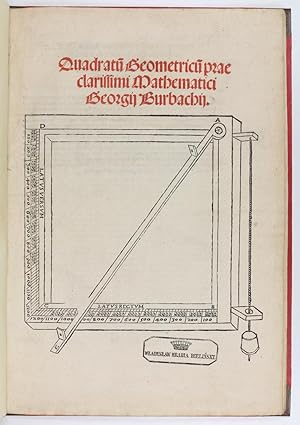
Quadratum geometricum praeclarissimi mathematici.
Verlag: Nuremberg, Johann Stuchs, 1516., 1516
Anbieter: Antiquariat INLIBRIS Gilhofer Nfg. GmbH, Vienna, A, Österreich
Verbandsmitglied: ILAB VDA VDAO
Verkäuferbewertung 5 von 5 Sternen
Erstausgabe
EUR 15.000,00
EUR 30,00 shipping
Versand von Österreich nach USAAnzahl: 1 verfügbar
In den WarenkorbFolio. 10 unnumbered ff. Title printed in red and black with full-page woodcut of the instrument in question (repeated on f. 2v) and numerous woodcut diagrams. Modern half morocco over red boards. First edition of one of the rarest works by the Austrian astronomer and instrument maker. The "Quadratum geometricum", a new geodetic measuring instrument, was invented by Peurbach himself, and its use is here described for the first time. - From the library of Werner Habel, with his ownership stamp, signature and acquisition date (1977) to front pastedown. Previously in the collections of Count Wladyslaw Hrabia Bielinski and Zygmunt Czarnecki, with their stamps to title. Rare, only a single copy recorded at auction within the last 60 years. - VD 16, P 2054. Adams P 2270. BNHCat P 943.
-

Habent sua fata libelli
Sprache: Deutsch
Verlag: De Gruyter Saur, De Gruyter Jul 2000, 2000
ISBN 10: 3598114524 ISBN 13: 9783598114526
Anbieter: buchversandmimpf2000, Emtmannsberg, BAYE, Deutschland
Verkäuferbewertung 5 von 5 Sternen
Buch. Zustand: Neu. Neuware -Frontmatter -- Grußwort -- Inhalt -- Vorworte -- ÜBER DIESES BUCH -- WAS WIR LERNTEN -- Das abenteüerlich Buoch von eyner Frauwen genant Melusina -- Das buch der himelischen offenbarung sant Birgitten wie es yetz in der weit ergen sol. : 1504 zu Augsburg gedruckt -- Das Confessionale des Bartholomaeus de Chaimis - ein weit verbreitetes Werk im späten Mittelalter -- M - ein Buch sucht seinen Drucker - exercitium grammaticale puerorum in den Händen der Inkunabelforscher -- Das Obsequiale Ratisponense von 1491: Ein früher Nürnberger Notendruck von Georg Stuchs -- Vocabularius predicantium Ein lateinisch-deutsches Wörterbuch für Prediger von Johannes Melber -- Fasern zum Festigen von PapierWalter de Gruyter GmbH, Genthiner Strasse 13, 10785 Berlin 144 pp. Deutsch.
-

Habent sua fata libelli : Integration von Wissenschaft und Praxis in der Buchrestaurierung.Dargestellt an den Dokumentationen zu exemplarischen Arbeiten aus der Staatlichen Fachakademie zur Ausbildung von Restauratoren
Anbieter: AHA-BUCH GmbH, Einbeck, Deutschland
Verkäuferbewertung 5 von 5 Sternen
Buch. Zustand: Neu. Druck auf Anfrage Neuware - Printed after ordering - Frontmatter -- Grußwort / Bayern, Herzog Franz von -- Inhalt -- Vorworte -- ÜBER DIESES BUCH / Bansa, Helmut -- WAS WIR LERNTEN / Ramsauer, Martin -- Das abenteüerlich Buoch von eyner Frauwen genant Melusina / Höck, Sabina -- Das buch der himelischen offenbarung sant Birgitten wie es yetz in der weit ergen sol. : 1504 zu Augsburg gedruckt / Castell-Castell, Gabrielle Gräfin zu -- Das Confessionale des Bartholomaeus de Chaimis - ein weit verbreitetes Werk im späten Mittelalter / Huber, Katrin -- M - ein Buch sucht seinen Drucker - exercitium grammaticale puerorum in den Händen der Inkunabelforscher / Rörig, Henrik -- Das Obsequiale Ratisponense von 1491: Ein früher Nürnberger Notendruck von Georg Stuchs / Ramsauer, Martin -- Vocabularius predicantium Ein lateinisch-deutsches Wörterbuch für Prediger von Johannes Melber / Brüggemann, Susanne -- Fasern zum Festigen von Papier / Bansa, Helmut.
-

Zustand: Hervorragend. Zustand: Hervorragend | Sprache: Deutsch | Produktart: Bücher | Frontmatter -- Grußwort -- Inhalt -- Vorworte -- ÜBER DIESES BUCH -- WAS WIR LERNTEN -- Das abenteüerlich Buoch von eyner Frauwen genant Melusina -- Das buch der himelischen offenbarung sant Birgitten wie es yetz in der weit ergen sol. : 1504 zu Augsburg gedruckt -- Das Confessionale des Bartholomaeus de Chaimis - ein weit verbreitetes Werk im späten Mittelalter -- M - ein Buch sucht seinen Drucker - exercitium grammaticale puerorum in den Händen der Inkunabelforscher -- Das Obsequiale Ratisponense von 1491: Ein früher Nürnberger Notendruck von Georg Stuchs -- Vocabularius predicantium Ein lateinisch-deutsches Wörterbuch für Prediger von Johannes Melber -- Fasern zum Festigen von Papier.
-
[Tabulae solis et lunae coniunctionum]. Opusculuz tabularum utile verarum Solis [et] lune coniunctionum
Verlag: Martin Landsberg[?], [Leipzig], 1495
Anbieter: James Cummins Bookseller, ABAA, New York, NY, USA
Verkäuferbewertung 4 von 5 Sternen
[8] leaves. Title printed in red and 2 pages printed in red and black. Quarto (210 x 153 mm). Very rare incunable edition of this novel method for predicting the new and full moon, which offers an ingenious alternative to the Alphonsine Tables. Composed by Wenzel Faber (d. 1518), the Leipzig university professor, astronomer, and prolific author of printed astrological practica, the Opusculum includes all the tables required to estimate times of the new and full moons occurring between the years 1377 and 1772. Replacing cumbersome iterative procedures of the Alfonsine Tables with a single addition of results from a double-entry solar and a single-entry lunar table, Faber's approach simplifies a table written c.1400 by Nicholaus de Heybech of Erfurt. Times of syzygy, reckoned to the nearest minute via such tables, were the most widely cited astronomical data of the incunable period, regularly appearing on the hundreds of broadside almanacs and multi-leaved astrological practica issued by the early printers. Faber's Opusculum was printed in two nearly identical editions, using the types of Martin Landsberg of Leipzig in 1494-95 and not before 1499, both of which are rare. The British Museum Catalogue originally assigned the printing to Georg Stuchs, though corrected in BMC III to an anonymous Leipzig press using the types of Landsberg and hence often attributed to him. ISTC records just two copies of this issue in the United States (Harvard and Library of Congress). Goff F9; HC 6860*; Klebs 388.1; Madsen 1550; IBP 2147; Sajó-Soltész 1293; imáková-Vrchotka 737; Günt(L) 1415; Borm 1006; Walsh 1033; Pr 2264; BMC II 469 & III 660; BSB-Ink F-25; Döring-Fuchs F-6; GW 9628; ISTC if00009000. Don C. Skemer, 'Wenzel Faber von Budweis (c. 1455/14601518): An astrologer and his library in the early age of printing', in: Gutenberg-Jahrbuch 82 (2007), pp. 241-277 Bound in old manuscript leaf over boards. Light staining at sheet edges. Provenance: R. David Parsons (booklabel) [8] leaves. Title printed in red and 2 pages printed in red and black. Quarto (210 x 153 mm).
-
Johannes Gerson Opera Incunable Edition Stuchs Nuremberg 1489 - 4 Parts in 3 Volumes
Verlag: Stuchs, Nürnberg, 1489
Anbieter: raremapexchange, Neuendettelsau, Deutschland
Verkäuferbewertung 5 von 5 Sternen
EUR 6.800,00
EUR 6,00 shipping
Versand von Deutschland nach USAAnzahl: 1 verfügbar
In den WarenkorbHardcover. Zustand: Gut. Johannes Gerson: Opera. 4 Parts in 3 Volumes. Georg Stuchs, Nuremberg, 1489. Modern hardcover binding. 240 leaves; 289, 1 w. leaves; 397 (of 399), 1 w. leaves, 52 leaves. With 4 full-page woodcuts. Reference: Hain-Copinger 7623. GW 10716. Goff G-188 . Proctor 2263. Condition: two leaves missing (in vol. 2 (gG4-5). The "Inventarium" bound at the beginning in the first volume. Text altogether slightly browned and with some staining in places. Very few old annotations. Very few leaves with minor restaurations. The woodcut for the inventarium with restored tears and very slight loss. The other woodcuts in good condtion.
-
Tertia pars operum.
Verlag: Georg Stuchs), S.l. (Nuremberg, 1489
Anbieter: Libreria Bardon, Madrid, M, Spanien
Verkäuferbewertung 5 von 5 Sternen
399 hojas sin numerar. Signatura: aa7 (de 8)-zz8, Aa-Zz8; AA8-DD8. Impresión en caracteres góticos a dos columnas, 50 líneas por plana. Letras capitulares miniadas a dos tintas roja y azul. Rara y bella edición incunable en caracteres góticos del libro o parte tercera de las obras que escribió el erudito y sabio escritor, historiador, teólogo, reformista, Jean de Gerson (1363-1469), considerado uno de los primeros humanistas. Durante el siglo XV se publicaron los tres primeros volúmenes que componen sus obras y ya en el siglo XVI, en 1502 exactamente, el cuarto y último volumen que completa su obra.La obra de Gerson, con más de 600 títulos, tuvo dos pilares básicos, la reforma de la iglesia y la educación Cristiana, sus manuscritos circularon por toda Europa, especialmente en Alemania y pronto tomaron el relevo los impresos, hasta 1483 se publicaron de forma separada y después conjuntamente.Ejemplar falto del folio aa1 blanco, con algunas manchas, en general, en buen estado de conservación. Hain, 7623; Polain 1592; Goff G188. Martín Abad: "Catálogo Bibliográfico de Incunables de la Biblioteca Nacional" recoge otras ediciones de la obra completa. El Catálogo Informatizado del Patrimonio Bibliográfico recoge ediciones incunables de todas las partes. Encuadernado en piel original sobre tabla, deteriorada y falta de algunos trozos, lomera de pergamino.
-
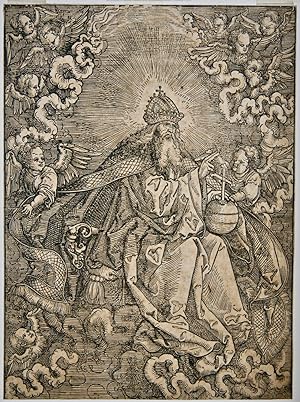
German missal leaf ca. 1512-5 with woodcut by Hans Springinklee of Deus Pater (God the Father)
Verlag: Circle of Johann Koberger, Nuremberg, 1512
Anbieter: Arca Amoris Alitis, New York, NY, USA
Verkäuferbewertung 5 von 5 Sternen
Kunst / Grafik / Poster
No Binding. Zustand: Very Good. Woodcut recto 235 x 172 mm, on laid paper without watermark, cut along the framing line on three sides and ca. 30 mm within it at bottom, on a portion of a leaf with rubricated text verso of a Preface to the Canon, 18 lines over 150 mm, with 5-line woodcut pictorial initial P 42 x 40 mm, followed by nine manuscript lines of an oratio to the Virgin in apparently a contemporaneous German hand. The impression of the woodcut is well printed, showing minor wear in the fine lines in the upper register. The letterpress verso is printed clearly, darkly and evenly, so that both recto and verso of the sheet suggest a first edition issue. The crisply-penned oratio is fluid and unfaded. The sheet is uniformly age-darkened to a light tan color and, apart from its being cut from a larger leaf, is otherwise in very good condition, without foxing or soiling recto or verso (saving one tiny spot recto in the rays above the crown). Citing the earlier cataloguing by J.D. Passavant, Le Peintre Graveur, vol. iii, p. 241, no. 63 (1862), Campbell Dodgson included this woodcut by Hans Springinklee in his Catalogue of Early German and Flemish Woodcuts, vol. 1, p. 411, no. 79 (1903), by reference to a photograph of the impression (266 x 169 mm) in the collection of King Friedrich August II at Dresden. Dodgson also lists the impression in the Kunsthalle, Hamburg with text on the back printed in red and black, from a missal. He observes (ibid., at p. 370): "[M]uch of Springinklee's work is to be found in illustrations published about 1515-1522 for the publishing firm founded by Koberger, whose books at that time were printed partly at Nuremberg by J. Stüchs and F. Peypus, partly at Lyons by Clein, Sacon, and Marion. [A]s a rule, he is at his best when most directly inspired by Dürer." New Hollstein (Hans Springinklee vol. I, pp. 2-3, no. 1, 2010) adds two further impressions of this woodcut to Dodgson's three and cites a Paris impression as 265 x 171 mm. The full prints are signed with the initials HSK in ligature in the block lower right. Thus the present impression is trimmed 30 mm on the bottom, excising the signature and an area filled mostly with ruled or blank background. The bottom 30 mm may have been cut from this impression by a former owner wanting to assert Dürer's ostensible authorship. (Several wood engravings formerly assigned to Dürer are now given to Springinklee, and at least one formerly given to Springinklee is now given to Dürer.) A much more medieval rendering was the frontispiece of the printer-publisher Anton Koberger's Liber Chronicarum ("Nuremberg Chronicle") of 1493, wood-engraved by Michael Wolgemut, a master of the young Dürer. The text of the Praefatio on the verso of the present woodcut follows exactly a form for weekdays and simple feasts (absent another assigned form) in the Missale Romanum Mendiolani 1474. It is printed with fonts matching very closely fonts used by Koberger in the 1493 Liber Chronicarum. Koberger ceased printing around 1504 and died in 1513, but his prodigious publishing house, continued by Johann Koberger, continued to publish other printers using his formats. (See Proctor, Early Printed Books Part II Section I (1903) at p. 94 and under Georg Stüchs and Friedrich Peypus, inter alia.) No copy of a missal has been located in digitized bibliographies or catalogues with an indication of a woodcut like the present. However, there could plausibly exist printings of a missal published by Koberger's house or circle with his fonts and with woodcuts from Dürer's circle, including specifically the present woodcut and letterpress. Exceeded by the superb impression, apparently on vellum, formerly in the collection of King Friedrich August II at Dresden, the present woodcut in turn appears to exceed the Paris impression illustrated in New Hollstein. Given the few catalogued European impressions and the open quest to identify the parent missal, this sheet is a consequential survival.
-
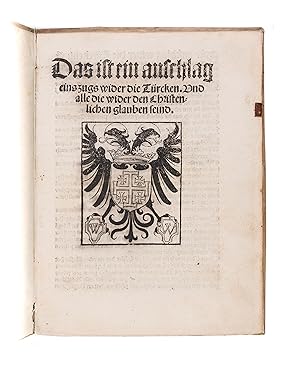
Das ist ein anschlag eins zugs wider die Türcken vnd alle die wider den Christenlichen glauben seind.
Verlag: 1518]., 1518
Anbieter: Maggs Bros. Ltd ABA, ILAB, PBFA, London, Vereinigtes Königreich
Verbandsmitglied: ABA ILAB PBFA
Verkäuferbewertung 5 von 5 Sternen
EUR 4.521,44
EUR 31,19 shipping
Versand von Vereinigtes Königreich nach USAAnzahl: 1 verfügbar
In den WarenkorbTitle with woodcut coat of arms. Small 4to. Bound in old flexible vellum, overall a very good copy. 4ff. [Nürenberg, Jobst Gutknecht, The expansion of the Ottoman Empire during the reign of Sultan Selim I (1465-1520) was closely watched throughout Europe. The present work calls for the formation of an army to be sent against the Ottomans (and all others opposed to Christianity). In the first half of the sixteenth century over 900 pamphlets relating to the Ottoman Empire were issued, documenting the widespread fear of Turkish domination. The present call to arms was issued in various cities throughout central Europe including Augsburg, Breslau, and Basel. Two other Nuremberg imprints are known to have been printed in the same year (Georg Stuchs & Friedrich Peypus). Rare. Only two copies in OCLC. Göllner, Turcica I, 107. VD16, D-160; Köhler, 664; Weller, 1088. .
-

Drucker
Verlag: Reference Series Books LLC Okt 2014, 2014
ISBN 10: 1158796692 ISBN 13: 9781158796694
Anbieter: BuchWeltWeit Ludwig Meier e.K., Bergisch Gladbach, Deutschland
Verkäuferbewertung 5 von 5 Sternen
Taschenbuch. Zustand: Neu. This item is printed on demand - it takes 3-4 days longer - Neuware -Quelle: Wikipedia. Seiten: 42. Kapitel: Tintenstrahldrucker, Laserdrucker, Fernschreiber, Nadeldrucker, Fotodrucker, Matrixdrucker, Drucken im Netzwerk, Ludwig Hemmer, Kartendrucker, Kontoauszugsdrucker, Hellschreiber, Sebastian Gryphius, Johann Gymnich I., HP Indigo, André Le Breton, MPS 801, Zeilendrucker, Siemens PT80i, MPS-Serie, Brailledrucker, Dr.-Grauert-Brief, Georg Stuchs, Unihammer, Sharp CE-126P, Game Boy Printer, Zink-Drucktechnologie, Trommeldrucker, Johann Georg Schwab, Kettendrucker, PoGo, LED-Drucker, Siemens PT88, StyleWriter, Fixiereinheit, Entwicklereinheit, Impact-Drucker, MPS 1270, CBM 4022, Chronoprinter, Netzwerkdrucker, ASR-33, MPS 1000, MPS 1500C, Seitendrucker, Zeichendrucker. Auszug: Tintenstrahldrucker sind Matrixdrucker, bei denen durch den gezielten Abschuss oder das Ablenken kleiner Tintentröpfchen ein Druckbild erzeugt wird. Sie gehören zur Gruppe der Non-Impact-Drucker. Man unterscheidet zwei Geräteklassen: Die Geschichte des Tintenstrahldruckers begann in den 60er Jahren. Der Teletype Inktronic wurde zwischen 1963 und 1970 vom US-amerikanischen Unternehmen The Teletype Corp Inktronic entwickelt. Er gilt als erster Tintenstrahldrucker der Welt. Der Teletype Inktronic war jedoch kein Drucker im klassischen Sinn, sondern ein Ausgabegerät, das in Verbindung mit einem Monitor funktionierte. Die Druckleistung ließ sehr zu wünschen übrig. Es gelang den Entwicklern nicht, die Tinte präzise auf das Papier zu befördern. Diese Tatsache führte zu verschiedenen Problemen, unter anderem verschmutzte der Drucker viel zu schnell. Das führte zu einer mangelhaften Druckqualität. Weiters war das Gerät so groß, dass eine private Nutzung von vornherein ausgeschlossen werden konnte. Die ersten funktionsfähigen Tintenstrahl-Druckgeräte wurden Anfang der 70er von IBM auf den Markt gebracht. Sie druckten im Permanentbetrieb (Continuous drop) und waren deshalb nur für den Einsatz in der Industrie zu gebrauchen. Das Verfahren des kontinuierlichen Tintenstrahls wird in verbesserter Form jedoch bis heute bei einigen Tintenstrahldruckern angewandt. Letztendlich waren es die heute weltbekannten Konzerne HP und Canon, denen die technische Umsetzung gelang. Im Jahre 1979 reichten beide beinahe zeitgleich das Patent ein. Einer der ersten Tintenstrahldrucker für den End-Kundenmarkt war der HP ThinkJet aus dem Jahre 1984. Im selben Jahr kam das erste Serien-Modell der Piezo-Drucker auf den Markt: der Epson SQ 2000. 1987 brachte der HP PaintJet endlich Farbe ins Büro. Im Jahre 1990 erschien schließlich der erste Tintenstrahldrucker für den Massenmarkt, der HP Deskjet 500. Nachdem zum Jahrtausendwechsel die ersten Drucker erschienen, die mit Zusatzfarben wie Rot, Blau, Grün u 42 pp. Deutsch.
-
![Bild des Verkäufers für Missale Hildensemense. Blatt, Leaf: IICCXXXIIII [234] zum Verkauf von ANTIQUARIAT.WIEN Fine Books & Prints](https://pictures.abebooks.com/inventory/md/md30321327486.jpg)
Missale Hildensemense. Blatt, Leaf: IICCXXXIIII [234]
Verlag: Georg Stuchs, Nürnberg, 1499
Anbieter: ANTIQUARIAT.WIEN Fine Books & Prints, Wien, Österreich
Verkäuferbewertung 5 von 5 Sternen
Kunst / Grafik / Poster
Inkunabelblatt in schwarzem und rotem Druck, Blattgröße ca. 25x35,5 cm, gedruckt auf starkem Büttenpapier, rote und schwarze Schrift in 2 Spalten in 32 Zeilen. Guter Zustand de 200 Grafik.
-
In hoc Opere haec continentur Nova translatio primi libri Geographiae Cl. Ptolomaei: quae quidem translatio verbum: habet e verbo fideliter expressum: Joanne Vernero Nurembergen. interprete [and other texts, see below]
Erscheinungsdatum: 1514
Anbieter: Jonathan A. Hill, Bookseller Inc., New York, NY, USA
Verkäuferbewertung 3 von 5 Sternen

Erstausgabe
Numerous fine woodcut diagrams & tables in the text. 68 unnumbered leaves. Small folio, attractive antique calf (title a little dusty), panelled in gilt & blind. [Nuremberg: J. Stuchs, 1514]. First edition of a very scarce and little-known book (because of its rarity, I think), which is of great importance in the history of cartography, navigation, and astronomy. It contains, amongst much else, the first published direct translation of any part of Ptolemy's Geography from the original Greek. It also includes the first publication of Johannes Werner's map projection, a development and correction of the two projections used by Ptolemy which had "reigned" for 1400 years; it was very influential in cartography and used for two centuries, most notably by Apianus, Finé, Ortelius, and Mercator. The texts include: I & II. Werner's translation of and commentary on the first and seventh books of Ptolemy's Geography and his Libellus quatuor terrarum orbis. Werner (1468-1522), astronomer, mathematician, and cartographer, knew Greek well and in the dedication of the present volume criticizes previous translators of Euclid and Ptolemy who were not skilled in mathematics. The first book of the Geography is concerned with the accurate drawing of a map of the inhabited world and describes proposals for two projections, one simple and one complex. "In the commentary on the first book of Ptolemy's Geography, Werner explains the basic concepts of spherical geography and then turns to the measurement of degrees on the sphere. When determining the declination of the sun, he refers to the tables compiled by Georg von Peurbach and Domenico Maria. Werner's method is interesting in that it determines simultaneously the longitude and the latitude of a place (ch. 3, annotation 8): For the first time it was possible for two sites the locations of which are being sought to be found by a combined series of observations. Since for the determination of latitude it is necessary merely to observe the upper and lower culmination of a circumpolar star, but not the position of the sun, quite a few sources of errors were removed. The fourth chapter deals with the determination of the difference in longitude of two places, which can be obtained by simultaneous observation of a lunar eclipse. Another method is based on the determination of the distance of a zodiac star from the moon as seen from two places (ch. 4, annotation 8). This method of calculating the distances to the moon requires only the determination of the angular distances, which can be carried out by means of the Jacob's staff, and the precise knowledge of the true and mean motions of the moon. This method soon replaced the older ones and was then used as the principal method for determining longitude in nautical astronomy "The methods used by Werner enabled him to improve or to explain certain details of the ancient geographers, especially those of Marinus. Werner's remarks in chapters 7-10 refer to Marinus' determination of places, which he proves to be often incorrect, or to the sea voyages mentioned and explained by Marinus. Werner demonstrated a knowledge of the existence and direction of the trade winds and explained their origin. In addition, he tried to present a theoretical proof of approximate formulas for the determination of distances that were used in navigation "Werner's contributions to cartography are based on his criticism of Marinus: they can be found at the end of the commentary on Ptolemy and in the 'Libellus quatuor terrarum orbis.' The remarks on chapter 24 of the Geography lead us to believe that Werner understood the two projections used by Ptolemy (simple conic projection and modified spherical projection) and developed them. The treatise on four other projections of the terrestrial globe, which is dedicated to Pirckheimer, contains more new ideas. In it Werner outlines the principles of stereographic projection and emphasizes that any point on the surface of the sphere can be chosen as the center of projection. In addition, Werner develops three cordiform map projections that resemble one another; the second gives an equal-area projection of the sphere. The idea of an equivalent projection occurred earlier in the works of Bernard Sylvanus, but Werner and Johannes Stabius were the first to work it out mathematically. Later, Oronce Fine, Peter Apian, and Gerardus Mercator adopted the cordiform projection "Werner's work in geography gained widespread recognition. Peter Apian, in particular, was a student of Werner's in theoretical cartography."D.S.B., XIV, pp. 274-75. III. The first printing of the essay on Ptolemy's Geography by the Greek scholar Georgios Amiroutzes (ca. 1400-70), who was in the retinue of Mohammed II and was commissioned by the sultan to translate the text of the Geography into Arabic. Following this, we have the valuable commentaries by Werner on Amiroutzes' writings. IV. Regiomontanus' description of the meteoroscope, written in 1462 in the form of a letter to Cardianal Bessarion and published here for the first time. The meteoroscope was a complex instrument used to observe the stars and planets; it aided in the solution of different tasks of spherical astronomy. The instrument was developed from the Arabic safea. It is very well illustrated in the text. A fine and crisp copy with deep impressions of the woodcuts. ? Bagrow, History of Cartography, pp. 34-35 & 209-10. Sabin 66479. Stillwell, The Awakening Interest in Science during the First Century of Printing, 212n & 252. Zinner, Astronomische Instrumente des 11. bis 18. Jahrhunderts, pp. 479-83 & pl. 63. Zinner, Geschichte und Bibliographie, 1019.
-

Haus Liechtenstein
Sprache: Deutsch
Verlag: Reference Series Books LLC Nov 2011, 2011
ISBN 10: 1159041725 ISBN 13: 9781159041724
Anbieter: BuchWeltWeit Ludwig Meier e.K., Bergisch Gladbach, Deutschland
Verkäuferbewertung 5 von 5 Sternen
Taschenbuch. Zustand: Neu. This item is printed on demand - it takes 3-4 days longer - Neuware -Quelle: Wikipedia. Seiten: 69. Kapitel: Stammliste von Liechtenstein, Hans-Adam II., Johann I. Josef, Franz Josef II., Gundaker von Liechtenstein, Johann II., Alois II., Vranov u Brna, Maximilian von Liechtenstein, Alois von Liechtenstein, Karl I., Josef Wenzel I., Anton Florian, Franz I., Karl Johann Anton von Liechtenstein, Alois von und zu Liechtenstein, Josefa zu Fürstenberg-Weitra, Moritz von Liechtenstein, Josef Johann Adam, Eleonore von Liechtenstein, Georgina von Wilczek, Wilhelm von und zu Liechtenstein, Heinrich I. von Liechtenstein, Maximilian von und zu Liechtenstein, Franz Josef I., Karl Eusebius, Johann Adam I. Andreas, Marie Kinsky von Wchinitz und Tettau, Nora von Liechtenstein, Johann Nepomuk Karl, Eleonore Barbara von Thun-Hohenstein, Leopoldine von Sternberg, Nikolaus von Liechtenstein, Elsa von Gutmann, Franziska Kinsky von Wchinitz und Tettau, Constantin von Liechtenstein, Karoline von Manderscheid-Blankenheim, Edmunda Maria Theresia von Dietrichstein-Nikolsburg, Johanna Beatrix von Dietrichstein-Nikolsburg, Rudolf von Liechtenstein, Maria Anna von Oettingen-Spielberg, Anna Maria von Liechtenstein, Alois I., Stefan von und zu Liechtenstein, Maria Josefa von Harrach, Maria Anna von Kottulinsky, Anna Maria Schembera von Czernahor von Boskowitz, Therese von Liechtenstein, Henriette von Liechtenstein, Gabriele von Liechtenstein, Aloysia von Liechtenstein. Auszug: Stammliste des Hauses Liechtenstein mit den in der Wikipedia vertretenen Personen und wichtigen Zwischengliedern. Heinrich I. von Liechtenstein ( 1265/6), Herr zu Nikolsburg, Liechtenstein und Petronell, 1260 Landeshauptmann von Steiermark, 8 Diemud N. 8 Mechthild N. ( nach 1265) Agnes ( um 1318) 8 N. von Plankenstein Hartneid ( 1277) Heinrich II., Herr zu Liechtenstein und Nikolsburg ( 13. April 1314) 8 Petrissa von Zelking ( 1318) GeorgBartholomäus ( nach 1386)Johann I., Herr zu Nikolsburg und Feldsberg ( 1397) 8 Agnes von Klingenberg ( vor 1387) 8 Katharina von Pottendorf 8 Elisabeth von Puechheim ( 1408) Hartneid III., 'der Ältere', ( 1376/7) 8 Anna von SternbergGeorg ( 1398) 8 Dorothea von Puchheim ( nach 1387)Hartneid IV., 'der Jüngere', Herr zu Rosenperg ( um 1395) 8 Afra von Walsee ( 1430), Tochter von Friedrich von Walsee Katharina 8 Ludwig von EckartsauHeinrich IV., der Jüngere ( 1383)Anna ( 13. Februar 1357) 8 Seyfried von Kranichsberg, Herr zu Steyregg ( 1342)Elisabeth 8 Dietmar von Losenstein ( 1358) 8 Gotthard von Neitperg 8 Weikard von WinkelKunigunde ( 1391/6) 8 Heinrich von Hackenberg ( um 1383) 8 Albert Stuchs von Trautmannsdorf ( 1403/4) Petrissa, Nonne Andrea/AndreasElisabeth ( nach 1314)Margaretha ( nach 1265) 8 Seifried Bais zu Baissenstein und ClemnitzDiemud ( nach 1265) 8 Otto III. von Liechtenstein-Murau ( 1311)Kunigunde ( um 1295) 8 Otto von GutradAlbert von Liechtenstein, Herr zu Petronell ( nach 1285) Albert, Herr zu Petronell ( vor 1291) 8 N. von Wildungsmauer ( nach 1295)Peter, Herr zu Petronell ( vor 1290)Albert ( 11. Juli 1190) 8 Kunigunde N. Luitgard von Matzen ( vor 1195) 8 Waldmann von Holnstein-PastbergRapoto ( nach 1196)Wirat, Nonne ( nach 1192)Tochter, Nonne in Klosterneuburg Ulrich ( um 1427) 8 Ursula von Stubenberg ( nach 1446) Margaretha 8 Albrecht von NeitpergHeinrich V. ( um 1418) 8 Dorothea von Eckartsau 8 Anna von Zelking ( 1441/8) Georg III., Herr zu Liechtenstein ( 1 69 pp. Deutsch.
-

Habent sua fata libelli
Anbieter: BuchWeltWeit Ludwig Meier e.K., Bergisch Gladbach, Deutschland
Verkäuferbewertung 5 von 5 Sternen
Buch. Zustand: Neu. This item is printed on demand - it takes 3-4 days longer - Neuware -Frontmatter -- Grußwort / Bayern, Herzog Franz von -- Inhalt -- Vorworte -- ÜBER DIESES BUCH / Bansa, Helmut -- WAS WIR LERNTEN / Ramsauer, Martin -- Das abenteüerlich Buoch von eyner Frauwen genant Melusina / Höck, Sabina -- Das buch der himelischen offenbarung sant Birgitten wie es yetz in der weit ergen sol. : 1504 zu Augsburg gedruckt / Castell-Castell, Gabrielle Gräfin zu -- Das Confessionale des Bartholomaeus de Chaimis - ein weit verbreitetes Werk im späten Mittelalter / Huber, Katrin -- M - ein Buch sucht seinen Drucker - exercitium grammaticale puerorum in den Händen der Inkunabelforscher / Rörig, Henrik -- Das Obsequiale Ratisponense von 1491: Ein früher Nürnberger Notendruck von Georg Stuchs / Ramsauer, Martin -- Vocabularius predicantium Ein lateinisch-deutsches Wörterbuch für Prediger von Johannes Melber / Brüggemann, Susanne -- Fasern zum Festigen von Papier / Bansa, Helmut 144 pp. Deutsch.


![Bild des Verkäufers für [Tabulae solis et lunae coniunctionum]. Opusculuz tabularum utile verarum Solis [et] lune coniunctionum zum Verkauf von James Cummins Bookseller, ABAA](https://pictures.abebooks.com/inventory/md/md32183900866.jpg)

![Bild des Verkäufers für In hoc Opere haec continentur Nova translatio primi libri Geographiae Cl. Ptolomaei: quae quidem translatio verbum: habet e verbo fideliter expressum: Joanne Vernero Nurembergen. interprete [and other texts, see below] zum Verkauf von Jonathan A. Hill, Bookseller Inc.](https://pictures.abebooks.com/inventory/md/md31946585557.jpg)
