
Verwandte Artikel zu Show Stopper! Cloth: THE BREAKNECK RACE TO CREATE WINDOWS...
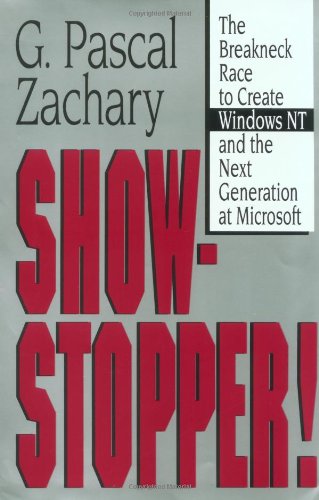
Show Stopper! Cloth: THE BREAKNECK RACE TO CREATE WINDOWS NT AND THE NEXT GENERATION AT MICROSOFT - Hardcover
Inhaltsangabe
The phenomenal success of Bill Gates and his Microsoft Corporation hinges, above all, on an ability to look to the future. Not content with holding a bulging share of the market for software applications, nor with dominating the crucial operating systems business by virtue of its DOS and Windows programs, Microsoft is always looking to the future. And the future for Microsoft now goes by the name of Windows NT. A software innovation of the first order, NT could redefine the standards for computing throughout the world, into the next century. NT endows inexpensive personal computers with the capabilities of giant mainframes -- yet without sacrificing the inherent flexibility and appeal of PCs. Showstopper! is the inside story of this stunning breakthrough in computer technology. Stripping away myth after myth, this unprecedented tale lays bare the messy, wrenching reality of winning innovations. To date, America has dominated the global software industry through creating cutting-edge code and by depending on both the ingenuity of a few visionaries and the coordination of huge, costly teams of programmers and testers. Gates -- a managerial genius as well as a technical visionary -- promotes an atmosphere of controlled chaos at Microsoft, and the story of Windows NT perfectly reflects this ethos. The brain-child of David Cutler, a legendary programmer recruited by Gates in 1988, NT took five years and $150 million to complete. For much of that time, the massive program demanded the obsessive attention of more than 200 testers, writers and technicians. Focusing on Cutler's mercurial ability to inspire and lash his team, Showstopper! brilliantly portrays the human drama of this mammoth undertaking exposing the pressures, disappointments and ultimate triumph that emerge from a cauldron of constant deadlines, competition with peers and a perpetual war against the inevitable and ubiquitous bugs in the program -- among them the potentially lethal "showstopper." Gripping vivid and accessible, Showstopper! reveals the outsize personalities that stand behind great advances: the mavericks, the organizers, the fixers, the motivators. Even as they wrestle with forces that threaten to tear them apart, Cutler and his team feverishly hunt for
Die Inhaltsangabe kann sich auf eine andere Ausgabe dieses Titels beziehen.
Über die Autorin bzw. den Autor
G. Pascal Zachary is an award-winning reporter for The Wall Street Journal and has written extensively about computers, software and the people who create them. Married with one son and one daughter, he lives in Berkeley, California.
Auszug. © Genehmigter Nachdruck. Alle Rechte vorbehalten.
Show Stopper! Cloth
By G. Pascal ZacharyFree Press
Copyright © 1994 G. Pascal ZacharyAll right reserved.
ISBN: 0029356717
Chapter 1
CODE WARRIOR
Dave Cutler was reared on adversity. He learned at a young age to care for himself, to keep his own counsel, to find a way around or through the obstacles in his path.
He was born on March 13, 1942, in Lansing, the state capital of Michigan. Lansing was auto country, home to a slew of car and car-parts makers. His father, Neil, worked in Lansing's Oldsmobile plant for nearly his entire life, first in the plant's shipping department and then as a janitor.
Neil Cutler was an intelligent and exacting man, but he was quiet and lacked ambition. He had been stricken with rheumatic fever as a boy, and it had left him too frail to play sports. Poor eyesight made it difficult for him to enjoy the outdoors. A certain bitterness crept into him. He was not sociable; he struck some as almost a hermit. At home, he could be unpredictable, angry and gruff. He drank.
Arleta, Neil's wife, raised her son Dave and his older sister, Bonnie, in an apartment above the home of Neil's parents in DeWitt, a town of some one thousand people about eight miles north of Lansing. DeWitt was surrounded by farmland and consisted mainly of retired farmers who had moved off their farms and into the town. When Dave was eight the Cutlers moved out of town to a forty-acre spread. The land wasn't suitable for farming and did not contain a dwelling. Neil built a small home, one side of which was literally carved out of the earth. By then Arleta had given birth to two more children. The family seemed to spend all its time together in one large room. Arleta kept a large garden, and the family planted pine trees on the land. In time thousands of trees took root and grew.
From the age of ten David Cutler earned money whenever he could. He mainly worked during the summertime for the many farmers in the area, building barns or doing odd jobs. One summer, he worked in a fertilizer plant. Another year he collected old newspapers with a friend, filling an entire trailer for sale to a recycler.
As a teenager, Cutler was drawn to sports. With a graduating class of thirty-four students, his tiny high school pressed him into service. He ran track and played baseball, basketball and football. He was co-captain of the basketball team and the quarterback of the football team. In one game, he ran for two touchdowns, running almost the entire length of the field for one score. He was very fast.
The local newspaper treated Cutler as a star, chronicling his exploits. Neil skipped nearly all of his son's games; it took a personal invitation from the football coach for him even to consider attending the one game during his son's senior year in which every player's father was introduced. Neil (who went) said he disliked sports, but Arleta suspected that jealousy had kept her husband from the sidelines.
Father and son were distant. While still in high school, Cutler moved out of his parents' home for a time, living first with the family of a baseball coach and then with Bonnie. At school, meanwhile, Cutler did well enough without studying hard. Graduating in June 1960, Cutler seemed serene about his prospects. Somewhere inside him sprang a confidence bordering on arrogance and a belief that he could be the best at anything he tackled. Others shared Cutler's buoyant sense of himself. In his high school yearbook, classmates captured his specialness in a line beneath his photograph:
"None but himself could be his parallel."
A small Michigan college called Olivet cobbled together several athletic and academic scholarships, offering them as a package to Cutler. He signed on. His freshman year, he started at quarterback, calling and directing his own plays just like a pro. He threw the ball well and ran one hundred yards fast -- in less than eleven seconds. He was about five feet nine inches tall, weighed about 175 pounds and had thick, strong legs. His coach, Stu Parsell, called him "a one-in-a-million player" and marveled at his elusiveness. Cutler was a wily player who confessed he "loved to run over people."
In the huddle, Cutler smartly dished out assignments in between plays. He brooked no dissent, berating teammates for their lapses and telling them: "This huddle is my territory. When you're in it, shut up." When players "screwed up," he said, "I'd really ride them, telling them what to do...to get out there and do their job."
Coach Parsell realized that Cutler relied on more than athletic skills. "He was smart enough to know he couldn't win alone," Parsell said. "He brought the other players up with him. They rose to him." The team responded to his brash assertions because Cutler led by example and "knew what he wanted."
Cutler's game peaked in his sophomore season. The long-suffering Olivet Comets, who had lost twenty-one games in a row in the late fifties, suddenly went white-hot in the fall of 1961. With Cutler at the helm, the team won its first eight games. Then, in its final game, disaster struck. Midway through the game, Cutler took the snap from the center and rolled right, preparing one of his quarterback rushes. He had already scored that season on just such a gambit. This time, he was in the clear, running full tilt along the sideline, right along his team's bench, so close that Coach Parsell could have grabbed him. Then a defender charged toward him, hurling his body in Cutler's way. Cutler tried to jump over him, but the defender smacked him squarely. He crumpled to the ground, his leg broken, his season over.
Cutler tried to return the next season, but on the eve of the opening game a doctor told him he risked permanent injuries if he played on. Cutler reluctantly withdrew.
With the end of his football days, Cutler concentrated on his studies. He excelled in math, dabbled in the sciences but finally decided to pursue engineering. When he graduated in January 1965, he was offered a job programming computers for General Motors. Along with other big companies, GM had begun shifting its business records from paper to computer in the 1950s. But Cutler was not eager to join GM. He knew nothing about computers, which seemed vaguely threatening -- even sinister -- to him. In the mid-1960s, many people shared this dystopian view of computers. These machines, which were designed to crunch numbers, were treated with skepticism and sometimes hostility because they symbolized regimentation. Computers seemed to bend humans to their will, forcing men and women to do little more than tend smart machines.
This gave a bad reputation to computers and the task of writing programs for them. Hardly anyone wished to call himself a programmer, and people who did were considered odd. Just a few years before Cutler graduated from Olivet, the top programmer in the Netherlands, an erstwhile physicist, described himself as a programmer on his marriage license. To his dismay, authorities rejected the license on the grounds that there was no such job.
Alert to signs of esteem and status, Cutler held a "very stereotyped view of programmers." To a young man, raised in relative penury and intent on making his way up the economic ladder without kowtowing to authority, programming "seemed a very uncreative job"; and those who did it followers of "this fixed bunch of rules," not leaders who called their own plays.
He wanted no part of software and turned General Motors down fiat. Instead he took a post with DuPont. He adapted easily to the conservative and prosperous chemical giant. He kept his hair...
„Über diesen Titel“ kann sich auf eine andere Ausgabe dieses Titels beziehen.
Suchergebnisse für Show Stopper! Cloth: THE BREAKNECK RACE TO CREATE WINDOWS...

Beispielbild für diese ISBN
Show Stopper!: The Breakneck Race to Create Windows NT and the Next Generation at Microsoft
Anbieter: Gulf Coast Books, Cypress, TX, USA
Verkäuferbewertung 5 von 5 Sternen

hardcover. Zustand: Good. Bestandsnummer des Verkäufers 0029356717-3-37747691
Gebraucht kaufen
EUR 4,58
Versand gratis
Versand innerhalb von USA
Versand innerhalb von USA
Anzahl: 1 verfügbar
Beispielbild für diese ISBN
Show-Stopper!: The Breakneck Race to Create Windows NT and the Next Generation at Microsoft
Anbieter: World of Books (was SecondSale), Montgomery, IL, USA
Verkäuferbewertung 5 von 5 Sternen
Hardback. Zustand: Good. Bestandsnummer des Verkäufers 00110278301
Gebraucht kaufen
EUR 4,59
Versand gratis
Versand innerhalb von USA
Versand innerhalb von USA
Anzahl: 1 verfügbar
Foto des Verkäufers
Show Stopper!: The Breakneck Race to Create Windows NT and the Next Generation at Microsoft
Anbieter: Dream Books Co., Denver, CO, USA
Verkäuferbewertung 5 von 5 Sternen
Zustand: acceptable. This copy has clearly been enjoyedâ"expect noticeable shelf wear and some minor creases to the cover. Binding is strong, and all pages are legible. May contain previous library markings or stamps. Bestandsnummer des Verkäufers DBV.0029356717.A
Gebraucht kaufen
EUR 4,62
Versand gratis
Versand innerhalb von USA
Versand innerhalb von USA
Anzahl: 1 verfügbar
Beispielbild für diese ISBN
Show Stopper!: The Breakneck Race to Create Windows NT and the Next Generation at Microsoft
Anbieter: BooksRun, Philadelphia, PA, USA
Verkäuferbewertung 5 von 5 Sternen
Hardcover. Zustand: Very Good. With dust jacket. It's a well-cared-for item that has seen limited use. The item may show minor signs of wear. All the text is legible, with all pages included. It may have slight markings and/or highlighting. Bestandsnummer des Verkäufers 0029356717-11-1-29
Gebraucht kaufen
EUR 5,15
Versand gratis
Versand innerhalb von USA
Versand innerhalb von USA
Anzahl: 1 verfügbar
Foto des Verkäufers
Show Stopper!: The Breakneck Race to Create Windows NT and the Next Generation at Microsoft
Anbieter: Goodwill Books, Hillsboro, OR, USA
Verkäuferbewertung 5 von 5 Sternen
Zustand: acceptable. Fairly worn, but readable and intact. If applicable: Dust jacket, disc or access code may not be included. Bestandsnummer des Verkäufers GICWV.0029356717.A
Gebraucht kaufen
EUR 2,73
EUR 3,56 Versand
Versand innerhalb von USA
Versand innerhalb von USA
Anzahl: 1 verfügbar
Beispielbild für diese ISBN
Show Stopper!: The Breakneck Race to Create Windows NT and the Next Generation at Microsoft
Anbieter: ThriftBooks-Atlanta, AUSTELL, GA, USA
Verkäuferbewertung 5 von 5 Sternen
Hardcover. Zustand: Good. No Jacket. Pages can have notes/highlighting. Spine may show signs of wear. ~ ThriftBooks: Read More, Spend Less. Bestandsnummer des Verkäufers G0029356717I3N00
Gebraucht kaufen
EUR 6,38
Versand gratis
Versand innerhalb von USA
Versand innerhalb von USA
Anzahl: 1 verfügbar
Beispielbild für diese ISBN
Show Stopper!: The Breakneck Race to Create Windows NT and the Next Generation at Microsoft
Anbieter: ThriftBooks-Phoenix, Phoenix, AZ, USA
Verkäuferbewertung 5 von 5 Sternen
Hardcover. Zustand: Good. No Jacket. Pages can have notes/highlighting. Spine may show signs of wear. ~ ThriftBooks: Read More, Spend Less. Bestandsnummer des Verkäufers G0029356717I3N00
Gebraucht kaufen
EUR 6,38
Versand gratis
Versand innerhalb von USA
Versand innerhalb von USA
Anzahl: 1 verfügbar
Beispielbild für diese ISBN
Show Stopper!: The Breakneck Race to Create Windows NT and the Next Generation at Microsoft
Anbieter: ThriftBooks-Reno, Reno, NV, USA
Verkäuferbewertung 5 von 5 Sternen
Hardcover. Zustand: Very Good. No Jacket. Former library book; May have limited writing in cover pages. Pages are unmarked. ~ ThriftBooks: Read More, Spend Less. Bestandsnummer des Verkäufers G0029356717I4N10
Gebraucht kaufen
EUR 6,38
Versand gratis
Versand innerhalb von USA
Versand innerhalb von USA
Anzahl: 1 verfügbar
Beispielbild für diese ISBN
Show Stopper!: The Breakneck Race to Create Windows NT and the Next Generation at Microsoft
Anbieter: ThriftBooks-Dallas, Dallas, TX, USA
Verkäuferbewertung 5 von 5 Sternen
Hardcover. Zustand: Good. No Jacket. Pages can have notes/highlighting. Spine may show signs of wear. ~ ThriftBooks: Read More, Spend Less. Bestandsnummer des Verkäufers G0029356717I3N00
Gebraucht kaufen
EUR 6,38
Versand gratis
Versand innerhalb von USA
Versand innerhalb von USA
Anzahl: 2 verfügbar
Beispielbild für diese ISBN
Show Stopper!: The Breakneck Race to Create Windows NT and the Next Generation at Microsoft
Anbieter: ThriftBooks-Reno, Reno, NV, USA
Verkäuferbewertung 5 von 5 Sternen
Hardcover. Zustand: Very Good. No Jacket. Missing dust jacket; May have limited writing in cover pages. Pages are unmarked. ~ ThriftBooks: Read More, Spend Less. Bestandsnummer des Verkäufers G0029356717I4N01
Gebraucht kaufen
EUR 6,38
Versand gratis
Versand innerhalb von USA
Versand innerhalb von USA
Anzahl: 1 verfügbar