
Verwandte Artikel zu Nazi Germany and the Jews: Volume 1: The Years of Persecutio...
Nazi Germany and the Jews: Volume 1: The Years of Persecution 1933-1939 - Hardcover
Buch 1 von 2: Nazi Germany and the Jews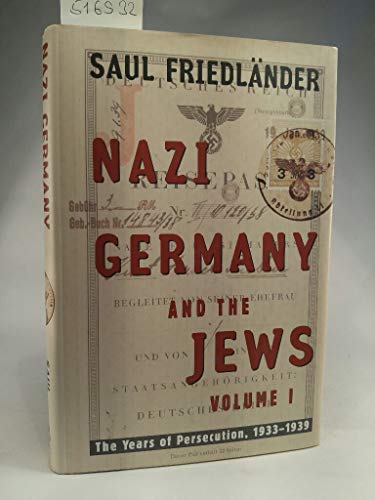
Inhaltsangabe
A great historian crowns a lifetime of thought and research by answering a question that has haunted us for more than 50 years: How did one of the most industrially and culturally advanced nations in the world embark on and continue along the path leading to one of the most enormous criminal enterprises in history, the extermination of Europe's Jews?
Giving considerable emphasis to a wealth of new archival findings, Saul Friedlander restores the voices of Jews who, after the 1933 Nazi accession to power, were engulfed in an increasingly horrifying reality. We hear from the persecutors themselves: the leaders of the Nazi party, the members of the Protestant and Catholic hierarchies, the university elites, and the heads of the business community. Most telling of all, perhaps, are the testimonies of ordinary German citizens, who in the main acquiesced to increasing waves of dismissals, segregation, humiliation, impoverishment, expulsion, and violence.
Die Inhaltsangabe kann sich auf eine andere Ausgabe dieses Titels beziehen.
Über die Autorin bzw. den Autor
Born in Prague, Saul Friedländer spent his boyhood in Nazi-occupied France. He is a professor of history at UCLA, and has written numerous books on Nazi Germany and World War II.
Von der hinteren Coverseite
A great historian crowns a lifetime of thought and research by answering a question that has haunted us for more than 50 years: How did one of the most industrially and culturally advanced nations in the world embark on and continue along the path leading to one of the most enormous criminal enterprises in history, the extermination of Europe's Jews?
Giving considerable emphasis to a wealth of new archival findings, Saul Friedlander restores the voices of Jews who, after the 1933 Nazi accession to power, were engulfed in an increasingly horrifying reality. We hear from the persecutors themselves: the leaders of the Nazi party, the members of the Protestant and Catholic hierarchies, the university elites, and the heads of the business community. Most telling of all, perhaps, are the testimonies of ordinary German citizens, who in the main acquiesced to increasing waves of dismissals, segregation, humiliation, impoverishment, expulsion, and violence.
Auszug. © Genehmigter Nachdruck. Alle Rechte vorbehalten.
Nazi Germany and the Jews
By Saul FriedlanderHarperCollins Publishers
Copyright ©1997 Saul FriedlanderAll right reserved.
ISBN: 0060190426
Introduction
Most historians of my generation, born on the eve of the Nazi era, recognize either explicitly or implicitly that plowing through the events of those years entails not only excavating and interpreting a collective past like any other, but also recovering and confronting decisive elements of our own lives. This recognition does not generate any agreement among us about how to define the Nazi regime, how to interpret its internal dynamics, how to render adequately both its utter criminality and its utter ordinariness, or, for that matter, where and how to place it within a wider historical context.Yet, despite our controversies, many of us share, I think, a sense of personal involvement in the depiction of this past, which gives a particular urgency to our inquiries.
For the next generation of historians--and by now also for the one after that--as for most of humanity, Hitler's Reich, World War II, and the fate of the Jews of Europe do not represent any shared memory. And yet, paradoxically, the centrality of these events in present-day historical consciousness seems much greater than it was some decades ago. The ongoing debates tend to unfold with unremitting bitterness as facts are questioned and evidence denied, as interpretations and commemorative endeavors confront one another, and as statements about historical responsibility periodically come to the fore in the public arena. It could be that in our century of genocide and mass criminality, apart from its specific historical context, the extermination of the Jews of Europe is perceived by many as the ultimate standard of evil, against which all degrees of evil may be measured. In these debates, the historian's role is central. For my generation, to partake at one and the same time in the memory and the present perceptions of this past may create an unsettling dissonance; it may, however, also nurture insights that would otherwise be inaccessible.
Establishing a historical acccount of the Holocaust in which the policies of the perpetrators, the attitudes of surrounding society, and the world of the victims could be addressed within an integrated framework remains a major challenge. Some of the best-known historical renditions of these events have focused mainly on the Nazi machinery of persecution and death, paying but scant attention to the wider society, to the wider European and world scene or to the changing fate of the victims themselves; others, less frequently, have concentrated more distinctly on the history of the victims and offered only a limited analysis of Nazi policies and the surrounding scene.The present study will attempt to convey an account in which Nazi policies are indeed the central element, but in which the surrounding world and the victims' attitudes, reactions, and fate are no less an integral part of this unfolding history.
In many works the implicit assumptions regarding the victims' generalized hopelessness and passivity, or their inability to change the course of events leading to their extermination, have turned them into a static and abstract element of the historical background. It is too often forgotten that Nazi attitudes and policies cannot be fully assessed without knowledge of the lives and indeed of the feelings of the Jewish men, women, and children themselves. Here, therefore, at each stage in the description of the evolving Nazi policies and the attitudes of German and European societies as they impinge on the evolution of those policies, the fate, the attitudes, and sometimes the initiatives of the victims are given major importance. Indeed, their voices are essential if we are to attain an understanding of this past.For it is their voices that reveal what was known and what could be known; theirs were the only voices that conveyed both the clarity of insight and the total blindness of human beings confronted with an entirely new and utterly horrifying reality. The constant presence of the victims in this book, while historically essential in itself, is also meant to put the Nazis' actions into full perspective.
It is easy enough to recognize the factors that shaped the overall historical context in which the Nazi mass murder took place. They determined the methods and scope of the "Final Solution"; they also contributed to the general climate of the times, which facilitated the way to the exterminations. Suffice it here to mention the ideological radicalization--with fervent nationalism and rabid anti-Marxism (later anti-Bolshevism) as its main propelling drives--that surfaced during the last decades of the nineteenth century and reached its climax after World War I (and the Russian Revolution); the new dimension of massive industrial killing introduced by that war; the growing technological and bureaucratic control exerted by modern societies; and the other major features of modernity itself, which were a dominant aspect of Nazism.Yet, asessential as these conditions were in preparing the ground for the Holocaust--and as such they are an integral part of this history--they nonetheless do not alone constitute the necessary cluster of elements that shaped the course of events leading from persecution to extermination.
With regard to that process, I have emphasized Hitler's personal role and the function of his ideology in the genesis and implementation of the Nazi regime's anti-Jewish measures. In no way, however, should this be seen as a return to earlier reductive interpretations, with their sole emphasis on the role (and responsibility) of the supreme leader But, over time, the contrary interpretations have, it seems to me, gone too far. Nazism was not essentially driven by the chaotic clash of competing bureaucratic and party fiefdoms, nor was the planning of its anti-Jewish policies mainly left to the cost-benefit calculations of technocrats.In all its major decisions the regime depended on Hitler. Especially with regard to the Jews, Hitler was driven by ideological obsessions that were anything but the calculated devices of a demagogue; that is, he carried a very specific brand of racial anti-Semitism to its most extreme and radical limits. I call that distinctive aspect of his worldview "redemptive anti-Semitism"; it is different, albeit derived, from other strands of anti-Jewish hatred that were common throughout Christian Europe, and different also from the ordinary brands of German and European racial anti-Semitism. It was this redemptive dimension, this synthesis of a murderous rage and an "idealistic" goal, shared by the Nazi leader and the hard core of the party, that led to Hitler's ultimate decision to exterminate the Jews.
But Hitler's policies were not shaped by ideology alone, and the interpretation presented here traces the interaction between the F*hrer and the system within which he acted. The Nazi leader did not take his decisions independently of the party and state organizations. His initiatives, mainly during the early phase of the regime, were molded not only by his worldview but also by the impact of internal pressures, the weight of bureaucratic constraints, at times the influence of German opinion at large and even the reactions of foreign governments and foreign opinion.
To what extent did the party and the populace partake in Hitler's ideological obsession? "Redemptive" anti-Semitism was common fare among the party elite. Recent studies have also shown that such extreme anti-Semitism was not unusual in the agencies that were to become central to the implementation of the...
„Über diesen Titel“ kann sich auf eine andere Ausgabe dieses Titels beziehen.
Suchergebnisse für Nazi Germany and the Jews: Volume 1: The Years of Persecutio...

Foto des Verkäufers
Nazi Germany and the Jews: Volume 1: The Years of Persecution 1933-1939
Anbieter: -OnTimeBooks-, Phoenix, AZ, USA
Verkäuferbewertung 5 von 5 Sternen

Zustand: good. A copy that has been read, remains in good condition. All pages are intact, and the cover is intact. The spine and cover show signs of wear. Pages can include notes and highlighting and show signs of wear, and the copy can include "From the library of" labels or previous owner inscriptions. 100% GUARANTEE! Shipped with delivery confirmation, if you're not satisfied with purchase please return item! Ships via media mail. Bestandsnummer des Verkäufers OTV.0060190426.G
Gebraucht kaufen
EUR 6,08
Versand gratis
Versand innerhalb von USA
Versand innerhalb von USA
Anzahl: 1 verfügbar
Beispielbild für diese ISBN
Nazi Germany and the Jews : Volume 1: the Years of Persecution 1933-1939
Verlag:
HarperCollins Publishers, 1997
ISBN 10: 0060190426
ISBN 13: 9780060190422
Gebraucht
Hardcover
Anbieter: Better World Books, Mishawaka, IN, USA
Verkäuferbewertung 5 von 5 Sternen
Zustand: Good. Former library copy. Pages intact with minimal writing/highlighting. The binding may be loose and creased. Dust jackets/supplements are not included. Includes library markings. Stock photo provided. Product includes identifying sticker. Better World Books: Buy Books. Do Good. Bestandsnummer des Verkäufers 4990170-75
Gebraucht kaufen
EUR 6,70
Versand gratis
Versand innerhalb von USA
Versand innerhalb von USA
Anzahl: 3 verfügbar
Beispielbild für diese ISBN
Nazi Germany and the Jews: Volume 1: The Years of Persecution 1933-1939
Anbieter: HPB Inc., Dallas, TX, USA
Verkäuferbewertung 5 von 5 Sternen
Hardcover. Zustand: Very Good. Connecting readers with great books since 1972! Used books may not include companion materials, and may have some shelf wear or limited writing. We ship orders daily and Customer Service is our top priority! Bestandsnummer des Verkäufers S_473875849
Gebraucht kaufen
EUR 3,75
EUR 3,24 Versand
Versand innerhalb von USA
Versand innerhalb von USA
Anzahl: 1 verfügbar
Beispielbild für diese ISBN
Nazi Germany and the Jews: Volume 1: The Years of Persecution 1933-1939
Anbieter: ThriftBooks-Dallas, Dallas, TX, USA
Verkäuferbewertung 5 von 5 Sternen
Hardcover. Zustand: Good. No Jacket. Pages can have notes/highlighting. Spine may show signs of wear. ~ ThriftBooks: Read More, Spend Less. Bestandsnummer des Verkäufers G0060190426I3N00
Gebraucht kaufen
EUR 7,01
Versand gratis
Versand innerhalb von USA
Versand innerhalb von USA
Anzahl: 1 verfügbar
Beispielbild für diese ISBN
Nazi Germany and the Jews: Volume 1: The Years of Persecution 1933-1939
Anbieter: ThriftBooks-Phoenix, Phoenix, AZ, USA
Verkäuferbewertung 5 von 5 Sternen
Hardcover. Zustand: Good. No Jacket. Missing dust jacket; Pages can have notes/highlighting. Spine may show signs of wear. ~ ThriftBooks: Read More, Spend Less. Bestandsnummer des Verkäufers G0060190426I3N01
Gebraucht kaufen
EUR 7,01
Versand gratis
Versand innerhalb von USA
Versand innerhalb von USA
Anzahl: 1 verfügbar
Beispielbild für diese ISBN
Nazi Germany and the Jews: Volume 1: The Years of Persecution 1933-1939
Anbieter: ThriftBooks-Atlanta, AUSTELL, GA, USA
Verkäuferbewertung 5 von 5 Sternen
Hardcover. Zustand: Very Good. No Jacket. May have limited writing in cover pages. Pages are unmarked. ~ ThriftBooks: Read More, Spend Less. Bestandsnummer des Verkäufers G0060190426I4N00
Gebraucht kaufen
EUR 7,01
Versand gratis
Versand innerhalb von USA
Versand innerhalb von USA
Anzahl: 2 verfügbar
Beispielbild für diese ISBN
Nazi Germany and the Jews: Volume 1: The Years of Persecution 1933-1939
Anbieter: ThriftBooks-Phoenix, Phoenix, AZ, USA
Verkäuferbewertung 5 von 5 Sternen
Hardcover. Zustand: Very Good. No Jacket. May have limited writing in cover pages. Pages are unmarked. ~ ThriftBooks: Read More, Spend Less. Bestandsnummer des Verkäufers G0060190426I4N00
Gebraucht kaufen
EUR 7,01
Versand gratis
Versand innerhalb von USA
Versand innerhalb von USA
Anzahl: 1 verfügbar
Beispielbild für diese ISBN
Nazi Germany and the Jews: Volume 1: The Years of Persecution 1933-1939
Anbieter: ThriftBooks-Reno, Reno, NV, USA
Verkäuferbewertung 5 von 5 Sternen
Hardcover. Zustand: Very Good. No Jacket. May have limited writing in cover pages. Pages are unmarked. ~ ThriftBooks: Read More, Spend Less. Bestandsnummer des Verkäufers G0060190426I4N00
Gebraucht kaufen
EUR 7,01
Versand gratis
Versand innerhalb von USA
Versand innerhalb von USA
Anzahl: 1 verfügbar
Beispielbild für diese ISBN
Nazi Germany and the Jews: Volume 1: The Years of Persecution 1933-1939
Anbieter: ThriftBooks-Atlanta, AUSTELL, GA, USA
Verkäuferbewertung 5 von 5 Sternen
Hardcover. Zustand: Good. No Jacket. Former library book; Pages can have notes/highlighting. Spine may show signs of wear. ~ ThriftBooks: Read More, Spend Less. Bestandsnummer des Verkäufers G0060190426I3N10
Gebraucht kaufen
EUR 7,01
Versand gratis
Versand innerhalb von USA
Versand innerhalb von USA
Anzahl: 1 verfügbar
Beispielbild für diese ISBN
Nazi Germany and the Jews: Volume 1: The Years of Persecution 1933-1939
Anbieter: ThriftBooks-Dallas, Dallas, TX, USA
Verkäuferbewertung 5 von 5 Sternen
Hardcover. Zustand: Good. No Jacket. Former library book; Pages can have notes/highlighting. Spine may show signs of wear. ~ ThriftBooks: Read More, Spend Less. Bestandsnummer des Verkäufers G0060190426I3N10
Gebraucht kaufen
EUR 7,01
Versand gratis
Versand innerhalb von USA
Versand innerhalb von USA
Anzahl: 1 verfügbar