
Verwandte Artikel zu Things You Should Know: A New York Times Notable Book―...
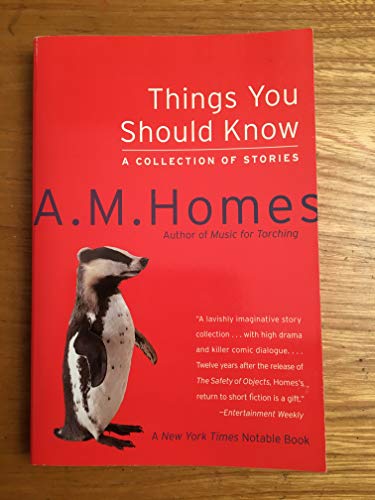
Things You Should Know: A New York Times Notable Book―Emotionally Precise Stories of Memory, Desire, and Loss - Softcover
Inhaltsangabe
A New York Times Notable Book
"Haunting, disturbing, often radiantly intense, these protean stories change shape as if they are made of fire. They are on the side of things lost, they are pushed by the emergency of our lives–yet in the dazzle of their language there is a wonderful stillness, and consolation." —Andrea Barrett
In this stunningly original collection, A. M. Homes writes with terrifying compassion about the things that matter most. Homes's distinctive narrative illuminates our dreams and desires, our memories and losses, and demonstrates how extraordinary the ordinary can be. With uncanny emotional accuracy, wit, and empathy, Homes takes us places we recognize but would rather not go alone.
Die Inhaltsangabe kann sich auf eine andere Ausgabe dieses Titels beziehen.
Über die Autorin bzw. den Autor
A.M. Homes is the author of the novels The End of Alice, In a Country of Mothers, and Jack, as well as the short-story collection The Safety of Objects and the artist's book Appendix A. Her fiction has been translated into eight languages, and she is the recipient of numerous awards, including a Guggenheim Fellowship and a National endowment for the Arts Fellowship. Her fiction and nonfiction appear in magazines such as The New Yorker and Artforum, among others, and she is a contributing editor at Vanity Fair, Mirabella, Bomb, Blind Spot, and Story. She teaches in the writing programs at Columbia University and The New School and lives in New York City.
Von der hinteren Coverseite
In this stunningly original collection, A. M. Homes writes with terrifying compassion about the things that matter most. Homes's distinctive narrative illuminates our dreams and desires, our memories and losses, and demonstrates how extraordinary the ordinary can be. With uncanny emotional accuracy, wit, and empathy, Homes takes us places we recognize but would rather not go alone.
Auszug. © Genehmigter Nachdruck. Alle Rechte vorbehalten.
Excerpt
The Chinese Lesson
I am walking, holding a small screen, watching the green dot move like the blip of a plane, the blink of a ship's radar. Searching. I am on the lookout for submarines. I am an air traffic controller trying to keep everything at the right distance. I am lost.
A man steps out of the darkness onto the sidewalk. "Plane gone down?" he asks.
It is nearly night; the sky is still blue at the top, but it is dark down here.
"I was just walking the dog," he says.
I nod. The dog is nowhere to be seen.
"You're not from around here are you?"
"Not originally," I say. "But we're over on Maple now."
"Tierney," the man says. "John Tierney."
"Harris," I say. "Geordie Harris."
"Welcome to the neighborhood. Welcome to town."
He points to my screen; the dot seems to have stopped traveling.
"I was hoping to hell that was a toy - a remote control," he says. "I was hoping to have some fun. Are you driving a car or floating a boat somewhere around here?"
"It's a chip," I say, cutting him off. "A global positioning screen. I'm looking for my mother-in-law."
There is a scratching sound from inside a nearby privet, and the unmistakable scent of dog shit rises like smoke.
"Good boy," Tierney says. "He doesn't like to do his business in public. Can't blame him - if they had me shitting outside, I'd hide in the bushes too."
Tierney - I hear it like tyranny. Tyrant, teaser, taunting me about my tracking system, my lost mother-in-law.
"It's not a game," I say, looking down at the blinking green dot.
A yellow Lab pushes out of the bushes and Tierney clips the leash back onto his collar. "Let's go, boy," Tierney says, slapping the side of his leg. "Good luck," he calls, pulling the dog down the road.
The cell phone clipped to my belt rings. "Who was that?" Susan asks. "Was that someone you know?"
"It was a stranger, a total stranger, looking for a playmate." I glance down at the screen. "She doesn't seem to be moving now."
"Is your antenna up?" Susan asks.
There is a pause. I hear her talking to Kate. "See Daddy. See Daddy across the street, wave to Daddy. Kate's waving," she tells me. I stare across the road at the black Volvo idling by the curb. With my free hand I wave back.
"That's Daddy," Susan says, handing Kate the phone.
"What are you doing, Daddy?" Kate asks. Her intonation, her annoyance, oddly accusatory for a three-year-old.
"I'm looking for Grandma."
"Me too," Kate giggles.
"Give the phone to Mommy."
"I don't think so," Kate says.
"Bye, Kate."
"What's new?" Kate says - it's her latest phrase.
"Bye-bye," I say, hanging up on her.
I step off the sidewalk and dart between the houses, through the grass alley that separates one man's yard from another's. A sneak, a thief, a prowling trespasser, I pull my flashlight out of my jacket and flick it on. The narrow Ever Ready beam catches patios and planters and picnic tables by surprise. I am afraid to call out, to attract attention. Ahead of me there is a basketball court, a slide, a sandbox, and there she is, sailing through my beam like an apparition. Her black hair blowing, her hands smoothly clutching the chain-link ropes of the swing as though they were reins. I catch her in mid-flight. Legs swinging in and out. I hold the light on her there and gone.
"I'm flying," she says, sailing through the night.
I step in close so that she has to stop swinging. "Did you have a pleasant flight, Mrs. Ha?"
"It was nice."
"Was there a movie?"
She eases herself off the swing and looks at me like I'm crazy. She looks down at the tracking device. "It's no game," Mrs. Ha says, putting her arm through mine. I lead her back through the woods. "What's for dinner, Georgie?" she says. And I hear the invisible echo of Susan's voice correcting - it's not Georgie, it's Geordie.
"What would you like, Mrs. Ha?"
In the distance, a fat man presses against a sliding glass door, looking out at us, his breath fogging the pane.
Susan is at the computer, drawing. She is making a map, a grid of the neighborhood. She is giving us something to go on in the future - coordinates.
She is an architect, everything is line, everything is order. Our house is G4. The blue light of the screen pours over her, pressing the flat planes of her face flatter still - illuminating. She hovers in an eerie blue glow.
"I called Ken," I say.
Ken is the one who had the chip put in. He is Susan's brother. When Mrs. Ha was sedated for a colonoscopy, Ken had the chip implanted at the bottom of her neck, above her shoulder blades. The chip company specialist came and stood by while a plastic surgeon inserted it just under the skin. Before they let her go home, they tested it by wheeling her gurney all over the hospital while Ken sat in the waiting room tracking her on the small screen.
"Why?"
"I called him about her memory. I was wondering if we should increase her medication."
Ken is a psychopharmacologist, a specialist in the containment of feeling. He used to be a stoner and now he is a shrink. He has no affect, no emotions.
"And?" she says.
"He asked if she seemed agitated."
"She seems perfectly happy," Susan says.
"I know," I say, not telling Susan what I told Ken - Susan is the one who's agitated.
"Does she know where she is?" Ken had asked. There had been a pause, a moment where I wondered if he was asking about Susan or his mother. "I'm not always sure," I'd said, failing to differentiate.
(Continues...)
Excerpted from Things You Should Knowby Homes, A. M. Excerpted by permission.
All rights reserved. No part of this excerpt may be reproduced or reprinted without permission in writing from the publisher.
Excerpts are provided by Dial-A-Book Inc. solely for the personal use of visitors to this web site.Copyright © 2003 Mia Ryan
All right reserved.
„Über diesen Titel“ kann sich auf eine andere Ausgabe dieses Titels beziehen.
Suchergebnisse für Things You Should Know: A New York Times Notable Book―...

Beispielbild für diese ISBN
Things You Should Know: A Collection of Stories
Anbieter: World of Books (was SecondSale), Montgomery, IL, USA
Verkäuferbewertung 5 von 5 Sternen

Zustand: Good. Item in good condition. Textbooks may not include supplemental items i.e. CDs, access codes etc. Bestandsnummer des Verkäufers 00049257431
Gebraucht kaufen
EUR 5,51
Versand gratis
Versand innerhalb von USA
Versand innerhalb von USA
Anzahl: 4 verfügbar
Beispielbild für diese ISBN
Things You Should Know: A Collection of Stories
Verlag:
Harper Perennial (edition Reprint), 2003
ISBN 10: 0060520132
ISBN 13: 9780060520137
Gebraucht
Paperback
Anbieter: BooksRun, Philadelphia, PA, USA
Verkäuferbewertung 5 von 5 Sternen
Paperback. Zustand: Fair. Reprint. The item might be beaten up but readable. May contain markings or highlighting, as well as stains, bent corners, or any other major defect, but the text is not obscured in any way. Bestandsnummer des Verkäufers 0060520132-7-1
Gebraucht kaufen
EUR 5,52
Versand gratis
Versand innerhalb von USA
Versand innerhalb von USA
Anzahl: 1 verfügbar
Beispielbild für diese ISBN
Things You Should Know : A Collection of Stories
Verlag:
HarperCollins Publishers, 2003
ISBN 10: 0060520132
ISBN 13: 9780060520137
Gebraucht
Softcover
Anbieter: Better World Books, Mishawaka, IN, USA
Verkäuferbewertung 5 von 5 Sternen
Zustand: Good. 1 Edition. Pages intact with minimal writing/highlighting. The binding may be loose and creased. Dust jackets/supplements are not included. Stock photo provided. Product includes identifying sticker. Better World Books: Buy Books. Do Good. Bestandsnummer des Verkäufers 2187058-6
Gebraucht kaufen
EUR 6,16
Versand gratis
Versand innerhalb von USA
Versand innerhalb von USA
Anzahl: 2 verfügbar
Beispielbild für diese ISBN
Things You Should Know: A Collection of Stories
Anbieter: ThriftBooks-Reno, Reno, NV, USA
Verkäuferbewertung 5 von 5 Sternen
Paperback. Zustand: Very Good. No Jacket. May have limited writing in cover pages. Pages are unmarked. ~ ThriftBooks: Read More, Spend Less. Bestandsnummer des Verkäufers G0060520132I4N00
Gebraucht kaufen
EUR 6,73
Versand gratis
Versand innerhalb von USA
Versand innerhalb von USA
Anzahl: 1 verfügbar
Beispielbild für diese ISBN
Things You Should Know: A Collection of Stories
Anbieter: ThriftBooks-Phoenix, Phoenix, AZ, USA
Verkäuferbewertung 5 von 5 Sternen
Paperback. Zustand: Very Good. No Jacket. May have limited writing in cover pages. Pages are unmarked. ~ ThriftBooks: Read More, Spend Less. Bestandsnummer des Verkäufers G0060520132I4N00
Gebraucht kaufen
EUR 6,75
Versand gratis
Versand innerhalb von USA
Versand innerhalb von USA
Anzahl: 1 verfügbar
Beispielbild für diese ISBN
Things You Should Know: A Collection of Stories
Anbieter: ThriftBooks-Dallas, Dallas, TX, USA
Verkäuferbewertung 5 von 5 Sternen
Paperback. Zustand: Very Good. No Jacket. May have limited writing in cover pages. Pages are unmarked. ~ ThriftBooks: Read More, Spend Less. Bestandsnummer des Verkäufers G0060520132I4N00
Gebraucht kaufen
EUR 6,75
Versand gratis
Versand innerhalb von USA
Versand innerhalb von USA
Anzahl: 1 verfügbar
Beispielbild für diese ISBN
Things You Should Know: A Collection of Stories
Anbieter: ThriftBooks-Atlanta, AUSTELL, GA, USA
Verkäuferbewertung 5 von 5 Sternen
Paperback. Zustand: Very Good. No Jacket. May have limited writing in cover pages. Pages are unmarked. ~ ThriftBooks: Read More, Spend Less. Bestandsnummer des Verkäufers G0060520132I4N00
Gebraucht kaufen
EUR 6,75
Versand gratis
Versand innerhalb von USA
Versand innerhalb von USA
Anzahl: 1 verfügbar
Foto des Verkäufers
Things You Should Know: A New York Times Notable BookâEmotionally Precise Stories of Memory, Desire, and Loss
Anbieter: Blue Vase Books, Interlochen, MI, USA
Verkäuferbewertung 5 von 5 Sternen
Zustand: good. The item shows wear from consistent use, but it remains in good condition and works perfectly. All pages and cover are intact including the dust cover, if applicable . Spine may show signs of wear. Pages may include limited notes and highlighting. May NOT include discs, access code or other supplemental materials. Bestandsnummer des Verkäufers BVV.0060520132.G
Gebraucht kaufen
EUR 6,78
Versand gratis
Versand innerhalb von USA
Versand innerhalb von USA
Anzahl: 1 verfügbar
Beispielbild für diese ISBN
Things You Should Know: A Collection of Stories
Anbieter: Campus Bookstore, Denton, TX, USA
Verkäuferbewertung 4 von 5 Sternen

Paperback. Zustand: Good. ARRIVES IN 2-4 BUSINESS DAYS if you choose Expedited Shipping! 03 May contain highlighting/underlining/notes/etc. May have used stickers on cover. Access codes and supplements are not guaranteed to be included with used books. Ships same or next day. Expedited shipping: 3-5 business days, Standard shipping: 4-14 business days. Bestandsnummer des Verkäufers mon0000072413
Gebraucht kaufen
EUR 3,66
EUR 3,55 Versand
Versand innerhalb von USA
Versand innerhalb von USA
Anzahl: 1 verfügbar
Beispielbild für diese ISBN
Things You Should Know: A Collection of Stories
Anbieter: HPB-Emerald, Dallas, TX, USA
Verkäuferbewertung 5 von 5 Sternen
paperback. Zustand: Very Good. Connecting readers with great books since 1972! Used books may not include companion materials, and may have some shelf wear or limited writing. We ship orders daily and Customer Service is our top priority! Bestandsnummer des Verkäufers S_478076986
Gebraucht kaufen
EUR 4,76
EUR 3,33 Versand
Versand innerhalb von USA
Versand innerhalb von USA
Anzahl: 1 verfügbar