
Verwandte Artikel zu The Doors of Perception and Heaven and Hell (Perennial...
Inhaltsangabe
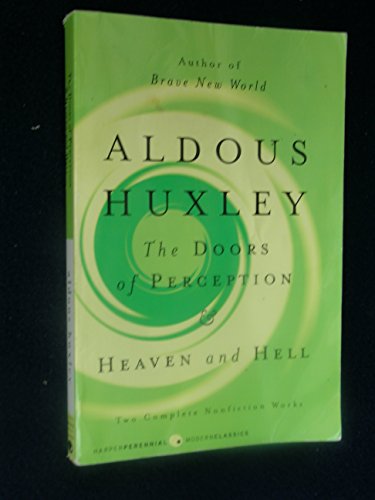
Two classic complete books -- The Doors of Perception (originally published in 1954) and Heaven and Hell (originally published in 1956) -- in which Aldous Huxley, author of the bestselling Brave New World, explores, as only he can, the mind's remote frontiers and the unmapped areas of human consciousness. These two astounding essays are among the most profound studies of the effects of mind-expanding drugs written in the twentieth century. These two books became essential for the counterculture during the 1960s and influenced a generation's perception of life.
Die Inhaltsangabe kann sich auf eine andere Ausgabe dieses Titels beziehen.
Über die Autorin bzw. den Autor
Aldous Huxley (1894–1963) is the author of the classic novels Brave New World, Island, Eyeless in Gaza, and The Genius and the Goddess, as well as such critically acclaimed nonfiction works as The Perennial Philosophy and The Doors of Perception. Born in Surrey, England, and educated at Oxford, he died in Los Angeles, California.
Von der hinteren Coverseite
Two classic complete books -- The Doors of Perception (originally published in 1954) and Heaven and Hell (originally published in 1956) -- in which Aldous Huxley, author of the bestselling Brave New World, explores, as only he can, the mind's remote frontiers and the unmapped areas of human consciousness. These two astounding essays are among the most profound studies of the effects of mind-expanding drugs written in the twentieth century. These two books became essential for the counterculture during the 1960s and influenced a generation's perception of life.
Auszug. © Genehmigter Nachdruck. Alle Rechte vorbehalten.
The Doors of Perception and Heaven and Hell
By Aldous HuxleyPerennial
Copyright © 2004 Aldous HuxleyAll right reserved.
ISBN: 0060595183
The Doors of Perception
It was in 1886 that the German pharmacologist, Louis Lewin, published the first systematic study of the cactus, to which his own name was subsequently given. Anhalonium Lewinii was new to science. To primitive religion and the Indians of Mexico and the American Southwest it was a friend of immemorially long standing. Indeed, it was much more than a friend. In the words of one of the early Spanish visitors to the New World, "they eat a root which they call peyote, and which they venerate as though it were a deity."
Why they should have venerated it as a deity became apparent when such eminent psychologists as Jaensch, Havelock Ellis and Weir Mitchell began their experiments with mescalin, the active principle of peyote. True, they stopped short at a point well this side of idolatry; but all concurred in assigning to mescalin a position among drugs of unique distinction. Administered in suitable doses, it changes the quality of consciousness more profoundly and yet is less toxic than any other substance in the pharmacologist's repertory.
Mescalin research has been going on sporadically ever since the days of Lewin and Havelock Ellis. Chemists have not merely isolated the alkaloid; they have learned how to synthesize it, so that the supply no longer depends on the sparse and intermittent crop of a desert cactus. Alienists have dosed themselves with mescalin in the hope thereby of coming to a better, a first-hand, understanding of their patients' mental processes. Working unfortunately upon too few subjects within too narrow a range of circumstances, psychologists have observed and catalogued some of the drug's more striking effects. Neurologists and physiologists have found out something about the mechanism of its action upon the central nervous system. And at least one professional philosopher has taken mescalin for the light it may throw on such ancient, unsolved riddles as the place of mind in nature and the relationship between brain and consciousness.
There matters rested until, two or three years ago, a new and perhaps highly significant fact was observed. Actually the fact had been staring everyone in the face for several decades; but nobody, as it happened, had noticed it until a young English psychiatrist, at present working in Canada, was struck by the close similarity, in chemical composition, between mescalin and adrenalin. Further research revealed that lysergic acid, an extremely potent hallucinogen derived from ergot, has a structural biochemical relationship to the others. Then came the discovery that adrenochrome, which is a product of the decomposition of adrenalin, can produce many of the symptoms observed in mescalin intoxication. But adrenochrome probably occurs spontaneously in the human body. In other words, each one of us may be capable of manufacturing a chemical, minute doses of which are known to cause profound changes in consciousness. Certain of these changes are similar to those which occur in that most characteristic plague of the twentieth century, schizophrenia. Is the mental disorder due to a chemical disorder? And is the chemical disorder due, in its turn, to psychological distresses affecting the adrenals? It would be rash and premature to affirm it. The most we can say is that some kind of a prima facie case has been made out. Meanwhile the clue is being systematically followed, the sleuths -- biochemists, psychiatrists, psychologists -- are on the trail.
By a series of, for me, extremely fortunate circumstances I found myself, in the spring of 1953, squarely athwart that trail. One of the sleuths had come on business to California. In spite of seventy years of mescalin research, the psychological material at his disposal was still absurdly inadequate, and he was anxious to add to it. I was on the spot and willing, indeed eager, to be a guinea pig. Thus it came about that, one bright May morning, I swallowed four-tenths of a gram of mescalin dissolved in half a glass of water and sat down to wait for the results.
We live together, we act on, and react to, one another; but always and in all circumstances we are by ourselves. The martyrs go hand in hand into the arena; they are crucified alone. Embraced, the lovers desperately try to fuse their insulated ecstasies into a single self-transcendence; in vain. By its very nature every embodied spirit is doomed to suffer and enjoy in solitude. Sensations, feelings, insights, fancies -- all these are private and, except through symbols and at second hand, incommunicable. We can pool information about experiences, but never the experiences themselves. From family to nation, every human group is a society of island universes.
Most island universes are sufficiently like one another to permit of inferential understanding or even of mutual empathy or "feeling into." Thus, remembering our own bereavements and humiliations, we can condole with others in analogous circumstances, can put ourselves (always, of course, in a slightly Pickwickian sense) in their places. But in certain cases communication between universes is incomplete or even nonexistent. The mind is its own place, and the places inhabited by the insane and the exceptionally gifted are so different from the places where ordinary men and women live, that there is little or no common ground of memory to serve as a basis for understanding or fellow feeling. Words are uttered, but fail to enlighten. The things and events to which the symbols refer belong to mutually exclusive realms of experience.
To see ourselves as others see us is a most salutary gift. Hardly less important is the capacity to see others as they see themselves. But what if these others belong to a different species and inhabit a radically alien universe? For example, how can the sane get to know what it actually feels like to be mad? Or, short of being born again as a visionary, a medium, or a musical genius, how can we ever visit the worlds which, to Blake, to Swedenborg, to Johann Sebastian Bach, were home? And how can a man at the extreme limits...
Continues...Continues...
Excerpted from The Doors of Perception and Heaven and Hellby Aldous Huxley Copyright © 2004 by Aldous Huxley. Excerpted by permission.
All rights reserved. No part of this excerpt may be reproduced or reprinted without permission in writing from the publisher.
Excerpts are provided by Dial-A-Book Inc. solely for the personal use of visitors to this web site.
„Über diesen Titel“ kann sich auf eine andere Ausgabe dieses Titels beziehen.
Weitere beliebte Ausgaben desselben Titels

Suchergebnisse für The Doors of Perception and Heaven and Hell (Perennial...

Beispielbild für diese ISBN
The Doors of Perception & Heaven and Hell: Two Complete Nonfiction Works (Perennial Classics)
ISBN 10: 0060595183
ISBN 13: 9780060595180
Gebraucht
Paperback
Anbieter: BooksRun, Philadelphia, PA, USA
Verkäuferbewertung 5 von 5 Sternen

Paperback. Zustand: Very Good. Perennial Classics. It's a well-cared-for item that has seen limited use. The item may show minor signs of wear. All the text is legible, with all pages included. It may have slight markings and/or highlighting. Bestandsnummer des Verkäufers 0060595183-8-1
Gebraucht kaufen
EUR 4,41
Versand gratis
Versand innerhalb von USA
Versand innerhalb von USA
Anzahl: 1 verfügbar
Foto des Verkäufers
The Doors of Perception & Heaven and Hell: Two Complete Nonfiction Works (Perennial Classics)
Verlag:
Harper Perennial Modern Classics, 2004
ISBN 10: 0060595183
ISBN 13: 9780060595180
Gebraucht
Softcover
Anbieter: -OnTimeBooks-, Phoenix, AZ, USA
Verkäuferbewertung 5 von 5 Sternen
Zustand: good. A copy that has been read, remains in good condition. All pages are intact, and the cover is intact. The spine and cover show signs of wear. Pages can include notes and highlighting and show signs of wear, and the copy can include "From the library of" labels or previous owner inscriptions. 100% GUARANTEE! Shipped with delivery confirmation, if you're not satisfied with purchase please return item! Ships via media mail. Bestandsnummer des Verkäufers OTV.0060595183.G
Gebraucht kaufen
EUR 7,21
Versand gratis
Versand innerhalb von USA
Versand innerhalb von USA
Anzahl: 1 verfügbar
Beispielbild für diese ISBN
The Doors of Perception & Heaven and Hell: Two Complete Nonfiction Works (Perennial Classics)
Verlag:
Harper Perennial Modern Classics, 2004
ISBN 10: 0060595183
ISBN 13: 9780060595180
Gebraucht
Paperback
Anbieter: HPB Inc., Dallas, TX, USA
Verkäuferbewertung 5 von 5 Sternen
Paperback. Zustand: Very Good. Connecting readers with great books since 1972! Used books may not include companion materials, and may have some shelf wear or limited writing. We ship orders daily and Customer Service is our top priority! Bestandsnummer des Verkäufers S_471769268
Gebraucht kaufen
EUR 4,53
EUR 3,24 Versand
Versand innerhalb von USA
Versand innerhalb von USA
Anzahl: 1 verfügbar
Beispielbild für diese ISBN
The Doors of Perception & Heaven and Hell: Two Complete Nonfiction Works (Perennial Classics)
Verlag:
Harper Perennial Modern Classics, 2004
ISBN 10: 0060595183
ISBN 13: 9780060595180
Gebraucht
Paperback
Anbieter: HPB-Diamond, Dallas, TX, USA
Verkäuferbewertung 5 von 5 Sternen
Paperback. Zustand: Very Good. Connecting readers with great books since 1972! Used books may not include companion materials, and may have some shelf wear or limited writing. We ship orders daily and Customer Service is our top priority! Bestandsnummer des Verkäufers S_472568685
Gebraucht kaufen
EUR 4,73
EUR 3,24 Versand
Versand innerhalb von USA
Versand innerhalb von USA
Anzahl: 1 verfügbar
Beispielbild für diese ISBN
The Doors of Perception and He
Verlag:
Harper Perennial Modern Classics, 2004
ISBN 10: 0060595183
ISBN 13: 9780060595180
Gebraucht
Softcover
Anbieter: World of Books (was SecondSale), Montgomery, IL, USA
Verkäuferbewertung 5 von 5 Sternen
Zustand: Good. Item in good condition. Textbooks may not include supplemental items i.e. CDs, access codes etc. Bestandsnummer des Verkäufers 00105967110
Gebraucht kaufen
EUR 8,06
Versand gratis
Versand innerhalb von USA
Versand innerhalb von USA
Anzahl: 2 verfügbar
Beispielbild für diese ISBN
The Doors of Perception & Heaven and Hell: Two Complete Nonfiction Works (Perennial Classics)
Verlag:
Harper Perennial Modern Classics, 2004
ISBN 10: 0060595183
ISBN 13: 9780060595180
Gebraucht
Paperback
Anbieter: HPB-Ruby, Dallas, TX, USA
Verkäuferbewertung 5 von 5 Sternen
Paperback. Zustand: Very Good. Connecting readers with great books since 1972! Used books may not include companion materials, and may have some shelf wear or limited writing. We ship orders daily and Customer Service is our top priority! Bestandsnummer des Verkäufers S_475293379
Gebraucht kaufen
EUR 4,98
EUR 3,24 Versand
Versand innerhalb von USA
Versand innerhalb von USA
Anzahl: 1 verfügbar
Foto des Verkäufers
The Doors of Perception & Heaven and Hell: Two Complete Nonfiction Works (Perennial Classics)
Verlag:
Harper Perennial Modern Classics, 2004
ISBN 10: 0060595183
ISBN 13: 9780060595180
Gebraucht
Softcover
Anbieter: Greenworld Books, Arlington, TX, USA
Verkäuferbewertung 5 von 5 Sternen
Zustand: very_good. Fast Free Shipping â" Very Good condition book with a firm cover and clean pages. Shows normal use and some light wear or limited notes markings. A solid, nice copy to enjoy. Bestandsnummer des Verkäufers GWV.0060595183.VG
Gebraucht kaufen
EUR 9,21
Versand gratis
Versand innerhalb von USA
Versand innerhalb von USA
Anzahl: 1 verfügbar
Beispielbild für diese ISBN
The Doors of Perception & Heaven and Hell
Verlag:
Harper Perennial Modern Classics, 2004
ISBN 10: 0060595183
ISBN 13: 9780060595180
Gebraucht
paperback
Anbieter: Magers and Quinn Booksellers, Minneapolis, MN, USA
Verkäuferbewertung 5 von 5 Sternen
paperback. Zustand: Very Good. Perennial Classics. May have light to moderate shelf wear and/or a remainder mark. Complete. Clean pages. Bestandsnummer des Verkäufers 922741
Gebraucht kaufen
EUR 7,35
EUR 3,45 Versand
Versand innerhalb von USA
Versand innerhalb von USA
Anzahl: 1 verfügbar
Beispielbild für diese ISBN
The Doors of Perception and Heaven and Hell (Perennial Classics)
Verlag:
Harper Perennial Modern Classics, 2004
ISBN 10: 0060595183
ISBN 13: 9780060595180
Gebraucht
Softcover
Anbieter: BookHolders, Towson, MD, USA
Verkäuferbewertung 5 von 5 Sternen
Zustand: Fair. [ No Hassle 30 Day Returns ][ Ships Daily ] [ Underlining/Highlighting: NONE ] [ Writing: NONE ] [ Edition: Reprint ] Publisher: Harper Perennial Modern Classics Pub Date: 5/1/2004 Binding: Paperback Pages: 192 Reprint edition. Bestandsnummer des Verkäufers 6972996
Gebraucht kaufen
EUR 12,74
Versand gratis
Versand innerhalb von USA
Versand innerhalb von USA
Anzahl: 1 verfügbar
Beispielbild für diese ISBN
The Doors of Perception and Heaven and Hell
Verlag:
HarperCollins Publishers, 2004
ISBN 10: 0060595183
ISBN 13: 9780060595180
Gebraucht
Softcover
Anbieter: Better World Books: West, Reno, NV, USA
Verkäuferbewertung 5 von 5 Sternen
Zustand: Good. Pages intact with minimal writing/highlighting. The binding may be loose and creased. Dust jackets/supplements are not included. Stock photo provided. Product includes identifying sticker. Better World Books: Buy Books. Do Good. Bestandsnummer des Verkäufers 4364233-6
Gebraucht kaufen
EUR 12,96
Versand gratis
Versand innerhalb von USA
Versand innerhalb von USA
Anzahl: 1 verfügbar