
Verwandte Artikel zu The Autism Sourcebook: Everything You Need to Know...
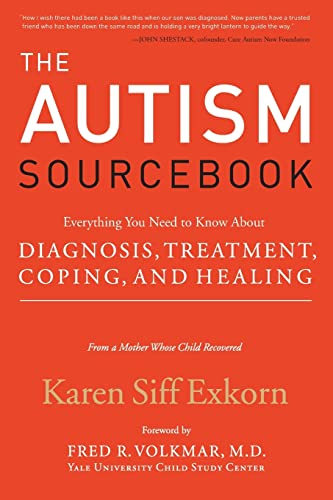
The Autism Sourcebook: Everything You Need to Know About Diagnosis, Treatment, Coping, and Healing-from a Mother Whose Child Recovered: Everything You ... Recovered – Expert Guidance for Families - Softcover
Inhaltsangabe
Practical advice and information from the world's foremost experts on autism - and a mother's own hard-won lessons from helping her son recover from the disorder
When Karen Siff Exkorn's son, Jake, was diagnosed with autism, she struggled to pull together comprehensive information about the disorder. Fortunately, she was able to educate herself quickly, and her extensive at-home treatment of her son led to his amazing full recovery. But the journey wasn't easy, and now, in The Autism Sourcebook, Siff Exkorn offers parents the wisdom she wishes she'd had at the beginning.
Recent studies show that there is a worldwide epidemic of autism. More than 1.5 million people are affected in the United States alone, with one in every 166 children diagnosed. Early detection and early intervention are two of the key factors in improving prognosis - but too often, writes Siff Exkorn, parents get bogged down in denial or confusion about the still mysterious disorder, and are unable to take the necessary steps. Providing accessible medical information gleaned from the world's foremost experts, Siff Exkorn offers an inside look at families with children who have autism, and ties in her own firsthand experience as a parent. The author shares valuable knowledge about the following:
- What the diagnosis really means
- Understanding and accessing treatment options
- Knowing your child's rights in the school system
- Coping with common marital and familial stress
- Making the stigma of autism a thing of the past
With extensive appendices, including the Modified Checklist for Autism in Toddlers, Diagnostic Criteria for the Five Pervasive Developmental Disorders, and carefully selected lists of Internet resources, recommended readings
Die Inhaltsangabe kann sich auf eine andere Ausgabe dieses Titels beziehen.
Über die Autorin bzw. den Autor
After her son's recovery from autism, Karen Siff Exkorn made it her mission to reach out as a consultant to other families living with autism. With a B.A. from Brown University and an M.A. from New York University, she is a frequent lecturer at universities and autism organizations around the world. Karen has appeared on ABC's Good Morning America, Nightline, and an international media tour. She and her husband recently established the Siff Exkorn Family Foundation, which provides funding for research and treatment of autism. The author donates a percentage of the proceeds from book sales to autism organizations worldwide. She lives in Rockland County, New York, with her husband and son.
Von der hinteren Coverseite
Practical advice and information from the world's foremost experts on autism -- and a mother's own hard-won lessons from helping her son recover from the disorder
When Karen Siff Exkorn's son, Jake, was diagnosed with autism, she struggled to pull together comprehensive information about the disorder. Fortunately, she was able to educate herself quickly, and her extensive at-home treatment of her son led to his amazing full recovery. But the journey wasn't easy, and now, in The Autism Sourcebook, Siff Exkorn offers parents the wisdom she wishes she'd had at the beginning.
Recent studies show that there is a worldwide epidemic of autism. More than 1.5 million people are affected in the United States alone, with one in every 166 children diagnosed. Early detection and early intervention are two of the key factors in improving prognosis -- but too often, writes Siff Exkorn, parents get bogged down in denial or confusion about the still mysterious disorder, and are unable to take the necessary steps. Providing accessible medical information gleaned from the world's foremost experts, Siff Exkorn offers an inside look at families with children who have autism, and ties in her own firsthand experience as a parent. The author shares valuable knowledge about the following:
- What the diagnosis really means
- Understanding and accessing treatment options
- Knowing your child's rights in the school system
- Coping with common marital and familial stress
- Making the stigma of autism a thing of the past
With extensive appendices, including the Modified Checklist for Autism in Toddlers, Diagnostic Criteria for the Five Pervasive Developmental Disorders, and carefully selected lists of Internet resources, recommended readings, and top autism organizations worldwide, The Autism Sourcebook is the single most comprehensive, practical resource available to parents and loved ones of children with autism.
Auszug. © Genehmigter Nachdruck. Alle Rechte vorbehalten.
The Autism Sourcebook
Everything You Need to Know About Diagnosis, Treatment, Coping, and Healing--from a Mother Whose Child RecoveredBy Karen ExkornHarperCollins Publishers, Inc.
Copyright © 2006 Karen ExkornAll right reserved.
ISBN: 006085975X
Chapter One
The Many Faces of Autism
His parents called Nathan their "gentle giant." At age six, he was big for his age but wouldn't hurt a fly. He appeared to be shy and fearful at all social activities—from playing with other kids to looking his mom and dad in the eye. Nathan's favorite activity was jumping on the trampoline all by himself in his backyard. He seemed to live in a world of his own and had never uttered a word in his life.
At age four, Michael could tell you everything about the life cycle and migratory patterns of the monarch butterfly. He'd even taught himself about photosynthesis. Although clearly intellectually gifted, Michael could not hold a two-way conversation. Instead, he preferred to lecture nonstop about a subject with which he was obsessed, such as butterflies or train schedules.
Blonde-haired, blue-eyed Samantha, age three, was a bundle of energy—always racing aimlessly around the house and flapping her hands. She had an uncanny habit of echoing people's language—using the exact same words and intonation—and could recite entire passages from a Disney video after having seen it only once.
At age two, Jake, who used to be messy and throw his toys around like most kids his age, was now lining up his trains in perfectly neat rows. He would often take a train, lie down on his belly, and push the train on an imaginary three-inch track, his eyes carefully following the wheels of the train. He could entertain himself in this manner for hours.
These children seem so different, yet they have one thing in common: They were all diagnosed with autism.
A Brief History of Autism
The word autism comes from the Greek word autos, which means self. Even though autism seems like a fairly new diagnosis, some of the earliest published descriptions of behaviors that resemble autism date back to the eighteenth century. It wasn't until 1911 that Swiss psychiatrist Eugen Bleuler coined the term autism in his work with schizophrenic patients. He observed that his patients were isolated from the outside world and extremely self-absorbed.
Dr. Leo Kanner and Dr. Hans Asperger are considered the pioneers in the field of autism as we know it today. In the early 1940s, unbeknownst to each other, both men conducted research in which they described children as autistic—not in reference to schizophrenics, but to what we now know as the more classic definition of the word. Kanner conducted his research on children in the United States, Asperger in Austria. It's a remarkable coincidence that these studies happened to occur at the same time in different parts of the world, and that both researchers used the word autistic to describe the children in their studies. Kanner's definition of autism was referred to as early infantile autism or childhood autism. Now we just use the word autism. Kanner's explanation is what we would consider to be the classic definition, where children display symptoms of impaired social interaction, lack of imaginative play, and verbal communication problems. Asperger described children with similar traits, except that his children seemed to have higher IQs and precocious language skills—they spoke like little adults. In the 1980s, Dr. Lorna Wing, psychiatric consultant for the National Autistic Society in the United Kingdom, coined the term Asperger's Syndrome to differentiate the condition from classic autism.
What Does Autism Mean Today?
The word autism is the catch-all term that many people use when referring to the spectrum of autistic disorders. The more current term for autism is ASDs, or Autism Spectrum Disorders, and includes the following five diagnoses: Autistic Disorder, Asperger's Disorder, Childhood Disintegrative Disorder CDD), Rett's Disorder, and PDD-NOS (Pervasive Developmental Disorder-Not Otherwise pecified).
Many people used to subscribe to the myth that everyone with an ASD behaved like the Dustin Hoffman character in the movie Rain Man, who had the uncanny ability to remember complex combinations of numbers but couldn't perform simple tasks like making toast. Or people subscribed to the myth that all children with ASDs were aloof and unresponsive, rejected hugs, and never showed affection. We now know that ASDs are much more complex, with a variety of symptoms and characteristics that can occur in different combinations and in varying degrees of severity. We also know that each individual with an ASD is unique, with a distinctive personality and individual character traits.
An ASD is not a disease, such as pneumonia or high blood pressure. (A disease is defined as an illness or sickness where typical physiological function is impaired). AnASD is a developmental disorder—a condition in which there is a disturbance of some stage in a child's typical physical and/or psychological development, often retarding development. AnASD shows up in the first few years of a child's life. It can affect a child's abilities to communicate, use his or her imagination, and connect with other people—even parents and siblings.
As the name implies, ASDs are spectrum disorders, ranging from mild to severe. A child on the severe end of the spectrum may be unable to speak and also have mental retardation. A child on the mild end of the spectrum may be able to function in a regular classroom and even reach the point where he or she no longer meets the criteria for autism. No two children with ASDs are alike, even if they have the same diagnosis. One child with an ASD may be nonverbal and have a low IQ. Another child with the exact same diagnosis may have an above-average IQ. A third child may be verbally and intellectually precocious. The terms high-functioning and low-functioning are sometimes used to describe where a child is on the autism spectrum.
You can't tell that a child has an ASD simply by looking at a picture of him or her. A two-year-old with an ASD can be the same height and weight and be just as adorable as a "typical" two-year-old. . . .
Continues...
Excerpted from The Autism Sourcebookby Karen Exkorn Copyright © 2006 by Karen Exkorn. Excerpted by permission.
All rights reserved. No part of this excerpt may be reproduced or reprinted without permission in writing from the publisher.
Excerpts are provided by Dial-A-Book Inc. solely for the personal use of visitors to this web site.
„Über diesen Titel“ kann sich auf eine andere Ausgabe dieses Titels beziehen.
Suchergebnisse für The Autism Sourcebook: Everything You Need to Know...

Beispielbild für diese ISBN
The Autism Sourcebook: Everything You Need to Know About Diagnosis, Treatment, Coping, and Healing?from a Mother Whose Child Recovered - Expert Guidance for Families
Verlag:
William Morrow Paperbacks, 2006
ISBN 10: 006085975X
ISBN 13: 9780060859756
Gebraucht
Softcover
Anbieter: World of Books (was SecondSale), Montgomery, IL, USA
Verkäuferbewertung 5 von 5 Sternen

Zustand: Good. Item in good condition. Textbooks may not include supplemental items i.e. CDs, access codes etc. Bestandsnummer des Verkäufers 00098567671
Gebraucht kaufen
EUR 4,69
Versand gratis
Versand innerhalb von USA
Versand innerhalb von USA
Anzahl: 3 verfügbar
Beispielbild für diese ISBN
The Autism Sourcebook: Everything You Need to Know About Diagnosis, Treatment, Coping, and Healing?from a Mother Whose Child Recovered - Expert Guidance for Families
Verlag:
William Morrow Paperbacks, 2006
ISBN 10: 006085975X
ISBN 13: 9780060859756
Gebraucht
Softcover
Anbieter: World of Books (was SecondSale), Montgomery, IL, USA
Verkäuferbewertung 5 von 5 Sternen
Zustand: Very Good. Item in very good condition! Textbooks may not include supplemental items i.e. CDs, access codes etc. Bestandsnummer des Verkäufers 00101135856
Gebraucht kaufen
EUR 4,69
Versand gratis
Versand innerhalb von USA
Versand innerhalb von USA
Anzahl: 1 verfügbar
Foto des Verkäufers
The Autism Sourcebook: Everything You Need to Know About Diagnosis, Treatment, Coping, and Healingâfrom a Mother Whose Child Recovered â" Expert Guidance for Families
Verlag:
William Morrow Paperbacks, 2006
ISBN 10: 006085975X
ISBN 13: 9780060859756
Gebraucht
Softcover
Anbieter: Greenworld Books, Arlington, TX, USA
Verkäuferbewertung 5 von 5 Sternen
Zustand: very_good. Fast Free Shipping â" Very Good condition book with a firm cover and clean pages. Shows normal use and some light wear or limited notes markings. A solid, nice copy to enjoy. Bestandsnummer des Verkäufers GWV.006085975X.VG
Gebraucht kaufen
EUR 4,69
Versand gratis
Versand innerhalb von USA
Versand innerhalb von USA
Anzahl: 2 verfügbar
Beispielbild für diese ISBN
The Autism Sourcebook: Everything You Need to Know About Diagnosis, Treatment, Coping, and Healingâfrom a Mother Whose Child Recovered â" Expert Guidance for Families
Verlag:
William Morrow Paperbacks (edition Reprint), 2006
ISBN 10: 006085975X
ISBN 13: 9780060859756
Gebraucht
Paperback
Anbieter: BooksRun, Philadelphia, PA, USA
Verkäuferbewertung 5 von 5 Sternen
Paperback. Zustand: Very Good. Reprint. It's a well-cared-for item that has seen limited use. The item may show minor signs of wear. All the text is legible, with all pages included. It may have slight markings and/or highlighting. Bestandsnummer des Verkäufers 006085975X-8-1
Gebraucht kaufen
EUR 5,53
Versand gratis
Versand innerhalb von USA
Versand innerhalb von USA
Anzahl: 2 verfügbar
Beispielbild für diese ISBN
The Autism Sourcebook : Everything You Need to Know about Diagnosis, Treatment, Coping, and Healing--From a Mother Whose Child Recovered
Verlag:
HarperCollins Publishers, 2006
ISBN 10: 006085975X
ISBN 13: 9780060859756
Gebraucht
Softcover
Anbieter: Better World Books, Mishawaka, IN, USA
Verkäuferbewertung 5 von 5 Sternen
Zustand: Good. Reprint. Pages intact with minimal writing/highlighting. The binding may be loose and creased. Dust jackets/supplements are not included. Stock photo provided. Product includes identifying sticker. Better World Books: Buy Books. Do Good. Bestandsnummer des Verkäufers 226353-6
Gebraucht kaufen
EUR 6,19
Versand gratis
Versand innerhalb von USA
Versand innerhalb von USA
Anzahl: 1 verfügbar
Beispielbild für diese ISBN
The Autism Sourcebook : Everything You Need to Know about Diagnosis, Treatment, Coping, and Healing--From a Mother Whose Child Recovered
Verlag:
HarperCollins Publishers, 2006
ISBN 10: 006085975X
ISBN 13: 9780060859756
Gebraucht
Softcover
Anbieter: Better World Books, Mishawaka, IN, USA
Verkäuferbewertung 5 von 5 Sternen
Zustand: Very Good. Reprint. Former library copy. Pages intact with possible writing/highlighting. Binding strong with minor wear. Dust jackets/supplements may not be included. Includes library markings. Stock photo provided. Product includes identifying sticker. Better World Books: Buy Books. Do Good. Bestandsnummer des Verkäufers GRP70354191
Gebraucht kaufen
EUR 6,19
Versand gratis
Versand innerhalb von USA
Versand innerhalb von USA
Anzahl: 1 verfügbar
Beispielbild für diese ISBN
The Autism Sourcebook: Everything You Need to Know About Diagnosis, Treatment, Coping, and Healing--from a Mother Whose Child Recovered
Verlag:
William Morrow Paperbacks, 2006
ISBN 10: 006085975X
ISBN 13: 9780060859756
Gebraucht
Softcover
Anbieter: Wonder Book, Frederick, MD, USA
Verkäuferbewertung 5 von 5 Sternen
Zustand: Good. Good condition. With remainder mark. A copy that has been read but remains intact. May contain markings such as bookplates, stamps, limited notes and highlighting, or a few light stains. Bundled media such as CDs, DVDs, floppy disks or access codes may not be included. Bestandsnummer des Verkäufers P03A-01528
Gebraucht kaufen
EUR 6,43
Versand gratis
Versand innerhalb von USA
Versand innerhalb von USA
Anzahl: 1 verfügbar
Beispielbild für diese ISBN
The Autism Sourcebook: Everything You Need to Know About Diagnosis, Treatment, Coping, and Healing--from a Mother Whose Child Recovered
Verlag:
HarperCollins Publishers Inc, 2008
ISBN 10: 006085975X
ISBN 13: 9780060859756
Gebraucht
Paperback
Anbieter: World of Books Inc, Montgomery, IL, USA
Verkäuferbewertung 4 von 5 Sternen

Paperback. Zustand: Good. Useful for parents and loved ones of children with autism, the author shares knowledge about the following what the diagnosis really means, and understanding and accessing treatment options. It also deals with: knowing your child's rights in the school system; coping with common marital stress; and making the stigma of autism a thing of the past. Bestandsnummer des Verkäufers CIN006085975XG
Gebraucht kaufen
EUR 6,52
Versand gratis
Versand innerhalb von USA
Versand innerhalb von USA
Anzahl: 3 verfügbar
Beispielbild für diese ISBN
The Autism Sourcebook: Everything You Need to Know About Diagnosis, Treatment, Coping, and Healing--from a Mother Whose Child Recovered
Verlag:
HarperCollins Publishers Inc, 2008
ISBN 10: 006085975X
ISBN 13: 9780060859756
Gebraucht
Paperback
Anbieter: World of Books Inc, Montgomery, IL, USA
Verkäuferbewertung 4 von 5 Sternen
Paperback. Zustand: Very Good. Useful for parents and loved ones of children with autism, the author shares knowledge about the following what the diagnosis really means, and understanding and accessing treatment options. It also deals with: knowing your child's rights in the school system; coping with common marital stress; and making the stigma of autism a thing of the past. Bestandsnummer des Verkäufers CIN006085975XVG
Gebraucht kaufen
EUR 6,52
Versand gratis
Versand innerhalb von USA
Versand innerhalb von USA
Anzahl: 1 verfügbar
Beispielbild für diese ISBN
The Autism Sourcebook: Everything You Need to Know about Diagnosis, Treatment, Coping, and Healing--From a Mother Whose Child Recovered
Verlag:
William Morrow & Company, 2006
ISBN 10: 006085975X
ISBN 13: 9780060859756
Gebraucht
Paperback
Anbieter: ThriftBooks-Atlanta, AUSTELL, GA, USA
Verkäuferbewertung 5 von 5 Sternen
Paperback. Zustand: Very Good. No Jacket. May have limited writing in cover pages. Pages are unmarked. ~ ThriftBooks: Read More, Spend Less. Bestandsnummer des Verkäufers G006085975XI4N00
Gebraucht kaufen
EUR 7,15
Versand gratis
Versand innerhalb von USA
Versand innerhalb von USA
Anzahl: 1 verfügbar