
Verwandte Artikel zu Meditation Now or Never: A Practical Guide to Getting...
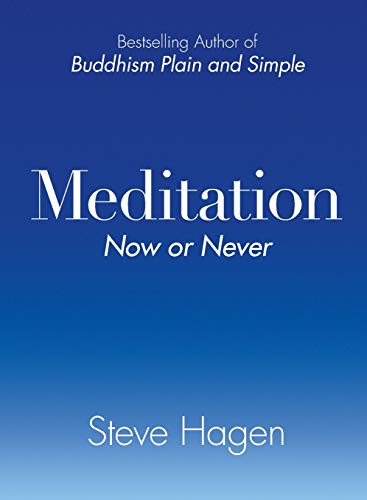
Meditation Now or Never: A Practical Guide to Getting Unstuck and Deepening Your Practice with Simple, Accessible Techniques - Softcover
Inhaltsangabe
National bestselling author and teacher Steve Hagen strips away the cultural and religious jargon surrounding meditation and provides an accessible and thorough manual for newcomers and experienced practitioners alike. Inside you will find:
- Simple practices to avoid needlessly complicating meditation
- Where most of us get stuck in meditation—and how to get unstuck
- A unique focus on meditation not simply as a spiritual technique, but as a way of living
Die Inhaltsangabe kann sich auf eine andere Ausgabe dieses Titels beziehen.
Über die Autorin bzw. den Autor
Steve Hagen is a Zen priest, a longtime teacher of Buddhism, and the author of the bestselling Buddhism Plain and Simple and Buddhism Is Not What You Think. Hagen began studying Buddhism in 1967. In 1975 he became a student of Dainin Katagiri Roshi, and in 1979 he was ordained a Zen priest. Steve lives in Minneapolis, where he lectures, teaches meditation, and writes. He is currently head teacher at Dharma Field Meditation and Learning Center in Minneapolis.
Von der hinteren Coverseite
National bestselling author and teacher Steve Hagen strips away the cultural and religious jargon surrounding meditation and provides an accessible and thorough manual for newcomers and experienced practitioners alike. Inside you will find:
- Simple practices to avoid needlessly complicating meditation
- Where most of us get stuck in meditation—and how to get unstuck
- A unique focus on meditation not simply as a spiritual technique, but as a way of living
Auszug. © Genehmigter Nachdruck. Alle Rechte vorbehalten.
Meditation Now or Never
By Steve HagenHarperCollins Publishers, Inc.
Copyright ©2007 Steve HagenAll right reserved.
ISBN: 9780061143298
Chapter One
It's About Coming Back
Meditation is very simple. Yet it requires time, energy, determination, and discipline.
Most people think of meditation as a special, relaxed state of mind—one that we maintain for extended periods of time and, with practice, stray from only occasionally. Meditation, however, as we'll first discuss it in this book, is quite another matter. In meditation, we are aware of the frequent wandering of our mind and bring it back, over and over, to the movement of the breath, to the posture of the body, and to itself. We repeatedly return to body, mind, and breath.
This activity, though simple, is not easy. It takes diligence to return again and again to what is taking place, without falling into distraction or agitation or mental dullness.
We are all human beings with human minds. Whether we acknowledge it or not, the human mind is busy and scattered much of the time. It tends to drift off a great deal, often creating difficulty for ourselves and for others in the process.
Our minds all have a profound ability to package Reality into conceptual models—mental representations of Reality.This conceptualizing mind is a great treasure. Our great art, music, literature, and invention, as well as the scientific exploration of the Earth and space beyond, are, in part, creations of this wonderful, incredible capacity of the human mind to package, process, and represent Reality.
Yet we easily get entangled in our conceptualizing minds—in beliefs, ideas, daydreams, and opinions. And we easily lose sight of the distinction between Reality and our ideas about Reality. In the process we miss the true, vibrant life being lived in this very moment, right here. As a result of our not recognizing this, we suffer.
Meditation is to leave the clamorous mishmash of our conjured-up world and return to the simple and still clarity of here and now.
The distracted mind can be likened to a very shallow river. With rocks, mounds of sand, and plants gathering at the bottom, the water passing over the riverbed creates ripples and vibrations. Our mental obstructions don't allow the experience of this moment to flow through, and we suffer turbulence, confusion, and instability.
In contrast, a mind that is calm and aware, that isn't disturbed by passing images, is like a deep river where the water runs smoothly and steadily. The riverbed far below does not disturb the water. In such a mind there is no grasping, and its activity just flows through tranquilly.
The undisciplined mind is easily agitated, nervous, wanting, fearful, preoccupied, distracted, scattered, and confused. In meditation we can begin to see just how busy and distracted our minds really are. We can learn to observe, without judgment, how our minds constantly go this way and that, lunging toward the things we want, and away from the things we loathe and fear. We also begin to see the pain and dissatisfaction that is none other than this leaning mind. And we return to this moment, where sanity, patience, confidence, and openness await—again and again, over and over.
This isn't to say that the leaning of our minds is bad or wrong or dysfunctional, or that we have to root it out and destroy it. There's nothing wrong with our human minds. It's just that we don't usually handle them properly.
In meditation we can see that our thoughts—for all that they obsess us, tease us, distract us, and disturb us—are insubstantial. And with patience, we can learn to hold our thoughts very lightly, like the phantasmagoria that they are.
In meditation we slow ourselves down and observe the activity of the mind. We then see that much of this activity is an incessant monologue of mostly inane chatter. We see that many of the things we obsess over, and that keep us preoccupied, have no consequence whatsoever. We see that much of what we worry about passes away within minutes; indeed, after a few minutes more, we have forgotten what we were so worried about and have moved on to the next temporary obsession.
In meditation we learn to break this pattern. We learn to take care of the mind by observing its dynamics without grabbing at, interfering with, or rejecting anything that comes up.
In meditation we begin seeing what we usually ignore—the vibrant Reality in which we all live, all the time—which is to say, right now. We begin to loosen our fixation on the thoughts that continuously come up in our minds, like clouds of smoke or bubbles in a glass of champagne. In time we learn not to grasp at the ungraspable.
Meditation is also an expression of faith—not faith in what you believe or what you think, but faith in direct experience itself. Meditation expresses our confidence in our ability to see for ourselves the root of human suffering and our trust in our capacity to bring it to an end.
Thus meditation is not something you need to ponder. Meditation is something you do. To truly take up this practice is none other than the actualization of freedom, right here, at your permanent address.
Continues...
Excerpted from Meditation Now or Neverby Steve Hagen Copyright ©2007 by Steve Hagen. Excerpted by permission.
All rights reserved. No part of this excerpt may be reproduced or reprinted without permission in writing from the publisher.
Excerpts are provided by Dial-A-Book Inc. solely for the personal use of visitors to this web site.
„Über diesen Titel“ kann sich auf eine andere Ausgabe dieses Titels beziehen.
Suchergebnisse für Meditation Now or Never: A Practical Guide to Getting...

Beispielbild für diese ISBN
Meditation Now or Never: A Practical Guide to Getting Unstuck and Deepening Your Practice with Simple, Accessible Techniques
Anbieter: World of Books (was SecondSale), Montgomery, IL, USA
Verkäuferbewertung 5 von 5 Sternen

Zustand: Good. Item in good condition. Textbooks may not include supplemental items i.e. CDs, access codes etc. Bestandsnummer des Verkäufers 00104077372
Gebraucht kaufen
EUR 3,99
Versand gratis
Versand innerhalb von USA
Versand innerhalb von USA
Anzahl: 2 verfügbar
Beispielbild für diese ISBN
Meditation Now or Never: A Practical Guide to Getting Unstuck and Deepening Your Practice with Simple, Accessible Techniques
Anbieter: World of Books (was SecondSale), Montgomery, IL, USA
Verkäuferbewertung 5 von 5 Sternen
Zustand: Acceptable. Item in acceptable condition! Textbooks may not include supplemental items i.e. CDs, access codes etc. Bestandsnummer des Verkäufers 00101970086
Gebraucht kaufen
EUR 3,99
Versand gratis
Versand innerhalb von USA
Versand innerhalb von USA
Anzahl: 2 verfügbar
Beispielbild für diese ISBN
Meditation Now or Never: A Practical Guide to Getting Unstuck and Deepening Your Practice with Simple, Accessible Techniques
Anbieter: World of Books (was SecondSale), Montgomery, IL, USA
Verkäuferbewertung 5 von 5 Sternen
Zustand: Very Good. Item in very good condition! Textbooks may not include supplemental items i.e. CDs, access codes etc. Bestandsnummer des Verkäufers 00110180807
Gebraucht kaufen
EUR 3,99
Versand gratis
Versand innerhalb von USA
Versand innerhalb von USA
Anzahl: 3 verfügbar
Foto des Verkäufers
Meditation Now or Never
Anbieter: Zoom Books East, Glendale Heights, IL, USA
Verkäuferbewertung 5 von 5 Sternen
Zustand: acceptable. Book is in acceptable condition and shows signs of wear. Book may also include underlining highlighting. The book can also include "From the library of" labels. May not contain miscellaneous items toys, dvds, etc. . We offer 100% money back guarantee and 24 7 customer service. Bestandsnummer des Verkäufers ZEV.0061143294.A
Gebraucht kaufen
EUR 3,99
Versand gratis
Versand innerhalb von USA
Versand innerhalb von USA
Anzahl: 1 verfügbar
Foto des Verkäufers
Meditation Now or Never
Anbieter: Zoom Books East, Glendale Heights, IL, USA
Verkäuferbewertung 5 von 5 Sternen
Zustand: good. Book is in good condition and may include underlining highlighting and minimal wear. The book can also include "From the library of" labels. May not contain miscellaneous items toys, dvds, etc. . We offer 100% money back guarantee and 24 7 customer service. Bestandsnummer des Verkäufers ZEV.0061143294.G
Gebraucht kaufen
EUR 3,99
Versand gratis
Versand innerhalb von USA
Versand innerhalb von USA
Anzahl: 1 verfügbar
Foto des Verkäufers
Meditation Now or Never: A Practical Guide to Getting Unstuck and Deepening Your Practice with Simple, Accessible Techniques
Anbieter: Zoom Books East, Glendale Heights, IL, USA
Verkäuferbewertung 5 von 5 Sternen
Zustand: very_good. Book is in very good condition and may include minimal underlining highlighting. The book can also include "From the library of" labels. May not contain miscellaneous items toys, dvds, etc. . We offer 100% money back guarantee and 24 7 customer service. Bestandsnummer des Verkäufers ZEV.0061143294.VG
Gebraucht kaufen
EUR 4,13
Versand gratis
Versand innerhalb von USA
Versand innerhalb von USA
Anzahl: 1 verfügbar
Foto des Verkäufers
Meditation Now or Never: A Practical Guide to Getting Unstuck and Deepening Your Practice with Simple, Accessible Techniques
Anbieter: Greenworld Books, Arlington, TX, USA
Verkäuferbewertung 5 von 5 Sternen
Zustand: good. Fast Free Shipping â" Good condition. It may show normal signs of use, such as light writing, highlighting, or library markings, but all pages are intact and the book is fully readable. A solid, complete copy that's ready to enjoy. Bestandsnummer des Verkäufers GWV.0061143294.G
Gebraucht kaufen
EUR 4,98
Versand gratis
Versand innerhalb von USA
Versand innerhalb von USA
Anzahl: 2 verfügbar
Beispielbild für diese ISBN
Meditation Now or Never: A Practical Guide to Getting Unstuck and Deepening Your Practice with Simple, Accessible Techniques
Anbieter: Once Upon A Time Books, Siloam Springs, AR, USA
Verkäuferbewertung 4 von 5 Sternen

paperback. Zustand: Good. This is a used book in good condition and may show some signs of use or wear . This is a used book in good condition and may show some signs of use or wear . Bestandsnummer des Verkäufers mon0003511060
Gebraucht kaufen
EUR 2,04
EUR 3,47 Versand
Versand innerhalb von USA
Versand innerhalb von USA
Anzahl: 1 verfügbar
Beispielbild für diese ISBN
Meditation Now or Never: A Practical Guide to Getting Unstuck and Deepening Your Practice with Simple, Accessible Techniques
Anbieter: BooksRun, Philadelphia, PA, USA
Verkäuferbewertung 5 von 5 Sternen
Paperback. Zustand: Very Good. It's a well-cared-for item that has seen limited use. The item may show minor signs of wear. All the text is legible, with all pages included. It may have slight markings and/or highlighting. Bestandsnummer des Verkäufers 0061143294-11-1
Gebraucht kaufen
EUR 5,70
Versand gratis
Versand innerhalb von USA
Versand innerhalb von USA
Anzahl: 1 verfügbar
Beispielbild für diese ISBN
Meditation Now or Never
Verlag:
HarperCollins Publishers Inc, 2007
ISBN 10: 0061143294
ISBN 13: 9780061143298
Gebraucht
Paperback
Anbieter: World of Books Inc, Montgomery, IL, USA
Verkäuferbewertung 2 von 5 Sternen

Paperback. Zustand: Good. National bestselling author and teacher Steve Hagen strips away the cultural and religious jargon surrounding meditation and provides an accessible and thorough manual for newcomers and experienced practitioners alike. Inside you will find: Simple practices to avoid needlessly complicating meditation Where most of us get stuck in meditation--and how to get unstuck A unique focus on meditation not simply as a spiritual technique, but as a way of living. Bestandsnummer des Verkäufers CIN0061143294G
Gebraucht kaufen
EUR 5,79
Versand gratis
Versand innerhalb von USA
Versand innerhalb von USA
Anzahl: 2 verfügbar