
Verwandte Artikel zu Best Practices: Time Management: Set Priorities to...
Best Practices: Time Management: Set Priorities to Get the Right Things Done - Softcover
Buch 2 von 7: Collins Best Practices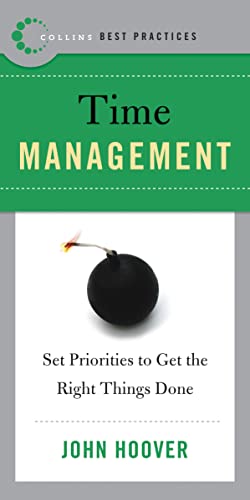
Inhaltsangabe
There are only twenty-four hours in a day, but you can make them count. Time Management, a comprehensive and essential resource for any manager on the run, shows you how.
Learn to:
- Set and prioritize goals, objectives, and tasks
- Create an effective schedule
- Avoid distractions and interruptions
- Respect other people's time
- Build a time-conscious organization
The Collins Best Practices guides offer new and seasoned managers the essential information they need to achieve more, both personally and professionally. Designed to provide tried-and-true advice from the world's most influential business minds, they feature practical strategies and tips to help you get ahead.
Die Inhaltsangabe kann sich auf eine andere Ausgabe dieses Titels beziehen.
Über die Autorin bzw. den Autor
By John Hoover
Von der hinteren Coverseite
There are only twenty-four hours in a day, but you can make them count. Time Management, a comprehensive and essential resource for any manager on the run, shows you how.
Learn to:
- Set and prioritize goals, objectives, and tasks
- Create an effective schedule
- Avoid distractions and interruptions
- Respect other people's time
- Build a time-conscious organization
The Collins Best Practices guides offer new and seasoned managers the essential information they need to achieve more, both personally and professionally. Designed to provide tried-and-true advice from the world's most influential business minds, they feature practical strategies and tips to help you get ahead.
Auszug. © Genehmigter Nachdruck. Alle Rechte vorbehalten.
Best Practices: Time Management
Set Priorities to Get the Right Things DoneBy John HooverHarperCollins Publishers, Inc.
Copyright © 2007 John HooverAll right reserved.
ISBN: 9780061145636
Chapter One
Prioritize Your Time
The 86,400 seconds in a day may sound like a lot, but they go fast. No matter how quickly time seems to fly by for you, even the most skilled time manager's hours, minutes, and seconds tick by at exactly the same rate.
Some people seem to get so much more done. It's not because they have more time, however, it's because of their skill at time management. Managing your time will positively affect your daily output, your career and financial goals, and, ultimately, your success.
"Time is the substance of our lives," writes Alexandra Stoddard in her book, Time Alive. She explains that we don't create time in our lives but instead "create our lives in time." But people too often feel that, in their personal and professional lives, time is running them. They feel they only have time for one life—personal or professional—but not both. The difference in giving your time more meaning or making it more productive is not found in trying to speed up or slow down your days. It is what you choose to do within the time frames that constrain us all that makes the difference. Are you taking advantage of the time that's available to you?
Some people seem to have been born with a natural understanding of time management. Fortunately for the rest of us, it's a skill that can be learned and developed. Leading organization expert and best-selling author Stephanie Winston claims that senior executives and CEOs seem to possess unique time management and organization skills that enable them to dramatically increase their productivity. Indeed, people who are good at managing their time have strong skills in several key areas. They have a clear vision of their big-picture goals at work and in life—long-term, yearly, monthly, weekly, and daily goals. They are skillful at breaking these goals down into smaller units, and they know how to translate these small units into action-oriented to-do lists filled with tasks. Finally, they understand that achieving long- and medium-range goals means crossing off every task they can on their to-do list, every day.
Ultimately, how well you manage time boils down to your level of personal motivation. How willing are you to learn from the mistakes you've made about using time in the past? How willing are you to go after the things you know are important to do for the future? Most people know what needs to be done; they even know how to do it. They just don't have their priorities straight at the moment they make decisions about how to spend their time. Being more efficient in the present will help you achieve the future of your dreams. First, however, you need to motivate yourself to change some of your thinking and your habits.
Managing Time and Goals
In one sense, time management is about managing your goals. If you know what you want to achieve in the future, you can figure out how to use your time in order to get there. To help you get the right things done—that is, get where you want to go at work and in life—it's important to line up your daily actions and your long-term goals. Thus, the first step is setting the right long-term goals and then making sure your objectives and daily actions support those goals.
Goals
A goal is a purpose toward which you direct your endeavors. For example, your goal could be to increase your company's sales revenue by 15 percent. A soccer team's goal might be to win the annual championship. Another goal might be to earn an MBA degree.
There's an art to setting goals. The most effective goals are specific and measurable and should be motivating. If a goal is too vague—for example, the resolution to make your firm the "best company in the world"—you will not be able to monitor your progress toward that goal, or even know whether or not you have achieved it. Does the "best company in the world" mean "greater sales than any other" or "a greater return on sales than any other company"? Does it mean that your employee retention rate is the highest of the firms in your field? If the goal you articulate can't be measured, take another stab at defining it.
An effective goal is also ambitious but not impossible to achieve. For instance, a goal of earning an MBA within 6 months is not realistic; getting the degree within 2 or 3 years is reasonable. Assigning a reasonable amount of time for the completion of your goals is essential. Only if you've established a clear and realistic deadline will you be able to determine how to best accomplish that goal. How you define a long-term goal is, to some degree, up to you: Is it a goal you want to achieve in 5 years, 1 year, 6 months, or 3 months?
Regardless of what that time frame is, strong time managers break down their long-term goals into objectives. If your long-term goal is to finish a particularly complex project within a year, for example, your objectives will state what you need to do in the next month, 3 months, 6 months, and so on to meet your long-term goal.
To move toward achieving these objectives, effective time managers break these objectives down further into tasks—things that you need to do in the short term—within the week, the day, or the hour. This process of dividing a long-term goal into smaller segments is also known as chunking. Look at a goal as you would a big bar of chocolate. It's just not possible to stuff the whole thing in your mouth at once, even if that's your first impulse. So you break it into pieces: First, you divide it in halves or quarters, and then you break apart the individual squares. Most people eat the chocolate bar a square at a time—and it doesn't take long for the whole bar to disappear.
Continues...
Excerpted from Best Practices: Time Managementby John Hoover Copyright © 2007 by John Hoover. Excerpted by permission.
All rights reserved. No part of this excerpt may be reproduced or reprinted without permission in writing from the publisher.
Excerpts are provided by Dial-A-Book Inc. solely for the personal use of visitors to this web site.
„Über diesen Titel“ kann sich auf eine andere Ausgabe dieses Titels beziehen.
Suchergebnisse für Best Practices: Time Management: Set Priorities to...

Beispielbild für diese ISBN
Best Practices - Time Manageme
Anbieter: World of Books (was SecondSale), Montgomery, IL, USA
Verkäuferbewertung 5 von 5 Sternen

Zustand: Acceptable. Item in acceptable condition! Textbooks may not include supplemental items i.e. CDs, access codes etc. Bestandsnummer des Verkäufers 00105612855
Gebraucht kaufen
EUR 4,62
Versand gratis
Versand innerhalb von USA
Versand innerhalb von USA
Anzahl: 1 verfügbar
Beispielbild für diese ISBN
Best Practices - Time Manageme
Anbieter: World of Books (was SecondSale), Montgomery, IL, USA
Verkäuferbewertung 5 von 5 Sternen
Zustand: Good. Item in good condition. Textbooks may not include supplemental items i.e. CDs, access codes etc. Bestandsnummer des Verkäufers 00109571650
Gebraucht kaufen
EUR 4,62
Versand gratis
Versand innerhalb von USA
Versand innerhalb von USA
Anzahl: 2 verfügbar
Beispielbild für diese ISBN
Best Practices: Time Management: Set Priorities to Get the Right Things Done
Verlag:
Harper Paperbacks (edition ), 2007
ISBN 10: 0061145637
ISBN 13: 9780061145636
Gebraucht
Paperback
Anbieter: BooksRun, Philadelphia, PA, USA
Verkäuferbewertung 5 von 5 Sternen
Paperback. Zustand: Very Good. It's a well-cared-for item that has seen limited use. The item may show minor signs of wear. All the text is legible, with all pages included. It may have slight markings and/or highlighting. Bestandsnummer des Verkäufers 0061145637-11-1
Gebraucht kaufen
EUR 4,63
Versand gratis
Versand innerhalb von USA
Versand innerhalb von USA
Anzahl: 1 verfügbar
Beispielbild für diese ISBN
Best Practices: Time Management: Set Priorities to Get the Right Things Done
Anbieter: Evergreen Goodwill, Seattle, WA, USA
Verkäuferbewertung 5 von 5 Sternen
paperback. Zustand: Good. Bestandsnummer des Verkäufers mon0000753326
Gebraucht kaufen
EUR 1,78
EUR 3,50 Versand
Versand innerhalb von USA
Versand innerhalb von USA
Anzahl: 1 verfügbar
Beispielbild für diese ISBN
Best Practices: Time Management: Set Priorities to Get the Right Things Done
Anbieter: Half Price Books Inc., Dallas, TX, USA
Verkäuferbewertung 5 von 5 Sternen
Paperback. Zustand: Very Good. Connecting readers with great books since 1972! Used books may not include companion materials, and may have some shelf wear or limited writing. We ship orders daily and Customer Service is our top priority! Bestandsnummer des Verkäufers S_403476352
Gebraucht kaufen
EUR 2,94
EUR 3,29 Versand
Versand innerhalb von USA
Versand innerhalb von USA
Anzahl: 1 verfügbar
Beispielbild für diese ISBN
Best Practices: Time Management: Set Priorities to Get the Right Things Done
Anbieter: HPB-Ruby, Dallas, TX, USA
Verkäuferbewertung 5 von 5 Sternen
paperback. Zustand: Very Good. Connecting readers with great books since 1972! Used books may not include companion materials, and may have some shelf wear or limited writing. We ship orders daily and Customer Service is our top priority! Bestandsnummer des Verkäufers S_464310475
Gebraucht kaufen
EUR 2,94
EUR 3,29 Versand
Versand innerhalb von USA
Versand innerhalb von USA
Anzahl: 1 verfügbar
Beispielbild für diese ISBN
Time Management
Verlag:
HarperCollins Publishers Inc, 2007
ISBN 10: 0061145637
ISBN 13: 9780061145636
Gebraucht
Paperback
Anbieter: World of Books Inc, Montgomery, IL, USA
Verkäuferbewertung 2 von 5 Sternen

Paperback. Zustand: Fair. There are only twenty-four hours in a day, but you can make them count. Time Management, a comprehensive and essential resource for any manager on the run, shows you how. Bestandsnummer des Verkäufers CIN0061145637A
Gebraucht kaufen
EUR 6,40
Versand gratis
Versand innerhalb von USA
Versand innerhalb von USA
Anzahl: 1 verfügbar
Beispielbild für diese ISBN
Best Practices: Time Management : Set Priorities to Get the Right Things Done
Verlag:
HarperCollins Publishers, 2007
ISBN 10: 0061145637
ISBN 13: 9780061145636
Gebraucht
Softcover
Anbieter: Better World Books, Mishawaka, IN, USA
Verkäuferbewertung 5 von 5 Sternen
Zustand: Very Good. Pages intact with possible writing/highlighting. Binding strong with minor wear. Dust jackets/supplements may not be included. Stock photo provided. Product includes identifying sticker. Better World Books: Buy Books. Do Good. Bestandsnummer des Verkäufers 5876345-6
Gebraucht kaufen
EUR 6,46
Versand gratis
Versand innerhalb von USA
Versand innerhalb von USA
Anzahl: 2 verfügbar
Beispielbild für diese ISBN
Best Practices: Time Management: Set Priorities to Get the Right Things Done
Anbieter: ThriftBooks-Dallas, Dallas, TX, USA
Verkäuferbewertung 5 von 5 Sternen
Paperback. Zustand: Very Good. No Jacket. May have limited writing in cover pages. Pages are unmarked. ~ ThriftBooks: Read More, Spend Less. Bestandsnummer des Verkäufers G0061145637I4N00
Gebraucht kaufen
EUR 6,58
Versand gratis
Versand innerhalb von USA
Versand innerhalb von USA
Anzahl: 1 verfügbar
Beispielbild für diese ISBN
Best Practices â" Time Management: Set Priorities to Get the Right Things Done
Anbieter: WorldofBooks, Goring-By-Sea, WS, Vereinigtes Königreich
Verkäuferbewertung 5 von 5 Sternen
Paperback. Zustand: Very Good. The book has been read, but is in excellent condition. Pages are intact and not marred by notes or highlighting. The spine remains undamaged. Bestandsnummer des Verkäufers GOR004973073
Gebraucht kaufen
EUR 5,42
EUR 6,51 Versand
Versand von Vereinigtes Königreich nach USA
Versand von Vereinigtes Königreich nach USA
Anzahl: 1 verfügbar