
Verwandte Artikel zu Being and Time: A Study of Being, Existence, and the...
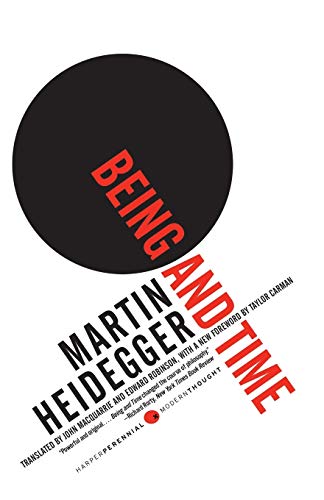
Being and Time: A Study of Being, Existence, and the Meaning of Time (Harper Perennial Modern Thought, 20) - Softcover
Inhaltsangabe
“Being and Time changed the course of philosophy.” —Richard Rorty, New York Times Book Review
“Heidegger’s masterwork.” —The Economist
"What is the meaning of being?" This is the central question of Martin Heidegger's profoundly important work, in which the great philosopher seeks to explain the basic problems of existence. This first paperback edition of John Macquarrie and Edward Robinson's definitive translation also features a foreword by Heidegger scholar Taylor Carman.
A central influence on later philosophy, literature, art, and criticism—as well as existentialism and much of postmodern thought—Being and Time forever changed the intellectual map of the modern world. As Richard Rorty wrote in the New York Times Book Review, "You cannot read most of the important thinkers of recent times without taking Heidegger's thought into account."
Die Inhaltsangabe kann sich auf eine andere Ausgabe dieses Titels beziehen.
Über die Autorin bzw. den Autor
Martin Heidegger (1889-1976) was born in Baden-Württemberg, Germany. He studied at the University of Freiburg and became a professor at the University of Marburg in 1932. After publishing his his magnum opus, Being and Time (1927), he returned to Freiburg to assume the chair of philosophy upon Husserl's retirement.
Von der hinteren Coverseite
"What is the meaning of being?" This is the central question of Martin Heidegger's profoundly important work, in which the great philosopher seeks to explain the basic problems of existence. A central influence on later philosophy, literature, art, and criticism—as well as existentialism and much of postmodern thought—Being and Time forever changed the intellectual map of the modern world. As Richard Rorty wrote in the New York Times Book Review, "You cannot read most of the important thinkers of recent times without taking Heidegger's thought into account."
This first paperback edition of John Macquarrie and Edward Robinson's definitive translation also features a new foreword by Heidegger scholar Taylor Carman.
Auszug. © Genehmigter Nachdruck. Alle Rechte vorbehalten.
Being and Time
By Martin HeideggerHarperCollins Publishers, Inc.
Copyright © 2008 Martin HeideggerAll right reserved.
ISBN: 9780061575594
Chapter One
Exposition of the Task of a Preparatory Analysis of Dasein
The Theme of the Analytic of Dasein
We are ourselves the entities to be analysed. The Being of any such entity is in each case mine. These entities, in their Being, comport themselves towards their Being. As entities with such Being, they are delivered over to their own Being. Being is that which is an issue for every such entity. This way of characterizing Dasein has a double consequence:
I. The 'essence' ["Wesen"] of this entity lies in its "to be" [Zu-sein]. Its Being-what-it-is [Was-sein] (essentia) must, so far as we can speak of it at all, be conceived in terms of its Being (existentia). But here our ontological task is to show that when we choose to designate the Being of this entity as "existence" [Existenz], this term does not and cannot have the ontological signification of the traditional term "existentia"; ontologically, existentia is tantamount to Being-present-at-hand, a kind of Being which is essentially inappropriate to entities of Dasein's character. To avoid getting bewildered, we shall always use the Interpretative expression "presence-at-hand" for the term "existentia", while the term "existence", as a designation of Being, will be allotted solely to Dasein.
The 'essence' of Dasein lies in its existence. Accordingly those characteristics which can be exhibited in this entity are not 'properties' present-at-hand of some entity which 'looks' so and so and is itself present-at-hand; they are in each case possible ways for it to be, and no more than that. All the Being-as-it-is [So-sein] which this entity possesses is primarily Being. So when we designate this entity with the term 'Dasein', we are expressing not its "what" (as if it were a table, house or tree) but its Being.
2. That Being which is an issue for this entity in its very Being, is in each case mine. Thus Dasein is never to be taken ontologically as an instance or special case of some genus of entities as things that are present-at-hand. To entities such as these, their Being is 'a matter of indifference'; or more precisely, they 'are' such that their Being can be neither a matter of indifference to them, nor the opposite. Because Dasein has in each case mineness [Femeinigkeit], one must always use a personal pronoun when one addresses it: 'I am', 'you are'.
Furthermore, in each case Dasein is mine to be in one way or another. Dasein has always made some sort of decision as to the way in which it is in each case mine [je meines]. That entity which in its Being has this very Being as an issue, comports itself towards its Being as its ownmost possibility. In each case Dasein is its possibility, and it 'has' this possibility, but not just as a property [eigenschaftlich], as something present-at-hand would. And because Dasein is in each case essentially its own possibility, it can, in its very Being, 'choose' itself and win itself; it can also lose itself and never win itself; or only 'seem' to do so. But only in so far as it is essentially something which can be authentic -- that is, something of its own -- can it have lost itself and not yet won itself. As modes of Being, authenticity and inauthenticity (these expressions have been chosen terminologically in a strict sense) are both grounded in the fact that any Dasein whatsoever is characterized by mineness. But the inauthenticity of Dasein does not signify any 'less' Being or any 'lower' degree of Being. Rather it is the case that even in its fullest concretion Dasein can be characterized by inauthenticity -- when busy, when excited, when interested, when ready for enjoyment.
The two characteristics of Dasein which we have sketched -- the priority of 'existentia' over essentia, and the fact that Dasein is in each case mine [die Jemeinigkeit] -- have already indicated that in the analytic of this entity we are facing a peculiar phenomenal domain. Dasein does not have the kind of Being which belongs to something merely present-at-hand within the world, nor does it ever have it. So neither is it to be presented thematically as something we come across in the same way as we come across what is present-at-hand. The right way of presenting it is so far from self-evident that to determine what form it shall take is itself an essential part of the ontological analytic of this entity. Only by presenting this entity in the right way can we have any understanding of its Being. No matter how provisional our analysis may be, it always requires the assurance that we have started correctly.
In determining itself as an entity, Dasein always does so in the light of a possibility which it is itself and which, in its very Being, it somehow understands. This is the formal meaning of Dasein's existential constitution. But this tells us that if we are to Interpret this entity ontologically, the problematic of its Being must be developed from the existentiality of its existence. This cannot mean, however, that "Dasein" is to be construed in terms of some concrete possible idea of existence. At the outset of our analysis it is particularly important that Dasein should not be Interpreted with the differentiated character [Differenz] of some definite way of existing, but that it should be uncovered [aufgedeckt] in the undifferentiated character which it has proximally and for the most part. This undifferentiated character of Dasein's everydayness is not nothing, but a positive phenomenal characteristic of this entity. Out of this kind of Being -- and back into it again -- is all existing, such as it is. We call this everyday undifferentiated character of Dasein "averageness" [Durchschnittlichkeit].
And because this average everydayness makes up what is ontically proximal for this entity, it has again and again been passed over in...
Continues...
Excerpted from Being and Timeby Martin Heidegger Copyright © 2008 by Martin Heidegger. Excerpted by permission.
All rights reserved. No part of this excerpt may be reproduced or reprinted without permission in writing from the publisher.
Excerpts are provided by Dial-A-Book Inc. solely for the personal use of visitors to this web site.
„Über diesen Titel“ kann sich auf eine andere Ausgabe dieses Titels beziehen.
Suchergebnisse für Being and Time: A Study of Being, Existence, and the...

Beispielbild für diese ISBN
Being and Time: A Study of Being, Existence, and the Meaning of Time (Harper Perennial Modern Thought, 20)
Verlag:
Harper Perennial Modern Classics (edition Reprint), 2008
ISBN 10: 0061575593
ISBN 13: 9780061575594
Gebraucht
Paperback
Anbieter: BooksRun, Philadelphia, PA, USA
Verkäuferbewertung 5 von 5 Sternen

Paperback. Zustand: Very Good. Reprint. It's a well-cared-for item that has seen limited use. The item may show minor signs of wear. All the text is legible, with all pages included. It may have slight markings and/or highlighting. Bestandsnummer des Verkäufers 0061575593-11-1
Gebraucht kaufen
EUR 9,88
Versand gratis
Versand innerhalb von USA
Versand innerhalb von USA
Anzahl: 1 verfügbar
Beispielbild für diese ISBN
Being and Time (Harper Perenni
Verlag:
Harper Perennial Modern Classics, 2008
ISBN 10: 0061575593
ISBN 13: 9780061575594
Gebraucht
Softcover
Anbieter: World of Books (was SecondSale), Montgomery, IL, USA
Verkäuferbewertung 5 von 5 Sternen
Zustand: Good. Item in good condition. Textbooks may not include supplemental items i.e. CDs, access codes etc. Bestandsnummer des Verkäufers 00109498276
Gebraucht kaufen
EUR 11,86
Versand gratis
Versand innerhalb von USA
Versand innerhalb von USA
Anzahl: 2 verfügbar
Beispielbild für diese ISBN
Being and Time (Harper Perennial Modern Thought)
Verlag:
Harper Perennial Modern Classics, 2008
ISBN 10: 0061575593
ISBN 13: 9780061575594
Gebraucht
Paperback
Anbieter: HPB-Diamond, Dallas, TX, USA
Verkäuferbewertung 5 von 5 Sternen
Paperback. Zustand: Very Good. Connecting readers with great books since 1972! Used books may not include companion materials, and may have some shelf wear or limited writing. We ship orders daily and Customer Service is our top priority! Bestandsnummer des Verkäufers S_483330665
Gebraucht kaufen
EUR 9,75
EUR 3,23 Versand
Versand innerhalb von USA
Versand innerhalb von USA
Anzahl: 1 verfügbar
Beispielbild für diese ISBN
Being and Time
Verlag:
Harper Perennial July 2008, 2008
ISBN 10: 0061575593
ISBN 13: 9780061575594
Gebraucht
Trade Paperback
Anbieter: Plot Twist Used Books, Chicago, IL, USA
Verkäuferbewertung 3 von 5 Sternen

Trade Paperback. Zustand: Used. Bestandsnummer des Verkäufers 7762
Gebraucht kaufen
EUR 9,18
EUR 4,74 Versand
Versand innerhalb von USA
Versand innerhalb von USA
Anzahl: 1 verfügbar
Foto des Verkäufers
Being and Time (Harper Perennial Modern Thought)
Verlag:
Harper Perennial Modern Classics, 2008
ISBN 10: 0061575593
ISBN 13: 9780061575594
Gebraucht
paperback
Anbieter: Santa Fe Used Books, Santa Fe, NM, USA
Verkäuferbewertung 5 von 5 Sternen
paperback. Zustand: Good. Clean text, strong binding, moderate wear. Bestandsnummer des Verkäufers AJ253
Gebraucht kaufen
EUR 8,87
EUR 5,17 Versand
Versand innerhalb von USA
Versand innerhalb von USA
Anzahl: 1 verfügbar
Foto des Verkäufers
Being and Time (Harper Perennial Modern Thought)
Verlag:
Harper Perennial Modern Classics, 2008
ISBN 10: 0061575593
ISBN 13: 9780061575594
Gebraucht
Soft cover
Anbieter: EdmondDantes Bookseller, Minneapolis, MN, USA
Verkäuferbewertung 5 von 5 Sternen
Soft cover. Zustand: Very Good. Trade Paperback with only minor reading wear; book is clean, unmarked. In stock. Ships from MN, USA. Bestandsnummer des Verkäufers 023322
Gebraucht kaufen
EUR 10,63
EUR 3,87 Versand
Versand innerhalb von USA
Versand innerhalb von USA
Anzahl: 1 verfügbar
Beispielbild für diese ISBN
Being and Time (Harper Perennial Modern Thought)
Verlag:
Harper Perennial Modern Classics, 2008
ISBN 10: 0061575593
ISBN 13: 9780061575594
Gebraucht
paperback
Anbieter: Midtown Scholar Bookstore, Harrisburg, PA, USA
Verkäuferbewertung 5 von 5 Sternen
paperback. Zustand: Very Good. Very Good paperback with light shelfwear - NICE! Standard-sized. Bestandsnummer des Verkäufers mon0000353651
Gebraucht kaufen
EUR 9,76
EUR 5,17 Versand
Versand innerhalb von USA
Versand innerhalb von USA
Anzahl: 1 verfügbar
Beispielbild für diese ISBN
Being and Time: A Study of Being, Existence, and the Meaning of Time (Harper Perennial Modern Thought)
Verlag:
Harper Perennial Modern Classics, 2008
ISBN 10: 0061575593
ISBN 13: 9780061575594
Gebraucht
Soft cover
Anbieter: Spine and Crown, Syracuse, NY, USA
Verkäuferbewertung 5 von 5 Sternen
Soft cover. Zustand: Near Fine. Near Fine trade paperback. Appears to be current printing (2026). No underlining or other markings. Bestandsnummer des Verkäufers 38041
Gebraucht kaufen
EUR 10,64
EUR 5,16 Versand
Versand innerhalb von USA
Versand innerhalb von USA
Anzahl: 1 verfügbar
Beispielbild für diese ISBN
Being and Time
Verlag:
Harper Perennial Modern Classics August 2008, 2008
ISBN 10: 0061575593
ISBN 13: 9780061575594
Gebraucht
Soft Cover
Anbieter: BookMarx Bookstore, Steubenville, OH, USA
Verkäuferbewertung 4 von 5 Sternen

Soft Cover. Zustand: Very Good. Support Small Business by buying this book! Family owned bookshop in Steubenville, Ohio. Book in Very Good condition. Binding sound. No marks in text. Bestandsnummer des Verkäufers 62021
Gebraucht kaufen
EUR 12,90
EUR 5,17 Versand
Versand innerhalb von USA
Versand innerhalb von USA
Anzahl: 1 verfügbar
Beispielbild für diese ISBN
Being and Time (Harper Perennial Modern Thought)
Verlag:
Harper Perennial Modern Classics, 2008
ISBN 10: 0061575593
ISBN 13: 9780061575594
Neu
Softcover
Anbieter: Lakeside Books, Benton Harbor, MI, USA
Verkäuferbewertung 5 von 5 Sternen
Zustand: New. Brand New! Not Overstocks or Low Quality Book Club Editions! Direct From the Publisher! We're not a giant, faceless warehouse organization! We're a small town bookstore that loves books and loves it's customers! Buy from Lakeside Books! Bestandsnummer des Verkäufers OTF-S-9780061575594
Neu kaufen
EUR 14,65
EUR 3,44 Versand
Versand innerhalb von USA
Versand innerhalb von USA
Anzahl: Mehr als 20 verfügbar