
Verwandte Artikel zu Beautiful & Poess: A Guide to Modern Poetry
Inhaltsangabe
"David Orr is no starry-eyed cheerleader for contemporary poetry; Orr’s a critic, and a good one. . . . Beautiful & Pointless is a clear-eyed, opinionated, and idiosyncratic guide to a vibrant but endangered art form, essential reading for anyone who loves poetry, and also for those of us who mostly just admire it from afar." —Tom Perrotta
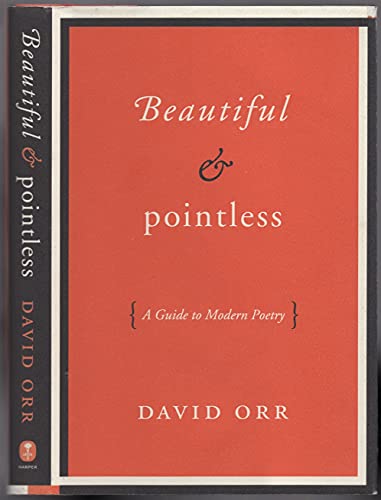
Award-winning New York Times Book Review poetry columnist David Orr delivers an engaging, amusing, and stimulating tour through the world of poetry. With echoes of Francine Prose’s Reading Like a Writer, Orr’s Beautiful & Pointless offers a smart and funny approach to appreciating an art form that many find difficult to embrace.
Die Inhaltsangabe kann sich auf eine andere Ausgabe dieses Titels beziehen.
Über die Autorin bzw. den Autor
David Orr is the poetry columnist for The New York Times Book Review. He is the winner of the Nona Balakian prize from the National Book Critics Circle and the Editors Prize for Reviewing from Poetry magazine. He lives in Ithaca, New York.
Von der hinteren Coverseite
For most readers, contemporary poetry is a foreign country. And because they've barely visited poetry, let alone lived there, readers struggle to enjoy the art for what it is, rather than what they imagine it to be.
In Beautiful & Pointless, award-winning critic David Orr provides a riveting tour of poetry as it actually exists today. Orr argues that readers should accept the foreignness of poetry in the way that they accept the strangeness of any place to which they haven't traveled—they should expect a little confusion, at least at first. Yet in the same way that we can, over time, learn to appreciate the idiosyncratic delights of, for instance, Belgium, we can learn to be comfortable with the odd pleasures of poetry by taking our time and pursuing what we like.
Reading poetry, Orr suggests, is more a matter of building a relationship than proceeding systematically through a checklist. Beautiful & Pointless provides the foundation for such a relationship by examining the things poets and poetry readers talk about when they discuss poetry, such as why poetry seems especially personal and what it means to write "in form." Orr, by turns acerbic, incisive, hilarious, and keen, is what every reader hopes for: that perfect guide who points the way, doesn't talk too much, and helps you see what you might have missed. Stimulating, amusing, and utterly engrossing, Beautiful & Pointless allows us to see how an individual reader engages poetry, so that we may feel better equipped to appreciate it in our own way.
Auszug. © Genehmigter Nachdruck. Alle Rechte vorbehalten.
Beautiful and Pointless
A Guide to Modern PoetryBy David OrrHarperCollins
Copyright © 2011 David OrrAll right reserved.
ISBN: 978-0-06-167345-0
Chapter One
Poetry critics are often nervous about be-ing asked what they do for a living. It?s not that
we don?t enjoy our work?we do, mostly?but
rather that it can be awkward to explain what a contem-
porary poetry critic does when many people are surprised
to learn that there is such a thing as contemporary po-
etry in the first place. We?re talking, after all, about an
art form that currently occupies a position in the popular
consciousness somewhere between lute playing and crewel
embroidery. But there?s another, more important reason
that poetry critics are sometimes reluctant to talk about
their occupation, and it is probably best demonstrated by
an anecdote.
Several years ago, I was at a party filled with nonpo-
ets and was introduced to a friend of a friend. She asked
about my job, and I told her that I worked part-time as a
book critic. She asked where my pieces usually appeared,
and I said The New York Times Book Review. At this, she
responded, ?Oh, that?s great!? and began talking about
how much she admired book reviewers, authors, and the
literary life in general. Then she put her hand on my arm
and asked, ?And what kind of books do you review?? I was
feeling pleased with myself after all the compliments, so I
proudly announced, ?I?m a poetry critic.? She gave me a
look as if I?d just tossed a sackful of kittens into a mulcher.
?Wait a minute,? she said, ?you mean you criticize people?s
poetry??
Because poetry, we?re told, is the pure expression of our
inner lives. It is the prism through which the soul is glimpsed.
It is the spontaneous overflow of powerful feeling. It is the
fulfillment of the desire expressed in Corinthians to ?know
even as also I am known,? and a means of answering Pete
Townshend?s question ?Can you see the real me?? To create
a poem is to express something central about oneself, and to
read poetry is to perceive a writer ?as he actually is.? Poetry
is personal.
Or such, at any rate, is the common belief. Poets them-
selves are more ambivalent. On one hand, we have T. S.
Eliot?s famous declaration that ?the progress of an artist is
a continual self-sacrifice, a continual extinction of personal-
ity?; on the other, we have the actual work of T. S. Eliot,
which in its nervous avoidance of sentiment can seem almost
sentimental. More recently, one can pick up an issue of Po-
etry and find lines like the ones that conclude Randall Mann?s
?The Fall of 1992?:
Love was a doorknob
statement, a breakneck goodbye?
and the walk of shame
without shame, the hair disheveled, curl
of Kools, and desolate birds like ampersands...
I re-did my face
in the bar bathroom, above
the urinal trough.
I liked it rough. From behind the stall,
Lady Pearl slurred the words: Don?t hold out for love.
This sounds pretty personal, doesn?t it? But then, one can
turn to the online magazine La Petite Zine and find lines like
these from Matthea Harvey:
All bright thought lay in future thought.
The coin was in the puddin hid.
Cod from the machine will not do,
said the dramaturg-turned-nutritionist.
Only the upper echelons could afford to be
nonchalant about it. They were, as in, oh.
It was the first time a lost Jocelyn
& a found Jocelyn had turned out
to be not one & the same...
Not so personal, are they? How much of our personal
lives belong in poems is a question that has occupied the po-
etry world for a century. And it remains unsettled in part
because nobody?certainly not us poets?seems to be sure
exactly what we mean by ?personal.?
That may seem like a curious claim; after all, surely if
there?s one thing we know, it?s what makes us us. But con-
sider the following sentences, assuming for the moment that
all are true:
Bob Smith was born on November 9, 1971.
Bob Smith?s favorite password is ?nutmeg456.?
Bob Smith?s Social Security number is 987-65-4320.
Bob Smith has a foot fetish.
As a child, Bob Smith had an imaginary friend named Mr. Pigwort.
Whenever Bob Smith hears the sound of a high wind,
it makes him think of his wife, who died ten years
earlier, and he hears her voice faintly calling, as if
from a great distance.
The first three sentences contain deeply private informa-
tion?indeed, information that might enable someone to
steal Mr. Smith?s identity?but they likely don?t seem per-
sonal in the way that the last three might. (And which of
those last three you consider the most intimate will depend
on how you look at the world.) The point here is that our
conception of ?the personal? has to do with more than the
data of our lives, no matter how sensitive. It has to do with
how we see ourselves, how we see others, how we imagine
others see us, how they actually see us, and the potential em-
barrassment, joy, and shame that occur at the intersection of
these different perspectives.
But why, you might wonder, do poets need to be concerned
about any of this in the first place? Why do so many people
who don?t read much poetry (and quite a few who do) reflex-
ively assume that poems generally relate, in however uncer-
tain and attenuated a manner, to a writer?s ?real life?? Why
are we amused by a comment like ?You mean you criticize
people?s poetry?? rather than simply perplexed, as we would
be if someone said, ?You mean you criticize people?s novels??
or ?You mean you criticize people?s narrative nonfiction??
After all, in order for a joke to be funny, we have to get the
premise. Why is the premise that poetry has something to do
with our inner lives something that we automatically under-
stand? Shouldn?t it be possible for us to read poems without
thinking about ?the personal? at all?
The short answer is: of course. Poetry has historically in-
cluded many genres?the epic, the short narrative poem, the
occasional poem?that have little to do with ?the personal?
as it?s generally understood today. And indeed, contempo-
rary poets have worked more successfully in these genres
than they are sometimes given credit for. Here, for instance,
is the opening of Les Murray?s novel-in-verse Fredy Neptune,
the epic tale of Fred Boettcher, an itinerant Australian mari-
ner who witnesses much of the worst violence of the twenti-
eth...
„Über diesen Titel“ kann sich auf eine andere Ausgabe dieses Titels beziehen.
Suchergebnisse für Beautiful & Poess: A Guide to Modern Poetry

Beispielbild für diese ISBN
Beautiful & Poess: A Guide to Modern Poetry
Anbieter: Orion Tech, Kingwood, TX, USA
Verkäuferbewertung 5 von 5 Sternen

hardcover. Zustand: Very Good. Bestandsnummer des Verkäufers 0061673455-2-37009011
Gebraucht kaufen
EUR 3,65
Versand gratis
Versand innerhalb von USA
Versand innerhalb von USA
Anzahl: 1 verfügbar
Beispielbild für diese ISBN
Beautiful & Poess: A Guide to Modern Poetry
Anbieter: Gulf Coast Books, Cypress, TX, USA
Verkäuferbewertung 5 von 5 Sternen
hardcover. Zustand: Good. Bestandsnummer des Verkäufers 0061673455-3-37358998
Gebraucht kaufen
EUR 3,68
Versand gratis
Versand innerhalb von USA
Versand innerhalb von USA
Anzahl: 1 verfügbar
Beispielbild für diese ISBN
Beautiful & Poess: A Guide to
Anbieter: World of Books (was SecondSale), Montgomery, IL, USA
Verkäuferbewertung 5 von 5 Sternen
Zustand: Good. Item in good condition. Textbooks may not include supplemental items i.e. CDs, access codes etc. Bestandsnummer des Verkäufers 00101195546
Gebraucht kaufen
EUR 3,69
Versand gratis
Versand innerhalb von USA
Versand innerhalb von USA
Anzahl: 2 verfügbar
Beispielbild für diese ISBN
Beautiful & Pointless: A Guide to Modern Poetry
Anbieter: Open Books, Chicago, IL, USA
Verkäuferbewertung 5 von 5 Sternen
Hardcover. Zustand: Very Good. Open Books is a nonprofit social venture that provides literacy experiences for thousands of readers each year through inspiring programs and creative capitalization of books. Bestandsnummer des Verkäufers mon0000364258
Gebraucht kaufen
EUR 2,64
EUR 3,48 Versand
Versand innerhalb von USA
Versand innerhalb von USA
Anzahl: 1 verfügbar
Beispielbild für diese ISBN
Beautiful & Poess: A Guide to Modern Poetry
Anbieter: ThriftBooks-Dallas, Dallas, TX, USA
Verkäuferbewertung 5 von 5 Sternen
Hardcover. Zustand: Very Good. No Jacket. May have limited writing in cover pages. Pages are unmarked. ~ ThriftBooks: Read More, Spend Less. Bestandsnummer des Verkäufers G0061673455I4N00
Gebraucht kaufen
EUR 6,22
Versand gratis
Versand innerhalb von USA
Versand innerhalb von USA
Anzahl: 1 verfügbar
Foto des Verkäufers
Beautiful & Poess: A Guide to Modern Poetry
Anbieter: Greenworld Books, Arlington, TX, USA
Verkäuferbewertung 5 von 5 Sternen
Zustand: very_good. Fast Free Shipping â" Very Good condition book with a firm cover and clean pages. Shows normal use and some light wear or limited notes markings. A solid, nice copy to enjoy. Bestandsnummer des Verkäufers GWV.0061673455.VG
Gebraucht kaufen
EUR 6,22
Versand gratis
Versand innerhalb von USA
Versand innerhalb von USA
Anzahl: 1 verfügbar
Beispielbild für diese ISBN
Beautiful & Poess: A Guide to Modern Poetry
Anbieter: ThriftBooks-Dallas, Dallas, TX, USA
Verkäuferbewertung 5 von 5 Sternen
Hardcover. Zustand: Very Good. No Jacket. Former library book; May have limited writing in cover pages. Pages are unmarked. ~ ThriftBooks: Read More, Spend Less. Bestandsnummer des Verkäufers G0061673455I4N10
Gebraucht kaufen
EUR 6,22
Versand gratis
Versand innerhalb von USA
Versand innerhalb von USA
Anzahl: 1 verfügbar
Beispielbild für diese ISBN
Beautiful and Poess : A Guide to Modern Poetry
Verlag:
HarperCollins Publishers, 2011
ISBN 10: 0061673455
ISBN 13: 9780061673450
Gebraucht
Hardcover
Erstausgabe
Anbieter: Better World Books: West, Reno, NV, USA
Verkäuferbewertung 5 von 5 Sternen
Zustand: Very Good. First Edition. Former library copy. Pages intact with possible writing/highlighting. Binding strong with minor wear. Dust jackets/supplements may not be included. Includes library markings. Stock photo provided. Product includes identifying sticker. Better World Books: Buy Books. Do Good. Bestandsnummer des Verkäufers GRP102398971
Gebraucht kaufen
EUR 6,85
Versand gratis
Versand innerhalb von USA
Versand innerhalb von USA
Anzahl: 1 verfügbar
Beispielbild für diese ISBN
Beautiful and Poess : A Guide to Modern Poetry
Verlag:
HarperCollins Publishers, 2011
ISBN 10: 0061673455
ISBN 13: 9780061673450
Gebraucht
Hardcover
Erstausgabe
Anbieter: Better World Books, Mishawaka, IN, USA
Verkäuferbewertung 5 von 5 Sternen
Zustand: Very Good. First Edition. Former library copy. Pages intact with possible writing/highlighting. Binding strong with minor wear. Dust jackets/supplements may not be included. Includes library markings. Stock photo provided. Product includes identifying sticker. Better World Books: Buy Books. Do Good. Bestandsnummer des Verkäufers GRP102398971
Gebraucht kaufen
EUR 6,85
Versand gratis
Versand innerhalb von USA
Versand innerhalb von USA
Anzahl: 1 verfügbar
Beispielbild für diese ISBN
Beautiful & Poess: A Guide to Modern Poetry
Anbieter: Redux Books, Grand Rapids, MI, USA
Verkäuferbewertung 5 von 5 Sternen
Hardcover. Zustand: Good. Hardcover with dust jacket. Dust jacket and cover show edge wear. Pages are clean and unmarked. Binding is tight, hinges strong.; 100% Satisfaction Guaranteed! Ships same or next business day! Bestandsnummer des Verkäufers 142512190023
Gebraucht kaufen
EUR 7,45
Versand gratis
Versand innerhalb von USA
Versand innerhalb von USA
Anzahl: 1 verfügbar