
Verwandte Artikel zu Lessons from the Greatest Stock Traders of All Time:...
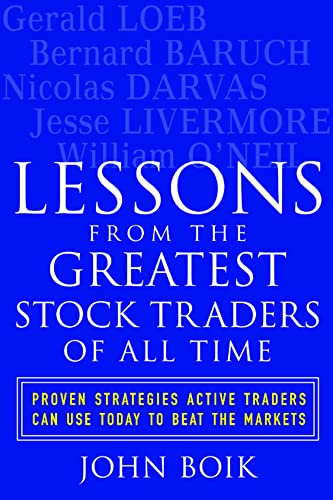
Lessons from the Greatest Stock Traders of All Time: Proven Strategies Active Traders Can Use Today to Beat the Markets - Softcover
Inhaltsangabe
The trading strategies of legends Jesse Livermore, Bernard Baruch, Gerald Loeb, and more provide ways to triumph in the market Today's bookshelves are so laden with Johnny-come-lately experts, eager to sell their knowledge to any and all, that it's sometimes hard for traders to know which way to turn or whom to trust. Lessons from the Greatest Stock Traders of All Time makes the choice simple, examining the careers of five traders--Jesse Livermore, Bernard Baruch, Gerald Loeb, Nicolas Darvas, and Bill O'Neil--who, more than any others over the past century, demonstrated tremendous success at conquering Wall Street. This technique-filled book presents numerous ways in which the timeless strategies of these investing icons can be used to tame today's high-speed, unforgiving marketplaces. Comparing and contrasting the successes--and occasional failures--of these five giants of finance, it reveals: What Jesse Livermore did to correctly call every market break between 1917 and 1940 How Bill O'Neil stuck to basics to create his famously effective CANSLIM system The strategies Nicolas Darvas used to become a self-made millionaire several times over
Die Inhaltsangabe kann sich auf eine andere Ausgabe dieses Titels beziehen.
Über die Autorin bzw. den Autor
McGraw-Hill authors represent the leading experts in their fields and are dedicated to improving the lives, careers, and interests of readers worldwide
Von der hinteren Coverseite
Timeless rules for profitable, low-risk trading--from five investing legends
Over the course of a century, in every type of economy and market, five traders wrote and perfected the rules for successful stock trading. Lessons from the Greatest Stock Traders of All Time examines these amazing traders and their careers, and reveals how you can use their remarkably similar skills, disciplines, and trading rules to improve your performance in today's high-risk, high-reward markets.
Look to these "Babe Ruths of Trading" to discover:
- Jesse Livermore--How early market defeats taught him the number one rule of profitable trading--Cut your losses and move on!
- Bernard Baruch--Techniques Baruch learned from his $5 a week Wall Street job--and how they helped him build a multimillion dollar portfolio
- Nicolas Darvas--What this "outsider" did to regularly outmaneuver Wall Street's top pros in his spare time
- Gerald Loeb--What Loeb saw that many others missed, allowing him to sidestep the Crash of 1929
- William O'Neil--How O'Neil expanded on the time-honored rules of his predecessors to become a great modern-day success story
Certain rules and techniques have always distinguished the best traders. Discover what those strategies are, and how to use them to power your trading profits while dramatically cutting your losses, in the entertaining, technique-driven, and always fascinating Lessons from the Greatest Stock Traders of All Time.
Auszug. © Genehmigter Nachdruck. Alle Rechte vorbehalten.
LESSONS FROM THE GREATEST STOCK TRADERS OF ALL TIME
By JOHN BOIKThe McGraw-Hill Companies, Inc.
Copyright © 2004 The McGraw-Hill Companies, Inc.
All rights reserved.
ISBN: 978-0-07-143788-2All rights reserved.
Contents
| Acknowledgments | |
| Introduction | |
| 1 Jesse Livermore | |
| 2 Bernard Baruch | |
| 3 Gerald M. Loeb | |
| 4 Nicolas Darvas | |
| 5 William J. O'Neil | |
| 6 Strategies of the Greatest Traders | |
| Conclusion | |
| Bibliography/Resources | |
| Index |
Excerpt
CHAPTER 1
Jesse Livermore
"It's not the thinking that makes the money; it's the sitting."
The Reclusive Genius
Jesse Livermore was born on July 26, 1877 in Massachusetts. He came from a poorfamily, as his father struggled as a farmer with the challenging New Englandsoil. Young Jesse knew he wanted more from life, and when his father pulled himout of school to follow in his footsteps, Jesse ran away from home at the age of14. With just a few dollars in his pocket—given to him by hismother—he headed to Boston. He landed a job as a chalkboard boy for PayneWebber that paid him the minimal wage of $6 per week. His responsibilities inhis new job required him to post the stock quotes on big chalkboards coveringthe length of the brokerage house as prices were called out by tape watcherssitting in the gallery as fast as they could yell them out from the ticker tapemachines.
Livermore always excelled at mathematics in school, and he found the tape of theStreet to be his calling. He was truly gifted, with a photographic memory whenit came to numbers. He actually performed three years of mathematics in one yearof school during his youth. He would memorize prices and ticker symbols from hisjob at Payne Webber. He became a voracious tape reader and watched the tape withtotal concentration and focus. He also started to keep a notebook of the numbersfrom his chalkboard job, and he soon noticed that certain patterns emerged. Hewould keep thousands of price changes in this notebook diary and study them,looking for these certain price patterns. By the time Livermore was 15, he wasseriously studying stock patterns and price changes. His "on the job training"allowed him to be ever observant of the activities and how people participatedin the market. He noticed that most people lost money in the stock marketbecause they acted randomly, did not act on rules or a predefined plan, and didnot put forth the required study that the market and its actions required.
His first trade was made jointly with a friend. They invested a total of $5 inBurlington because Livermore's friend thought the stock would rise. Theyexecuted the trade with one of the "bucket shops" in Boston. The atmospherewithin the shops was more conducive to low-budget speculation, as one wasbasically betting on the next move of the stock, or very short term trading. Youcould also bet on the movement of the stock without actually owning the stockcertificates. If the stock moved against you by 10 percent, your trade was wipedout. This was the 10-percent margin rule that was in effect at the time, and itwould establish a strict loss-cutting rule for Livermore that he adhered to mostof the time during his trading career. Over time and due to experience, he wouldactually improve on this and he would be able to cut his losses to less than 10percent.
Concerning Burlington, Livermore first checked his notebook and became convincedthat the stock would rise based on its recent trading pattern. So his firststock trade took place when he was 15, and he ended up making a profit of $3.12on his share of the trade.
He continued to trade in the bucket shops, and by the time he was 16 he wasmaking more money trading than he was making at his job with Payne Webber. Whenhe made a total of $1000 he quit his job to trade full time in the bucket shops.
Livermore made so much money by the time he was 20 that he was banned from thebucket shops of Boston and New York, as he was having an adverse effect on theshop owners' profits. (He would bounce back and forth between the two citieswhen he would be discovered in one or the other.) His success earned him thenickname "The Boy Plunger." Bucket shop owners wanted nothing to do with him, orhis winning trades, which were constantly taking profits from their shops.
With his confidence high he decided to head to New York and trade the stocks onthe listed New York Stock Exchange. After all, this was the big time and he wasnow ready to test his skills in the big league. He set up an account with abrokerage office with $2500 he had as his capital stake. This was down from ahigh of $10,000 he had attained at one time from his bucket shop trades.
As he lost his profits, Livermore learned the hard way that trading wasn'talways easy. As a result, he started to analyze the mistakes he made that causedhis losses. This detailed analysis of past mistakes would prove to be a vitaltrait of his later success. This also became one of his best learning tools.
One of the lessons he discovered during this first analysis period was he wouldbecome impatient and thought he had to trade. Impatience in the market usuallyleads one to making impulse trades, which rarely leads to profitable success.This mistake would cost him dearly, and it is a mistake made by many tradersstill today.
New York did not produce much success for Livermore. He went broke within sixmonths and had to borrow $500 from his brokerage firm. With money in hand heheaded back to the bucket shops to regain his stake. He discovered that thebucket shops would quote prices instantaneously, whereas there was a delay inthe New York quotes. His system at the time was based on instant quotes andquick trades. He returned to New York in two days with $2800 and repaid the $500loan to the brokerage firm.
But upon his return he found it more difficult than he had expected and stillfound he was only able to break even in New York, so he returned for a finaltime to the bucket shops. Just when Livermore successfully brought his accountup to $10,000 by trading in disguise, the bucket shop owners finally discoveredhim again and he was banned for good from the shops.
In 1901, now in New York and trading stocks listed on The New York StockExchange during a strong bull market, Livermore went long (bought) on NorthernPacific, and he turned his $10,000 into $50,000. Then just as quickly, he gaveit all back on two short positions (borrowing stock from your broker in hopes ofbuying it back at a lower price and profiting from the difference), as hethought the market would break for a short time. Though he lost on these twotrades, he was initially right, but the delays due to the huge volume in tryingto fill the trades caused his losses when the stocks reversed on him.
It was from this experience that he learned how difficult very short termtrading was going to be on The Big Board. Livermore realized he had to learn howto adapt to the different trading environment that separated the instantaneousaction of the bucket shops when compared to the more sophisticated processes oforganized trading. So once again, by the spring of 1901, Livermore found himselfbroke. He then discovered a new hybrid bucket shop that had opened for business.He thought he could regain his stake quickly if he traded in these hybrids. Foralmost a year he successfully regained his capital until he was discovered...
„Über diesen Titel“ kann sich auf eine andere Ausgabe dieses Titels beziehen.
Suchergebnisse für Lessons from the Greatest Stock Traders of All Time:...

Beispielbild für diese ISBN
Lessons from the Greatest Stock Traders of All Time
Verlag:
McGraw Hill (edition 1), 2004
ISBN 10: 0071437886
ISBN 13: 9780071437882
Gebraucht
Paperback
Anbieter: BooksRun, Philadelphia, PA, USA
Verkäuferbewertung 5 von 5 Sternen

Paperback. Zustand: Very Good. 1. It's a well-cared-for item that has seen limited use. The item may show minor signs of wear. All the text is legible, with all pages included. It may have slight markings and/or highlighting. Bestandsnummer des Verkäufers 0071437886-11-1
Gebraucht kaufen
EUR 4,57
Versand gratis
Versand innerhalb von USA
Versand innerhalb von USA
Anzahl: 1 verfügbar
Beispielbild für diese ISBN
Lessons from the Greatest Stock Traders of All Time
Verlag:
McGraw Hill (edition 1), 2004
ISBN 10: 0071437886
ISBN 13: 9780071437882
Gebraucht
Paperback
Anbieter: BooksRun, Philadelphia, PA, USA
Verkäuferbewertung 5 von 5 Sternen
Paperback. Zustand: Very Good. 1. It's a well-cared-for item that has seen limited use. The item may show minor signs of wear. All the text is legible, with all pages included. It may have slight markings and/or highlighting. Bestandsnummer des Verkäufers 0071437886-11-6
Gebraucht kaufen
EUR 4,76
Versand gratis
Versand innerhalb von USA
Versand innerhalb von USA
Anzahl: 1 verfügbar
Beispielbild für diese ISBN
Lessons from the Greatest Stock Traders of All Time
Anbieter: World of Books (was SecondSale), Montgomery, IL, USA
Verkäuferbewertung 5 von 5 Sternen
Zustand: Good. Item in good condition. Textbooks may not include supplemental items i.e. CDs, access codes etc. Bestandsnummer des Verkäufers 00097547264
Gebraucht kaufen
EUR 4,81
Versand gratis
Versand innerhalb von USA
Versand innerhalb von USA
Anzahl: 3 verfügbar
Foto des Verkäufers
Lessons from the Greatest Stock Traders of All Time
Anbieter: Dream Books Co., Denver, CO, USA
Verkäuferbewertung 5 von 5 Sternen
Zustand: acceptable. This copy has clearly been enjoyedâ"expect noticeable shelf wear and some minor creases to the cover. Binding is strong, and all pages are legible. May contain previous library markings or stamps. Bestandsnummer des Verkäufers DBV.0071437886.A
Gebraucht kaufen
EUR 5,26
Versand gratis
Versand innerhalb von USA
Versand innerhalb von USA
Anzahl: 1 verfügbar
Beispielbild für diese ISBN
Lessons from the Greatest Stock Traders of All Time
Anbieter: ThriftBooks-Atlanta, AUSTELL, GA, USA
Verkäuferbewertung 5 von 5 Sternen
Paperback. Zustand: Very Good. No Jacket. May have limited writing in cover pages. Pages are unmarked. ~ ThriftBooks: Read More, Spend Less. Bestandsnummer des Verkäufers G0071437886I4N00
Gebraucht kaufen
EUR 6,49
Versand gratis
Versand innerhalb von USA
Versand innerhalb von USA
Anzahl: 1 verfügbar
Beispielbild für diese ISBN
Lessons from the Greatest Stock Traders of All Time
Anbieter: ThriftBooks-Atlanta, AUSTELL, GA, USA
Verkäuferbewertung 5 von 5 Sternen
Paperback. Zustand: Good. No Jacket. Pages can have notes/highlighting. Spine may show signs of wear. ~ ThriftBooks: Read More, Spend Less. Bestandsnummer des Verkäufers G0071437886I3N00
Gebraucht kaufen
EUR 6,49
Versand gratis
Versand innerhalb von USA
Versand innerhalb von USA
Anzahl: 1 verfügbar
Beispielbild für diese ISBN
Lessons from the Greatest Stock Traders of All Time
Anbieter: ThriftBooks-Phoenix, Phoenix, AZ, USA
Verkäuferbewertung 5 von 5 Sternen
Paperback. Zustand: Good. No Jacket. Pages can have notes/highlighting. Spine may show signs of wear. ~ ThriftBooks: Read More, Spend Less. Bestandsnummer des Verkäufers G0071437886I3N00
Gebraucht kaufen
EUR 6,49
Versand gratis
Versand innerhalb von USA
Versand innerhalb von USA
Anzahl: 1 verfügbar
Beispielbild für diese ISBN
Lessons from the Greatest Stock Traders of All Time
Anbieter: ThriftBooks-Dallas, Dallas, TX, USA
Verkäuferbewertung 5 von 5 Sternen
Paperback. Zustand: Good. No Jacket. Pages can have notes/highlighting. Spine may show signs of wear. ~ ThriftBooks: Read More, Spend Less. Bestandsnummer des Verkäufers G0071437886I3N00
Gebraucht kaufen
EUR 6,49
Versand gratis
Versand innerhalb von USA
Versand innerhalb von USA
Anzahl: 1 verfügbar
Beispielbild für diese ISBN
Lessons from the Greatest Stock Traders of All Time
Verlag:
McGraw-Hill Education - Europe, 2004
ISBN 10: 0071437886
ISBN 13: 9780071437882
Gebraucht
Paperback
Anbieter: World of Books Inc, Montgomery, IL, USA
Verkäuferbewertung 4 von 5 Sternen

Paperback. Zustand: Good. Presents rules for profitable, low-risk trading - from five investing legends including Jesse Livermore, Bernard Baruch, Nicolas Darvas, Gerald Loeb, and William O'Neil. This title reveals how you can use their similar skills, disciplines, and trading rules to improve your performance in high-risk, high-reward markets. Bestandsnummer des Verkäufers CIN0071437886G
Gebraucht kaufen
EUR 6,62
Versand gratis
Versand innerhalb von USA
Versand innerhalb von USA
Anzahl: 4 verfügbar
Beispielbild für diese ISBN
Lessons from the Greatest Stock Traders of All Time
Verlag:
McGraw-Hill Education, 2004
ISBN 10: 0071437886
ISBN 13: 9780071437882
Gebraucht
Softcover
Erstausgabe
Anbieter: Better World Books, Mishawaka, IN, USA
Verkäuferbewertung 5 von 5 Sternen
Zustand: Good. 1st Edition. Pages intact with minimal writing/highlighting. The binding may be loose and creased. Dust jackets/supplements are not included. Stock photo provided. Product includes identifying sticker. Better World Books: Buy Books. Do Good. Bestandsnummer des Verkäufers 4296319-6
Gebraucht kaufen
EUR 7,10
Versand gratis
Versand innerhalb von USA
Versand innerhalb von USA
Anzahl: 1 verfügbar