
Verwandte Artikel zu Building Outrigger Sailing Canoes: Modern Construction...
Building Outrigger Sailing Canoes: Modern Construction Methods For Three Fast, Beautiful Boats - Softcover
Inhaltsangabe
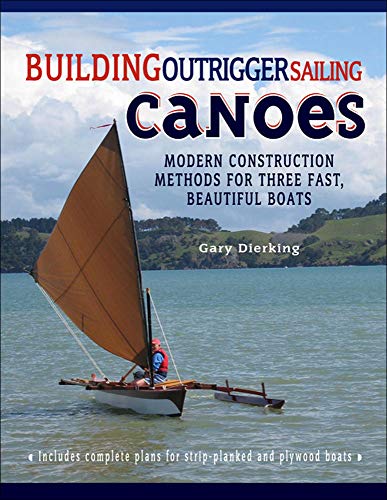
Build the fastest, most exotic sailboats around! Popular in Hawaii and throughout the South Pacific and Indian Oceans, outrigger canoes combine the romance of the South Seas with a ruthless efficiency of design and breathtaking sailing performance. This is the first book to present complete plans and building instructions for three outrigger sailing canoes. Based on traditional Hawaiian and Micronesian types, the designs are lightweight, easy to build, and screamingly fast. Author Gary Dierking shows you how to build these boats using stitch-and-glue and strip-planking construction, explains what tools and materials are required, how to rig and equip the boats, and more.
Die Inhaltsangabe kann sich auf eine andere Ausgabe dieses Titels beziehen.
Über die Autorin bzw. den Autor
Gary Dierking has been designing and building boats for more than 40 years. Raised in northern Wisconsin, he served in the US Coast Guard, then built a 37' trimaran and logged 20,000 nautical miles throughout the Pacific. His interest in outrigger canoes and other multihulls continued in the 1980s, when he worked as head builder and assistant designer for Rudy Choy Boatworks in Honolulu, building a series of high tech offshore catamarans for racing and the tourist industry. Since 1991, he has run his own boat shop in Coromandel, New Zealand. He designs, builds, repairs, and modifies a wide variety of working and recreational vessels, especially multihulls, up to 50 feet in length. He series-manufactures his Ulua outrigger canoe design in molded fiberglass.
Auszug. © Genehmigter Nachdruck. Alle Rechte vorbehalten.
BUILDING OUTRIGGER SAILING CaNoes
Modern Construction Methods for Three Fast, Beautiful Boats
By Gary DierkingThe McGraw-Hill Companies, Inc.
Copyright © 2008 International Marine
All rights reserved.
ISBN: 978-0-07-148791-7All rights reserved.
Contents
| Preface | |
| Acknowledgments | |
| Introduction Some Outrigger Basics | |
| Chapter 1. The Ulua | |
| Chapter 2. The T2 | |
| Chapter 3. The Wa'apa | |
| Chapter 4. Sailing Rigs | |
| Chapter 5. Boatbuilding Basics | |
| Chapter 6. Building the Ulua and T2 Strip-Composite Hulls | |
| Chapter 7. Building the Wa'apa Plywood Hull | |
| Chapter 8. Amas | |
| Chapter 9. Cross Beams and Hull Connections | |
| Chapter 10. Steering, Leeboards, and Accessories | |
| Chapter 11. Spars, Spar Specifications, and Sails | |
| Chapter 12. Rigging, Tuning, and Sailing | |
| Glossary | |
| Resources | |
| Index |
Excerpt
CHAPTER 1
The Ulua
"Ulua" is the Hawaiian term for the Giant Trevally fish found in deep, rockywater and off some beaches of the Pacific islands.
The Ulua canoe is based on Hawaiian outrigger canoe design. The channels betweenthe Hawaiian islands are extremely rough and more often than not have strongtrade winds blowing. This fact, along with the very small number of naturalharbors, provided the breeding ground for a very special canoe. The ability tomaintain control during high-surf landings was the most important factor intheir design.
The Ulua design broadly resembles the classic Hawaiian canoe, with somedifferences. The round bottom, which is important in the surf, performs poorlywhen sailed to windward. I've added a pivoting leeboard for lateral resistancethat can be retracted when paddling or when landing in surf. A steering oar orrudder can be used instead of the traditional paddlefor steering. The Ulua hull has a little more "V" in the hull than a traditionalHawaiian model, and this improves its speed and windward sailing ability.
Watertight bulkheads in each end of the hull provide reserve buoyancy in theevent of damage or capsize. Additional reserve buoyancy can be built in underthe two seats in the form of foam blocks or hollow storage compartments. The amacan be either solid foam covered with fiberglass, or hollow and strip planked,with foam or plastic bottles inside for emergency flotation. The large ama is ofsufficient size to support cargo stored on the iakos (outrigger booms) alongwith a crew member on the hiking seat.
A hiking seat enables the crew or helmsperson to shift their weight outboard ofthe narrow hull's gunwale to balance the force of the sail. It can consist of aslatted wooden seat or fabric stretched on a frame. The outboard edge issupported by a fore and aft pole resting on the iakos, while the inboard edgerests on the gunwale. At least one hiking seat must be fitted on the ama side ofthe hull, but an additional seat can be installed on the opposite side, supported by extended iakos.
The sailing rig shown is of a modern Hawaiian type. The availability offiberglass windsurfing masts allows for a very simple lightweight plug-in rigthat can be lowered entirely while at sea and stowed on the iakos. A brailingline folds the boom and sail up against the mast for quick furling and thusavoids dumping the sail onto the crew.
The Ulua can be paddled, sailed, surfed, or powered by a two-horsepower outboardmotor. This canoe is capable of extended coastal expeditions and can be cartopped to your favorite launching spot or carried on its side on a trailer withthe ama up in the air.
The hull can be stretched to a greater length by increasing the spacing betweenthe molds before the planking begins. You can safely increase the hull length by150 percent without any changes to the structure.
While the Ulua is an excellent sailing canoe, the shape of the hull is optimizedfor its ability to turn quickly while tacking. For long-distance paddling, footpedals, like those used in sea kayaks, can be connected with small lines to thesailing rudder. Steering with your feet allows for stronger paddling withoutusing energy to keep the canoe on a straight course.
MATERIALS FOR BUILDING THE ULUA
Hull
• 60 planks of ¼" × ¾" × 18.5' (6mm × 19mm × 5700mm)
• Enough planks for the hull and end decks can be ripped from 5 pieces oftimber, 5 ½" × ¾" × 18.5' (140mm × 19mm × 5.7m), assuming the use of a thin kerfcircular saw blade.
Molds
• 2 sheets of ½" (12mm) or thicker plywood or particle board
Stems
• 2 pieces of 1" × 4" × 30" (25mm × 100mm × 750mm). These can be of cedar or anyother softwood.
Gunwales
• 4 pieces of 3/8" × 1" × 18.5' (10mm × 40mm × 5700mm). Harder woods like mahoganyor ash are more durable.
Bulkheads and Ring Frame
• 3 pieces of 16" × 18" × 3/16 or ¼" (400mm × 450mm × 4 or 6mm) plywood. Bulkheadscan be strip composite.
Seats
• 2 pieces of ¾" × 10" × 18" (19mm × 250mm × 450mm). The seats can be of plywoodor solid timber.
Iakos
• 10 pieces of 5/16" × 2" × 6'8" (8mm × 60mm × 2000mm)
Fore and Aft Decks
• 2 pieces of 18" × 3'8", 3/16" or ¼" (450mm × 1100mm, 4 or 6mm plywood
• OR: 30 strips of 3/16" × ¾" × 44" (4 to 6mm × 19mm × 1100mm) plywood for stripdecks
Epoxy Resin
• 3 1-gallon (4-liter) kits of resin and hardener
• Bag of glue powder
• Bag of fairing powder
Fiberglass
• 4 pieces of 6-ounce (200-gram) 18.5' × 26" (6000mm × 650mm) for hull
• 4 pieces of glass for top and bottom of strip deck, 18" × 44" (450mm × 1100mm)
• Miscellaneous strips for glassing in bulkheads
• 2 pieces of 10-ounce (330-gram), 16' × 16" (5000mm × 400mm) for ama, or:
• 4 pieces of 6-ounce (200-gram) fiberglass cloth
Ama
• 2 pieces of 4" × 8" × 12'8" (100mm × 200mm × 4000mm) blue Styrofoam (can use2" [50mm] foam and glue layers together) ½ sheet; 1/8" or 3/16 (3mm or 4mm) plywood forshear web
APPROXIMATE TIME AND COST FOR BUILDING THE ULUA
The amount of time that it takes to complete a sailing Ulua is widely variableand reflects the personal standards and skill of the individual builder. Gettingstarted can seem slow, with little to look at that resembles a canoe, but onceplanking commences, the hull will take shape rapidly. The average time to set up,plank, and fiberglass a bare hull is about 100 hours. The total time to completea ready to sail Ulua is a minimum of 300 hours.
The minimum cost of materials is about U.S. $1,200. Half of this amount is forthe epoxy resin and fiberglass. The sailing rig can be home made with a plastictarp sail and a used Windsurfer mast for a very low cost, or you can have a sailmaker provide a sail...
„Über diesen Titel“ kann sich auf eine andere Ausgabe dieses Titels beziehen.
Suchergebnisse für Building Outrigger Sailing Canoes: Modern Construction...

Foto des Verkäufers
Building Outrigger Sailing Canoes: Modern Construction Methods for Three Fast, Beautiful Boats
Verlag:
International Marine/Ragged Mountain Press, 2007
ISBN 10: 0071487913
ISBN 13: 9780071487917
Gebraucht
Softcover
Anbieter: Books for Life, LAUREL, MD, USA
Verkäuferbewertung 5 von 5 Sternen

Zustand: very_good. Book is in very good condition. Clean with little to no signs of wear or markings highlights. Bestandsnummer des Verkäufers LFM.9GDP
Gebraucht kaufen
EUR 11,14
Versand gratis
Versand innerhalb von USA
Versand innerhalb von USA
Anzahl: 1 verfügbar
Beispielbild für diese ISBN
Building Outrigger Sailing Canoes: Modern Construction Methods for Three Fast, Beautiful Boats
Verlag:
International Marine Publishing, 2007
ISBN 10: 0071487913
ISBN 13: 9780071487917
Gebraucht
Paperback
Anbieter: ThriftBooks-Dallas, Dallas, TX, USA
Verkäuferbewertung 5 von 5 Sternen
Paperback. Zustand: Very Good. No Jacket. Former library book; May have limited writing in cover pages. Pages are unmarked. ~ ThriftBooks: Read More, Spend Less. Bestandsnummer des Verkäufers G0071487913I4N10
Gebraucht kaufen
EUR 12,12
Versand gratis
Versand innerhalb von USA
Versand innerhalb von USA
Anzahl: 1 verfügbar
Beispielbild für diese ISBN
Building Outrigger Sailing Canoes: Modern Construction Methods for Three Fast, Beautiful Boats
Verlag:
International Marine Publishing, 2007
ISBN 10: 0071487913
ISBN 13: 9780071487917
Gebraucht
Paperback
Anbieter: ThriftBooks-Atlanta, AUSTELL, GA, USA
Verkäuferbewertung 5 von 5 Sternen
Paperback. Zustand: Good. No Jacket. Former library book; Pages can have notes/highlighting. Spine may show signs of wear. ~ ThriftBooks: Read More, Spend Less. Bestandsnummer des Verkäufers G0071487913I3N10
Gebraucht kaufen
EUR 12,12
Versand gratis
Versand innerhalb von USA
Versand innerhalb von USA
Anzahl: 1 verfügbar
Foto des Verkäufers
Building Outrigger Sailing Canoes: Modern Construction Methods for Three Fast, Beautiful Boats
Verlag:
International Marine/Ragged Mountain Press, 2007
ISBN 10: 0071487913
ISBN 13: 9780071487917
Gebraucht
Softcover
Anbieter: Goodwill of Greater Milwaukee and Chicago, Racine, WI, USA
Verkäuferbewertung 5 von 5 Sternen
Zustand: acceptable. Book is considered to be in acceptable condition. The actual cover image may not match the stock photo. Book may have one or more of the following defects: noticeable wear on the cover dust jacket or spine; curved, dog eared or creased page s ; writing or highlighting inside or on the edges; sticker s or other adhesive on cover; CD DVD may not be included; and book may be a former library copy. Bestandsnummer des Verkäufers SEWV.0071487913.A
Gebraucht kaufen
EUR 12,32
EUR 2,62 Versand
Versand innerhalb von USA
Versand innerhalb von USA
Anzahl: 1 verfügbar
Beispielbild für diese ISBN
Building Outrigger Sailing Canoes: Modern Construction Methods for Three Fast, Beautiful Boats
Verlag:
International Marine/Ragged Mountain Press, 2007
ISBN 10: 0071487913
ISBN 13: 9780071487917
Gebraucht
Paperback
Anbieter: Affordable Collectibles, Columbia, MO, USA
Verkäuferbewertung 5 von 5 Sternen
Paperback. Zustand: Very Good. About like new with no marks. Later printing. Bestandsnummer des Verkäufers 26050071
Gebraucht kaufen
EUR 14,35
EUR 3,49 Versand
Versand innerhalb von USA
Versand innerhalb von USA
Anzahl: 1 verfügbar
Beispielbild für diese ISBN
Building Outrigger Sailing Canoes - Modern Construction Methods for Three Fast, Beautiful Boats
Verlag:
International Marines / McGraw Hill, Camden,. ME, 2008
ISBN 10: 0071487913
ISBN 13: 9780071487917
Gebraucht
Softcover
Anbieter: Cultural Connection, Cape Coral, FL, USA
Verkäuferbewertung 5 von 5 Sternen
14th printing. 4to Softcover 11" tall. Clean. Tightly bound. Sharp. Like new condition. Bestandsnummer des Verkäufers 027982
Gebraucht kaufen
EUR 15,75
EUR 3,49 Versand
Versand innerhalb von USA
Versand innerhalb von USA
Anzahl: 1 verfügbar
Foto des Verkäufers
Building Outrigger Sailing Canoes Modern Construction Methods for Three Fast, Beautiful Boats
Verlag:
International Marine/Ragged Mountain Press, 2007
ISBN 10: 0071487913
ISBN 13: 9780071487917
Gebraucht
Softcover
Anbieter: Readers Cove Used Books & Gallery, DEMING, NM, USA
Verkäuferbewertung 4 von 5 Sternen

Softcover. Zustand: Very Good. Glossy covers, solid binding. Minimal wear. Clean unmarked pages. ; 10.75 X 8.25 X 0.30 inches; 171 pages. Bestandsnummer des Verkäufers 23258
Gebraucht kaufen
EUR 17,99
EUR 6,11 Versand
Versand innerhalb von USA
Versand innerhalb von USA
Anzahl: 1 verfügbar
Beispielbild für diese ISBN
Building Outrigger Sailing Canoes : Modern Construction Methods for Three Fast, Beautiful Boats
Verlag:
International Marine/Ragged Mountain Press, 2007
ISBN 10: 0071487913
ISBN 13: 9780071487917
Neu
Softcover
Anbieter: GreatBookPrices, Columbia, MD, USA
Verkäuferbewertung 5 von 5 Sternen
Zustand: New. Bestandsnummer des Verkäufers 5201710-n
Neu kaufen
EUR 24,55
EUR 2,31 Versand
Versand innerhalb von USA
Versand innerhalb von USA
Anzahl: Mehr als 20 verfügbar
Foto des Verkäufers
Building Outrigger Sailing Canoes: Modern Construction Methods for Three Fast, Beautiful Boats (Paperback or Softback)
Verlag:
International Marine Publishing 9/5/2007, 2007
ISBN 10: 0071487913
ISBN 13: 9780071487917
Neu
Paperback or Softback
Anbieter: BargainBookStores, Grand Rapids, MI, USA
Verkäuferbewertung 5 von 5 Sternen
Paperback or Softback. Zustand: New. Building Outrigger Sailing Canoes: Modern Construction Methods for Three Fast, Beautiful Boats. Book. Bestandsnummer des Verkäufers BBS-9780071487917
Foto des Verkäufers
Building Outrigger Sailing Canoes : Modern Construction Methods for Three Fast, Beautiful Boats
Verlag:
International Marine/Ragged Mountain Press, 2007
ISBN 10: 0071487913
ISBN 13: 9780071487917
Gebraucht
Softcover
Anbieter: GreatBookPrices, Columbia, MD, USA
Verkäuferbewertung 5 von 5 Sternen
Zustand: As New. Unread book in perfect condition. Bestandsnummer des Verkäufers 5201710
Gebraucht kaufen
EUR 25,15
EUR 2,31 Versand
Versand innerhalb von USA
Versand innerhalb von USA
Anzahl: Mehr als 20 verfügbar