
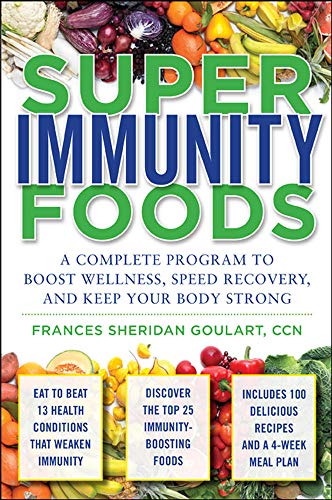
Super Immunity Foods: A Complete Program To Boost Wellness, Speed Recovery, And Keep Your Body Strong - Softcover
Inhaltsangabe
Achieve Optimal Health with the Top 25 Immunity-Boosting Foods
Build immunity that beats disease and slows down aging while increasing your energy
Who doesn't want fewer colds, softer skin, or youthful vitality? Frances Sheridan Goulart, author of the ever-popular Super Healing Foods, now brings you a program for the 25 foods that strengthen the body's six immune centers and help heal and reverse the most common ailments.
Focusing on the top 25 foods provides a simple plan that you can easily incorporate into your lifestyle. With delicious recipes and complete menus, a newer, healthier you is now within reach.
- Did you know these food facts?:
- Apple peels are rich in a compound that helps to halt the growth of cancer cells
Die Inhaltsangabe kann sich auf eine andere Ausgabe dieses Titels beziehen.
Über die Autorin bzw. den Autor
Frances Sheridan Goulart, CCN, is a certifiedclinical nutritionist, yoga instructor, and author of 16books on health, nutrition, cooking, and wellness. She cofoundedPotsanjammer, one of the first natural foods cookingschools in the country.
Auszug. © Genehmigter Nachdruck. Alle Rechte vorbehalten.
SUPER IMMUNITY FOODS
A COMPLETE PROGRAM TO BOOST WELLNESS, SPEED RECOVERY, AND KEEP YOUR BODY STRONGBy FRANCES SHERIDAN GOULARTThe McGraw-Hill Companies, Inc.
Copyright © 2009 Frances Sheridan GoulartAll right reserved.
ISBN: 978-0-07-159882-8
Contents
Chapter One
The Body's Six Immune Centers
Our own physical body possesses a wisdom which we who inhabit it lack," observed author Henry Miller. The immune system, in its own wisdom, is, functionally speaking, not one system but several—six, in fact.
Immune cells defending us from harm keep company with one another in an interlocking round-the-clock system of biotelepathy throughout the body. It's the equivalent of having a squad of bodyguards always on call but positioned according to purpose. Thus your heart and arteries are protected by the defensive cellular team in your cardiovascular center, while the liver, kidney, and bladder, more concerned with detoxification and cleansing, call up a different but equally vigilant squad of cells and cellular defenses as needed.
Different organs, structures, and substances are all involved. In general, what causes immunity to stumble and leave us vulnerable to disease is the overactivity of one or more of the body's six immune centers. In response to exposure to toxins, your overactive white blood cells begin to attack neurons in the brain (causing aging, Alzheimer's, or dementia, for example), or the lining of the arteries (causing coronary or arterial disease), or the cartilage in the joints (causing osteoarthritis). And we all have our combinations of strengths and weaknesses that make us unique—strong heart, weak knees; bad bones, good digestion; bad back, good mind—so we are defended and fight back in uniquely different ways.
Weakening of the immune centers or, equally imbalancing, over-activity of the immune centers (autoimmunity) makes us susceptible to any and every type of illness. A few red flags telling you your immunity is out of whack include fatigue (cardiovascular and nervous centers), poor wound healing (all six centers), diarrhea (digestive center), allergies (respiratory center), and cancer (any of the six centers).
And what does your good, bad, or indifferent diet have to do with the high, low, or just fair functioning of each of these six centers that determine your well-being? Plenty. Read on.
Center One: Cardiovascular Center
This center includes the heart (no bigger than a clenched fist, it beats 3 million times a year), blood and blood vessels (60,000 miles of them), and the circulatory system. Blood moves from the heart to the lungs, mixes with oxygen, and then circulates along with nutrients (e.g., those anthocyanins from your blueberry breakfast, that fiber from your lunchtime wrap) to wherever it's needed. What goes around comes around: that same oxygenated blood makes a return trip to pick up and dispose of toxins in your system. The blood vessels or arteries (which could circle the globe two and a half times if strung together) connect with smaller capillaries and veins to bring blood back to the heart. It should all work like clockwork if the specialized immune cells in this center—the white blood cells that defend against invaders and the platelets that help the system self-repair—are up to steam.
Center Two: Nervous Center
The brain has a mind of its own, and indeed, this center comprising brain, spinal cord, and complex network of nerves is telecommunications and intelligent design in action. The central nervous system is central to tasting, seeing, thinking, hearing, dreaming, breathing, and feeling pain and pleasure. Thin threads of nerves called neurons are bundled together and carry information back and forth like wires gathered on a telephone pole. Sensory nerves send messages to the brain by way of the spinal cord, and motor nerves carry messages back from the brain to all the muscles and glands. When a neuron is stimulated by heat, cold, touch, or sound vibrations, it generates an electrical pulse that travels the length of the neuron and then is carried by chemicals to the next cell, hot- potato style. Plenty of events from the outer and inner environments can interfere with this interplay—and plenty of foods can keep this center strong!
Center Three: Glandular Center
The lymphatic system includes important organs: the spleen, thymus, tonsils, and lymph nodes, which continuously cleanse the body at the cellular level, eliminating toxins and debris and destroying depleted cells. Lymph nodes (carrying T and B cells) that fight infections are located in the neck, armpits, chest, pelvis, and groin.
Center Four: Digestive/Detoxification Center
Think before you munch. Digestion begins in the mouth with the salivary glands and wraps up in the small intestine. But it is a long, complex journey. Immune cells in the mucosa of the digestive tract in the mouth, esophagus, stomach, small and large intestines, and gallbladder must all be well fed and functioning to keep you protected. The liver and pancreas are also digestive organs, as is the gallbladder. Even the nervous and circulatory systems interact with this immune center. Most digested molecules of food, for example, are absorbed through the small intestine. The viability of the specific cells involved in this process is essential to the next step: passage into the bloodstream and distribution to the rest of the body for storage or further chemical transformation.
The many steps in the digestion of carbohydrates, fats, protein, vitamins, water, and salts depend on how well immune cells in the eight organs of this system are working. The well- being of the immune cells in turn ensures that the hormones controlling digestion from the mouth to the pancreas and the hormones stimulating and inhibiting the appetite are in good working order.
In the liver, Phase I and Phase II enzymes defend the body against toxins. These two enzyme systems are central to your body's ability to defend itself against bacteria, viruses, parasites, and toxic chemicals. Because of the wide variety of chemical reactions these enzymes undertake, they are major players in the fight against disease and illness. Nutrition has a significant role in the activation of these enzymes, says Dr. Paul Talalay, John Jacob Abel Distinguished Service Professor of Pharmacology and Director of the Laboratory for Molecular Sciences at Johns Hopkins University School of Medicine in Baltimore. According to Dr. Talalay, when Phase I enzymes are activated, they seek out toxic substances to make them water soluble and easier to usher out of the body. When Phase II enzymes are activated, they detoxify the toxins produced by Phase I enzymes, render them inert, and remove them from the body. Highly reactive molecules called free radicals are sometimes produced by this drama and can be tamed by antioxidants in your system. Many foods can tamp down oxidative damage, including cruciferous vegetables such as broccoli and cauliflower, as well as foods high in antioxidant vitamins A and C.
Center Five: Musculoskeletal Center
The body has 206 bones, including the skull, which protects the brain; the spinal column, which protects the spinal cord; the ribs, which protect the heart, lungs, liver, and spleen; and the pelvis, which protects the bladder, intestines, and (in women) the reproductive organs. In addition, joints make the skeleton flexible. Bones contain three types of cells: osteoblasts, which make new bone and repair old; osteoclasts, which...
„Über diesen Titel“ kann sich auf eine andere Ausgabe dieses Titels beziehen.
Suchergebnisse für Super Immunity Foods: A Complete Program To Boost Wellness,...

Beispielbild für diese ISBN
Super Immunity Foods: A Complete Program to Boost Wellness, Speed Recovery, and Keep Your Body Strong
Anbieter: World of Books (was SecondSale), Montgomery, IL, USA
Verkäuferbewertung 5 von 5 Sternen

Zustand: Good. Item in good condition. Textbooks may not include supplemental items i.e. CDs, access codes etc. Bestandsnummer des Verkäufers 00091715044
Gebraucht kaufen
EUR 6,00
Versand gratis
Versand innerhalb von USA
Versand innerhalb von USA
Anzahl: 1 verfügbar
Beispielbild für diese ISBN
Super Immunity Foods: A Complete Program to Boost Wellness, Speed Recovery, and Keep Your Body Strong
Anbieter: World of Books (was SecondSale), Montgomery, IL, USA
Verkäuferbewertung 5 von 5 Sternen
Zustand: Acceptable. Item in acceptable condition! Textbooks may not include supplemental items i.e. CDs, access codes etc. Bestandsnummer des Verkäufers 00095601385
Gebraucht kaufen
EUR 6,00
Versand gratis
Versand innerhalb von USA
Versand innerhalb von USA
Anzahl: 1 verfügbar
Beispielbild für diese ISBN
Super Immunity Foods: A Complete Program to Boost Wellness, Speed Recovery, and Keep Your Body Strong
Anbieter: ThriftBooks-Dallas, Dallas, TX, USA
Verkäuferbewertung 5 von 5 Sternen
Paperback. Zustand: Very Good. No Jacket. May have limited writing in cover pages. Pages are unmarked. ~ ThriftBooks: Read More, Spend Less. Bestandsnummer des Verkäufers G0071598820I4N00
Gebraucht kaufen
EUR 6,00
Versand gratis
Versand innerhalb von USA
Versand innerhalb von USA
Anzahl: 1 verfügbar
Beispielbild für diese ISBN
Super Immunity Foods: A Complete Program to Boost Wellness, Speed Recovery, and Keep Your Body Strong
Anbieter: ThriftBooks-Dallas, Dallas, TX, USA
Verkäuferbewertung 5 von 5 Sternen
Paperback. Zustand: Very Good. No Jacket. Former library book; May have limited writing in cover pages. Pages are unmarked. ~ ThriftBooks: Read More, Spend Less. Bestandsnummer des Verkäufers G0071598820I4N10
Gebraucht kaufen
EUR 6,00
Versand gratis
Versand innerhalb von USA
Versand innerhalb von USA
Anzahl: 1 verfügbar
Beispielbild für diese ISBN
Super Immunity Foods: A Complete Program to Boost Wellness, Speed Recovery, and Keep Your Body Strong
Anbieter: ThriftBooks-Reno, Reno, NV, USA
Verkäuferbewertung 5 von 5 Sternen
Paperback. Zustand: Good. No Jacket. Pages can have notes/highlighting. Spine may show signs of wear. ~ ThriftBooks: Read More, Spend Less. Bestandsnummer des Verkäufers G0071598820I3N00
Gebraucht kaufen
EUR 6,00
Versand gratis
Versand innerhalb von USA
Versand innerhalb von USA
Anzahl: 1 verfügbar
Beispielbild für diese ISBN
Super Immunity Foods: A Complete Program to Boost Wellness, Speed Recovery, and Keep Your Body Strong
Anbieter: ThriftBooks-Atlanta, AUSTELL, GA, USA
Verkäuferbewertung 5 von 5 Sternen
Paperback. Zustand: Very Good. No Jacket. May have limited writing in cover pages. Pages are unmarked. ~ ThriftBooks: Read More, Spend Less. Bestandsnummer des Verkäufers G0071598820I4N00
Gebraucht kaufen
EUR 6,00
Versand gratis
Versand innerhalb von USA
Versand innerhalb von USA
Anzahl: 1 verfügbar
Beispielbild für diese ISBN
Super Immunity Foods: A Complete Program to Boost Wellness, Speed Recovery, and Keep Your Body Strong
Anbieter: ThriftBooks-Phoenix, Phoenix, AZ, USA
Verkäuferbewertung 5 von 5 Sternen
Paperback. Zustand: Very Good. No Jacket. May have limited writing in cover pages. Pages are unmarked. ~ ThriftBooks: Read More, Spend Less. Bestandsnummer des Verkäufers G0071598820I4N00
Gebraucht kaufen
EUR 6,00
Versand gratis
Versand innerhalb von USA
Versand innerhalb von USA
Anzahl: 1 verfügbar
Beispielbild für diese ISBN
Super Immunity Foods: A Complete Program to Boost Wellness, Speed Recovery, and Keep Your Body Strong
Anbieter: ThriftBooks-Atlanta, AUSTELL, GA, USA
Verkäuferbewertung 5 von 5 Sternen
Paperback. Zustand: Good. No Jacket. Pages can have notes/highlighting. Spine may show signs of wear. ~ ThriftBooks: Read More, Spend Less. Bestandsnummer des Verkäufers G0071598820I3N00
Gebraucht kaufen
EUR 6,00
Versand gratis
Versand innerhalb von USA
Versand innerhalb von USA
Anzahl: 1 verfügbar
Beispielbild für diese ISBN
Super Immunity Foods: A Complete Program to Boost Wellness, Speed Recovery, and Keep Your Body Strong
Anbieter: Idaho Youth Ranch Books, Boise, ID, USA
Verkäuferbewertung 5 von 5 Sternen
Zustand: Good. A copy that has been read, but remains in clean condition. All pages are intact, and the cover is intact (including dust cover, if applicable). The spine may show signs of wear. Pages can include limited notes and highlighting, and the copy can include "From the library of" labels or limited small stickers. Book may have a remainder mark or be a price cutter. Bestandsnummer des Verkäufers D-05-01-05-0592
Gebraucht kaufen
EUR 2,76
EUR 3,51 Versand
Versand innerhalb von USA
Versand innerhalb von USA
Anzahl: 1 verfügbar
Beispielbild für diese ISBN
Super Immunity Foods: a Complete Program to Boost Wellness, Speed Recovery, and Keep Your Body Strong
Verlag:
McGraw-Hill Education, 2009
ISBN 10: 0071598820
ISBN 13: 9780071598828
Gebraucht
Softcover
Erstausgabe
Anbieter: Better World Books, Mishawaka, IN, USA
Verkäuferbewertung 5 von 5 Sternen
Zustand: Good. 1st Edition. Former library copy. Pages intact with minimal writing/highlighting. The binding may be loose and creased. Dust jackets/supplements are not included. Includes library markings. Stock photo provided. Product includes identifying sticker. Better World Books: Buy Books. Do Good. Bestandsnummer des Verkäufers GRP95806672
Gebraucht kaufen
EUR 8,22
Versand gratis
Versand innerhalb von USA
Versand innerhalb von USA
Anzahl: 1 verfügbar