
Verwandte Artikel zu Winning Body Language: Control The Conversation, Command...
Winning Body Language: Control The Conversation, Command Attention, And Convey The Right Message Without Saying A Word - Softcover
Buch 17 von 36: BUSINESS SKILLS AND DEVELOPMENT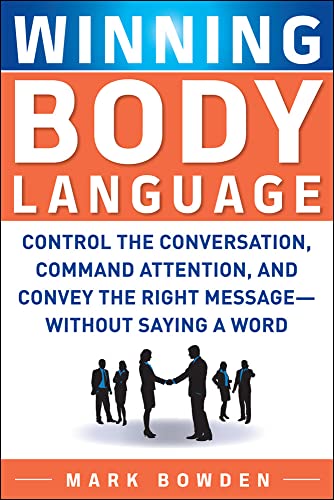
Inhaltsangabe
The Unique System of Nonverbal Skills Used by the Most Effective Leaders in Business Today CONTROL THE CONVERSATION, COMMAND ATTENTION, AND CONVEY THE RIGHT MESSAGE--WITHOUT SAYING A WORD Whether you're presenting an idea, delivering a speech, managing a team, or negotiating a deal, your body language plays a key role in your overall success. This ingenious step-by-step guide, written by an elite trainer of Fortune 50 CEOs and G8 world leaders, unlocks the secrets of nonverbal communication--using a proven system of universal techniques that can give you the ultimate professional advantage. Learn easily how to: Successfully master the visual TruthPlane around you to win trust now. Gesture in a way that gains everyone's attention-even before you speak. Appeal to others' deep psychological needs for immediate rapport and influence. You'll discover how to sit, stand, and subtly alter your body language to move with confidence, control conversations, command attention, persuade and influence others, and convey positive energy-without saying a word. It's the one key to success nobody talks about!
Die Inhaltsangabe kann sich auf eine andere Ausgabe dieses Titels beziehen.
Über die Autorin bzw. den Autor
Mark Bowden is a noted body language expert andcreator of TruthPlane, a communication and presentationtraining program used by Fortune 50 companies and CEO s throughout the world. Visit www.truthplane.com
Auszug. © Genehmigter Nachdruck. Alle Rechte vorbehalten.
WINNING BODY LANGUAGE
Control the Conversation, Command Attention, and Convey the Right Message—Without Saying a WordBy Mark BowdenMcGraw-Hill
Copyright © 2010 Mark BowdenAll right reserved.
ISBN: 978-0-07-170057-3
Contents
Chapter One
Communication Is More than WordsThey Just Don't See What You're Saying The single biggest problem in communication is the illusion that it has taken place. —George Bernard Shaw
In this chapter you'll learn:
• The fundamental mechanism for all communication
• How we all know what we all know
• Why content is not king
• Congruence and the key to losing trust and business
• The most important person in the history of communication, ever!
Before we get deep into body language, it is important to break down communication as a whole into its basic parts and understand the fundamentals behind it. This knowledge, the understanding of how communication actually works, is the starting line from which your real competitive advantage can really take off.
Human communication, reduced to its simplest form, consists of a source transmitting a message to a receiver in order to achieve an intended result.
So, to make sure that your communication is really taking place, first you need to make sure that there is a source (you), that you have a way of transmitting a message (using your body or your voice, writing, or some other method), and finally that you have a receiver (someone else). Oh, and there's something else that is too often forgotten: you need a reason to send the message, an intended outcome, or it will be impossible to form the communication at all, or at best it will be nonsense, because if you do not know the intended end goal of any action, you cannot hope to select the best actions to perform in order to achieve that goal.
Thus, the basic linear model for human communication looks like this: the source encodes a message and sends it via a channel, to be received and decoded by the receiver. Of course, there is also the inevitable feedback to the source. For example, as you make your way to a business meeting, you notice that a car is about to pull in front of your vehicle; as a courtesy, you hit your horn to alert the driver of that car of the danger to him; he hears it and, to your surprise, flips you the finger in return!
Clearly one thing to look out for is whether your message has had the desired effect that you intended, or anything close to the desired effect, on your audience. As the highly influential American communication theorist Harold Lasswell described: Who (says) What (to) Whom (in) What Channel (with) What Effect.
Talking Trash
If the specific communication has not had the intended effect, when you look for where your message has been let down, it is best to keep in mind the modern computational communication model described by the acronym GIGO (Garbage In—Garbage Out). This principle was perhaps first hit upon by the genius engineer Charles Babbage commenting in his autobiography, Passages from the Life of a Philosopher (1864), that when he was asked (by an eminent British member of Parliament, no less) whether the outcome of a calculation would be correct even when incorrect data were placed into that calculation, he could only reply, "I am not able to comprehend the kind of confusion of ideas that could provoke such a question!"
The observation is that if the feedback appears to be nonsense, it could well be because you fed in a stream of similar nonsense in the first place! In all communication, pay attention to the fact that it is a two-way system with a feedback loop. In other words, "the phone goes both ways," and any message can easily escalate out of control and spiral into craziness, and when it does, everyone is to blame.
Understanding the Message
On top of all this, according to Shannon and Weaver's very popular model of communication, while the message is in transit, it is subject to all manner of distortion, and understandings and misunderstandings are influenced by factors well beyond the control of either the sender or the receiver.
To illustrate, a simple but relatively comprehensive diagram of human communication looks something like Figure 1.1.
You can see the possibilities for corruption of the message and its meaning at every point in this model, either in the mind of the receiver through generalization, deletion, or distortion; or during the transit of the message as a result of "noise" either interrupting, distorting, or creating an amplified resonance in the message.
So how do we ever get to understand a communication?
How We Know What We Know
Let's look at it from the viewpoint of an area of philosophy called epistemology, which deals in theories around the question, "How do we know what we know?"
At this point, you may be thinking, "Why should an area of philosophical study be so important to the business body language practitioner, who surely should be focused on the influential effects of physical action, the doing rather than the thinking?" Well, the answer is that if you know the exact mechanism by which people understand any communication, you will have a better ability to influence the mechanics of that conversation. By doing so, you will optimize your persuasive influence over the recipient's mind and the final outcome of the communication: bringing the receiver's understanding in line with your goals.
Simply stated, when you can comprehend the cogs and wheels of how we gain understanding, you can deliver understanding more effectively, just as a mechanic who understands the workings of an engine can supercharge it, or a programmer who understands code can hack it, or a bartender who understands the simple science of a martini can mix the best Manhattan in town.
So what, according to philosophers, are the major ingredients that make up the cocktail that we call "knowledge"?
Facts
Thought in this area is as diverse as you might expect from a discipline in which thinking is an end in itself. However, the debate tends to summarily lead toward two main ingredients: "belief" and "truth." Indeed, the great Harvard epistemologist and metaphysician Roderick Chishol defined knowledge as justified true belief. But what justifies the truth of a belief? Many would say that facts do the job—and as the eminent philosopher Edmund Burke once said of facts, "They are to the mind as food is to the body." So where does the mind get these nutritional facts, and why might some be more tasty to our feeling of knowing than others?
The word fact originally comes from the Latin factum, meaning "a thing done or performed." This definition provokes the question: how do we know, as certainly as we ever can, that anything has really been done or performed? The answer may be that we ourselves must sense it with one or more of our traditional five senses or potentially more than a dozen other exteroceptive and interoceptive senses. Certainly, this is the viewpoint of Aristotle and a line of thinkers who place our senses as the foundation of all fact and belief, and so of truth and knowledge. You might say, "We sense it, therefore it is." From this idea, we can understand that our senses, which form our impressions of reality, are our route to knowing that what is out there is indeed out there. Our senses are the exact tools that we use to...
„Über diesen Titel“ kann sich auf eine andere Ausgabe dieses Titels beziehen.
Suchergebnisse für Winning Body Language: Control The Conversation, Command...

Foto des Verkäufers
Winning Body Language: Control the Conversation, Command Attention, and Convey the Right Message without Saying a Word
Anbieter: Zoom Books East, Glendale Heights, IL, USA
Verkäuferbewertung 5 von 5 Sternen

Zustand: good. Book is in good condition and may include underlining highlighting and minimal wear. The book can also include "From the library of" labels. May not contain miscellaneous items toys, dvds, etc. . We offer 100% money back guarantee and 24 7 customer service. Bestandsnummer des Verkäufers ZEV.0071700579.G
Gebraucht kaufen
EUR 3,97
Versand gratis
Versand innerhalb von USA
Versand innerhalb von USA
Anzahl: 2 verfügbar
Foto des Verkäufers
Winning Body Language: Control the Conversation, Command Attention, and Convey the Right Message without Saying a Word
Anbieter: Zoom Books Company, Lynden, WA, USA
Verkäuferbewertung 5 von 5 Sternen
Zustand: very_good. Book is in very good condition and may include minimal underlining highlighting. The book can also include "From the library of" labels. May not contain miscellaneous items toys, dvds, etc. . We offer 100% money back guarantee and 24 7 customer service. Bestandsnummer des Verkäufers ZBV.0071700579.VG
Gebraucht kaufen
EUR 3,97
Versand gratis
Versand innerhalb von USA
Versand innerhalb von USA
Anzahl: 2 verfügbar
Beispielbild für diese ISBN
Winning Body Language: Control the Conversation, Command Attention, and Convey the Right Message without Saying a Word
Anbieter: World of Books (was SecondSale), Montgomery, IL, USA
Verkäuferbewertung 5 von 5 Sternen
Zustand: Good. Item in good condition. Textbooks may not include supplemental items i.e. CDs, access codes etc. Bestandsnummer des Verkäufers 00103108024
Gebraucht kaufen
EUR 3,97
Versand gratis
Versand innerhalb von USA
Versand innerhalb von USA
Anzahl: 9 verfügbar
Foto des Verkäufers
Winning Body Language: Control the Conversation, Command Attention, and Convey the Right Message without Saying a Word
Anbieter: Zoom Books East, Glendale Heights, IL, USA
Verkäuferbewertung 5 von 5 Sternen
Zustand: very_good. Book is in very good condition and may include minimal underlining highlighting. The book can also include "From the library of" labels. May not contain miscellaneous items toys, dvds, etc. . We offer 100% money back guarantee and 24 7 customer service. Bestandsnummer des Verkäufers ZEV.0071700579.VG
Gebraucht kaufen
EUR 3,97
Versand gratis
Versand innerhalb von USA
Versand innerhalb von USA
Anzahl: 1 verfügbar
Foto des Verkäufers
Winning Body Language: Control the Conversation, Command Attention, and Convey the Right Message without Saying a Word
Anbieter: Greenworld Books, Arlington, TX, USA
Verkäuferbewertung 5 von 5 Sternen
Zustand: very_good. Fast Free Shipping â" Very Good condition book with a firm cover and clean pages. Shows normal use and some light wear or limited notes markings. A solid, nice copy to enjoy. Bestandsnummer des Verkäufers GWV.0071700579.VG
Gebraucht kaufen
EUR 5,15
Versand gratis
Versand innerhalb von USA
Versand innerhalb von USA
Anzahl: 1 verfügbar
Beispielbild für diese ISBN
Winning Body Language: Control the Conversation, Command Attention, and Convey the Right Message without Saying a Word
Verlag:
McGraw Hill (edition 1), 2010
ISBN 10: 0071700579
ISBN 13: 9780071700573
Gebraucht
Paperback
Anbieter: BooksRun, Philadelphia, PA, USA
Verkäuferbewertung 5 von 5 Sternen
Paperback. Zustand: Very Good. 1. It's a well-cared-for item that has seen limited use. The item may show minor signs of wear. All the text is legible, with all pages included. It may have slight markings and/or highlighting. Bestandsnummer des Verkäufers 0071700579-11-1
Gebraucht kaufen
EUR 5,71
Versand gratis
Versand innerhalb von USA
Versand innerhalb von USA
Anzahl: 1 verfügbar
Beispielbild für diese ISBN
Winning Body Language: Control the Conversation, Command Attention, and Convey the Right Message--Without Saying a Word
Anbieter: ThriftBooks-Atlanta, AUSTELL, GA, USA
Verkäuferbewertung 5 von 5 Sternen
Paperback. Zustand: Very Good. No Jacket. Former library book; May have limited writing in cover pages. Pages are unmarked. ~ ThriftBooks: Read More, Spend Less. Bestandsnummer des Verkäufers G0071700579I4N10
Gebraucht kaufen
EUR 5,84
Versand gratis
Versand innerhalb von USA
Versand innerhalb von USA
Anzahl: 1 verfügbar
Beispielbild für diese ISBN
Winning Body Language: Control the Conversation, Command Attention, and Convey the Right Message--Without Saying a Word
Anbieter: ThriftBooks-Atlanta, AUSTELL, GA, USA
Verkäuferbewertung 5 von 5 Sternen
Paperback. Zustand: Fair. No Jacket. Readable copy. Pages may have considerable notes/highlighting. ~ ThriftBooks: Read More, Spend Less. Bestandsnummer des Verkäufers G0071700579I5N00
Gebraucht kaufen
EUR 5,84
Versand gratis
Versand innerhalb von USA
Versand innerhalb von USA
Anzahl: 1 verfügbar
Beispielbild für diese ISBN
Winning Body Language: Control the Conversation, Command Attention, and Convey the Right Message--Without Saying a Word
Anbieter: ThriftBooks-Phoenix, Phoenix, AZ, USA
Verkäuferbewertung 5 von 5 Sternen
Paperback. Zustand: Good. No Jacket. Pages can have notes/highlighting. Spine may show signs of wear. ~ ThriftBooks: Read More, Spend Less. Bestandsnummer des Verkäufers G0071700579I3N00
Gebraucht kaufen
EUR 5,84
Versand gratis
Versand innerhalb von USA
Versand innerhalb von USA
Anzahl: 1 verfügbar
Beispielbild für diese ISBN
Winning Body Language: Control the Conversation, Command Attention, and Convey the Right Message--Without Saying a Word
Anbieter: ThriftBooks-Reno, Reno, NV, USA
Verkäuferbewertung 5 von 5 Sternen
Paperback. Zustand: Good. No Jacket. Pages can have notes/highlighting. Spine may show signs of wear. ~ ThriftBooks: Read More, Spend Less. Bestandsnummer des Verkäufers G0071700579I3N00
Gebraucht kaufen
EUR 5,84
Versand gratis
Versand innerhalb von USA
Versand innerhalb von USA
Anzahl: 2 verfügbar