
Verwandte Artikel zu Being Happy: You Don't Have to Be Perfect to Lead...
Being Happy: You Don't Have to Be Perfect to Lead a Richer, Happier Life - Softcover
Buch 18 von 22: NTC SELF-HELP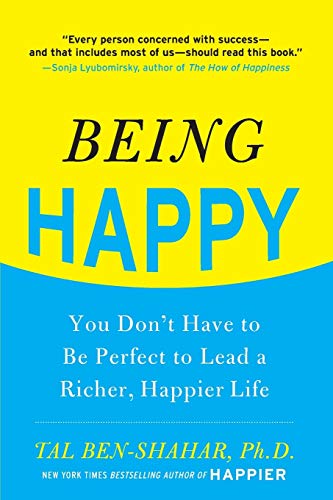
Inhaltsangabe
A brilliant guide to living a happier life (even if it's not so perfect)
Bestselling author Tal Ben-Shahar has done it again. In Being Happy (originally published in hardcover as The Pursuit of Perfect, 978-0-07160882-4), he gives you not only you the theory but also the tools to help you learn how to accept life as it actually is instead of what you think it should be. By using the science of positive psychology along with acceptance, Ben-Shahar shows you how to escape the rat race and begin living a life of serenity, happiness, and fulfillment.
With the same technique that made Happier such a great success, Being Happy shows you how to let go of unrealistic expectations and truly accept your emotions for a more serene life.
Praise for Ben-Shahar:
"[Tal Ben-Shahar has] a rare brand of good sense that is embedded in scientific knowledge about how to increase happiness." -- Martin E. P. Seligman, author of Authentic Happiness
"Ben-Shahar teaches that happiness isn't as elusive as people think." -- Publishers Weekly
"One of the most popular teachers in Harvard's recent history." -- Ellen J. Langer, author of Mindfulness and On Becoming an Artist
Tal Ben-Shahar is the New York Times bestselling author of Happier. He consults and lectures around the world to executives in multinational corporations, the general public, and at-risk populations. For more information, visit www.talbenshahar.com
Die Inhaltsangabe kann sich auf eine andere Ausgabe dieses Titels beziehen.
Über die Autorin bzw. den Autor
Tal Ben-Shahar is the New York Times bestselling author of Happier. He consults and lectures around the world to executives in multinational corporations, the general public, and at-risk populations. For more information, visit www.talbenshahar.com
Auszug. © Genehmigter Nachdruck. Alle Rechte vorbehalten.
BEING HAPPY
You Don't Have to Be Perfect to Lead a Richer, Happier LifeBy TAL BEN-SHAHARMcGraw-Hill
Copyright © 2011 Tal Ben-ShaharAll right reserved.
ISBN: 978-0-07-174661-8
Contents
Chapter One
Accepting FailureThe greatest mistake a man can make is to be afraid of making one.
—Elbert Hubbard
On the evening of May 31, 1987, I became Israel's youngest-ever national squash champion. I was thrilled to win the championship and felt truly happy. For about three hours. And then I began to think that this accomplishment wasn't actually very significant: squash, after all, was not a major sport in Israel, and there were only a few thousand players. Was it really a big deal to be the best of such a small group? By the next morning I decided that the deep and lasting satisfaction I craved would only come if I won a world championship. I resolved right then to become the best player in the world. A few weeks later I graduated from high school, packed my bags, and left for England, which was considered the center of international squash. From Heathrow Airport, I took the underground train straight to Stripes, the squash club in Ealing Broadway where the world champion, Jansher Khan, trained. And although he did not know it, that was the day I started my apprenticeship with him.
I followed his every move on the court, in the gym, and on the road. Each morning before heading to the club, he ran seven miles; so I did the same. He then spent four hours on court, playing against a few training partners and working out with his coach; so I did the same. In the afternoon he lifted weights for an hour and then stretched for another hour; so I did the same.
The first step in my plan to win the world championship was to improve quickly, so that Jansher would invite me to be one of his regular training partners. I did in fact improve, and within six months of moving to England, I was invited by Jansher to play with him whenever one of his regular partners could not make it. A few months later I became one of the regulars. Jansher and I played and trained together every day, and when he traveled to tournaments I would join him and either warm up with him before his match or, if the match was not taxing for him (and most matches weren't), we would play afterward.
Although I improved by leaps and bounds, there was a price. While Jansher had gradually built up to the intensity of his workout regime, I had taken a shortcut. When I arrived in England, I believed I had only two options before me: either to train like the world champion (and become one myself) or not to train at all (and give up on my dream). All or nothing. The intensity of Jansher's regime far exceeded anything I had ever done before. No matter, I thought: to be a world champion, do as the world champion does.
My body thought differently. I began to get injured with increasing regularity. Initially, the injuries were minor—a pulled hamstring, mild backache, soreness in my knee—nothing that could keep me off the court for more than a couple of days. And I felt confident in my approach, because despite my injuries, I was training the way the world champion trained, and my game continued to improve.
But I was dismayed to find that my performance was much weaker in tournaments than during practice. While I had no problem focusing for hours at a time during practice sessions, intense pre-match jitters kept me awake at night and hurt my performance on the court. Playing the big matches or the big points, I would often choke under the pressure.
A year after moving to London, I reached the final of a major junior tournament. I was expected to win comfortably, having beaten the top ranked players in earlier rounds. My coach was watching, my friends were rooting for me, and a reporter from the local paper was there, ready to let the world know about the bright new star on the squash circuit. I won the first two games easily and was within two points of clinching the match when first my feet, then my leg, and finally my arm cramped. I lost the match.
I had never experienced such cramps during practice, no matter how hard I had trained, and it was clear to me that the physical symptoms were a result of psychological pressure. What held me back on that occasion, and on so many other occasions, was my intense fear of failure. In my quest to become the world champion, failure was not an option. By this I mean that not only did I regard becoming the world champion the only goal worth attaining, but I also believed that only the shortest and most direct route to my goal was acceptable. The road to the top had to be a straight line— there was no time (and, I believed, no reason) for anything else.
But my body, once again, thought otherwise. After two years of doing too much too soon, the injuries gradually became more serious, taking weeks rather than days to heal. Nevertheless, I stuck to my punishing regime. Eventually, at the grand old age of twenty-one, plagued by injuries and strongly advised by medical experts to slow down, I had to give up my dream of becoming the best player in the world. I was devastated, and yet part of me felt relieved: the doctors had provided me with an acceptable excuse for my failure.
As an alternative to a professional athletic career, I applied to college. My focus shifted from sports to academia. But I brought to the classroom the same behaviors, feelings, and attitudes that had driven me on the court. Once again, I believed that I faced a choice of all or nothing, in terms of how much work I needed to do and what kind of grades I had to earn. And so I applied myself to reading every word that every professor assigned, and I tolerated nothing short of perfect grades on all the papers that I wrote and the exams that I took. Working to achieve this goal kept me up at night, and anxiety that I still might fail kept me up long after all the papers were handed in and the exams were taken. As a result, I spent my first years of college in a state of almost constant stress and unhappiness.
My original plan, when I entered college, was to major in one of the hard sciences. My best grades had always been in science and mathematics. To me, that was reason enough to continue along the same path; it was the most straightforward way to achieve perfect grades. But although I did very well in my courses, my unhappiness and my increasing weariness gradually drew me away from this safe choice, and I began to explore the humanities and social sciences. I was initially uneasy about leaving the hard sciences, with their satisfying, objective truths, and was unsure about the more nuanced—and to me, uncharted—territory of the "softer" disciplines. However, my desire to alleviate the anxiety and unhappiness was stronger than my fear and uneasiness about change, and so at the beginning of my junior year I switched my major from computer science to psychology and philosophy.
It was then that I encountered for the first time the research on perfectionism conducted by David Burns, Randy Frost, Gordon Flett, and Paul Hewitt. I had not realized until then that so many people struggled, to a greater or lesser degree, with the same problems I had. Both the research and the knowledge that I was not alone comforted me somewhat. Initially, I scanned the literature looking for a quick fix to get me from where I was (a maladaptive Perfectionist) to where I wanted to be (an adaptive Perfectionist)—I was still looking for the straight-line solution. But when my attempts failed, I delved...
„Über diesen Titel“ kann sich auf eine andere Ausgabe dieses Titels beziehen.
Suchergebnisse für Being Happy: You Don't Have to Be Perfect to Lead...

Foto des Verkäufers
Being Happy: You Don't Have to Be Perfect to Lead a Richer, Happier Life: You Don't Have to Be Perfect to Lead a Richer, Happier Life
Anbieter: Dream Books Co., Denver, CO, USA
Verkäuferbewertung 5 von 5 Sternen

Zustand: good. Gently used with minimal wear on the corners and cover. A few pages may contain light highlighting or writing, but the text remains fully legible. Dust jacket may be missing, and supplemental materials like CDs or codes may not be included. May be ex-library with library markings. Ships promptly! Bestandsnummer des Verkäufers DBV.0071746617.G
Gebraucht kaufen
EUR 3,71
Versand gratis
Versand innerhalb von USA
Versand innerhalb von USA
Anzahl: 2 verfügbar
Beispielbild für diese ISBN
Being Happy You Dont Have to B
Anbieter: World of Books (was SecondSale), Montgomery, IL, USA
Verkäuferbewertung 5 von 5 Sternen
Zustand: Very Good. Item in very good condition! Textbooks may not include supplemental items i.e. CDs, access codes etc. Bestandsnummer des Verkäufers 00088010055
Gebraucht kaufen
EUR 3,75
Versand gratis
Versand innerhalb von USA
Versand innerhalb von USA
Anzahl: 2 verfügbar
Beispielbild für diese ISBN
Being Happy You Dont Have to B
Anbieter: World of Books (was SecondSale), Montgomery, IL, USA
Verkäuferbewertung 5 von 5 Sternen
Zustand: Good. Item in good condition. Textbooks may not include supplemental items i.e. CDs, access codes etc. Bestandsnummer des Verkäufers 00094988823
Gebraucht kaufen
EUR 3,75
Versand gratis
Versand innerhalb von USA
Versand innerhalb von USA
Anzahl: 6 verfügbar
Foto des Verkäufers
Being Happy: You Don't Have to Be Perfect to Lead a Richer, Happier Life: You Don't Have to Be Perfect to Lead a Richer, Happier Life
Anbieter: Zoom Books East, Glendale Heights, IL, USA
Verkäuferbewertung 5 von 5 Sternen
Zustand: very_good. Book is in very good condition and may include minimal underlining highlighting. The book can also include "From the library of" labels. May not contain miscellaneous items toys, dvds, etc. . We offer 100% money back guarantee and 24 7 customer service. Bestandsnummer des Verkäufers ZEV.0071746617.VG
Gebraucht kaufen
EUR 3,96
Versand gratis
Versand innerhalb von USA
Versand innerhalb von USA
Anzahl: 2 verfügbar
Beispielbild für diese ISBN
Being Happy: You Don't Have to Be Perfect to Lead a Richer, Happier Life: You Don't Have to Be Perfect to Lead a Richer, Happier Life
Verlag:
McGraw Hill (edition 1), 2010
ISBN 10: 0071746617
ISBN 13: 9780071746618
Gebraucht
Paperback
Anbieter: BooksRun, Philadelphia, PA, USA
Verkäuferbewertung 5 von 5 Sternen
Paperback. Zustand: Very Good. 1. It's a well-cared-for item that has seen limited use. The item may show minor signs of wear. All the text is legible, with all pages included. It may have slight markings and/or highlighting. Bestandsnummer des Verkäufers 0071746617-11-6
Gebraucht kaufen
EUR 4,66
Versand gratis
Versand innerhalb von USA
Versand innerhalb von USA
Anzahl: 1 verfügbar
Foto des Verkäufers
Being Happy: You Don't Have to Be Perfect to Lead a Richer, Happier Life: You Don't Have to Be Perfect to Lead a Richer, Happier Life
Anbieter: 2nd Life Books, Burlington, NJ, USA
Verkäuferbewertung 5 von 5 Sternen
Zustand: very_good. Used book in very good condition. May have some minor wear. May NOT include discs, or access code or other supplemental material. Ships directly from Amazon and is eligible for Prime or super saver FREE shipping. We ship Monday-Saturday and respond to inquiries within 24 hours. Bestandsnummer des Verkäufers BXM.DCLJ
Gebraucht kaufen
EUR 1,32
EUR 3,48 Versand
Versand innerhalb von USA
Versand innerhalb von USA
Anzahl: 1 verfügbar
Foto des Verkäufers
Being Happy: You Don't Have to Be Perfect to Lead a Richer, Happier Life: You Don't Have to Be Perfect to Lead a Richer, Happier Life
Anbieter: Greenworld Books, Arlington, TX, USA
Verkäuferbewertung 5 von 5 Sternen
Zustand: very_good. Fast Free Shipping â" Very Good condition book with a firm cover and clean pages. Shows normal use and some light wear or limited notes markings. A solid, nice copy to enjoy. Bestandsnummer des Verkäufers GWV.0071746617.VG
Gebraucht kaufen
EUR 5,16
Versand gratis
Versand innerhalb von USA
Versand innerhalb von USA
Anzahl: 1 verfügbar
Foto des Verkäufers
Being Happy: You Don't Have to Be Perfect to Lead a Richer, Happier Life: You Don't Have to Be Perfect to Lead a Richer, Happier Life
Anbieter: Greenworld Books, Arlington, TX, USA
Verkäuferbewertung 5 von 5 Sternen
Zustand: good. Fast Free Shipping â" Good condition. It may show normal signs of use, such as light writing, highlighting, or library markings, but all pages are intact and the book is fully readable. A solid, complete copy that's ready to enjoy. Bestandsnummer des Verkäufers GWV.0071746617.G
Gebraucht kaufen
EUR 5,70
Versand gratis
Versand innerhalb von USA
Versand innerhalb von USA
Anzahl: 1 verfügbar
Beispielbild für diese ISBN
Being Happy: You Don't Have to Be Perfect to Lead a Richer, Happier Life: You Don't Have to Be Perfect to Lead a Richer, Happier Life
Anbieter: ThriftBooks-Dallas, Dallas, TX, USA
Verkäuferbewertung 5 von 5 Sternen
Paperback. Zustand: Good. No Jacket. Pages can have notes/highlighting. Spine may show signs of wear. ~ ThriftBooks: Read More, Spend Less. Bestandsnummer des Verkäufers G0071746617I3N00
Gebraucht kaufen
EUR 5,83
Versand gratis
Versand innerhalb von USA
Versand innerhalb von USA
Anzahl: 1 verfügbar
Beispielbild für diese ISBN
Being Happy: You Don't Have to Be Perfect to Lead a Richer, Happier Life: You Don't Have to Be Perfect to Lead a Richer, Happier Life
Anbieter: ThriftBooks-Atlanta, AUSTELL, GA, USA
Verkäuferbewertung 5 von 5 Sternen
Paperback. Zustand: As New. No Jacket. Pages are clean and are not marred by notes or folds of any kind. ~ ThriftBooks: Read More, Spend Less. Bestandsnummer des Verkäufers G0071746617I2N00
Gebraucht kaufen
EUR 5,83
Versand gratis
Versand innerhalb von USA
Versand innerhalb von USA
Anzahl: 1 verfügbar