
Verwandte Artikel zu Leveraged Financial Markets: A Comprehensive Guide...
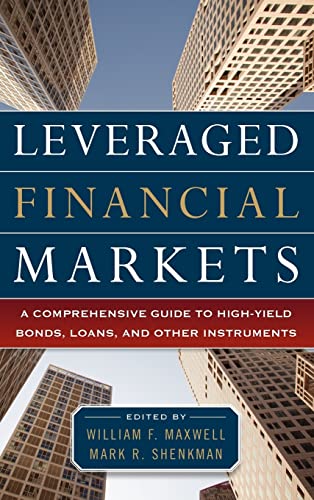
Leveraged Financial Markets: A Comprehensive Guide to Loans, Bonds, and Other High-Yield Instruments: A Comprehensive Guide to High-Yield Bonds, ... Instruments (McGraw-Hill Financial Education) - Hardcover
Inhaltsangabe
Public companies acquire most of their outside capital from debt fi nancing and, more specifi cally, leveraged finance--an asset class that falls somewhere between traditional fixed income and stocks. While this type of debt fi nancing carries significant risk to both investors and companies, the potential returns make leveraged finance a cornerstone of the modern financial markets. Leveraged Financial Markets is a gathering of the most astute and informed minds in the business. The powerhouse editorial team of William F. Maxwell and Mark R. Shenkman have handselected contributions from the top practitioners and thinkers working in leveraged finance today. The result is an authoritative guidebook that provides you with what you need to navigate the highyield market in the integrated global economy. Packed with a wealth of analytical models illustrating the realities of distress probabilities and losses in default, Leveraged Financial Markets gives you all the insight and strategies you need to: Use the Sharpe ratio to measure the return versus risk for high-yield debt Develop and oversee a portfolio of high-yield bonds Value individual high-yield issuances It also updates you on changes in the high-yield bond market and features in-depth coverage of numerous debt vehicles leveraged in the market today, including collateralized debt obligations (CDOs), credit derivative swaps (CDSs), collateralized loan obligations (CLOs), and leveraged loans. Leveraged Financial Markets is your blueprint to becoming a virtuoso of this resilient and popular asset class.
Die Inhaltsangabe kann sich auf eine andere Ausgabe dieses Titels beziehen.
Über die Autorin bzw. den Autor
McGraw-Hill authors represent the leading experts in their fields and are dedicated to improving the lives, careers, and interests of readers worldwide
Auszug. © Genehmigter Nachdruck. Alle Rechte vorbehalten.
LEVERAGED FINANCIAL MARKETS
A COMPREHENSIVE GUIDE TO HIGH-YIELD BONDS, LOANS, AND OTHER INSTRUMENTS
By WILLIAM F. MAXWELL, MARK R. SHENKMANThe McGraw-Hill Companies, Inc.
Copyright © 2010 The McGraw-Hill Companies, Inc.
All rights reserved.
ISBN: 978-0-07-174668-7All rights reserved.
Contents
| Chapter 1: An Overview of Leveraged Finance William F. Maxwell | |
| Chapter 2: The Components of the Leveraged Finance Market William F. Maxwell | |
| Chapter 3: Understanding the Role of Credit Rating Agencies William F. Maxwell, and Philip Delbridge | |
| Chapter 4: Leveraged Loans as an Asset Class Daniel Toscano | |
| Chapter 5: Collateralized Loan Obligations Frederic R. Bernhard, CFA, John E. Kim, and Jonathan A. Savas | |
| Chapter 6: Differences between CLOs and Structured Finance CDOs Jonathan Blau | |
| Chapter 7: Credit Analysis and Analyzing a High-Yield Issuance Amy Levine, CFA, and Nicholas Sarchese, CFA | |
| Chapter 8: Bond Indentures and Bond Characteristics William J. Whelan, III | |
| Chapter 9: Credit Models for Assessing Firm Risk William F. Maxwell, and Philip Delbridge | |
| Chapter 10: Performance of Credit Metrics William F. Maxwell, and Philip Delbridge | |
| Chapter 11: Principles of Managing High-Yield Assets Mark R. Shenkman | |
| Chapter 12: The Pitfalls of Managing High-Yield Assets Mark R. Shenkman | |
| Chapter 13: Performance Analysis Frederic R. Bernhard, CFA | |
| Chapter 14: Trading in the High-Yield Market Neil Yaris, and Jason Hodes | |
| Chapter 15: CDS: A Primer on Single Name Instruments and Strategies Sivan Mahadevan | |
| Chapter 16: Leveraged Loan CDSs Vishwanath Tirupattu and Sivan Mahadevan | |
| Chapter 17: Debtor-in-Possession Financing William F. Maxwell, and Philip Delbridge | |
| Chapter 18: Distressed Investing David J. Breazzano | |
| Glossary of Key Terms | |
| Notes | |
| Bibliography | |
| Index |
Excerpt
CHAPTER 1
AN OVERVIEW OF LEVERAGED FINANCE
William F. Maxwell
Rauscher Chair in Financial Investments, Cox School of Business at SMU
Broadly defined, leveraged finance deals with the riskiest forms of debtfinancing. These encompass original issue debt from investment-bank-issued debt,high-yield bonds, or bank-issued debt (leveraged loans), and debt that hasfallen from investment grade to high-yield status ("fallen angels"). Creditdefault swaps also play an important role in these markets because they arederivative contracts deriving their value from the risk of default on specificfirm debt or aggregate default risk. As such, they provide an alternativemechanism for investors to take short or long positions on the underlyingassets.
The modern high-yield bond market began in the early to mid-1980s when DrexelBurnham started issuing bonds, which were rated high yield at issuance. Beforethis time, high-yield bonds consisted of "fallen angels." Since the mid-1980s,the high-yield market has gone through significant changes and upheavals, andthe market has evolved from being solely based on high-yield bonds to being abroader and more diverse market. Leveraged loans (the equivalent of high-yieldbonds issued by banks) and credit default swaps (default-triggered derivativeinstruments) became prevalent in the market in the middle to late 1990s.
The leveraged finance market has always been a volatile market, with the marketexperiencing significant boom and bust periods. It is not surprising then thatthe leveraged finance market as well as all aspects of the financial marketexperienced dramatic upheaval during 2008. In 2008, the high-yield bond,leveraged loan, and credit default swap (CDS) indexes were down by 27%, 29%, and13%, respectively. However, the high-yield bond and leveraged loan marketsrecovered with historically high returns of 50% in 2009. In addition, 2009 was arecord year for high-yield bond issuance, but it also evolved back closer to itsroots with the virtual disappearance of leveraged loans. Even after thefinancial market meltdown in 2008, it is clear that leveraged finance remainsone of the cornerstones of financial markets.
Leveraged finance is a large and significant component of the fixed-incomemarket. It has grown dramatically since its inception, and there were $864billion and $1.64 trillion in high-yield bonds and leveraged loans outstandingin 2007. In total this represents 8% of all fixed-income assets (see Figure1.1).
Debt is the primary source of external capital for public companies. Within thebroader category of debt financing, leveraged finance is the predominant source(Table 1.1 provides issuance volume by security class). It is clear thatleveraged finance (high-yield and leveraged loans) is the primary source ofcapital. However, there is significant variation in the proportion of newfinancing associated with leveraged finance over time. During down economicperiods, access to these markets is limited. This is apparent as issuance volumein the leveraged finance market can drop significantly in down periods.
What also is apparent from Tables 1.1 and 1.2 is that there hasbeen dramatic growth in the use of leveraged loans. (Some of the leveraged loansissuance volume can be misleading because it includes "revolvers." These are acommitment by the banks to issue short-term debt, less than a year to maturity,but rarely do firms fully draw on these "revolvers.") The growth of leveragedloans is the result of the introduction of the institutional leveraged loanmarket, loans that are syndicated to nonbank institutions. Until the late 1990s,leveraged loans were issued by banks with the loans typically being syndicatedto other banks. In the late 1990s, loan documentation was standardized, whichpermitted the development of a secondary market in bank loans. This wasnecessary before nonbank institutional investors would purchase the securitiesin either the primary or the secondary market. In addition, the late 1990s andearly 2000s led to an increased demand for securitized products. Given thematched payout structures and variable rates of leveraged loans and securitizedproducts, there was a strong demand for leveraged loans, which were thenpackaged into collateralized loan obligations (CLOs). With these developments,the leveraged loan market exploded (see Tables 1.1 and 1.2).
The sizes of the leveraged loan and high-yield bond market were roughlyequivalent in 2004 (Table 1.2). But by 2007, the leveraged loan marketwas 2.5 times larger than the high-yield market in terms of new issuance.However, the financial meltdown in 2008 brought about a fundamental shift backto the issuance of high-yield bonds away from leveraged loans for corporations.While new issuance volume dropped dramatically for both high-yield bonds andleveraged loans in 2008, this shift was more pronounced in the leveraged loanmarkets as bank capital was seriously constrained. This trend continued into2009 as the high-yield bond market experienced a historical peak of new issuancevolume while the leveraged loan market was next to nonexistent.
The Increasing Use of High-Yield Debt as a Financing...
„Über diesen Titel“ kann sich auf eine andere Ausgabe dieses Titels beziehen.
Suchergebnisse für Leveraged Financial Markets: A Comprehensive Guide...

Beispielbild für diese ISBN
Leveraged Financial Markets: A Comprehensive Guide to Loans, Bonds, and Other High-Yield Instruments
Verlag:
McGraw-Hill Education - Europe, 2010
ISBN 10: 0071746684
ISBN 13: 9780071746687
Gebraucht
Hardcover
Anbieter: World of Books (was SecondSale), Montgomery, IL, USA
Verkäuferbewertung 5 von 5 Sternen

Hardback. Zustand: Good. A guidebook that provides you with what you need to navigate the highyield market in the integrated global economy. It gives you the insight and strategies you need to: use the Sharpe ratio to measure the return versus risk for high-yield debt; develop and oversee a portfolio of high-yield bonds; and, value individual high-yield issuances. Bestandsnummer des Verkäufers 00109802958
Gebraucht kaufen
EUR 41,29
Versand gratis
Versand innerhalb von USA
Versand innerhalb von USA
Anzahl: 2 verfügbar
Beispielbild für diese ISBN
Leveraged Financial Markets: A Comprehensive Guide to Loans, Bonds, and Other High-Yield Instruments (McGraw-Hill Financial Education Series)
Anbieter: HPB-Red, Dallas, TX, USA
Verkäuferbewertung 5 von 5 Sternen
Hardcover. Zustand: Good. Connecting readers with great books since 1972! Used textbooks may not include companion materials such as access codes, etc. May have some wear or writing/highlighting. We ship orders daily and Customer Service is our top priority! Bestandsnummer des Verkäufers S_473750411
Gebraucht kaufen
EUR 41,30
EUR 3,33 Versand
Versand innerhalb von USA
Versand innerhalb von USA
Anzahl: 1 verfügbar
Beispielbild für diese ISBN
Leveraged Financial Markets: A Comprehensive Guide to Loans, Bonds, and Other High-Yield Instruments (McGraw-Hill Financial Education Series)
Verlag:
McGraw Hill, 2010
ISBN 10: 0071746684
ISBN 13: 9780071746687
Gebraucht
Hardcover
Erstausgabe
Signiert
Anbieter: BookScene, Hull, MA, USA
Verkäuferbewertung 5 von 5 Sternen
Hardcover. Zustand: Very Fine. Zustand des Schutzumschlags: Very Fine. First Edition. 1st Printing. Hardcover. Book Condition: Very Fine. Jacket Condition: Very Fine. McGraw Hill, 2010. Signed by Author Shenkman on free page with Presentation notation, with date. First Edition. 1st Printing. 416 pages. Nice Firm Clean copy ! Size: 8vo 7.75 - 9.75'' tall. Signed Business::Investing 0432. Bestandsnummer des Verkäufers 137131
Gebraucht kaufen
EUR 65,91
EUR 4,88 Versand
Versand innerhalb von USA
Versand innerhalb von USA
Anzahl: 1 verfügbar
Foto des Verkäufers
Leveraged Financial Markets : A Comprehensive Guide to High-Yield Bonds, Loans, and Other Instruments
Anbieter: GreatBookPrices, Columbia, MD, USA
Verkäuferbewertung 5 von 5 Sternen
Zustand: New. Bestandsnummer des Verkäufers 9819700-n
Neu kaufen
EUR 105,15
EUR 2,35 Versand
Versand innerhalb von USA
Versand innerhalb von USA
Anzahl: 2 verfügbar
Foto des Verkäufers
Leveraged Financial Markets: A Comprehensive Guide to Loans, Bonds, and Other High-Yield Instruments (Hardcover)
Verlag:
McGraw-Hill Education - Europe, 2010
ISBN 10: 0071746684
ISBN 13: 9780071746687
Neu
Hardcover
Anbieter: Grand Eagle Retail, Bensenville, IL, USA
Verkäuferbewertung 5 von 5 Sternen
Hardcover. Zustand: new. Hardcover. Public companies acquire most of their outside capital from debt fi nancing and, more specifi cally, leveraged finance--an asset class that falls somewhere between traditional fixed income and stocks. While this type ofdebt fi nancing carries significant risk to both investorsand companies, the potential returns make leveraged finance a cornerstone of the modern financial markets.Leveraged Financial Markets is a gathering of the most astute and informed minds in the business.The powerhouse editorial team of William F. Maxwell and Mark R. Shenkman have handselected contributions from the top practitioners and thinkers working in leveraged finance today.The result is an authoritative guidebook that providesyou with what you need to navigate the highyield market in the integrated global economy. Packed with a wealth of analytical models illustrating the realities of distress probabilities and losses in default, Leveraged Financial Markets gives you all the insight and strategies you need to:Use the Sharpe ratio to measure the return versus risk for high-yield debtDevelop and oversee a portfolio of high-yield bondsValue individual high-yield issuancesIt also updates you on changes in the high-yield bond market and features in-depth coverage of numerous debt vehicles leveraged in the market today, including collateralized debt obligations (CDOs), credit derivative swaps (CDSs), collateralized loan obligations (CLOs), andleveraged loans.Leveraged Financial Markets is your blueprint tobecoming a virtuoso of this resilient and popular asset class. A guidebook that provides you with what you need to navigate the highyield market in the integrated global economy. It gives you the insight and strategies you need to: use the Sharpe ratio to measure the return versus risk for high-yield debt; develop and oversee a portfolio of high-yield bonds; and, value individual high-yield issuances. This item is printed on demand. Shipping may be from multiple locations in the US or from the UK, depending on stock availability. Bestandsnummer des Verkäufers 9780071746687
Foto des Verkäufers
Leveraged Financial Markets : A Comprehensive Guide to High-Yield Bonds, Loans, and Other Instruments
Anbieter: GreatBookPrices, Columbia, MD, USA
Verkäuferbewertung 5 von 5 Sternen
Zustand: As New. Unread book in perfect condition. Bestandsnummer des Verkäufers 9819700
Gebraucht kaufen
EUR 108,57
EUR 2,35 Versand
Versand innerhalb von USA
Versand innerhalb von USA
Anzahl: 2 verfügbar
Beispielbild für diese ISBN
Leveraged Financial Markets: A Comprehensive Guide to Loans, Bonds, and Other High-Yield Instruments (McGraw-Hill Financial Education Series)
Anbieter: California Books, Miami, FL, USA
Verkäuferbewertung 5 von 5 Sternen
Zustand: New. Bestandsnummer des Verkäufers I-9780071746687
Neu kaufen
EUR 115,34
Versand gratis
Versand innerhalb von USA
Versand innerhalb von USA
Anzahl: Mehr als 20 verfügbar
Beispielbild für diese ISBN
Leveraged Financial Markets: A Comprehensive Guide to Loans, Bonds, and Other High-Yield Instruments: A Comprehensive Guide to High-Yield Bonds, . (McGraw-Hill Financial Education Series)
Anbieter: WorldofBooks, Goring-By-Sea, WS, Vereinigtes Königreich
Verkäuferbewertung 5 von 5 Sternen
Hardback. Zustand: Very Good. The book has been read, but is in excellent condition. Pages are intact and not marred by notes or highlighting. The spine remains undamaged. Bestandsnummer des Verkäufers GOR007720238
Gebraucht kaufen
EUR 116,21
EUR 6,59 Versand
Versand von Vereinigtes Königreich nach USA
Versand von Vereinigtes Königreich nach USA
Anzahl: 1 verfügbar
Foto des Verkäufers
Leveraged Financial Markets : A Comprehensive Guide to High-Yield Bonds, Loans, and Other Instruments
Anbieter: GreatBookPricesUK, Woodford Green, Vereinigtes Königreich
Verkäuferbewertung 5 von 5 Sternen
Zustand: As New. Unread book in perfect condition. Bestandsnummer des Verkäufers 9819700
Gebraucht kaufen
EUR 116,35
EUR 17,65 Versand
Versand von Vereinigtes Königreich nach USA
Versand von Vereinigtes Königreich nach USA
Anzahl: 2 verfügbar
Foto des Verkäufers
Leveraged Financial Markets : A Comprehensive Guide to High-Yield Bonds, Loans, and Other Instruments
Anbieter: GreatBookPricesUK, Woodford Green, Vereinigtes Königreich
Verkäuferbewertung 5 von 5 Sternen
Zustand: New. Bestandsnummer des Verkäufers 9819700-n
Neu kaufen
EUR 127,23
EUR 17,65 Versand
Versand von Vereinigtes Königreich nach USA
Versand von Vereinigtes Königreich nach USA
Anzahl: 2 verfügbar