
Verwandte Artikel zu Pitch Anything: An Innovative Method for Presenting,...
Pitch Anything: An Innovative Method for Presenting, Persuading, and Winning the Deal (Scienze) - Hardcover
Buch 34 von 36: BUSINESS SKILLS AND DEVELOPMENT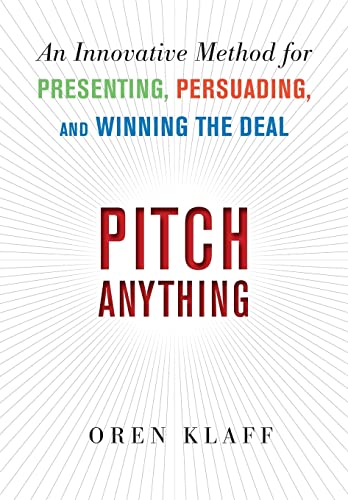
Inhaltsangabe
Gold Medal Winner--Tops Sales World's Best Sales and Marketing Book "Fast, fun and immensely practical." -JOE SULLIVAN, Founder, Flextronics "Move over Neil Strauss and game theory. Pitch Anything reveals the next big thing in social dynamics: game for business." -JOSH WHITFORD, Founder, Echelon Media "What do supermodels and venture capitalists have in common?They hear hundreds of pitches a year. Pitch Anything makes sure you get the nod (or wink) you deserve." -RALPH CRAM, Investor "Pitch Anything offers a new method that will differentiate you from the rest of the pack." -JASON JONES, Senior Vice President, Jones Lang LaSalle "If you want to pitch a product, raise money, or close a deal, read Pitch Anything and put its principles to work." -STEVEN WALDMAN, Principal and Founder, Spectrum Capital "Pitch Anything opened my eyes to what I had been missing in my presentations and business interactions." -LOUIE UCCIFERRI, President, Regent Capital Group "I use Oren's unique strategies to sell deals, raise money, and handle tough situations." -TAYLOR GARRETT, Vice President, White Cap "A counter-intuitive method that works." -JAY GOYAL, CEO, SumOpti About the Book: When it comes to delivering a pitch, Oren Klaff has unparalleled credentials. Over the past 13 years, he has used his one-of-a- kind method to raise more than $400 million-and now, for the fi rst time, he describes his formula to help you deliver a winning pitch in any business situation. Whether you're selling ideas to investors, pitching a client for new business, or even negotiating for a higher salary, Pitch Anything will transform the way you position your ideas. According to Klaff, creating and presenting a great pitch isn't an art-it's a simple science. Applying the latest findings in the field of neuroeconomics, while sharing eye-opening stories of his method in action, Klaff describes how the brain makes decisions and responds to pitches. With this information, you'll remain in complete control of every stage of the pitch process. Pitch Anything introduces the exclusive STRONG method of pitching, which can be put to use immediately: Setting the Frame Telling the Story Revealing the Intrigue Offering the Prize Nailing the Hookpoint Getting a Decision One truly great pitch can improve your career, make you a lot of money-and even change your life. Success is dependent on the method you use, not how hard you try. "Better method, more money," Klaff says. "Much better method, much more money." Klaff is the best in the business because his method is much better than anyone else's. And now it's yours. Apply the tactics and strategies outlined inPitch Anything to engage and persuade your audience-and you'll have more funding and support than you ever thought possible.
Die Inhaltsangabe kann sich auf eine andere Ausgabe dieses Titels beziehen.
Über die Autorin bzw. den Autor
Oren Klaff is Director of Capital Markets for the investment bank Intersection Capital, where he raises tens of millions of dollars from investors and institutions. Intersection Capital has grown to $250 million of assets under management by usi
Von der hinteren Coverseite
When it comes to delivering a pitch, Oren Klaff has unparalleled credentials. Over the past 13 years, he has used his one-of-a- kind method to raise more than $400 million-and now, for the fi rst time, he describes his formula to help you deliver a winning pitch in any business situation.
Whether you're selling ideas to investors, pitching a client for new business, or even negotiating for a higher salary, Pitch Anything will transform the way you position your ideas.
According to Klaff, creating and presenting a great pitch isn't an art-it's a simple science. Applying the latest findings in the field of neuroeconomics, while sharing eye-opening stories of his method in action, Klaff describes how the brain makes decisions and responds to pitches. With this information, you'll remain in complete control of every stage of the pitch process.
Aus dem Klappentext
When it comes to delivering a pitch, Oren Klaff has unparalleled credentials. Over the past 13 years, he has used his one-of-a- kind method to raise more than $400 million-and now, for the fi rst time, he describes his formula to help you deliver a winning pitch in any business situation.
Whether you're selling ideas to investors, pitching a client for new business, or even negotiating for a higher salary, Pitch Anything will transform the way you position your ideas.
According to Klaff, creating and presenting a great pitch isn't an art-it's a simple science. Applying the latest findings in the field of neuroeconomics, while sharing eye-opening stories of his method in action, Klaff describes how the brain makes decisions and responds to pitches. With this information, you'll remain in complete control of every stage of the pitch process.
Auszug. © Genehmigter Nachdruck. Alle Rechte vorbehalten.
PITCH ANYTHING
An Innovative Method for PRESENTING, PERSUADING, AND WINNING THE DEALBy OREN KLAFFMcGraw-Hill
Copyright © 2011 Oren KlaffAll right reserved.
ISBN: 978-0-07-175285-5
Contents
Chapter One
The MethodHere's the "big idea" in 76 words: There is a fundamental disconnect between the way we pitch anything and the way it is received by our audience. As a result, at the crucial moment, when it is most important to be convincing, nine out of ten times we are not. Our most important messages have a surprisingly low chance of getting through.
You need to understand why this disconnect occurs in order to overcome it, succeed, and profit. This book tells you how.
I Am Not a Natural
I pitch deals for a living. My job is to raise capital for businesses looking to expand rapidly or go public. I am good at it. When companies need money, I get it for them. I have raised millions for deals involving Marriott, Hershey's, Citigroup, and many other household names—and I continue to do so at a rate of about $2 million per week. From the outside, the reasons for my success seem simple: I offer wealthy investors profitable deals that involve Wall Street banks. But others do that, too. Yet I raise a lot more money than they do. They compete in the same market. Do the same types of deals. Pitch the same kinds of facts and figures. But the numbers show I am consistently one of the best. The difference isn't luck. It is not a special gift. And I have no background in sales. What I do have is a good method.
As it turns out, pitching is one of those business skills that depends heavily on the method you use and not how hard you try. Better method, more money. Much better method, much more money. It's no different for you. The better you are at advocating your position, the more successful you will be. Maybe you want to sell an idea to investors, convince a client to choose you over the other guy, or even explain to your boss why you should be paid more. I can help you get better at it using the five methods in this book.
Pitching a Master of the Universe
Over the years, I've pitched to—and closed deals with—some of the iconic businesspeople of our time, including founding members of Yahoo!, Google, and Qualcomm. But the story of what I can offer you cannot really be told without my explaining the day I went to pitch one of the guys Tom Wolfe would describe as a "master of the universe."
"Jonathan" (never Johnny or even John) is an investment banker who controls vast sums of capital. He gets between 600 and 800 pitches a year; that's three to four every business day. He often makes multimillion-dollar investment decisions based on no more information than a few e-mails on his BlackBerry.
As a dealmaker, this guy—and I have absolutely no intention of giving you his name; he sues everyone and anyone at a moment's notice—is the real deal.
There are three things you must know about Jonathan. First, he's a math phenom who can calculate yield curves in his head. He doesn't need spreadsheets. He can instantly analyze what you are pitching him. Second, he's seen more than 10,000 deals and can detect any kind of flaw or BS no matter how well hidden. Third, he's tough talking and, at the same time, witty and charismatic. The upshot: When he's pitching you, his chances are good. When you're pitching him, yours aren't. Yet, if you want to be taken seriously in venture capital, you need to have done a deal with this guy. And so, some years ago, when I was working to raise money for a software company, I arranged to pitch Jonathan and his investment team. Given their reputation, I knew if I got them on board, it would be a lot easier to raise money from other investors who were still undecided. They'd say, "Hey, if Jonathan signed off on this, then I'm in too." But Jonathan knew the power of his endorsement—and he wasn't going to give me an easy win.
As my pitch got underway, he made things difficult. Maybe it was for sport. Maybe he was having a bad day. But it was clear he wanted to take—and keep—control of the whole presentation. I didn't realize this at the start, however, so, I began, as I always do, by framing (frames create context and relevance; as we will see, the person who owns the frame owns the conversation). I explained exactly what I would—and would not—be talking about, and Jonathan immediately started giving me a type of resistance called deframing, which is exactly like it sounds.
For example, when I said, "We expect revenues to be $10 million next year," he cut me off and changed the frame with, "Who cares about your made-up revenue projections. Tell me what your expenses are going to be."
A minute later, I was explaining, "Our secret sauce is such-and-such advanced technology."
And he said, "No, that's not a secret sauce. That's just ketchup."
I knew not to react to these comments. I pressed on.
"We have a Fortune 50 company as our largest customer."
He interrupted with, "Look, I'm done here in nine minutes, so can you get to the point?"
He was really making it difficult. You can imagine how hard it was to use all the right techniques: setting the frame, telling the story, revealing the intrigue, offering the prize, nailing the hookpoint, and getting the decision.
Collectively, I call these the STRONG method (you will learn about these soon).
Some 12 minutes after I began, what I had hoped was going to be my best pitch ever instead showed all the signs of being my one of my worst.
Put yourself in my situation. After just 12 minutes of your presentation, you've been told that your secret sauce is ketchup. Told that your projections are made-up numbers. And that you have nine minutes left to actually make a point.
I was faced with the presenter's problem: You can have incredible knowledge about your subject. You can make your most important points clearly, even with passion, and you can be very well organized. You can do all those things as well as they can be done—and still not be convincing. That's because a great pitch is not about procedure. It's about getting and keeping attention. And that means you have to own the room with frame control, drive emotions with intrigue pings, and get to a hookpoint fairly quickly. (Details on those last two in a second.)
I reminded myself of these steps in the face of Jonathan's interruptions. Then I swallowed hard and hoped my nervousness wasn't showing. I went back to my pitch, concentrating on my three objectives. I was determined. When he deframed, I reframed. When he looked disinterested, I delivered an intrigue ping (this is a short but provocative piece of information that arouses curiosity): "By the way, an NFL quarterback is also an investor." And finally, I got him to the hookpoint, the place in the presentation where your listeners become emotionally engaged. Instead of you giving them information, they are asking you for more on their own. At the hookpoint, they go beyond interested to being involved and then committed.
At the end of the 21 minutes, my pitch was complete. I knew Jonathan was in. He leaned forward and whispered, "Forget the deal for a moment. What in the hell was that? Nobody pitches like that but me."
I tried to show no emotion as I told him, "That, in general terms, is called...
„Über diesen Titel“ kann sich auf eine andere Ausgabe dieses Titels beziehen.
Suchergebnisse für Pitch Anything: An Innovative Method for Presenting,...

Foto des Verkäufers
Pitch Anything: An Innovative Method for Presenting, Persuading, and Winning the Deal
Anbieter: Zoom Books East, Glendale Heights, IL, USA
Verkäuferbewertung 5 von 5 Sternen

Zustand: good. Book is in good condition and may include underlining highlighting and minimal wear. The book can also include "From the library of" labels. May not contain miscellaneous items toys, dvds, etc. . We offer 100% money back guarantee and 24 7 customer service. Bestandsnummer des Verkäufers ZEV.0071752854.G
Gebraucht kaufen
EUR 4,29
Versand gratis
Versand innerhalb von USA
Versand innerhalb von USA
Anzahl: 1 verfügbar
Foto des Verkäufers
Pitch Anything: An Innovative Method for Presenting, Persuading, and Winning the Deal
Anbieter: Zoom Books East, Glendale Heights, IL, USA
Verkäuferbewertung 5 von 5 Sternen
Zustand: very_good. Book is in very good condition and may include minimal underlining highlighting. The book can also include "From the library of" labels. May not contain miscellaneous items toys, dvds, etc. . We offer 100% money back guarantee and 24 7 customer service. Bestandsnummer des Verkäufers ZEV.0071752854.VG
Gebraucht kaufen
EUR 4,62
Versand gratis
Versand innerhalb von USA
Versand innerhalb von USA
Anzahl: 2 verfügbar
Beispielbild für diese ISBN
Pitch Anything: An Innovative Method for Presenting, Persuading, and Winning the Deal
Anbieter: More Than Words, Waltham, MA, USA
Verkäuferbewertung 5 von 5 Sternen
Zustand: Good. A sound copy with only light wear. Overall a solid copy at a great price! Bestandsnummer des Verkäufers BOS-S-12b-01535
Gebraucht kaufen
EUR 2,08
EUR 3,55 Versand
Versand innerhalb von USA
Versand innerhalb von USA
Anzahl: 1 verfügbar
Foto des Verkäufers
Pitch Anything: An Innovative Method for Presenting, Persuading, and Winning the Deal
Anbieter: Dream Books Co., Denver, CO, USA
Verkäuferbewertung 5 von 5 Sternen
Zustand: good. Gently used with minimal wear on the corners and cover. A few pages may contain light highlighting or writing, but the text remains fully legible. Dust jacket may be missing, and supplemental materials like CDs or codes may not be included. May be ex-library with library markings. Ships promptly! Bestandsnummer des Verkäufers DBV.0071752854.G
Gebraucht kaufen
EUR 6,26
Versand gratis
Versand innerhalb von USA
Versand innerhalb von USA
Anzahl: 1 verfügbar
Beispielbild für diese ISBN
Pitch Anything: An Innovative Method for Presenting, Persuading, and Winning the Deal
Anbieter: ThriftBooks-Reno, Reno, NV, USA
Verkäuferbewertung 5 von 5 Sternen
Hardcover. Zustand: Good. No Jacket. Pages can have notes/highlighting. Spine may show signs of wear. ~ ThriftBooks: Read More, Spend Less. Bestandsnummer des Verkäufers G0071752854I3N00
Gebraucht kaufen
EUR 6,43
Versand gratis
Versand innerhalb von USA
Versand innerhalb von USA
Anzahl: 1 verfügbar
Beispielbild für diese ISBN
Pitch Anything: An Innovative Method for Presenting, Persuading, and Winning the Deal
Anbieter: ThriftBooks-Atlanta, AUSTELL, GA, USA
Verkäuferbewertung 5 von 5 Sternen
Hardcover. Zustand: Good. No Jacket. Missing dust jacket; Pages can have notes/highlighting. Spine may show signs of wear. ~ ThriftBooks: Read More, Spend Less. Bestandsnummer des Verkäufers G0071752854I3N01
Gebraucht kaufen
EUR 6,43
Versand gratis
Versand innerhalb von USA
Versand innerhalb von USA
Anzahl: 3 verfügbar
Beispielbild für diese ISBN
Pitch Anything: An Innovative Method for Presenting, Persuading, and Winning the Deal
Anbieter: ThriftBooks-Atlanta, AUSTELL, GA, USA
Verkäuferbewertung 5 von 5 Sternen
Hardcover. Zustand: Very Good. No Jacket. May have limited writing in cover pages. Pages are unmarked. ~ ThriftBooks: Read More, Spend Less. Bestandsnummer des Verkäufers G0071752854I4N00
Gebraucht kaufen
EUR 6,43
Versand gratis
Versand innerhalb von USA
Versand innerhalb von USA
Anzahl: 2 verfügbar
Beispielbild für diese ISBN
Pitch Anything: An Innovative Method for Presenting, Persuading, and Winning the Deal
Anbieter: ThriftBooks-Phoenix, Phoenix, AZ, USA
Verkäuferbewertung 5 von 5 Sternen
Hardcover. Zustand: Very Good. No Jacket. May have limited writing in cover pages. Pages are unmarked. ~ ThriftBooks: Read More, Spend Less. Bestandsnummer des Verkäufers G0071752854I4N00
Gebraucht kaufen
EUR 6,43
Versand gratis
Versand innerhalb von USA
Versand innerhalb von USA
Anzahl: 2 verfügbar
Beispielbild für diese ISBN
Pitch Anything: An Innovative Method for Presenting, Persuading, and Winning the Deal
Anbieter: ThriftBooks-Reno, Reno, NV, USA
Verkäuferbewertung 5 von 5 Sternen
Hardcover. Zustand: Fair. No Jacket. Missing dust jacket; Readable copy. Pages may have considerable notes/highlighting. ~ ThriftBooks: Read More, Spend Less. Bestandsnummer des Verkäufers G0071752854I5N01
Gebraucht kaufen
EUR 6,43
Versand gratis
Versand innerhalb von USA
Versand innerhalb von USA
Anzahl: 1 verfügbar
Beispielbild für diese ISBN
Pitch Anything: An Innovative Method for Presenting, Persuading, and Winning the Deal
Anbieter: ThriftBooks-Phoenix, Phoenix, AZ, USA
Verkäuferbewertung 5 von 5 Sternen
Hardcover. Zustand: Good. No Jacket. Pages can have notes/highlighting. Spine may show signs of wear. ~ ThriftBooks: Read More, Spend Less. Bestandsnummer des Verkäufers G0071752854I3N00
Gebraucht kaufen
EUR 6,43
Versand gratis
Versand innerhalb von USA
Versand innerhalb von USA
Anzahl: 1 verfügbar