
Verwandte Artikel zu The Essentials of Financial Analysis
Inhaltsangabe
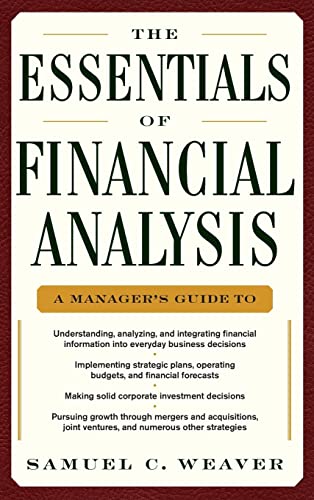
It's easier than you think to understand the financial reports you face every day . . . If your job focus is on managing employees and overseeing corporate affairs, financial analysis may sound like a foreign language to you. But, in today's competitive business environment, it is crucial that managers and business executives have a firm grasp of financial analysis. The Essentials of Financial Analysis simplifies an often difficult-to-understand topic so stakeholders ranging from employees to executives to investors can understand and discuss an organization's financial workings. The Essentials of Financial Analysis delivers practical, in-depth coverage on the key components of financial reporting, budgeting, and analysis to help you better relate to the numbers behind the business issues you face every day. By the time you turn the final page of this book, you will be able to command confident discussions on performance, investment, and other financial situations with members of your finance team and senior management. This hands-on book helps you make better business decisions by showing you how to structure financial analysis, as well as: Contribute to an organization's success and guide others companywide to make better financial decisions Reduce cost of capital and hurdle rates by selecting the financial markets, intermediaries, and instruments that work best for your company's financing needs Increase shareholder value by pursuing growth through capital investment, new products, mergers and acquisitions, joint ventures, and other strategies Your career success and the prosperity of your company depends on your ability to understand and act upon basic financial principles. With The Essentials of Financial Analysis, you can go inside the numbers and get a clear picture of where your company has been, where it is going, and how you can help it get there.
Die Inhaltsangabe kann sich auf eine andere Ausgabe dieses Titels beziehen.
Über die Autorin bzw. den Autor
McGraw-Hill authors represent the leading experts in their fields and are dedicated to improving the lives, careers, and interests of readers worldwide
Von der hinteren Coverseite
The Essentials of Financial Analysis is a practical, in-depth survey of the key elements of financial reporting, budgeting, and analysis to help business managers with little or no background in finance relate to the numbers they deal with every day, boost their performance, and better lead their staff. The Essentials of Financial Analysis explains how to:
- Use a balance sheet, income statement, and cash flow statement to spotlight a company’s weaker areas and improve its financial efficiencies
- Implement strategic plans, operational budgets, and financial forecasts as competitive tools for direction setting, communication, and compensation
- Make capital-investment decisions that contribute to a company’s success
The Essentials of Financial Analysis has all the critical information you need to ensure your decisions are grounded in sound financial judgment. Whether you’re presenting financial results, executing performance comparisons, allocating resources, or budgeting expenses, it helps you transform your know-how into real results.
Auszug. © Genehmigter Nachdruck. Alle Rechte vorbehalten.
THE ESSENTIALS OF FINANCIAL ANALYSIS
By SAMUEL C. WEAVERThe McGraw-Hill Companies, Inc.
Copyright © 2012 The McGraw-Hill Companies, Inc.
All rights reserved.
ISBN: 978-0-07-176836-8All rights reserved.
Contents
| Preface | |
| PART ONE ACCOUNTING AND FINANCE FUNDAMENTALS | |
| Chapter 1 The Role and Functions of Accounting and Finance | |
| Chapter 2 Understanding Financial Statements | |
| Chapter 3 Financial Performance Metrics | |
| Chapter 4 The Impact of Income Taxes on Financial Analysis | |
| PART TWO FINANCIAL PLANNING AND CONTROL | |
| Chapter 5 Short-Term Financial Management and Supply Chain Finance | |
| Chapter 6 Strategic Financial Planning | |
| PART THREE CAPITAL ANALYSIS AND CORPORATE INVESTMENT DECISIONS | |
| Chapter 7 The Time Value of Money | |
| Chapter 8 Interest Rates and Valuation of Financial Securities | |
| Chapter 9 Capital Investment Decisions | |
| Chapter 10 Determining Cash Flows | |
| PART FOUR LONG-TERM FINANCING STRATEGIES | |
| Chapter 11 Cost of Capital, Hurdle Rates, and Financial Structure | |
| Chapter 12 Long-Term Financing | |
| Chapter 13 Leasing as a Financing and Business Alternative | |
| PART FIVE FINANCE AND CORPORATE STRATEGY | |
| Chapter 14 Strategy and Valuation: Creating Shareholder Value | |
| Chapter 15 Mergers and Acquisitions | |
| Index |
Excerpt
CHAPTER 1
THE ROLE AND FUNCTIONS OF ACCOUNTING AND FINANCE
Corporate finance is a middle ground between economics and accounting. Corporatefinance is based on theoretical economic concepts applied to the "hard" numbersdeveloped by accountants. Finance uses accounting information to analyzeeconomic events. In a phrase, finance is applied economics. While accounting isthe language of business, finance is its literature. Financial analysis providesa systematic approach to making business decisions.
Finance is not an end in and of itself. It is a tool used to monitor, evaluate,and communicate the results of business decisions. Finance is a tool used toassess past events as well as anticipate the consequences of future decisions.It is a tool that is well suited for the board room and the production-shopfloor, the executive suite and the distribution center, and corporate anddivisional staff offices to a distant sales office. Improving financialperformance is the responsibility of every member of the organization, eitherdirectly or indirectly.
FINANCE IS EVERYONE'S JOB
In order to take on a general management role or become the head of a businessunit or functional unit, every manager must have a working knowledge of finance.He or she must be adaptive in improving day-to-day operations and enhancing thevalue of the organization. Managers must know how to make strategic investmentdecisions as well as operational decisions that use the many tools introducedand illustrated in this book.
Large corporations have specific staff to handle financial analysis and to helpmanagers make business decisions. In many organizations, diverse cross-functional project teams are formed to tackle specific assignments. These teamsmay include members from operations such as sales, marketing, production, andlogistics and staff areas such as human resources, engineering, research anddevelopment, and legal. These teams often will include a finance professional tohelp lead and guide the group's efforts toward financially sound decisions. Itis important for each functional area to better understand the role of financeand for finance to understand the role of the other functional areas as well asthe company's business model, its supply chain, and its strategic direction.
In smaller organizations, it is even more important for functional areas tounderstand finance and financial implications because often there is nodedicated financial analysis staff to assume responsibility.
Both the nonfinancial professional and the financial professional must be ableto understand and clearly communicate financial results and objectives. In away, all managers are financial managers because everyone has an impact on thebottom line and affects the value of the organization. Whatever your position,you need to know about the following necessary topics to be a more effectivemember of any business team:
• Reading, understanding, and using financial statements
• Analyzing financial statements to determine the financial health of a companyand its competitors, suppliers, and customers
• Managing the supply chain
• Planning the financial direction in support of the organization's mission,goals, and objectives
• Investing in the business through new products, new facilities, and cost-saving equipment
• Financing business growth through various techniques
• Determining the intrinsic value of the organization and how to enhance thatvalue
• Growing the business via acquisitions
Many members of an organization have bonuses and other compensation tied toachieving certain specific financial goals as well as the organization's commonfinancial objectives. It is important to understand the drivers for attainingthose goals as well as the other areas that are affected.
For example, sales and marketing often share an objective centered on top-line(sales) growth. This objective can be achieved easily with price reductions,advertising, or promotions (such as a buy-one-get-one-free offer) and so on. Ofcourse, all those "solutions" have income and cash-flow effects that may have anegative impact on the financial health of the organization. By extending theobjectives for the sales and marketing group to include sales and incometargets, the situation is partially resolved. However, sales and marketing willquickly learn about extended dating on accounts receivables. That is, instead of30 days for a customer to pay its bills, customers are given 60 or more days topay. While there are only minimal indirect income statement effects (i.e.,additional interest expense or lost interest income), the balance-sheetimplications and additional investment in working capital add pressure tofinancing availability and even may result in less business reinvestment inother areas.
Engineering, production, logistics, and research may want to manufactureproducts using the latest equipment with the fastest capabilities in a worldclass manufacturing facility. However, the financial implications must beunderstood. That is, does this investment provide an adequate rate of return?What are other business ramifications? Financing limitations may be imposed,balance sheets may be weakened, and business risk may increase substantially.Perhaps a less expensive alternative would provide maximum shareholder valuewithout having a discernible impact on the quality of the product. Capitalinvestment analysis determines the value-enhancement attributes of any capitalproject, whereas financial strategic planning anticipates the financial impactand assists in ranking alternative approaches.
Business is a series of managed conflicts. Marketing and sales want to sell aninfinite variety of products, whereas production would like to produce oneproduct. The conflicts can be...
„Über diesen Titel“ kann sich auf eine andere Ausgabe dieses Titels beziehen.
Suchergebnisse für The Essentials of Financial Analysis

Beispielbild für diese ISBN
The Essentials of Financial Analysis
Verlag:
McGraw-Hill Education - Europe, 2012
ISBN 10: 007176836X
ISBN 13: 9780071768368
Gebraucht
Hardcover
Anbieter: World of Books (was SecondSale), Montgomery, IL, USA
Verkäuferbewertung 5 von 5 Sternen

Hardback. Zustand: Good. A practical tutorial that helps business managers with little or no background in finance build their financial analysis skills to improve job performance. Bestandsnummer des Verkäufers 00108792099
Gebraucht kaufen
EUR 8,15
Versand gratis
Versand innerhalb von USA
Versand innerhalb von USA
Anzahl: 2 verfügbar
Beispielbild für diese ISBN
The Essentials of Financial Analysis
Anbieter: HPB-Red, Dallas, TX, USA
Verkäuferbewertung 5 von 5 Sternen
Hardcover. Zustand: Good. Connecting readers with great books since 1972! Used textbooks may not include companion materials such as access codes, etc. May have some wear or writing/highlighting. We ship orders daily and Customer Service is our top priority! Bestandsnummer des Verkäufers S_460526441
Gebraucht kaufen
EUR 4,84
EUR 3,35 Versand
Versand innerhalb von USA
Versand innerhalb von USA
Anzahl: 1 verfügbar
Beispielbild für diese ISBN
The Essentials of Financial Analysis
Verlag:
McGraw-Hill Education - Europe, 2012
ISBN 10: 007176836X
ISBN 13: 9780071768368
Gebraucht
Hardcover
Anbieter: World of Books Inc, Montgomery, IL, USA
Verkäuferbewertung 4 von 5 Sternen

Hardback. Zustand: Good. A practical tutorial that helps business managers with little or no background in finance build their financial analysis skills to improve job performance. Bestandsnummer des Verkäufers CIN007176836XG
Gebraucht kaufen
EUR 9,99
Versand gratis
Versand innerhalb von USA
Versand innerhalb von USA
Anzahl: 2 verfügbar
Foto des Verkäufers
The Essentials of Financial Analysis
Anbieter: 2nd Life Books, Burlington, NJ, USA
Verkäuferbewertung 5 von 5 Sternen
Zustand: acceptable. A readable copy. All pages are intact, and the cover is intact. Dust jacket may be missing. Pages can include considerable highlighting markings writing but cannot obscure the text. May be an Ex-lib. copy and have standard library stamps and or stickers. May NOT include discs, or access code or other supplemental material. We ship Monday-Saturday and respond to inquiries within 24 hours. Bestandsnummer des Verkäufers BXM.8H8V
Gebraucht kaufen
EUR 7,13
EUR 3,57 Versand
Versand innerhalb von USA
Versand innerhalb von USA
Anzahl: 1 verfügbar
Foto des Verkäufers
The Essentials of Financial Analysis
Anbieter: Scissortail, Oklahoma City, OK, USA
Verkäuferbewertung 5 von 5 Sternen
Zustand: good. This is a pre-loved book that shows moderate signs of wear from previous reading. You may notice creases, edge wear, or a cracked spine, but it remains in solid, readable condition. Please note: -May include library or rental stickers, stamps, or markings. -Supplemental materials e.g., CDs, access codes, inserts are not guaranteed. -Box sets may not come with the original outer box. If it does, the box will not be in perfect condition. Your satisfaction is our top priority! If you have any questions or concerns about your order, please don't hesitate to reach out. Thank you for shopping with us and supporting small businessâ"happy reading! Bestandsnummer des Verkäufers STM.JCO
Gebraucht kaufen
EUR 11,83
Versand gratis
Versand innerhalb von USA
Versand innerhalb von USA
Anzahl: 1 verfügbar
Foto des Verkäufers
The Essentials of Financial Analysis
Anbieter: Scissortail, Oklahoma City, OK, USA
Verkäuferbewertung 5 von 5 Sternen
Zustand: good. This is a pre-loved book that shows moderate signs of wear from previous reading. You may notice creases, edge wear, or a cracked spine, but it remains in solid, readable condition. Please note: -May include library or rental stickers, stamps, or markings. -Supplemental materials e.g., CDs, access codes, inserts are not guaranteed. -Box sets may not come with the original outer box. If it does, the box will not be in perfect condition. Your satisfaction is our top priority! If you have any questions or concerns about your order, please don't hesitate to reach out. Thank you for shopping with us and supporting small businessâ"happy reading! Bestandsnummer des Verkäufers STM.JCA
Gebraucht kaufen
EUR 11,83
Versand gratis
Versand innerhalb von USA
Versand innerhalb von USA
Anzahl: 1 verfügbar
Foto des Verkäufers
The Essentials of Financial Analysis
Anbieter: MERS Goodwill, Saint Louis, MO, USA
Verkäuferbewertung 5 von 5 Sternen
Zustand: acceptable. Used - Acceptable: All pages and the cover are intact, but shrink wrap, dust covers, or boxed set case may be missing. Pages may include limited notes, highlighting, or minor water damage but the text is readable. Pages may include limited notes and highlighting, but the text cannot be obscured or unreadable. Any access codes or passwords originally included with the book may be expired, used or no longer valid. Image is stock photo and cover art edition may be different than pictured. Bestandsnummer des Verkäufers MERV.007176836X.A
Gebraucht kaufen
EUR 11,82
EUR 3,57 Versand
Versand innerhalb von USA
Versand innerhalb von USA
Anzahl: 2 verfügbar
Beispielbild für diese ISBN
The Essentials of Financial Analysis
Anbieter: GoldBooks, Denver, CO, USA
Verkäuferbewertung 5 von 5 Sternen
Hardcover. Zustand: new. New Copy. Customer Service Guaranteed. Bestandsnummer des Verkäufers 59Q42_91_007176836X
Neu kaufen
EUR 38,55
EUR 4,91 Versand
Versand innerhalb von USA
Versand innerhalb von USA
Anzahl: 1 verfügbar
Beispielbild für diese ISBN
Essentials of Financial Analysis
Anbieter: GreatBookPrices, Columbia, MD, USA
Verkäuferbewertung 5 von 5 Sternen
Zustand: New. Bestandsnummer des Verkäufers 12843328-n
Neu kaufen
EUR 41,16
EUR 2,36 Versand
Versand innerhalb von USA
Versand innerhalb von USA
Anzahl: 4 verfügbar
Foto des Verkäufers
Essentials of Financial Analysis
Anbieter: GreatBookPrices, Columbia, MD, USA
Verkäuferbewertung 5 von 5 Sternen
Zustand: As New. Unread book in perfect condition. Bestandsnummer des Verkäufers 12843328
Gebraucht kaufen
EUR 49,12
EUR 2,36 Versand
Versand innerhalb von USA
Versand innerhalb von USA
Anzahl: 4 verfügbar