
Verwandte Artikel zu Power Sales Writing: Using Communication to Turn Prospects...
Power Sales Writing: Using Communication to Turn Prospects into Clients - Softcover
Buch 67 von 81: MARKETING/SALES/ADV & PROMO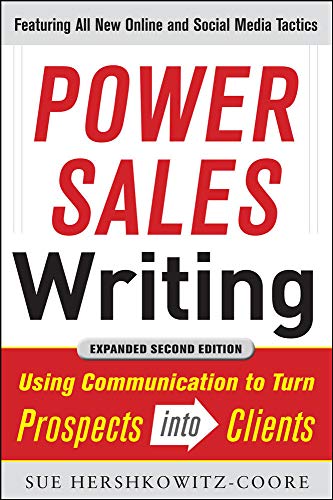
Inhaltsangabe
High-impact language for today's lightning-fast world of sales
Filled with practical writing tips, shortcuts, and examples, Power Sales Writing brings you up to date in a world where e-mail, social media, and smart phones dominate sales communication. If you're not highly skilled with the latest communication platforms, you're missing sales opportunities. Power Sales Writing will get you there in no time!
"Your customers can ignore your correspondence or you can read this book. It's that simple!"
-Larry Winget, television personality and #1 bestselling author of Shut Up, Stop Whining & Get a Life
"If you can't write well, you can't sell. Power Sales Writing shows you how to be crisp, clear, and communicate at the highest levels."
-Tim Sanders, author of Today We Are Rich
"Can't get enough! It's so refreshing to find a resource that offers easy-to-use tools to help our sales teams deliver a compelling and engaging message that sets us apart from our competition."
-Robin Farrell, Director of Corporate Sales Training, North America Operations, Hyatt Hotels and Resorts
Die Inhaltsangabe kann sich auf eine andere Ausgabe dieses Titels beziehen.
Über die Autorin bzw. den Autor
McGraw-Hill authors represent the leading experts in their fields and are dedicated to improving the lives, careers, and interests of readers worldwide
Auszug. © Genehmigter Nachdruck. Alle Rechte vorbehalten.
POWER SALES WRITING
Using Communication to Turn Prospects into Clients
By SUE HERSHKOWITZ-COOREThe McGraw-Hill Companies, Inc.
Copyright © 2012 Sue Hershkowitz-Coore
All rights reserved.
ISBN: 978-0-07-177014-9All rights reserved.
Contents
| Acknowledgments | |
| Introduction | |
| Part One Getting Started | |
| Chapter 1 Getting Started | |
| Chapter 2 Plan It: Save up to 80 Percent of Writing Time | |
| Chapter 3 Do It: Why Being Creative Is Less Important than You Think | |
| Chapter 4 Check It: The Failure-Proof Step | |
| Part Two the Psychology of Persuasive Writing | |
| Chapter 5 Create a Selling Message That Builds Sales | |
| Chapter 6 Connect the Dots to Sell More | |
| Chapter 7 Be Likable to Win the Business | |
| Chapter 8 Use Social Media Trends to Write More Persuasive E-mails | |
| Part Three successful Prospecting with e-mail | |
| Chapter 9 Write "Cold E-mail" Messages That Get Results | |
| Chapter 10 Craft Powerful Subject Lines | |
| Chapter 11 Ask for What You Want—and Get It! | |
| Chapter 12 Build Interest to Sell More Easily | |
| Part Four Brand Yourself as a Professional | |
| Chapter 13 Use the Language of Business to Drive Profits | |
| Chapter 14 How to Not Be Your Own Worst Enemy | |
| Chapter 15 Get Results, Not Ridicule | |
| Chapter 16 E-mail on a Smartphone: Use This, Not That | |
| Part Five Keeping Customers Happy | |
| Chapter 17 Write "Bad News" Messages—and keep Customers Happy | |
| Chapter 18 What to Say when "I'm Sorry" Doesn't Work | |
| Chapter 19 How to Follow Up When You're Ignored—or Worse | |
| Part six Bonus to Use Right Now! | |
| Chapter 20 Writing Awesome Prospecting E-mails | |
| Chapter 21 Writing Amazing Follow-up E-mails | |
| Chapter 22 Enhance Your Worth | |
| Index |
Excerpt
CHAPTER 1
GETTING STARTED
Organizing is what you do before you do something, so that when you do it,it is not all mixed up.
—A.A. MILNE, WINNIE-THE-POOH
I hate busywork. Drying dishes, for instance, is busywork. Why waste time dryingdishes when the air will dry them? I could be accomplishing a million otherthings instead of just standing there, drying.
"Sharing ideas" at a workshop is another example of busywork that drives menuts. When there is one right answer, don't make me waste time guessing whatthat answer is and discussing all the wrong ones. Just tell me the right answerand help me apply it.
Anything that doesn't help me move forward and get the job done, in my opinion,is busywork and should be eliminated. You can imagine my surprise, then, afterdespising being made to "outline" in school (busywork—why can't I justwrite the report?), when I realized that taking the time to organize my thoughtsbefore writing (not to be confused with outlining!) would actuallypropel me forward and help to accomplish the job more quickly.
Here's what I learned: by taking the time to focus on your sales strategy andwrite your goals before you write your e-mail, you save time!"Measure twice, cut once." It applies to e-mail writing too.
By taking the time to think through what you want your e-mail to accomplishbefore you start writing, you can save up to 80 percent of the time you spendwriting.
THE LIFE-CHANGING AND VERY COOL THREE-STEP WRITING PROCESS
The three-step process you're about to read about will change your life.Seriously. Not only will you save time (a CEO I worked with claimed that it hadtaken him as long as "2½ hours to get started" until he learned thisprocess), but the e-mails you write will be more concise, more persuasive, andmore likely to get read. And there's more. You'll save additional time becauseyour prospects will understand your intent and content the first time. They'llhave fewer questions for you, and those outrageously annoying time-sucking back-forth-back-forth e-mails will be eliminated. By knowing what you want to achieveand what matters to your buyer, you'll present yourself as an organized, smartsales professional, and that is, as they say, "priceless."
What are the three steps?
• Plan it.
• Do it.
• Check it.
Planning your sales purpose before you write enables you to focus both on yoursales goal (the outcome you'd like your e-mail to achieve) and the strategy touse to achieve that result. (Contrary to what many professionals think, the goalof an e-mail is rarely to close the business. Most selling messages are writtento excite the buyer and earn the right to advance.) With a plan firmly in place,you write more quickly, more cleverly, and more successfully, and your clarityof purpose makes it much easier for your customer to say yes to you instead ofto your competition.
PLANNING IS THE CATALYST FOR QUICK, CLEAR WRITING
Organizing before you write is the basis for clear, persuasive writing. All ittakes is answering five questions. (With practice, you'll be able to do this injust a few seconds.) The questions act as a guide to help you focus on thespecific outcome you'd like your e-mail to deliver, and the answers provide aclear path to successful writing and profitable selling. This planning, or"prewriting," step changes everything about the way you present your message,engage your buyer, and stand out from the crowd of competitors. Here are thefive planning questions:
1. Why am I writing?
2. What do I want to say?
3. What do I want to accomplish?
4. What is the next step?
5. Have I provided a reason why this person would be delighted to do what I askor say?
These (deceptively) simple questions will begin to transform the way you write.How?
Here is an example of a situation that screams for planning.
Situation: You're an experienced salesperson, but you're new with Company X. Youneed to start filling your sales funnel so that you can build business quickly.You're given a list of potential leads and know that you need to create acompelling e-mail to introduce yourself to these potential leads.
Without the prewriting step, you might create an e-mail similar to the one aworkshop attendee submitted, prior to attending the training:
Hi Name,
Greetings from sunny Scottsdale!
I'm writing to introduce myself as your new sales manager. I've recently takenover Sophie Spaniel's position, and I'm excited about working with you. Myexperience includes three years with a nonprofit and most recently as a nationalsales manager for a competitor, and I can say, I'm very glad to be here!
Our hotel has undergone an $XX million renovation in the last two years, and ourballroom space has expanded to 15,000 square feet! The spa also was enlarged,giving a total of 13,455 square feet of serenity.
I'd love to invite you to come down to see us and maybe have some lunch or aquick cup of coffee. It would be fun to meet you in person! I look forward tohearing from you soon.
Does this sound typical to you? Does...
„Über diesen Titel“ kann sich auf eine andere Ausgabe dieses Titels beziehen.
Suchergebnisse für Power Sales Writing: Using Communication to Turn Prospects...

Beispielbild für diese ISBN
Power Sales Writing, Revised and Expanded Edition: Using Communication to Turn Prospects into Clients
Anbieter: World of Books (was SecondSale), Montgomery, IL, USA
Verkäuferbewertung 5 von 5 Sternen

Zustand: Very Good. Item in very good condition! Textbooks may not include supplemental items i.e. CDs, access codes etc. Bestandsnummer des Verkäufers 00100966430
Gebraucht kaufen
EUR 4,05
Versand gratis
Versand innerhalb von USA
Versand innerhalb von USA
Anzahl: 2 verfügbar
Beispielbild für diese ISBN
Power Sales Writing, Revised and Expanded Edition: Using Communication to Turn Prospects into Clients
Anbieter: World of Books (was SecondSale), Montgomery, IL, USA
Verkäuferbewertung 5 von 5 Sternen
Zustand: Good. Item in good condition. Textbooks may not include supplemental items i.e. CDs, access codes etc. Bestandsnummer des Verkäufers 00101988896
Gebraucht kaufen
EUR 4,05
Versand gratis
Versand innerhalb von USA
Versand innerhalb von USA
Anzahl: 1 verfügbar
Beispielbild für diese ISBN
Power Sales Writing, Revised and Expanded Edition: Using Communication to Turn Prospects into Clients
Anbieter: World of Books (was SecondSale), Montgomery, IL, USA
Verkäuferbewertung 5 von 5 Sternen
Zustand: Like New. Item in very good condition! Textbooks may not include supplemental items i.e. CDs, access codes etc. Bestandsnummer des Verkäufers 00078434970
Gebraucht kaufen
EUR 4,05
Versand gratis
Versand innerhalb von USA
Versand innerhalb von USA
Anzahl: 1 verfügbar
Foto des Verkäufers
Power Sales Writing, Revised and Expanded Edition: Using Communication to Turn Prospects into Clients
Anbieter: Zoom Books East, Glendale Heights, IL, USA
Verkäuferbewertung 5 von 5 Sternen
Zustand: very_good. Book is in very good condition and may include minimal underlining highlighting. The book can also include "From the library of" labels. May not contain miscellaneous items toys, dvds, etc. . We offer 100% money back guarantee and 24 7 customer service. Bestandsnummer des Verkäufers ZEV.0071770143.VG
Gebraucht kaufen
EUR 4,06
Versand gratis
Versand innerhalb von USA
Versand innerhalb von USA
Anzahl: 1 verfügbar
Beispielbild für diese ISBN
Power Sales Writing, Revised and Expanded Edition: Using Communication to Turn Prospects into Clients
Verlag:
McGraw-Hill Education - Europe, 2011
ISBN 10: 0071770143
ISBN 13: 9780071770149
Gebraucht
Paperback
Anbieter: World of Books Inc, Montgomery, IL, USA
Verkäuferbewertung 4 von 5 Sternen

Paperback. Zustand: Good. A concise guide to the words and phrases that wow clients, win sales, and sell your boss on your ideas--updated to include the most current language used on today's digital platforms. Bestandsnummer des Verkäufers CIN0071770143G
Gebraucht kaufen
EUR 5,89
Versand gratis
Versand innerhalb von USA
Versand innerhalb von USA
Anzahl: 1 verfügbar
Beispielbild für diese ISBN
Power Sales Writing, Revised and Expanded Edition: Using Communication to Turn Prospects into Clients
Verlag:
McGraw-Hill Education - Europe, 2011
ISBN 10: 0071770143
ISBN 13: 9780071770149
Gebraucht
Paperback
Anbieter: World of Books Inc, Montgomery, IL, USA
Verkäuferbewertung 4 von 5 Sternen
Paperback. Zustand: Like New. A concise guide to the words and phrases that wow clients, win sales, and sell your boss on your ideas--updated to include the most current language used on today's digital platforms. Bestandsnummer des Verkäufers CIN0071770143LN
Gebraucht kaufen
EUR 5,89
Versand gratis
Versand innerhalb von USA
Versand innerhalb von USA
Anzahl: 1 verfügbar
Beispielbild für diese ISBN
Power Sales Writing, Revised and Expanded Edition: Using Communication to Turn Prospects into Clients
Verlag:
McGraw-Hill Education - Europe, 2011
ISBN 10: 0071770143
ISBN 13: 9780071770149
Gebraucht
Paperback
Anbieter: World of Books Inc, Montgomery, IL, USA
Verkäuferbewertung 4 von 5 Sternen
Paperback. Zustand: Very Good. A concise guide to the words and phrases that wow clients, win sales, and sell your boss on your ideas--updated to include the most current language used on today's digital platforms. Bestandsnummer des Verkäufers CIN0071770143VG
Gebraucht kaufen
EUR 5,89
Versand gratis
Versand innerhalb von USA
Versand innerhalb von USA
Anzahl: 2 verfügbar
Beispielbild für diese ISBN
Power Sales Writing, Revised and Expanded Edition: Using Communication to Turn Prospects into Clients
Anbieter: Better World Books: West, Reno, NV, USA
Verkäuferbewertung 5 von 5 Sternen
Zustand: Very Good. 2nd Edition. Pages intact with possible writing/highlighting. Binding strong with minor wear. Dust jackets/supplements may not be included. Stock photo provided. Product includes identifying sticker. Better World Books: Buy Books. Do Good. Bestandsnummer des Verkäufers 15529210-6
Gebraucht kaufen
EUR 6,18
Versand gratis
Versand innerhalb von USA
Versand innerhalb von USA
Anzahl: 1 verfügbar
Beispielbild für diese ISBN
Power Sales Writing, Revised and Expanded Edition: Using Communication to Turn Prospects into Clients
Anbieter: Better World Books, Mishawaka, IN, USA
Verkäuferbewertung 5 von 5 Sternen
Zustand: Very Good. 2nd Edition. Pages intact with possible writing/highlighting. Binding strong with minor wear. Dust jackets/supplements may not be included. Stock photo provided. Product includes identifying sticker. Better World Books: Buy Books. Do Good. Bestandsnummer des Verkäufers 15529210-6
Gebraucht kaufen
EUR 6,18
Versand gratis
Versand innerhalb von USA
Versand innerhalb von USA
Anzahl: 1 verfügbar
Beispielbild für diese ISBN
Power Sales Writing, Revised and Expanded Edition: Using Communication to Turn Prospects Into Clients
Anbieter: ThriftBooks-Dallas, Dallas, TX, USA
Verkäuferbewertung 5 von 5 Sternen
Paperback. Zustand: As New. No Jacket. Pages are clean and are not marred by notes or folds of any kind. ~ ThriftBooks: Read More, Spend Less. Bestandsnummer des Verkäufers G0071770143I2N00
Gebraucht kaufen
EUR 9,85
Versand gratis
Versand innerhalb von USA
Versand innerhalb von USA
Anzahl: 1 verfügbar