
Verwandte Artikel zu The Well-Balanced Leader: Interactive Learning Techniques...
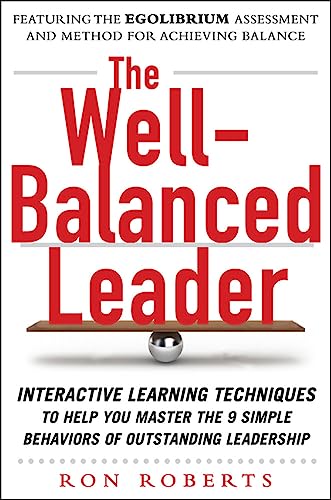
The Well-Balanced Leader: Interactive Learning Techniques to Help You Master the 9 Simple Behaviors of Outstanding Leadership - Hardcover
Inhaltsangabe
Empower your people, your company—and yourself—with leadership egolibrium
egolibrium: the ability to toggle between egocentric and “other-centric” attitudes, values, and behaviors for organizational success
There’s no doubt about it: the very best leaders are deeply in tune with their behavior and understand the impact it has on others. As one of the world’s top trainers in the field of accelerated experiential learning, Ron Roberts understands this more keenly than anyone, and in The Well-Balanced Leader, he helps you re-envision your own behavior to become the best leader you can be.
Roberts makes the process of finding the perfect leadership balance—what he calls egolibrium—personally enriching and easy to achieve. He begins by identifying the nine human behavioral dichotomies that most affect the quality of leadership:
- Nonjudgmental / Judgmental
- Nondefensive / Defensive
- Relinquishing Control / Controlling
- Openness to learning / Know it all
- Doing the right thing / Doing whatever you want
- Patience / Impatience
- Letting go / Holding on
- Acceptance / Resistance
- Other-centric / Egocentric
Everyone’s behaviors fall somewhere between each dichotomy. Using the activities, action steps, games, and thought exercises included for each pair, you’ll figure out exactly where your behaviors land, and then learn how to move that position in one direction or the other to find the right balance or your specific needs.
When you transcend your personal needs and focus on the needs of others and of the organization, everyone benefits—including you. The result is not only greater job satisfaction for people at all levels, but greater productivity— regardless of the organization’s field, product, or service.
The Well-Balanced Leader gives you the tools for making the small, incremental changes in behavior that lead to big changes in awareness—and huge changes in your leadership effectiveness.
Die Inhaltsangabe kann sich auf eine andere Ausgabe dieses Titels beziehen.
Über die Autorin bzw. den Autor
Ron Roberts is one of today’s top consultants and trainers in the area of accelerated experiential learning. He frequently serves as keynote speaker at national conferences and professional meetings. Roberts is president of Action Centered Training Inc., ACT Government Support Services, and ACT Games, LLC, where he has trained executives, managers, supervisors, and line staff in all phases of industry, corporate, and government.
Von der hinteren Coverseite
In The Well-Balanced Leader, top experiential, accelerated-learning trainer Ron Roberts shows you how to identify your strengths and weaknesses in the nine most critical behavioral areas. He helps you “unstick” yourself from behavioral patterns that damage your influence as a leader, your relationships with those you lead, and the effectiveness of your organization.
The Well-Balanced Leader provides valuable insight into the inner workings of great leadership, along with activities, games, and exercises to determine where you excel—and where you fall short. It empowers you to:
- Strike a balance among the needs of the people you lead, your own needs, and the needs of the organization
- Become more conscious of what motivates you, drives your behavior, and determines how you relate to others
- Think before you speak and respond to every situation with measured behavior
With The Well-Balanced Leader, you’ll learn how to alter your behavior in ways that benefit your people, contribute value to your organization, and launch yourself to the highest level of success.
Auszug. © Genehmigter Nachdruck. Alle Rechte vorbehalten.
The Well-Balanced Leader
INTERACTIVE LEARNING TECHNIQUES TO HELP YOU MASTER THE 9 SIMPLE BEHAVIORS OF OUTSTANDING LEADERSHIP
By RON ROBERTSThe McGraw-Hill Companies, Inc.
Copyright © 2012 Ron Roberts
All rights reserved.
ISBN: 978-0-07-177244-0All rights reserved.
Contents
| Acknowledgments | |
| Introduction | |
| CHAPTER 1 Who's in Charge Here Anyway, You or Your Ego? | |
| CHAPTER 2 FACE 1. Nonjudgmental versus Judgmental | |
| CHAPTER 3 FACE 2. Nondefensive versus Defensive | |
| CHAPTER 4 FACE 3. Relinquishing Control versus Controlling | |
| CHAPTER 5 FACE 4. Open to Learning versus Know-It-All | |
| CHAPTER 6 FACE 5. Doing the Right Thing versus Doing Whatever You Want | |
| CHAPTER 7 FACE 6. Patient versus Impatient | |
| CHAPTER 8 FACE 7. Letting Go versus Holding On | |
| CHAPTER 9 FACE 8. Acceptance versus Resistance | |
| CHAPTER 10 FACE 9. Other-Centric versus Ego-Centric | |
| Guiding Principles | |
| Index |
Excerpt
CHAPTER 1
Who's in Charge Here Anyway, You or Your Ego?
Lisa, a director at a major government agency, got things done and made sure herhighly talented staff did too. But few people felt comfortable talking toher—or even approaching her. This became such a problem that her bosssuggested that she and her staff take a team building and communications course.The class included trust building games, energizers, and interpersonalcommunication exercises. After the last session, everyone was basking in theenergy created by three days of positive, respectfulinteractions—laughing, joking, clowning around—until Lisa suddenlysnapped:
"Time to get back to work!"
She then proceeded to rip into her staff, collectively and individually,sarcastically detailing recent failures and making demeaning comments. Within 10minutes, she had wiped out three days of training.
Lisa was stuck:
* In her short-sighted ego-driven management mode which focused on herown needs to the exclusion of others
* In a state of near unconsciousness regarding her own supercriticalnature and her extremely demotivating, negative impact on others
* In a constant state of imbalance, with the pendulum swinging towardmanipulating others to get what she needed regardless of the outcome, and worstof all, not having any inkling of the extended effects on her team, unit, or theorganization as a whole
Lisa's reaction is pretty typical of many ego-driven executives. Sometimesthey're told to change; sometimes they themselves know they need to change. Buteven when their careers or departments are at stake, most find it difficult tochange—even when the new, desired behaviors are spelled out to them bybosses in their annual reviews or during team building courses. The Well-BalancedLeader provides a proven methodology for achieving lasting change.It can help leaders change their behavior in a way that sticks.
Most leaders and even their subordinates resist change—because they'reafraid of it, because it's difficult, and because their egos find itthreatening. Ego-driven leaders are in downward spirals or never-ending loopsthat keep them and their subordinates stuck in situations that are not working.Organizations often resist change too by keeping outdated structures andprocesses in place and locking people into their existing roles, makingindividual change even more difficult.
Leaders' Natural Tendency Toward Imbalance
The Well-Balanced Leader helps leaders to manage and master the 10 mostcommon unconscious tendencies (and traps) that those driven by their egos fallinto:
1. Being continuously self-inflating
2. Being absorbed with their own needs and self-importance
3. Trying to gain unlimited power and control
4. Proving their amazing, unquestionable, natural intelligence
5. Demonstrating their total self-reliance (needing no one or anything)
6. Searching for absolute security and certainty
7. Avoiding pain and discomfort and seeking positive results only
8. Attempting to accumulate a maximum amount of material things,objects, and "toys"
9. Desperately seeking perpetual personal affirmation at all levels
10. Unrealistically comparing themselves to others
Ego (and seeking self-fulfillment) is often the true motivating force for manyleaders and managers. The main issue again: Most leaders are not aware orconscious that they even have an ego problem because many of the above processesoccur subliminally, without their knowledge. When average managers demonstratethe subtle ego-driven characteristics listed above, they are seldom aware ofthem (and often hire people just like themselves). On the other hand, whenleaders practice the art of Egolibrium, they begin to observe themselves and canbecome highly aware of the ego's insidious subtle power. Great leaders humblyadmit their flaws and dig them up as they would dig up weeds about to take root.They take counterbalancing measures to change immediately.
GUIDING PRINCIPLE It is not that which is seen but that which is unseenthat causes leadership difficulties.
Analogy: Driving a Car
When driving, some people overidentify with their cars, especially on longtrips. Is this you? In your mind, you the driver become the vehicle itself. Ifpeople cut you off or drive erratically or ding your vehicle in the parking lot,you feel they have done it to YOU. When drivers overidentify with their cars,horrible scenes—swearing, distasteful digital symbols, even physicalblows—often ensue. How did this happen? The boundaries between the driversand their cars became temporarily blurred.
The same things happen when we identify with our externally conditioned sense ofself, which Freud called simply "the ego." The ego is how we mediate with theworld. It's influenced by our environment, how we want people to think of us(and how we want to think of ourselves!), our work, our status, our education,income, and all our external achievements. We all have a higher, more authenticself that transcends the ego. This true authentic self is the person we reallyare at our best, when we are in tune with our universe and independentof others' judgments and external rewards. When we overidentify with our egosand let them direct our perceptions of who we are, we get in as much trouble asdrivers who overidentify with their cars.
Getting Unstuck: Egolibrium
Egolibrium helps you get unstuck from the disabling power of the ego in anorderly systematic manner that empowers you by giving you three strengths:
1. Other-Centric perspectives: Paradoxically, remembering who you reallyare and thinking of others more often than yourself will allow you to be more intouch with your true authentic self. Other-Centric means realizing thatyou are not the center of the universe. Having a clear perspective about yourimportance (or lack thereof) in the bigger picture and larger scheme of thingswithin your workplace is the sign of a great leader.
Great leaders are like astronauts circling the earth in a state ofweightlessness, exposed to a rare perspective that reminds them how small theyreally are in the...
„Über diesen Titel“ kann sich auf eine andere Ausgabe dieses Titels beziehen.
Suchergebnisse für The Well-Balanced Leader: Interactive Learning Techniques...

Beispielbild für diese ISBN
The Well-Balanced Leader: Interactive Learning Techniques to Help You Master the 9 Simple Behaviors of Outstanding Leadership
Anbieter: Better World Books, Mishawaka, IN, USA
Verkäuferbewertung 5 von 5 Sternen

Zustand: Good. Former library copy. Pages intact with minimal writing/highlighting. The binding may be loose and creased. Dust jackets/supplements are not included. Includes library markings. Stock photo provided. Product includes identifying sticker. Better World Books: Buy Books. Do Good. Bestandsnummer des Verkäufers 9823417-6
Gebraucht kaufen
EUR 6,36
Versand gratis
Versand innerhalb von USA
Versand innerhalb von USA
Anzahl: 1 verfügbar
Beispielbild für diese ISBN
The Well-Balanced Leader: Interactive Learning Techniques to Help You Master the 9 Simple Behaviors of Outstanding Leadership
Anbieter: Better World Books, Mishawaka, IN, USA
Verkäuferbewertung 5 von 5 Sternen
Zustand: Very Good. Former library copy. Pages intact with possible writing/highlighting. Binding strong with minor wear. Dust jackets/supplements may not be included. Includes library markings. Stock photo provided. Product includes identifying sticker. Better World Books: Buy Books. Do Good. Bestandsnummer des Verkäufers 13396108-75
Gebraucht kaufen
EUR 6,36
Versand gratis
Versand innerhalb von USA
Versand innerhalb von USA
Anzahl: 1 verfügbar
Beispielbild für diese ISBN
The Well-Balanced Leader: Interactive Learning Techniques to Help You Master the 9 Simple Behaviors of Outstanding Leadership
Anbieter: ThriftBooks-Dallas, Dallas, TX, USA
Verkäuferbewertung 5 von 5 Sternen
Hardcover. Zustand: Good. No Jacket. Former library book; Pages can have notes/highlighting. Spine may show signs of wear. ~ ThriftBooks: Read More, Spend Less. Bestandsnummer des Verkäufers G0071772448I3N10
Gebraucht kaufen
EUR 6,40
Versand gratis
Versand innerhalb von USA
Versand innerhalb von USA
Anzahl: 1 verfügbar
Beispielbild für diese ISBN
The Well-Balanced Leader: Interactive Learning Techniques to Help You Master the 9 Simple Behaviors of Outstanding Leadership
Anbieter: ThriftBooks-Atlanta, AUSTELL, GA, USA
Verkäuferbewertung 5 von 5 Sternen
Hardcover. Zustand: Very Good. No Jacket. Missing dust jacket; May have limited writing in cover pages. Pages are unmarked. ~ ThriftBooks: Read More, Spend Less. Bestandsnummer des Verkäufers G0071772448I4N01
Gebraucht kaufen
EUR 6,40
Versand gratis
Versand innerhalb von USA
Versand innerhalb von USA
Anzahl: 1 verfügbar
Beispielbild für diese ISBN
The Well-Balanced Leader: Interactive Learning Techniques to Help You Master the 9 Simple Behaviors of Outstanding Leadership
Anbieter: ThriftBooks-Dallas, Dallas, TX, USA
Verkäuferbewertung 5 von 5 Sternen
Hardcover. Zustand: Very Good. No Jacket. Missing dust jacket; May have limited writing in cover pages. Pages are unmarked. ~ ThriftBooks: Read More, Spend Less. Bestandsnummer des Verkäufers G0071772448I4N01
Gebraucht kaufen
EUR 6,40
Versand gratis
Versand innerhalb von USA
Versand innerhalb von USA
Anzahl: 1 verfügbar
Beispielbild für diese ISBN
The Well-Balanced Leader: Interactive Learning Techniques to Help You Master the 9 Simple Behaviors of Outstanding Leadership
Anbieter: ThriftBooks-Atlanta, AUSTELL, GA, USA
Verkäuferbewertung 5 von 5 Sternen
Hardcover. Zustand: Very Good. No Jacket. May have limited writing in cover pages. Pages are unmarked. ~ ThriftBooks: Read More, Spend Less. Bestandsnummer des Verkäufers G0071772448I4N00
Gebraucht kaufen
EUR 6,40
Versand gratis
Versand innerhalb von USA
Versand innerhalb von USA
Anzahl: 1 verfügbar
Beispielbild für diese ISBN
The Well-Balanced Leader: Interactive Learning Techniques to Help You Master the 9 Simple Behaviors of Outstanding Leadership
Verlag:
McGraw Hill, 2012
ISBN 10: 0071772448
ISBN 13: 9780071772440
Gebraucht
Hardcover
Erstausgabe
Anbieter: One Planet Books, Columbia, MO, USA
Verkäuferbewertung 4 von 5 Sternen

hardcover. Zustand: Good. 1st Edition. Ships same day or next business day! UPS shipping available (Priority Mail for AK/HI/APO/PO Boxes). Used sticker and some writing and/or highlighting. Used books may not include working access code. Used books will not include dust jackets. Bestandsnummer des Verkäufers 001227317U
Gebraucht kaufen
EUR 3,66
EUR 3,55 Versand
Versand innerhalb von USA
Versand innerhalb von USA
Anzahl: 10 verfügbar
Foto des Verkäufers
The Well-Balanced Leader: Interactive Learning Techniques to Help You Master the 9 Simple Behaviors of Outstanding Leadership
Anbieter: Goodwill of Greater Milwaukee and Chicago, Racine, WI, USA
Verkäuferbewertung 5 von 5 Sternen
Zustand: good. Book is considered to be in good or better condition. The actual cover image may not match the stock photo. Hard cover books may show signs of wear on the spine, cover or dust jacket. Paperback book may show signs of wear on spine or cover as well as having a slight bend, curve or creasing to it. Book should have minimal to no writing inside and no highlighting. Pages should be free of tears or creasing. Stickers should not be present on cover or elsewhere, and any CD or DVD expected with the book is included. Book is not a former library copy. Bestandsnummer des Verkäufers SEWV.0071772448.G
Gebraucht kaufen
EUR 6,40
EUR 2,67 Versand
Versand innerhalb von USA
Versand innerhalb von USA
Anzahl: 1 verfügbar
Beispielbild für diese ISBN
The Well-Balanced Leader: Interactive Learning Techniques to Help You Master the 9 Simple Behaviors of Outstanding Leadership
Verlag:
McGraw Hill, 2012
ISBN 10: 0071772448
ISBN 13: 9780071772440
Gebraucht
Hardcover
Erstausgabe
Anbieter: Textbooks_Source, Columbia, MO, USA
Verkäuferbewertung 5 von 5 Sternen
hardcover. Zustand: Good. 1st Edition. Ships in a BOX from Central Missouri! May not include working access code. Will not include dust jacket. Has used sticker(s) and some writing or highlighting. UPS shipping for most packages, (Priority Mail for AK/HI/APO/PO Boxes). Bestandsnummer des Verkäufers 001227317U
Gebraucht kaufen
EUR 19,41
EUR 3,55 Versand
Versand innerhalb von USA
Versand innerhalb von USA
Anzahl: 12 verfügbar
Foto des Verkäufers
Well-Balanced Leader : Interactive Learning Techniques to Help You Master the 9 Simple Behaviors of Outstanding Leadership
Anbieter: GreatBookPrices, Columbia, MD, USA
Verkäuferbewertung 5 von 5 Sternen
Zustand: good. May show signs of wear, highlighting, writing, and previous use. This item may be a former library book with typical markings. No guarantee on products that contain supplements Your satisfaction is 100% guaranteed. Twenty-five year bookseller with shipments to over fifty million happy customers. Bestandsnummer des Verkäufers 12843332-5
Gebraucht kaufen
EUR 20,65
EUR 2,35 Versand
Versand innerhalb von USA
Versand innerhalb von USA
Anzahl: 4 verfügbar