
Verwandte Artikel zu Practice Makes Perfect Linear Algebra: With 500 Exercises
Practice Makes Perfect Linear Algebra: With 500 Exercises - Softcover
Buch 33 von 67: Practice Makes Perfect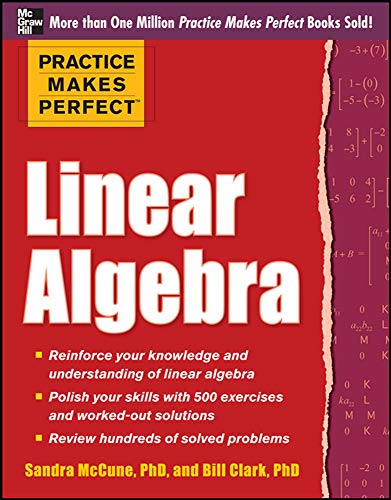
Inhaltsangabe
Expert instruction and plenty of practice to reinforce advanced math skills Presents concepts with application to natural sciences, engineering, economics, computer science, and other branches of mathematics Complementary to most linear algebra courses or as a refresher text More than 500 exercises and answers Hundreds of solved problems The Practice Makes Perfect series has sold more than 1 million copies worldwide
Die Inhaltsangabe kann sich auf eine andere Ausgabe dieses Titels beziehen.
Auszug. © Genehmigter Nachdruck. Alle Rechte vorbehalten.
Practice Makes Perfect Linear Algebra
By Sandra Luna McCune William D. ClarkMcGraw-Hill Companies, Inc.
Copyright © 2013 The McGraw-Hill Companies, Inc.All right reserved.
ISBN: 978-0-07-177843-5
Contents
Chapter One
Systems of linear equations and matrices
In this chapter, you will learn:
* Systems of linear equations
* General systems of linear equations
* Matrices
* Row transformations and equivalence of matrices
* Row-echelon form
* Homogeneous systems
This chapter provides some basic terminology associated with systems of linear equations and matrices and presents methods for solving linear systems. As you will see, systems of linear equations and matrices go hand-in-hand.
Systems of linear equations
A linear equation is an equation of the form a1x1 + a2x2 + ... anxn = c1 where there are n unknowns (variables), x1, x2, ..., xn, and a1, a2, ..., an and c1 are known constants. An equation is linear if all the variables occur to the first power only and if there are no products or quotients of variables. A solution of a linear equation a1x1 + a2x2 + ... + anxn = c1 in n unknowns is an ordered list of n numbers s1, s2, ..., sn that satisfy the equation when x1 = s1, x2, = s2, ..., xn = sn. In linear algebra you will need to simultaneously solve linear equations in several variables. You likely have seen two basic algebraic methods of solving simultaneous equations. An example of each method is shown for a quick review.
The equation of a linear function in two variables has several forms but for the purposes of this chapter, the form ax + by = c is preferred. You know from elementary algebra that the graph of such a linear equation is a line. When you encounter two linear equations, the basic question underlying a simultaneous solution is "What are the coordinates of the point of intersection, if any, of the two lines that are the graphs of the two equations?" This question has three possible answers. If the two lines do not intersect, there is no solution; if the two lines intersect, there is only one solution, an ordered pair (x, y); and if the two lines are equivalent versions of the same line, then there are infinitely many solutions: an infinite set of ordered pairs. This same idea carries over to systems of m equations in n unknowns. That is,
Given a system of m equations and n unknowns, only one of the following three possibilities for a solution to the system occurs:
1. There is no solution.
2. There is exactly one solution.
3. There are infinitely many solutions.
If there is no solution to the system, the system is inconsistent. If there is at least one solution to the system, the system is consistent.
When you are solving two linear equations in two variables (a 2 x 2 system), an example of the standard form of writing them together is
2x - y = 1
x + y = 2
Figures 1.1, 1.2, and 1.3 graphically show the three possible outcomes for a 2 x 2 system of equations.
You solve the 2 x 2 system when you answer the question: "What are the coordinates of the point of intersection, if any, of the two lines that are the graphs of the two equations?"
Method 1: Substitution. This method requires you to solve one equation for one of the variables in terms of the other variable, and then use substitution to solve the system.
[MATHEMATICAL NOT REPRODUCIBLE IN ASCII]
SOLUTION Solve the first equation for y in terms of x:
2x = y = 0
2x = y
Substitute 2x for y into the second equation and solve for x:
x + (2x) = 3
x = 1
Substitute 1 for x into the second equation and solve for y:
1 + y = 3
y = 2
The solution is x = 1 and y = 2. That is, the two lines intersect at the point (1, 2).
Method 2: Elimination of a variable. This method involves multiplying the equations by constants to create opposites as coefficients of one variable so that it can be eliminated by adding the two equations.
PROBLEM Solve the system.
5x + 2y = 3
2x + 3y = -1
SOLUTION To eliminate y, multiply the first equation by 3 and the second equation by -2:
[MATHEMATICAL NOT REPRODUCIBLE IN ASCII]
Add the resulting two equations and solve for x:
[MATHEMATICAL NOT REPRODUCIBLE IN ASCII]
Substitute 1 for x into one of the original equations and solve for y:
[MATHEMATICAL NOT REPRODUCIBLE IN ASCII]
The solution is x = 1 and y = -1. That is, the two lines intersect at the point (1, -1).
You can use the two methods exemplified above to solve systems of several linear equations in several variables, but linear algebra is a study of more powerful ways of solving systems of equations. Solving systems of equations is elevated to answering more sophisticated questions than "Where do lines intersect?" Moreover, solving such systems is basic to the study of linear algebra. Chapter 2 presents a discussion of the algebra of matrices and methods of solving simultaneous equations using that algebra. As you might expect, the solution(s) of 2 x 2 systems are ordered pairs; 3 x 3 systems, ordered triples; 4 x 4 systems, ordered quadruples; and, in general, n x n systems, ordered n-tuples.
General systems of linear equations
The simple 1 x 2 linear system ax + by = c with nonzero coefficients has infinitely many solutions whose graph is a straight line. The solutions can be written as (x, y), where [MATHEMATICAL NOT REPRODUCIBLE IN ASCII]. The variable x is a free variable, meaning its value is unrestricted. The variable y is dependent on x because substituting any value for x will produce a corresponding value for y. By letting x = t, you can represent the solutions in parametric form as x = t, [MATHEMATICAL NOT REPRODUCIBLE IN ASCII], where the arbitrary number t is called a parameter. Similar parametric substitutions are made if you have several free variables.
PROBLEM Solve the following system: -2x + 5y = 4z = 0
SOLUTION Solve for one variable in terms of the other two:
[MATHEMATICAL NOT REPRODUCIBLE IN ASCII], where y and z are free variables. In parametric form, the solution is [MATHEMATICAL NOT REPRODUCIBLE IN ASCII], y = s and z = t, where s and t are arbitrary.
A system of linear equations can have any number of equations and any number of variables. The solution to many such systems...
„Über diesen Titel“ kann sich auf eine andere Ausgabe dieses Titels beziehen.
Suchergebnisse für Practice Makes Perfect Linear Algebra: With 500 Exercises

Foto des Verkäufers
Practice Makes Perfect Linear Algebra: With 500 Exercises
Anbieter: 2nd Life Books, Burlington, NJ, USA
Verkäuferbewertung 5 von 5 Sternen

Zustand: very_good. Used book in very good condition. May have some minor wear. May NOT include discs, or access code or other supplemental material. Ships directly from Amazon and is eligible for Prime or super saver FREE shipping. We ship Monday-Saturday and respond to inquiries within 24 hours. Bestandsnummer des Verkäufers BXM.E587
Gebraucht kaufen
EUR 10,66
EUR 3,57 Versand
Versand innerhalb von USA
Versand innerhalb von USA
Anzahl: 1 verfügbar
Beispielbild für diese ISBN
Practice Makes Perfect Linear Algebra
Verlag:
McGraw-Hill Education - Europe, 2013
ISBN 10: 0071778438
ISBN 13: 9780071778435
Gebraucht
Paperback
Anbieter: World of Books (was SecondSale), Montgomery, IL, USA
Verkäuferbewertung 5 von 5 Sternen
Paperback. Zustand: Good. Presents concepts with application to natural sciences, engineering, economics, computer science, and other branches of mathematics. Bestandsnummer des Verkäufers 00110690626
Gebraucht kaufen
EUR 14,37
Versand gratis
Versand innerhalb von USA
Versand innerhalb von USA
Anzahl: 1 verfügbar
Foto des Verkäufers
Practice Makes Perfect Linear Algebra: With 500 Exercises
Anbieter: -OnTimeBooks-, Phoenix, AZ, USA
Verkäuferbewertung 5 von 5 Sternen
Zustand: good. A copy that has been read, remains in good condition. All pages are intact, and the cover is intact. The spine and cover show signs of wear. Pages can include notes and highlighting and show signs of wear, and the copy can include "From the library of" labels or previous owner inscriptions. 100% GUARANTEE! Shipped with delivery confirmation, if you're not satisfied with purchase please return item! Ships via media mail. Bestandsnummer des Verkäufers OTV.0071778438.G
Gebraucht kaufen
EUR 14,55
Versand gratis
Versand innerhalb von USA
Versand innerhalb von USA
Anzahl: 2 verfügbar
Foto des Verkäufers
Linear Algebra
Anbieter: Aspen Book Co., Denver, CO, USA
Verkäuferbewertung 5 von 5 Sternen
Paperback. Zustand: Good. This paperback copy of "Practice Makes Perfect: Linear Algebra" is in good condition. The cover shows some wear, particularly along the edges, but remains intact. The pages are clean and free of inscriptions or markings, and the binding is solid. Overall, it is a well-preserved copy suitable for study and reference. Bestandsnummer des Verkäufers A21-B6-KU-0639
Gebraucht kaufen
EUR 14,60
Versand gratis
Versand innerhalb von USA
Versand innerhalb von USA
Anzahl: 1 verfügbar
Beispielbild für diese ISBN
Practice Makes Perfect Linear Algebra: With 500 Exercises
Anbieter: HPB-Red, Dallas, TX, USA
Verkäuferbewertung 5 von 5 Sternen
paperback. Zustand: Good. Connecting readers with great books since 1972! Used textbooks may not include companion materials such as access codes, etc. May have some wear or writing/highlighting. We ship orders daily and Customer Service is our top priority! Bestandsnummer des Verkäufers S_478687832
Gebraucht kaufen
EUR 11,85
EUR 3,34 Versand
Versand innerhalb von USA
Versand innerhalb von USA
Anzahl: 1 verfügbar
Beispielbild für diese ISBN
Practice Makes Perfect Linear Algebra
Verlag:
McGraw-Hill Education - Europe, 2013
ISBN 10: 0071778438
ISBN 13: 9780071778435
Gebraucht
Paperback
Anbieter: World of Books Inc, Montgomery, IL, USA
Verkäuferbewertung 4 von 5 Sternen

Paperback. Zustand: Good. Presents concepts with application to natural sciences, engineering, economics, computer science, and other branches of mathematics. Bestandsnummer des Verkäufers CIN0071778438G
Gebraucht kaufen
EUR 16,20
Versand gratis
Versand innerhalb von USA
Versand innerhalb von USA
Anzahl: 1 verfügbar
Foto des Verkäufers
Practice Makes Perfect Linear Algebra
Anbieter: GreatBookPrices, Columbia, MD, USA
Verkäuferbewertung 5 von 5 Sternen
Zustand: New. Bestandsnummer des Verkäufers 18421247-n
Neu kaufen
EUR 21,44
EUR 2,35 Versand
Versand innerhalb von USA
Versand innerhalb von USA
Anzahl: Mehr als 20 verfügbar
Foto des Verkäufers
Practice Makes Perfect Linear Algebra: With 500 Exercises (Paperback or Softback)
Verlag:
McGraw-Hill Education 1/8/2013, 2013
ISBN 10: 0071778438
ISBN 13: 9780071778435
Neu
Paperback or Softback
Anbieter: BargainBookStores, Grand Rapids, MI, USA
Verkäuferbewertung 5 von 5 Sternen
Paperback or Softback. Zustand: New. Practice Makes Perfect Linear Algebra: With 500 Exercises. Book. Bestandsnummer des Verkäufers BBS-9780071778435
Foto des Verkäufers
Practice Makes Perfect Linear Algebra
Anbieter: GreatBookPrices, Columbia, MD, USA
Verkäuferbewertung 5 von 5 Sternen
Zustand: As New. Unread book in perfect condition. Bestandsnummer des Verkäufers 18421247
Gebraucht kaufen
EUR 22,67
EUR 2,35 Versand
Versand innerhalb von USA
Versand innerhalb von USA
Anzahl: Mehr als 20 verfügbar
Beispielbild für diese ISBN
Practice Makes Perfect Linear Algebra: With 500 Exercises
Anbieter: California Books, Miami, FL, USA
Verkäuferbewertung 5 von 5 Sternen
Zustand: New. Bestandsnummer des Verkäufers I-9780071778435
Neu kaufen
EUR 25,72
Versand gratis
Versand innerhalb von USA
Versand innerhalb von USA
Anzahl: Mehr als 20 verfügbar