
Verwandte Artikel zu Reader-Friendly Reports: A No-nonsense Guide to Effective...
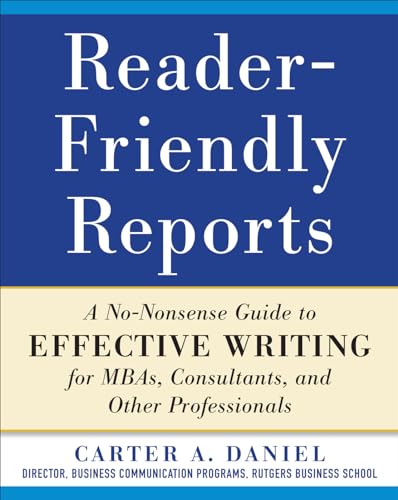
Reader-Friendly Reports: A No-nonsense Guide to Effective Writing for MBAs, Consultants, and Other Professionals - Softcover
Inhaltsangabe
The book that has taught thousands of students how to write winning business reports
For more than 30 years, Carter A. Daniel has been teaching MBA students at Rutgers University the art of effective business communication with the aid of his eminently practical guide Reader-Friendly Reports.
Now available to the public for the first time, this beloved resource gives you everything you need to translate your hard-won figures, conclusions, and insights into concise and powerful reports. No definition of communication, no history, no theory, no diagrams Reader-Friendly Reports simply shows you how to:
- Target your audience
- Determine your purpose
- Develop your points
- Organize your ideas
- Make smooth transitions
- Conduct research
- Illustrate with clear graphs and charts
Reader-Friendly Reports (the "Daniel Manual") is the A to Z guide to ensuring you meet your first priority: making sure people can understand and remember your report from beginning to end.
Die Inhaltsangabe kann sich auf eine andere Ausgabe dieses Titels beziehen.
Über die Autorin bzw. den Autor
Carter A. Daniel is the director of the Business Communication Programs at Rutgers University. He has published articles and manuals on business communication and is the author of MBA: The First Century, the only comprehensive history of
Auszug. © Genehmigter Nachdruck. Alle Rechte vorbehalten.
Reader-Friendly Reports
A No-nonsense Guide to EFFECTIVE WRITING for MBAs, Consultants, and Other Professionals
By CARTER DANIELThe McGraw-Hill Companies, Inc.
Copyright ©2012 The McGraw-Hill Companies
All rights reserved.
ISBN: 978-0-07-178285-2All rights reserved.
Contents
| I. Planning a Reader-Friendly Report | |
| II. Writing a Reader-Friendly Report | |
| III. Research Techniques | |
| IV. Other Things | |
| V. Sample Reports | |
| VI. The Appearance of the Finished Document | |
| Appendix: Checklists | |
| Index |
Excerpt
CHAPTER 1
Planning a Reader-Friendly Report
Right and Wrong, Boss and Book
What Business Writing Isn't and Is
Understanding the Assignment
Assessing the Audience
Determining the Controlling Purpose
Organizing a Report
Afterword
RIGHT AND WRONG, BOSS AND BOOK
For some reason, questions of writing style and correctness bring out people'smost mule-headed private opinions. A boss who doesn't know anything aboutcalculus or linear programming would never think of overruling a subordinate onone of those subjects. But just let that same subordinate do something contraryto what the boss's ignorant sixth-grade teacher said—some asinine ruleabout not ending a sentence with a preposition or not starting one withand or because—and the boss will pounce with fangs bared.
Such a situation is much more political than it is intellectual, and the moralto be drawn from it is that if somebody is paying your salary, you should writethe way that person wants. Writing is far less often "right" or "wrong" than itis "appropriate" or "inappropriate." Obviously, if you write in a way thatirritates your boss, you're writing inappropriately.
This manual sets forth some reasonable suggestions about decent businesswriting—suggestions you might want to follow if you haven't been given anyspecific rules to govern the particular task you're doing. Everything that issaid here, however, should be considered subject to being overruled by anyspecial requirements you have been given for a particular assignment.
Just to make sure it's clear, let's say it one more time, a different way: Forthe love of mud, whatever you do, don't go wave this book in your boss's faceand shout, "See? You're wrong!" When your boss tells you one thing and the booktells you something different, do what your boss says.
WHAT BUSINESS WRITING ISN'T AND IS
Business writing isn't a different language with a separate set of words andphrases. In receipt of, as per your request, beg to acknowledge, andplease be advised are relics of the past. They aren't used anymore, orshouldn't be anyway.
Business writing also isn't dull and stereotyped. Bad writing is dull; goodwriting is interesting. These statements are true for all writing, business orany other kind. If you are interested in a subject but find the report dull,something's wrong with the way the report is written.
Business writing is just like any other writing except more efficient. Whereassome kinds of writing aim at being dreamy, witty, entertaining, spooky,outrageous, shocking, or sexy, when you're doing the kind of writing beingdescribed here you have only one aim: to persuade your reader, as efficiently aspossible, of the validity of your thesis.
Think for a minute about who your audience is, and you'll understand the reasonfor insisting on efficiency. Businesspeople are intelligent, suspicious, andbusy. So when you write for them you have to be factual, persuasive, andefficient: factual because they are too intelligent to be fooled by vaguenessand bluffing; persuasive because you have to overcome the suspicion that alwaysaccompanies money matters; and efficient because you'll lose your reader if youwaste time.
A few pages from now (page 9, to be exact) you will encounter adescription of the thesis-and-subheaded-structured-segments organization, thestandard pattern for organizing business reports. Even before you get there,however, you might do well to think for a moment about the whole reason fororganizing a business report differently from the way you organize a magazinearticle, a novel, or an advertisement. Try this explanation:
The people who assigned you the report did so because they didn't have time todo the work themselves. They asked you the questions, and now they want theanswers. The answers are, therefore, the most important things in your report,and you must organize your whole report around those answers and wave them inyour readers' faces. State the answers at the beginning; elaborate on them oneby one in the rest of the report; include only things that pertain to theseanswers; and be sure that the pertinence is always clear. Reread this paragraph.
Or, to be still more specific, don't say anything that isn't part of the answerto the question you were asked. Don't restate the problem, or announce that youhave finished researching it, or summarize the background, or spend timedefining terms, or tell about how you made your calculations or classified yourevidence. Just answer the bleeding question, starting at the very verybeginning. You may reread this paragraph too.
To put it still another way, don't say something unless you're making some pointby saying it. If, for instance, there's nothing in the company's history thathas any relevance to the problem, then in the name of good sense don't go intothe company's history. On the other hand, if the company's problems are partlytraceable to the fact that it has always been family owned, then by all means dotell the history—making sure, every moment, that the point of your tellingit is clear.
Help your reader every way you can. Be certain that the point of each paragraphis clear. After you've finished writing, go back and check each one of them tosee if you can state its point in a quick phrase and to see if each of thesephrases fits in with the thesis. Even if the report is short, use subheadingsnot merely (1) to demarcate the segments but more importantly (2) to let thereaders know what they're getting ready to read. And remember to include in yourreport only what your first paragraph promised. Never, for even a moment, letout of your sight the purpose of a business report: to convince your reader, asefficiently as possible, of the validity of your thesis. (More, as noted before,starting on page 9.)
UNDERSTANDING THE ASSIGNMENT
Before starting to answer the question, you've got to know what the question is.A sizable portion of business writing troubles can be traced to a failure toidentify the assignment correctly. For example, although asked what to do abouta problem, an incompetent report writer might waste the entire report tellinginstead how the problem occurred, which isn't the same thing at all. As aresult, the reader has to suffer through the whole tedious report without everfinding out the answer to the question. Likewise if the boss asks a supervisorto recommend for or against promotion of an employee, but the supervisor insteadspends the whole report recounting the employee's work history and never getsaround to the yes-or-no recommendation, the boss will be furious—andshould be, too, because it's a bad report.
The importance of this point can't be overstated: if you don't get theassignment right, if you don't answer the right question, then no amount of"good...
„Über diesen Titel“ kann sich auf eine andere Ausgabe dieses Titels beziehen.
Suchergebnisse für Reader-Friendly Reports: A No-nonsense Guide to Effective...

Beispielbild für diese ISBN
Reader-Friendly Reports: A No-nonsense Guide to Effective Writing for MBAs, Consultants, and Other Professionals
Anbieter: World of Books (was SecondSale), Montgomery, IL, USA
Verkäuferbewertung 5 von 5 Sternen

Zustand: Very Good. Item in very good condition! Textbooks may not include supplemental items i.e. CDs, access codes etc. Bestandsnummer des Verkäufers 00100714990
Gebraucht kaufen
EUR 4,50
Versand gratis
Versand innerhalb von USA
Versand innerhalb von USA
Anzahl: 4 verfügbar
Beispielbild für diese ISBN
Reader-Friendly Reports: A No-nonsense Guide to Effective Writing for MBAs, Consultants, and Other Professionals
Anbieter: World of Books (was SecondSale), Montgomery, IL, USA
Verkäuferbewertung 5 von 5 Sternen
Zustand: Good. Item in good condition. Textbooks may not include supplemental items i.e. CDs, access codes etc. Bestandsnummer des Verkäufers 00106086428
Gebraucht kaufen
EUR 4,50
Versand gratis
Versand innerhalb von USA
Versand innerhalb von USA
Anzahl: 2 verfügbar
Foto des Verkäufers
Reader-Friendly Reports: A No-nonsense Guide to Effective Writing for MBAs, Consultants, and Other Professionals
Anbieter: Greenworld Books, Arlington, TX, USA
Verkäuferbewertung 5 von 5 Sternen
Zustand: good. Fast Free Shipping â" Good condition. It may show normal signs of use, such as light writing, highlighting, or library markings, but all pages are intact and the book is fully readable. A solid, complete copy that's ready to enjoy. Bestandsnummer des Verkäufers GWV.0071782850.G
Gebraucht kaufen
EUR 4,50
Versand gratis
Versand innerhalb von USA
Versand innerhalb von USA
Anzahl: 2 verfügbar
Beispielbild für diese ISBN
Reader-Friendly Reports: A No-nonsense Guide to Effective Writing for MBAs, Consultants, and Other Professionals
Verlag:
McGraw Hill (edition 1), 2012
ISBN 10: 0071782850
ISBN 13: 9780071782852
Gebraucht
Paperback
Anbieter: BooksRun, Philadelphia, PA, USA
Verkäuferbewertung 5 von 5 Sternen
Paperback. Zustand: Very Good. 1. It's a well-cared-for item that has seen limited use. The item may show minor signs of wear. All the text is legible, with all pages included. It may have slight markings and/or highlighting. Bestandsnummer des Verkäufers 0071782850-11-1
Gebraucht kaufen
EUR 5,37
Versand gratis
Versand innerhalb von USA
Versand innerhalb von USA
Anzahl: 1 verfügbar
Beispielbild für diese ISBN
Reader-Friendly Reports: A No-nonsense Guide to Effective Writing for MBAs, Consultants, and Other Professionals
Verlag:
McGraw-Hill Education - Europe, 2012
ISBN 10: 0071782850
ISBN 13: 9780071782852
Gebraucht
Paperback
Anbieter: World of Books Inc, Montgomery, IL, USA
Verkäuferbewertung 4 von 5 Sternen

Paperback. Zustand: Very Good. When writing a report, the first rule is to make sure you are understood. This book shows you how to plan your report, determine its purpose, its target audience and how to organize your ideas and do research. Bestandsnummer des Verkäufers CIN0071782850VG
Gebraucht kaufen
EUR 6,33
Versand gratis
Versand innerhalb von USA
Versand innerhalb von USA
Anzahl: 4 verfügbar
Beispielbild für diese ISBN
Reader-Friendly Reports: A No-nonsense Guide to Effective Writing for MBAs, Consultants, and Other Professionals
Verlag:
McGraw-Hill Education - Europe, 2012
ISBN 10: 0071782850
ISBN 13: 9780071782852
Gebraucht
Paperback
Anbieter: World of Books Inc, Montgomery, IL, USA
Verkäuferbewertung 4 von 5 Sternen
Paperback. Zustand: Good. When writing a report, the first rule is to make sure you are understood. This book shows you how to plan your report, determine its purpose, its target audience and how to organize your ideas and do research. Bestandsnummer des Verkäufers CIN0071782850G
Gebraucht kaufen
EUR 6,33
Versand gratis
Versand innerhalb von USA
Versand innerhalb von USA
Anzahl: 2 verfügbar
Beispielbild für diese ISBN
Reader-Friendly Reports: a No-Nonsense Guide to Effective Writing for MBAs, Consultants, and Other Professionals
Anbieter: Better World Books, Mishawaka, IN, USA
Verkäuferbewertung 5 von 5 Sternen
Zustand: Very Good. Former library copy. Pages intact with possible writing/highlighting. Binding strong with minor wear. Dust jackets/supplements may not be included. Includes library markings. Stock photo provided. Product includes identifying sticker. Better World Books: Buy Books. Do Good. Bestandsnummer des Verkäufers 4806397-6
Gebraucht kaufen
EUR 6,54
Versand gratis
Versand innerhalb von USA
Versand innerhalb von USA
Anzahl: 1 verfügbar
Beispielbild für diese ISBN
Reader-Friendly Reports: a No-Nonsense Guide to Effective Writing for MBAs, Consultants, and Other Professionals
Anbieter: Better World Books, Mishawaka, IN, USA
Verkäuferbewertung 5 von 5 Sternen
Zustand: Good. Pages intact with minimal writing/highlighting. The binding may be loose and creased. Dust jackets/supplements are not included. Stock photo provided. Product includes identifying sticker. Better World Books: Buy Books. Do Good. Bestandsnummer des Verkäufers 10994430-6
Gebraucht kaufen
EUR 6,54
Versand gratis
Versand innerhalb von USA
Versand innerhalb von USA
Anzahl: 3 verfügbar
Beispielbild für diese ISBN
Reader-Friendly Reports: a No-Nonsense Guide to Effective Writing for MBAs, Consultants, and Other Professionals
Anbieter: Better World Books: West, Reno, NV, USA
Verkäuferbewertung 5 von 5 Sternen
Zustand: Very Good. Pages intact with possible writing/highlighting. Binding strong with minor wear. Dust jackets/supplements may not be included. Stock photo provided. Product includes identifying sticker. Better World Books: Buy Books. Do Good. Bestandsnummer des Verkäufers 6340132-6
Gebraucht kaufen
EUR 6,54
Versand gratis
Versand innerhalb von USA
Versand innerhalb von USA
Anzahl: 1 verfügbar
Beispielbild für diese ISBN
Reader-Friendly Reports: A No-nonsense Guide to Effective Writing for MBAs, Consultants, and Other Professionals
Anbieter: HPB-Red, Dallas, TX, USA
Verkäuferbewertung 5 von 5 Sternen
paperback. Zustand: Good. Connecting readers with great books since 1972! Used textbooks may not include companion materials such as access codes, etc. May have some wear or writing/highlighting. We ship orders daily and Customer Service is our top priority! Bestandsnummer des Verkäufers S_392255427
Gebraucht kaufen
EUR 4,58
EUR 3,33 Versand
Versand innerhalb von USA
Versand innerhalb von USA
Anzahl: 1 verfügbar