
Verwandte Artikel zu The Handbook for Quality Management: A Complete Guide...
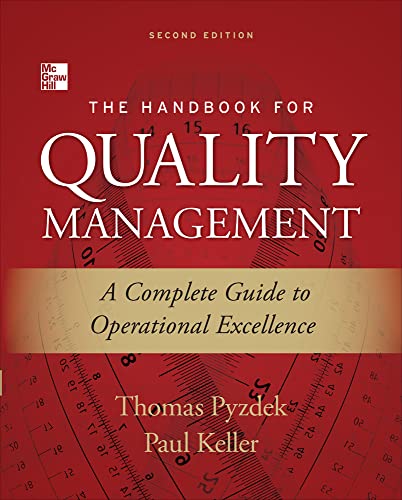
Inhaltsangabe
Publisher's Note: Products purchased from Third Party sellers are not guaranteed by the publisher for quality, authenticity, or access to any online entitlements included with the product.
The definitive guide to organizational excellence--completely updated
Fully revised for the latest American Society for Quality (ASQ) Certified Manager of Quality/Organizational Excellence (CMQ/QE) Body of Knowledge, The Handbook for Quality Management: A Complete Guide to Operational Excellence, Second Edition offers in-depth guidance on effectively applying the principles of quality management in today's business environment and delivering superior results. Designed to help you prepare for and pass the ASQ CMQ/QE exam, this authoritative volume also serves as an essential on-the-job reference.
Coverage includes:
- Business-integrated quality systems
- Organizational structures
- The quality function
- Approaches to quality
- Customer-focused organizations
- Integrated planning
- Strategic planning
- Understanding customer expectations and needs
- Benchmarking
- Organizational assessment
- Process control
- Quantifying process variation
- Quality audits
- Supply chain management
- Continuous improvement
- Effective change management
- Six Sigma methodology, including detailed descriptions of the DMAIC and DMADV approaches
- Management of human resources
- Motivation theories and principles
- Management styles
- Resource requirements to manage the quality function
Over the past 40 years, the quality management discipline has undergone steady evolution from disparate quality assurance efforts to strategic, business-integrated functions. Today's quality manager must be able to plan and implement measurable, cost-effective process-improvement initiatives across the organization.
Written by two of the foremost authorities on the subject and fully updated for the latest American Society for Quality (ASQ) Certified Manager of Quality/Organizational Excellence (CMQ/OE) Body of Knowledge, The Handbook for Quality Management, Second Edition provides an operational guide to the proper understanding and application of quality management in the current business environment. It serves as a primary reference source for an organization's quality program and for anyone seeking to pass the CMQ/OE exam, given by the ASQ.
The Handbook for Quality Management: A Complete Guide to Operational Excellence, Second Edition:
- Clearly defines quality management principles and their application within a cross section of industries
- Integrates the application of Theory of Constraints, Six Sigma, and Lean thinking into the Quality Management discipline
- Contains detailed methods for planning, including customer needs recognition, benchmarking, and organizational assessments
- Discusses controls such as statistical process control, audits, and supply chain management
- Explains the stages of continuous improvement
- Incorporates classic motivation theory with more current management practices advocated by Joiner, Senge, and Deming, among others
Die Inhaltsangabe kann sich auf eine andere Ausgabe dieses Titels beziehen.
Über die Autorin bzw. den Autor
Thomas Pyzdek is a Six Sigma consultant withmore than 40 years of experience in the field. His clients include Ford, McDonald's, Intuit, Boeing, Seagate, Avon Products, and many other companies. Mr. Pyzdek is a recipient of the American Society for Quality EdwardsMedal for outstanding contributions to the practice of quality management and the E.L. Grant Medal for outstanding leadership in the development and presentation of meritorious educational programs in quality. He has also received a Lean Six Sigma Leadership award fromthe American Quality Institute.
Paul Keller is President and Chief OperatingOfficer with Quality America, Inc. He has developed and implemented successful Six Sigma and quality improvement programs in service and manufacturing environments. He is the author of several books, including The Six Sigma Handbook, Third Edition (coauthor), and Six Sigma Demystified.
Auszug. © Genehmigter Nachdruck. Alle Rechte vorbehalten.
The Handbook for Quality Management
A Complete Guide to Operational ExcellenceBy Thomas Pyzdek Paul KellerMcGraw-Hill Companies, Inc.
Copyright © 2013 The McGraw-Hill Companies, Inc.All right reserved.
ISBN: 978-0-07-179924-9
Contents
Chapter One
Organizational Structures
Organizations exist because they serve a useful purpose. The transaction-cost theory of a firm (Coase, 1937) postulates that there are costs associated with market transactions, and organizations prosper only when they provide a cost advantage. Examples of these costs include the cost of discovering market prices, negotiation and contracting costs, sales taxes and other taxes on exchanges between firms, cost of regulation of transactions between firms, and so on.
Transaction-cost theory offers a framework for understanding limits on the size of a firm. As firms grow, it becomes more costly to organize additional transactions within the firm, called "decreasing returns to management." When the cost of organizing an additional transaction equals the cost of carrying out the transaction in the open market, growth of the firm will cease. Of course, these costs are also affected by technology: facsimile machines (in their day), satellites, computers, and more recently the Internet each altered the cost of organization, impacting the optimal size of the firm accordingly. Such inventions simultaneously impact the cost of using external markets, so the relative impact of the technology on market costs and organization costs determines the overall impact on the organization. Clearly, the ability to efficiently carry out market transactions, with minimal bureaucratic overhead, impacts an organization's usefulness to the market, and its prosperity and eventual life span.
General Theory of Organization Structure
Organizations consist of systems of relationships that direct and allocate resources; therefore the purpose of organization structure is to develop relationships that perform these functions well. There are several possible ways in which these relationships can be viewed. The most common is the reporting relationship view. Here the organization is viewed as an entity consisting of people who have the authority to direct other people, their "reports." In this view the organization appears as a stratified triangle, with the positions higher in a given strata of the triangle having the authority to direct the lower positions. In modern organizations, the authority to set policy and plan strategic direction is vested in the highest level of the structure: the strategic apex. The middle line consists of management personnel who deploy the policy and plan to the operating core (at the bottom of the structure). Technological expertise and support are provided by groups of professionals not directly involved in operations. The entire organization is held together by a common set of beliefs and shared values known as the organization's ideology. Figure 1.1 illustrates these ideas.
The Functional/Hierarchical Structure
The traditional organization that results from the above view of the organization is the functional/hierarchical structure. This is a command and control structure with ancient military origins. In this type of organization, work is divided according to function, for example, marketing, engineering, finance, manufacturing, etc. A stratum within the organization is given responsibility for a particular function. Work is delegated from top to bottom within the stratum to personnel who specialize in the function. An example of the traditional functional hierarchical organization chart is shown in Fig. 1.2.
A key component of the hierarchal structure is its command and control elements, facilitated by the theories of scientific management developed by Frederick Taylor. Taylor believed that management could never effectively control the workplace unless it controlled the work itself, that is, the specific tasks performed by the workers to get the job done. Management could improve the efficiency of work, to the benefit of both management and workers, by applying the methods of science in (1) selecting the individuals best suited to a particular job and (2) identifying the optimal way in which the jobs could be performed. Henry Ford further advanced this de-skilling of the workforce through production mechanization.
In spite of resistance from craftsmen and machinists, who understood the value of their knowledge and skill in terms of monetary rewards and job security, the reduction of work to a series of simple tasks done with relatively small investment in training is one of the major results of scientific management. The ramifications of these efforts includes better management oversight, reduced investment in worker training, and easier replacement of those who did unsatisfactory work (with employee incentives to improve performance). Unfortunately, the de-skilled work is usually far more boring, leading to a variety of problems such as high levels of stress and employee turnover.
The legacy of de-skilling is that the workforce is less able to change as new conditions arise. Whereas a machinist could work for any number of companies in many industries, machine loaders had limited mobility outside their current employer, thus increasing worker demands for job security. In the modern era, lack of generalized employee skills can be a major impediment to a quick reaction to rapidly changing market conditions. When rapid change creates new tasks, the workers' previous experience does not help them adapt to the new circumstance; they must be constantly "retrained."
Organizationally, the introduction of scientific management perpetuated the growth of the bureaucratic form, and increasingly led to larger and larger organizational support structures. On the technical side, organizational units were formed to codify the detailed knowledge of necessary work practices, including manufacturing engineering, industrial engineering, quality control, human resources, and cost accounting. This de-skilling of the workforce creates an increasingly large number of transactions to manage, which leads in turn to larger bureaucracies and decreasing returns to management, an issue described earlier by Coase.
The traditional organization structure has come under pressure in recent years. One problem with the structure is that it tends to produce a "silo mentality" among those who work in a particular stratum: they tend to see the company from the perspective of an "accountant" or an "engineer" rather than from a companywide perspective. This produces a tendency to optimize their function without regard for the effect on the rest of the organization—a tendency that produces markedly suboptimal results when viewed from a holistic perspective. Cooperation is discouraged in such an organization. In these structures, employees tend to think of their superiors as their "customers." The focus becomes pleasing one's boss rather than pleasing the external customer. Finally, the top- down arrangement often results in resource allocation that does not optimally meet the needs of external customers, who are generally served by processes that cut across several different functions.
Given these problems, one might wonder why such organizations still dominate the business scene. There are several reasons, chief among them the comfort level employees have with this model: this has been the dominant model for decades, so there...
„Über diesen Titel“ kann sich auf eine andere Ausgabe dieses Titels beziehen.
Suchergebnisse für The Handbook for Quality Management: A Complete Guide...

Foto des Verkäufers
The Handbook for Quality Management, Second Edition: A Complete Guide to Operational Excellence
Anbieter: clickgoodwillbooks, Indianapolis, IN, USA
Verkäuferbewertung 4 von 5 Sternen

Zustand: acceptable. Used - Acceptable: All pages and the cover are intact, but shrink wrap, dust covers, or boxed set case may be missing. Pages may include limited notes, highlighting, or minor water damage but the text is readable. Item may be missing bundled media. Bestandsnummer des Verkäufers CSIV.0071799249.A
Gebraucht kaufen
EUR 34,11
EUR 3,56 Versand
Versand innerhalb von USA
Versand innerhalb von USA
Anzahl: 1 verfügbar
Beispielbild für diese ISBN
The Handbook for Quality Management: A Complete Guide to Operational Excellence
Anbieter: ThriftBooks-Atlanta, AUSTELL, GA, USA
Verkäuferbewertung 5 von 5 Sternen

Hardcover. Zustand: Fair. No Jacket. Readable copy. Pages may have considerable notes/highlighting. ~ ThriftBooks: Read More, Spend Less. Bestandsnummer des Verkäufers G0071799249I5N00
Gebraucht kaufen
EUR 37,77
Versand gratis
Versand innerhalb von USA
Versand innerhalb von USA
Anzahl: 1 verfügbar
Foto des Verkäufers
The Handbook for Quality Management, Second Edition: A Complete Guide to Operational Excellence
Anbieter: clickgoodwillbooks, Indianapolis, IN, USA
Verkäuferbewertung 4 von 5 Sternen
Zustand: good. Used - Good: A book that has been read but is in good condition. Very minimal damage to the cover including scuff marks, but no holes or tears. The dust jacket for hard covers may not be included. Binding has minimal wear. The majority of pages are undamaged with minimal creasing or tearing, minimal pencil underlining of text, no highlighting of text, no writing in margins. No missing pages. Bestandsnummer des Verkäufers CSIV.0071799249.G
Gebraucht kaufen
EUR 40,18
EUR 3,56 Versand
Versand innerhalb von USA
Versand innerhalb von USA
Anzahl: 1 verfügbar
Beispielbild für diese ISBN
The Handbook for Quality Management, Second Edition: A Complete Guide to Operational Excellence
Anbieter: YESIBOOKSTORE, MIAMI, FL, USA
Verkäuferbewertung 5 von 5 Sternen
hardcover. Zustand: As New. Bestandsnummer des Verkäufers 0071799249-VB
Gebraucht kaufen
EUR 131,96
Versand gratis
Versand innerhalb von USA
Versand innerhalb von USA
Anzahl: 1 verfügbar
Beispielbild für diese ISBN
The Handbook for Quality Management, Second Edition: A Complete Guide to Operational Excellence
Anbieter: GoldBooks, Denver, CO, USA
Verkäuferbewertung 5 von 5 Sternen
Hardcover. Zustand: new. New Copy. Customer Service Guaranteed. Bestandsnummer des Verkäufers 44V88_83_0071799249
Neu kaufen
EUR 227,91
EUR 4,91 Versand
Versand innerhalb von USA
Versand innerhalb von USA
Anzahl: 1 verfügbar