
Verwandte Artikel zu Red Sorghum: A Novel of China
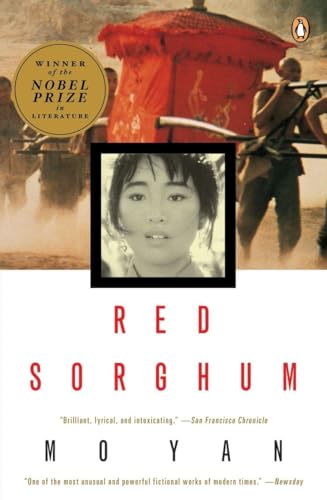
Inhaltsangabe
The acclaimed novel of love and resistance during late 1930s China by Mo Yan, winner of the Nobel Prize in Literature
Spanning three generations, this novel of family and myth is told through a series of flashbacks that depict events of staggering horror set against a landscape of gemlike beauty, as the Chinese battle both Japanese invaders and each other in the turbulent 1930s.
A legend in China, where it won major literary awards and inspired an Oscar-nominated film directed by Zhang Yimou, Red Sorghum is a book in which fable and history collide to produce fiction that is entirely new—and unforgettable.
Die Inhaltsangabe kann sich auf eine andere Ausgabe dieses Titels beziehen.
Über die Autorin bzw. den Autor
Mo Yan is the pen name of the Chinese novelist Guan Moye, who is one of the most celebrated writers in the Chinese language. His best-known novels in the West include Red Sorghum, which was made into an award-winning film; The Garlic Ballads, Shifu: You’ll Do Anything for a Laugh; and Big Breasts and Wide Hips. He was awarded the 2012 Nobel Prize in Literature, making him the first resident of mainland China to win the award.
Auszug. © Genehmigter Nachdruck. Alle Rechte vorbehalten.
Spectacular reviews for
Red Sorghum
“Red Sorghum creates the backdrop for mythic heroism and primitivist vitality through the exotically portrayed setting of Shandong’s lush sorghum fields.”
—The Boston Globe
“[Yan’s] style is vibrant, alternating between lyrical passages and an oddly conversational tone. This historical tale has a remarkable sense of immediacy and an impressive scope.”
—Los Angeles Times
“Having read Red Sorghum, I believe Mo Yan deserves a place in world literature. His imagery is astounding, sensual and visceral. His story is electrifying and epic. I was amazed from the first page. It is unlike anything I’ve read coming out of China in past or recent times. I am convinced this book will successfully leap over the international boundaries that many translated works face. . . . This is an important work from an important writer.”
—Amy Tan
“Mo Yan spares us nothing . . . Red Sorghum fixes our attention on a series of exquisite images . . . [as] he paints his pictures of a world in chaos, where every day is a struggle to preserve life, if not honor, and there is no safety even in death.”
—New York Magazine
“Red Sorghum is so unlike any other piece of contemporary Chinese literature that, were it not so clearly set in China, one might imagine it to be a product of another place and time. . . . With this work Mo Yan has helped his country find a new and powerfully convincing literary voice.”
—Orville Schell
“A masterful translation . . . The appearance of Red Sorghum is an important event for English-language literature, one which bids well for the power and influence of Chinese fiction in the 21st century.”
—Richmond Times Dispatch
“Yan tempers his brutal tale with a powerfully evocative lyricism . . . A powerful new voice on the brutal unrest of rural China in the late ’20s and ’30s.”
—Kirkus Reviews
PENGUIN BOOKS
RED SORGHUM
Mo Yan (literally “don’t speak”) is the pen name of Guan Moye. Born in 1955 to a peasant family in Shandong province, he is the author of ten novels including Red Sorghum, which was made into a feature film, dozens of novellas, and hundreds of short stories. Mo Yan is the winner of the 2012 Nobel Prize in Literature and the 2009 Newman Prize for Chinese Literature. He has won virtually every Chinese literary prize, including the Mao Dun Literature Prize in 2011 (China’s most prestigious literary award) and is the most critically acclaimed Chinese writer of his generation, in both China and around the world. He lives in Beijing.
Howard Goldblatt is the foremost translator of modern and contemporary Chinese literature in the West. The founding editor of the journal Modern Chinese Literature, he has written for The Washington Post, The Times of London, Time, World Literature Today, and the Los Angeles Times. He is currently a professor at the University of Notre Dame.
MO YAN
Red
Sorghum
A NOVEL OF CHINA
Translated from the Chinese
by Howard Goldblatt
PENGUIN BOOKS
WITH THIS BOOK I respectfully invoke the heroic, aggrieved souls wandering in the boundless bright-red sorghum fields of my hometown. As your unfilial son, I am prepared to carve out my heart, marinate it in soy sauce, have it minced and placed in three bowls, and lay it out as an offering in a field of sorghum. Partake of it in good health!
Table of Contents
CHAPTER ONE
Red Sorghum
1
THE NINTH DAY of the eighth lunar month, 1939. My father, a bandit’s offspring who had passed his fifteenth birthday, was joining the forces of Commander Yu Zhan’ao, a man destined to become a legendary hero, to ambush a Japanese convoy on the Jiao-Ping highway. Grandma, a padded jacket over her shoulders, saw them to the edge of the village. “Stop here,” Commander Yu ordered her. She stopped.
“Douguan, mind your foster-dad,” she told my father. The sight of her large frame and the warm fragrance of her lined jacket chilled him. He shivered. His stomach growled.
Commander Yu patted him on the head and said, “Let’s go, foster-son.”
Heaven and earth were in turmoil, the view was blurred. By then the soldiers’ muffled footsteps had moved far down the road. Father could still hear them, but a curtain of blue mist obscured the men themselves. Gripping tightly to Commander Yu’s coat, he nearly flew down the path on churning legs. Grandma receded like a distant shore as the approaching sea of mist grew more tempestuous, holding on to Commander Yu was like clinging to the railing of a boat.
That was how Father rushed toward the uncarved granite marker that would rise above his grave in the bright-red sorghum fields of his hometown. A bare-assed little boy once led a white billy goat up to the weed-covered grave, and as it grazed in unhurried contentment, the boy pissed furiously on the grave and sang out: “The sorghum is red—the Japanese are coming—compatriots, get ready—fire your rifles and cannons—”
Someone said that the little goatherd was me, but I don’t know. I had learned to love Northeast Gaomi Township with all my heart, and to hate it with unbridled fury. I didn’t realize until I’d grown up that Northeast Gaomi Township is easily the most beautiful and most repulsive, most unusual and most common, most sacred and most corrupt, most heroic and most bastardly, hardest-drinking and hardest-loving place in the world. The people of my father’s generation who lived there ate sorghum out of preference, planting as much of it as they could. In late autumn, during the eighth lunar month, vast stretches of red sorghum shimmered like a sea of blood. Tall and dense, it reeked of glory; cold and graceful, it promised enchantment; passionate and loving, it was tumultuous.
The autumn winds are cold and bleak, the sun’s rays intense. White clouds, full and round, float in the tile-blue sky, casting full round purple shadows onto the sorghum fields below. Over decades that seem but a moment in time, lines of scarlet figures shuttled among the sorghum stalks to weave a vast human tapestry. They killed, they looted, and they defended their country in a valiant, stirring ballet that makes us unfilial descendants who now occupy the land pale by comparison. Surrounded by progress, I feel a nagging sense of our species’ regression.
After leaving the village, the troops marched down a narrow dirt path, the tramping of their feet merging with the rustling of weeds. The heavy mist was strangely animated, kaleidoscopic. Tiny droplets of water pooled into large drops on Father’s face; clumps of hair stuck to his forehead. He was used to the delicate peppermint aroma and the slightly sweet yet pungent odor of ripe sorghum wafting over from the sides of the path—nothing new there. But as they marched through the heavy mist, his nose detected a new, sickly-sweet odor, neither yellow nor red, blending with the smells of peppermint and sorghum to call up memories hidden deep in his soul.
Six days later, the fifteenth day of the eighth month, the night of the Mid-Autumn Festival. A bright round moon climbed slowly in the sky above the solemn, silent sorghum fields, bathing the tassels in its light until they shimmered...
„Über diesen Titel“ kann sich auf eine andere Ausgabe dieses Titels beziehen.
Weitere beliebte Ausgaben desselben Titels

Suchergebnisse für Red Sorghum: A Novel of China

Beispielbild für diese ISBN
Red Sorghum A Novel of China
Anbieter: World of Books (was SecondSale), Montgomery, IL, USA
Verkäuferbewertung 5 von 5 Sternen

Zustand: Good. Item in good condition. Textbooks may not include supplemental items i.e. CDs, access codes etc. Bestandsnummer des Verkäufers 00107203548
Gebraucht kaufen
EUR 4,01
Versand gratis
Versand innerhalb von USA
Versand innerhalb von USA
Anzahl: 1 verfügbar
Beispielbild für diese ISBN
Red Sorghum: A Novel of China
Verlag:
Penguin Books (edition First Edition), 1994
ISBN 10: 0140168540
ISBN 13: 9780140168549
Gebraucht
Paperback
Erstausgabe
Anbieter: BooksRun, Philadelphia, PA, USA
Verkäuferbewertung 5 von 5 Sternen
Paperback. Zustand: Fair. First Edition. The item might be beaten up but readable. May contain markings or highlighting, as well as stains, bent corners, or any other major defect, but the text is not obscured in any way. Bestandsnummer des Verkäufers 0140168540-7-1
Gebraucht kaufen
EUR 4,86
Versand gratis
Versand innerhalb von USA
Versand innerhalb von USA
Anzahl: 1 verfügbar
Foto des Verkäufers
Red Sorghum: A Novel of China
Anbieter: Dream Books Co., Denver, CO, USA
Verkäuferbewertung 5 von 5 Sternen
Zustand: good. Gently used with minimal wear on the corners and cover. A few pages may contain light highlighting or writing, but the text remains fully legible. Dust jacket may be missing, and supplemental materials like CDs or codes may not be included. May be ex-library with library markings. Ships promptly! Bestandsnummer des Verkäufers DBV.0140168540.G
Gebraucht kaufen
EUR 5,75
Versand gratis
Versand innerhalb von USA
Versand innerhalb von USA
Anzahl: 1 verfügbar
Beispielbild für diese ISBN
Red Sorghum : A Novel of China
Verlag:
Penguin Publishing Group, 1994
ISBN 10: 0140168540
ISBN 13: 9780140168549
Gebraucht
Softcover
Anbieter: Better World Books, Mishawaka, IN, USA
Verkäuferbewertung 5 von 5 Sternen
Zustand: Good. Former library copy. Pages intact with minimal writing/highlighting. The binding may be loose and creased. Dust jackets/supplements are not included. Includes library markings. Stock photo provided. Product includes identifying sticker. Better World Books: Buy Books. Do Good. Bestandsnummer des Verkäufers GRP82273099
Gebraucht kaufen
EUR 6,38
Versand gratis
Versand innerhalb von USA
Versand innerhalb von USA
Anzahl: 2 verfügbar
Beispielbild für diese ISBN
Red Sorghum: A Novel of China
Anbieter: ThriftBooks-Dallas, Dallas, TX, USA
Verkäuferbewertung 5 von 5 Sternen
Paperback. Zustand: Good. No Jacket. Pages can have notes/highlighting. Spine may show signs of wear. ~ ThriftBooks: Read More, Spend Less. Bestandsnummer des Verkäufers G0140168540I3N00
Gebraucht kaufen
EUR 6,45
Versand gratis
Versand innerhalb von USA
Versand innerhalb von USA
Anzahl: 2 verfügbar
Beispielbild für diese ISBN
Red Sorghum: A Novel of China
Anbieter: ThriftBooks-Phoenix, Phoenix, AZ, USA
Verkäuferbewertung 5 von 5 Sternen
Paperback. Zustand: Good. No Jacket. Pages can have notes/highlighting. Spine may show signs of wear. ~ ThriftBooks: Read More, Spend Less. Bestandsnummer des Verkäufers G0140168540I3N00
Gebraucht kaufen
EUR 6,45
Versand gratis
Versand innerhalb von USA
Versand innerhalb von USA
Anzahl: 2 verfügbar
Beispielbild für diese ISBN
Red Sorghum: A Novel of China
Anbieter: ThriftBooks-Reno, Reno, NV, USA
Verkäuferbewertung 5 von 5 Sternen
Paperback. Zustand: Fair. No Jacket. Readable copy. Pages may have considerable notes/highlighting. ~ ThriftBooks: Read More, Spend Less. Bestandsnummer des Verkäufers G0140168540I5N00
Gebraucht kaufen
EUR 6,45
Versand gratis
Versand innerhalb von USA
Versand innerhalb von USA
Anzahl: 2 verfügbar
Beispielbild für diese ISBN
Red Sorghum: A Novel of China
Anbieter: ThriftBooks-Atlanta, AUSTELL, GA, USA
Verkäuferbewertung 5 von 5 Sternen
Paperback. Zustand: Good. No Jacket. Pages can have notes/highlighting. Spine may show signs of wear. ~ ThriftBooks: Read More, Spend Less. Bestandsnummer des Verkäufers G0140168540I3N00
Gebraucht kaufen
EUR 6,45
Versand gratis
Versand innerhalb von USA
Versand innerhalb von USA
Anzahl: 3 verfügbar
Beispielbild für diese ISBN
Red Sorghum: A Novel of China
Anbieter: ThriftBooks-Atlanta, AUSTELL, GA, USA
Verkäuferbewertung 5 von 5 Sternen
Paperback. Zustand: Fair. No Jacket. Former library book; Readable copy. Pages may have considerable notes/highlighting. ~ ThriftBooks: Read More, Spend Less. Bestandsnummer des Verkäufers G0140168540I5N10
Gebraucht kaufen
EUR 6,45
Versand gratis
Versand innerhalb von USA
Versand innerhalb von USA
Anzahl: 1 verfügbar
Beispielbild für diese ISBN
Red Sorghum: A Novel of China
Anbieter: ThriftBooks-Atlanta, AUSTELL, GA, USA
Verkäuferbewertung 5 von 5 Sternen
Paperback. Zustand: Fair. No Jacket. Readable copy. Pages may have considerable notes/highlighting. ~ ThriftBooks: Read More, Spend Less. Bestandsnummer des Verkäufers G0140168540I5N00
Gebraucht kaufen
EUR 6,45
Versand gratis
Versand innerhalb von USA
Versand innerhalb von USA
Anzahl: 3 verfügbar