
Verwandte Artikel zu The Basque History of the World: The Story of a Nation
Inhaltsangabe
"A lively, anecdotal, all-encompassing history of Basque ingenuity and achievement." —Atlantic Monthly
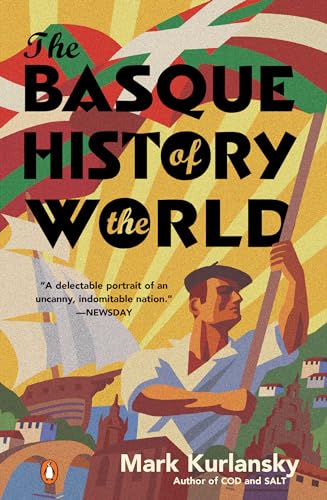
From Mark Kurlansky, the bestselling author of Cod, Salt, Birdseye, and Paper—the illuminating story of an ancient and enigmatic people
Straddling a small corner of Spain and France in a land that is marked on no maps except their own, the Basques are a puzzling contradiction—they are Europe's oldest nation without ever having been a country. No one has ever been able to determine their origins, and even the Basques' language, Euskera—the most ancient in Europe—is related to none other on earth. For centuries, their influence has been felt in nearly every realm, from religion to sports to commerce. Even today, the Basques are enjoying what may be the most important cultural renaissance in their long existence, as displayed by new cookbooks like chefs Alexandra Raij and Eder Montero's The Basque Book and restaurateur Jose Pizarro’s Basque. Mark Kurlansky's passion for the Basque people and his exuberant eye for detail shine throughout this fascinating book. Like Cod, The Basque History of the World, blends human stories with economic, political, literary, and culinary history into a rich and heroic tale.
Among the Basques' greatest accomplishments:
• Exploration—the first man to circumnavigate the globe, Juan Sebastian de Elcano, was a Basque and the Basques were the second Europeans, after the Vikings, in North America
• Gastronomy and agriculture—they were the first Europeans to eat corn and chili peppers and cultivate tobacco, and were among the first to use chocolate
• Religion—Ignatius Loyola, a Basque, founded the Jesuit religious order
• Business and politics—they introduced capitalism and modern commercial banking to southern Europe
• Recreation—they invented beach resorts, jai alai, and racing regattas, and were the first Europeans to play sports with balls
"Entertaining and instructive… [Kurlansky’s] approach is unorthodox, mixing history with anecdotes, poems with recipes.” –The New York Times Book Review
Die Inhaltsangabe kann sich auf eine andere Ausgabe dieses Titels beziehen.
Über die Autorin bzw. den Autor
Mark Kurlansky was born in Hartford, Connecticut. After receiving a BA in Theater from Butler University in 1970—and refusing to serve in the military—Kurlansky worked in New York as a playwright, having a number of off-off Broadway productions, and as a playwright-in-residence at Brooklyn College. He has worked many other jobs, including as a commercial fisherman, a dock worker, a paralegal, a cook, and a pastry chef. In the mid-1970s he turned to journalism, and from 1976 to 1991 he worked as a foreign correspondent for The International Herald Tribune, The Chicago Tribune, The Miami Herald, and The Philadelphia Inquirer. Based in Paris and then Mexico, he reported on Europe, West Africa, Southeast Asia, Central America, Latin America, and the Caribbean. His articles have appeared in a wide variety of newspapers and magazines, including The Philadelphia Inquirer, The Miami Herald, The Chicago Tribune, The Los Angeles Times, Time, The New York Times and many more.
He has had 35 books published including fiction, nonfiction, and children's books. His books include Havana, Cod, Salt, Paper, The Basque History of the World, 1968, The Big Oyster, among other titles. He has received the Dayton Literary Peace Prize, Bon Appetit’s Food Writer of the Year Award, the James Beard Award, and the Glenfiddich Award. He lives in New York City.
Auszug. © Genehmigter Nachdruck. Alle Rechte vorbehalten.
"Nomansland, the territory of the Basques, is in a region called Cornucopia, where the vines are tied up with sausages. And in those parts there was a mountain made entirely of grated Parmesan cheese on whose slopes there were people who spent their whole time making macaroni and ravioli, which they cooked in chicken broth and then cast it to the four winds, and the faster you could pick it up, the more you got of it." —Giovanni Boccaccio, The Decameron, 1352
The game the rest of the world knows as jai alai was invented in the French Basque town of St.-Pée-sur-Nivelle. St. Pée, like most of the towns in the area, holds little more than one curving street against a steep-pastured slope. The houses are whitewashed, with either red or green shutters and trim. Originally the whitewash was made of chalk. The traditional dark red color, known in French as rouge Basque, Basque red, was originally made from cattle blood. Espelette, Ascain, and other towns in the valley look almost identical. A fronton court—a single wall with bleachers to the left—is always in the center of town.
While the French were developing tennis, the Basques, asthey often did, went in a completely different direction. The French ball was called a pelote, a French word derived from a verb for winding string. These pelotes were made of wool or cotton string wrapped into a ball and covered with leather. The Basques were the first Europeans to use a rubber ball, a discovery from the Americas, and the added bounce of wrapping rubber rather than string—the pelote Basque, as it was originally called—led them to play the ball off walls, a game which became known also as pelote or, in Spanish and English, pelota. A number of configurations of walls as well as a range of racquets, paddles, and barehanded variations began to develop. Jai alai, an Euskera phrase meaning "happy game," originally referred to a pelota game with an additional long left-hand wall. Then in 1857, a young farm worker in St. Pée named Gantxiki Harotcha, scooping up potatoes into a basket, got the idea of propelling the ball even faster with a long, scoop-shaped basket strapped to one hand. The idea quickly spread throughout the Nivelle Valley and in the twentieth century, throughout the Americas, back to where the rubber ball had begun.
St. Pée seems to be a quiet town. But it hasn't always been so. During World War II the Basques, working with the French underground, moved British and American fliers and fleeing Jews on the route up the valley from St.-Jean-de-Luz to Sare and across the mountain pass to Spain.
The Gestapo was based in the big house next to the fronton, the pelota court. Jeanine Pereuil, working in her family's pastry shop across the street, remembers refugees whisked past the gaze of the Germans. The Basques are said to be a secretive people. It is largely a myth—one of many. But in 1943, the Basques of the Nivelle Valley kept secrets very well. Jeanine Pereuil has many stories about the Germans and the refugees. She married a refugee from Paris.
The only change Jeanine made in the shop in her generation was to add a few figurines on a shelf. Before the Basques embraced Christianity with a legendary passion, they had other beliefs, and many of these have survived. Jeanine goes to her shelf and lovingly picks out the small figurine of a joaldun, a man clad in sheepskin with bells on his back. "Can you imagine," she says, "at my age buying such things. This is my favorite" she says, picking out a figure from the ezpata dantza, the sword dance performed on the Spanish side especially for the Catholic holiday of Corpus Christi. The dancer is wearing white with a red sash, one leg kicked out straight and high and the arms stretched out palms open.
Born in 1926, Jeanine is the fourth generation to make gâteau Basque and sell it in this shop. Her daughter is the fifth generation. The Pereuils all speak Basque as their first language and make the exact same cake. She is not sure when her great grandfather, Jacques Pereuil, started the shop, but she knows her grandfather, Jacques's son, was born in the shop in 1871.
Gâteau Basque, like the Basques themselves, has an uncertain origin. It appears to date from the eighteenth century and may have originally been called bistochak. While today's gâteau Basque is a cake filled with either cherry jam or pastry cream, the original bistochak was not a gâteau but a bread. The cherry filling predates the cream one. The cake appears to have originated in the valley of the winding Nivelle River, which includes the town of Itxassou, famous for its black cherries, a Basque variety called xapata.
Basques invented their own language and their own shoes, espadrilles. They also created numerous sports including not only pelota but wagon-lifting contests called orgo joko, and sheep fighting known as agaritalka. They developed their own farm tools such as the two-pronged hoe called a laia, their own breed of cow known as the blond cow, their own sheep called the whitehead sheep, and their own breed of pig, which was only recently rescued from extinction.
And so they also have their own black cherry, the xapata from Itxassou, which only bears fruit for a few weeks in June but is so productive during those weeks that a large surplus is saved in the form of preserves. The cherry, preserve-filled cakes were sold in the market in Bayonne, a city celebrated for its chocolate makers, who eventually started buying Itxassou black cherries to dip in chocolate.
Today in most of France and Spain a gâteau Basque is cream filled, but the closer to the valley of the Nivelle, the more likely it is to be cherry filled.
Jeanine, whose shop makes nothing besides one kind of bread, the two varieties of gâteau Basque, and a cookie based on the gâteau Basque dough, finds it hard to believe that her specialty originated as cherry bread. Just as the shop's furniture has never been changed, the recipe has never changed. The Pereuils have always made it as cake, not bread, and, she insists, have always made both the cream and cherry fillings. Cream is overwhelmingly the favorite. The mailman, given a little two-inch cake every morning when he brings the mail, always chooses cream.
Maison Pereuil may not be old enough for the earlier bistochak cherry bread recipe, but the Pereuil cake is not like the modern buttery gâteau Basque either. Jeanine's tawny, elastic confection is a softer, more floury version of the sugar-and-egg-white macaroon offered to Louis XIV and his young bride, the Spanish princess Maria Theresa, on their wedding day, May 8, 1660, in St.-Jean-de-Luz. Ever since, the macaroon has been a specialty of that Basque port at the mouth of the Nivelle.
When asked for the antique recipe for her family's gâteau Basque, Jeanine Pereuil smiled bashfully and said, "You know, people keep offering me a lot of money for this recipe."
How much do they offer?
"I don't know. I'm not going to bargain. I will never give out the recipe. If I sold the recipe, the house would vanish. And this is the house of my father and his father. I am keeping their house. And I hope my daughter will do the same for me."
Chapter One
1. The Basque Myth
—Miguel de Unamuno quoting...
„Über diesen Titel“ kann sich auf eine andere Ausgabe dieses Titels beziehen.
Suchergebnisse für The Basque History of the World: The Story of a Nation

Foto des Verkäufers
The Basque History of the World: The Story of a Nation
Anbieter: Dream Books Co., Denver, CO, USA
Verkäuferbewertung 5 von 5 Sternen

Zustand: acceptable. This copy has clearly been enjoyedâ"expect noticeable shelf wear and some minor creases to the cover. Binding is strong, and all pages are legible. May contain previous library markings or stamps. Bestandsnummer des Verkäufers DBV.0140298517.A
Gebraucht kaufen
EUR 5,82
Versand gratis
Versand innerhalb von USA
Versand innerhalb von USA
Anzahl: 2 verfügbar
Foto des Verkäufers
The Basque History of the World: The Story of a Nation
Anbieter: 3Brothers Bookstore, Egg harbor township, NJ, USA
Verkäuferbewertung 5 von 5 Sternen
Zustand: very_good. Cover may have light wear, pages in very good condition and binding is sturdy; may have other light shelf wear or creases. May have notes or highlighting. Bestandsnummer des Verkäufers EVV.0140298517.VG
Gebraucht kaufen
EUR 6,64
Versand gratis
Versand innerhalb von USA
Versand innerhalb von USA
Anzahl: 1 verfügbar
Beispielbild für diese ISBN
The Basque History of the World : The Story of a Nation
Verlag:
Penguin Publishing Group, 2001
ISBN 10: 0140298517
ISBN 13: 9780140298512
Gebraucht
Softcover
Anbieter: Better World Books: West, Reno, NV, USA
Verkäuferbewertung 5 von 5 Sternen
Zustand: Fine. Used book that is in almost brand-new condition. May contain a remainder mark. Better World Books: Buy Books. Do Good. Bestandsnummer des Verkäufers 38862247-6
Gebraucht kaufen
EUR 6,98
Versand gratis
Versand innerhalb von USA
Versand innerhalb von USA
Anzahl: 1 verfügbar
Beispielbild für diese ISBN
The Basque History of the World : The Story of a Nation
Verlag:
Penguin Publishing Group, 2001
ISBN 10: 0140298517
ISBN 13: 9780140298512
Gebraucht
Softcover
Anbieter: Better World Books, Mishawaka, IN, USA
Verkäuferbewertung 5 von 5 Sternen
Zustand: Good. Former library copy. Pages intact with minimal writing/highlighting. The binding may be loose and creased. Dust jackets/supplements are not included. Includes library markings. Stock photo provided. Product includes identifying sticker. Better World Books: Buy Books. Do Good. Bestandsnummer des Verkäufers 8411203-6
Gebraucht kaufen
EUR 6,98
Versand gratis
Versand innerhalb von USA
Versand innerhalb von USA
Anzahl: 1 verfügbar
Beispielbild für diese ISBN
The Basque History of the World : The Story of a Nation
Verlag:
Penguin Publishing Group, 2001
ISBN 10: 0140298517
ISBN 13: 9780140298512
Gebraucht
Softcover
Anbieter: Better World Books: West, Reno, NV, USA
Verkäuferbewertung 5 von 5 Sternen
Zustand: Good. Pages intact with minimal writing/highlighting. The binding may be loose and creased. Dust jackets/supplements are not included. Stock photo provided. Product includes identifying sticker. Better World Books: Buy Books. Do Good. Bestandsnummer des Verkäufers 298225-6
Gebraucht kaufen
EUR 6,98
Versand gratis
Versand innerhalb von USA
Versand innerhalb von USA
Anzahl: 1 verfügbar
Beispielbild für diese ISBN
The Basque History of the World : The Story of a Nation
Verlag:
Penguin Publishing Group, 2001
ISBN 10: 0140298517
ISBN 13: 9780140298512
Gebraucht
Softcover
Anbieter: Better World Books: West, Reno, NV, USA
Verkäuferbewertung 5 von 5 Sternen
Zustand: Very Good. Pages intact with possible writing/highlighting. Binding strong with minor wear. Dust jackets/supplements may not be included. Stock photo provided. Product includes identifying sticker. Better World Books: Buy Books. Do Good. Bestandsnummer des Verkäufers 4410826-6
Gebraucht kaufen
EUR 6,98
Versand gratis
Versand innerhalb von USA
Versand innerhalb von USA
Anzahl: 2 verfügbar
Beispielbild für diese ISBN
The Basque History of the World : The Story of a Nation
Verlag:
Penguin Publishing Group, 2001
ISBN 10: 0140298517
ISBN 13: 9780140298512
Gebraucht
Softcover
Anbieter: Better World Books, Mishawaka, IN, USA
Verkäuferbewertung 5 von 5 Sternen
Zustand: Good. Pages intact with minimal writing/highlighting. The binding may be loose and creased. Dust jackets/supplements are not included. Stock photo provided. Product includes identifying sticker. Better World Books: Buy Books. Do Good. Bestandsnummer des Verkäufers 298225-6
Gebraucht kaufen
EUR 6,98
Versand gratis
Versand innerhalb von USA
Versand innerhalb von USA
Anzahl: 9 verfügbar
Beispielbild für diese ISBN
The Basque History of the World: The Story of a Nation
Anbieter: The Book Cellar, LLC, Nashua, NH, USA
Verkäuferbewertung 4 von 5 Sternen

paperback. Zustand: Good. Some wear, but still a good reading copy. A portion of your purchase of this book will be donated to non-profit organizations.Over 1,000,000 satisfied customers since 1997! Choose expedited shipping (if available) for much faster delivery. Delivery confirmation on all US orders. Bestandsnummer des Verkäufers 10850083
Gebraucht kaufen
EUR 3,82
EUR 3,55 Versand
Versand innerhalb von USA
Versand innerhalb von USA
Anzahl: 1 verfügbar
Beispielbild für diese ISBN
The Basque History of the World: The Story of a Nation
Anbieter: HPB-Emerald, Dallas, TX, USA
Verkäuferbewertung 5 von 5 Sternen
Paperback. Zustand: Very Good. Connecting readers with great books since 1972! Used books may not include companion materials, and may have some shelf wear or limited writing. We ship orders daily and Customer Service is our top priority! Bestandsnummer des Verkäufers S_469901931
Gebraucht kaufen
EUR 4,23
EUR 3,33 Versand
Versand innerhalb von USA
Versand innerhalb von USA
Anzahl: 1 verfügbar
Beispielbild für diese ISBN
The Basque History of the World: The Story of a Nation
Anbieter: HPB Inc., Dallas, TX, USA
Verkäuferbewertung 5 von 5 Sternen
Paperback. Zustand: Very Good. Connecting readers with great books since 1972! Used books may not include companion materials, and may have some shelf wear or limited writing. We ship orders daily and Customer Service is our top priority! Bestandsnummer des Verkäufers S_474002329
Gebraucht kaufen
EUR 4,23
EUR 3,33 Versand
Versand innerhalb von USA
Versand innerhalb von USA
Anzahl: 1 verfügbar