
Verwandte Artikel zu The Social Contract (Penguin Classics)
Inhaltsangabe
'Man was born free, and he is everywhere in chains'
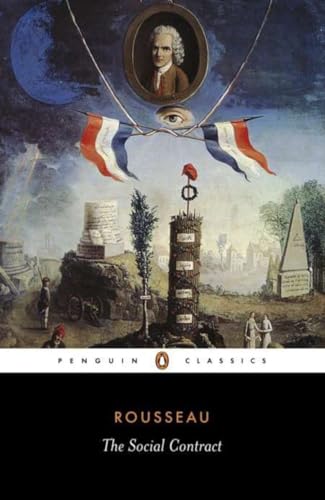
These are the famous opening words of a treatise that has not ceased to stir debate since its publication in 1762. Rejecting the view that anyone has a natural right to wield authority over others, Rousseau argues instead for a pact, or 'social contract', that should exist between all the citizens of a state and that should be the source of sovereign power. From this fundamental premise, he goes on to consider issues of liberty and law, freedom and justice, arriving at a view of society that has seemed to some a blueprint for totalitarianism, to others a declaration of democratic principles.
Translated and Introduced by Maurice Cranston
Die Inhaltsangabe kann sich auf eine andere Ausgabe dieses Titels beziehen.
Über die Autorin bzw. den Autor
Jean-Jacques Rousseau (1712-78) the French political philosopher and educationalist, is the author of A Discourse on Inequality, and Emile.
Maurice Cranston was Professor of Political Science at the London School of Economics and wrote and published widely on Rousseau, including two volumes of biography.
Auszug. © Genehmigter Nachdruck. Alle Rechte vorbehalten.
The Social Contract
By Jean Jacques RousseauPenguin Books
Copyright © 1968 Jean Jacques RousseauAll right reserved.
ISBN: 0140442014
Introduction
Rousseau's Political Triptych SUSAN DUNNIs there any deed more shocking, more hateful, more infamous than the willful burning of a library? Is there any blow more devastating to the core of human civilization? In the mid-eighteenth century, Jean-Jacques Rousseaustartled - and excited - his readers by praising Caliph Omar, who in the year 650 ordered the incineration of the glorious library in Alexandria.
In his first important work, The Discourse on the Sciences and Arts (1750), also known as the First Discourse, Rousseau held that the search for knowledge was so socially and morally destructive that book burning and the subsequent return to ignorance, innocence, and poverty would be a step forward rather than a step backward in the history of civilization. He was convinced that only cultural and material regression could accompany the movement of society toward morality. The entire rational enterprise of the Enlightenment found itself unexpectedly under fierce and principled attack.
When Rousseau burst upon the intellectual scene, the philosophers and writers of eighteenth-century France had for decades been passionately engaged in an audacious, innovative project: the questioning and dismantlingof all the traditional underpinnings of their society. Their daring charge entailed exposing to the light of reason all preconceived ideas, supernatural dogmas and superstitious beliefs, all political and social assumptions.Intellectuals were challenging the theological foundation of monarchy, the privileges of the aristocracy, the doctrines of Catholicism. Having wiped their intellectual slate as clean as they could, men of letters in France embarked upon the bold plan of using human reason to address people's needs: how they should live, govern themselves, organize society, and conceive morality. Their goal was a rational society dedicated to equality,freedom, and happiness. Life had become an intellectual adventure, and people were optimistic that they could shape their own destinies.
Rousseau had once participated in this luminous and probing culture. He too had wanted to embrace all knowledge; he too had known the joy of intellectual curiosity, the bliss of creativity. Mingling and collaborating with artists, musicians, philosophers, and writers - the great philosopheVoltaire, the composer Rameau, the versatile man of letters Diderot, the witty playwright Marivaux, the philosophe Fontenelle - he had reveled in the aristocratic world of brilliant salons, where luxury, elegance, and genius combined to make life a joy for the mind and the senses.
But his fascination with the sophisticated world of the Enlightenment was also colored by bitterness and resentment, the result of his humiliating experience in 1743 working as the secretary for the French Ambassador in Venice; by his disappointments in life, especially his dismay in 1745 at not having received more recognition for his part in a musical collaboration with Voltaire and Rameau; and by his own deep insecurities and demons, his paranoid feeling that he was the target of various cabals conspiring to undermine and discredit him. Suddenly his eyes bore into the heart of this dazzling culture. He judged. He condemned. Behind the splendid facade, he concluded, lay a world that was superficial, corrupt, and cruel.
Astonishingly, Rousseau turned against the entire Enlightenment project.He branded the daring intellectual, scientific, and artistic culture of eighteenth-century France a lie, a vast devolution, a symptom of alarming moral decline. Nothing more than a fake veneer, the century's worldly accomplishments were all the more perfidious because they masked so effectively the deep corruption of a decadent, unequal society. The quest for knowledge and intellectual advancement was a superficial luxury that, insteadof serving society, reinforced its self-indulgence and decay. "We have physicists, geometers, chemists, astronomers, poets, musicians, painters," he remarked, adding tellingly that "we no longer have citizens."
People, Rousseau was convinced, had been deceived, seduced, and corruptedby the radiance of the Enlightenment. And what was worse, they cherished their corruption, for it seemed to mark the summit of progress and civilization. Everywhere Rousseau saw educated individuals who resembled"happy slaves," preferring the glitter of high culture to true freedom and happiness. The search for knowledge had merely taken on a life of its own, divorced from the real needs of society and citizens.
Skepticism and vain inquiry attracted people more than a search for a meaningful life. People believed that they knew everything, Rousseau remarked,but they did not know the meaning of the words magnanimity, equity, temperance, humanity, courage, fatherland, and God. Overwhelmed by pretension, affectation, and deceit, the values that create robust citizensand a healthy society - self-sacrifice, sincere friendships, love of country - had disappeared.
The principles of science and philosophy and the decadent values implicitin the arts on the one hand and the requirements of a healthy societyon the other, Rousseau insisted, are irremediably at odds with one another. Whereas science searches for the truth by fostering doubt and undermining faith and virtue, a vigorous, patriotic society, Rousseau contended, requires assent to the principles of its foundation.
What then is the mission of the intellectual in society? The proper, socially useful role of philosophers and men of letters, according to Rousseau,was not to spread mistrust, not to make piecemeal proposals for incremental reform, not to seek fame and glory for themselves through their intellectual acrobatics, but rather to offer, as he himself would, a radical prescription for the complete social and political overhaul of the nation and for the moral regeneration of its citizens.
In his mind's eye, he saw, in the place of a decadent culture that valued superficial luxury, prosperity, and free though vain inquiry, a muscular, Spartan society that imposed rules and discipline and asked its citizens for sacrifice. In such a polity, virtuous citizens would have no need for futile intellectual pursuits. Indeed, Spartan virtue itself is anti-intellectual. Derivedfrom the Latin word for "man," vir, virtue implied not just moral goodness, but rather strength, courage, and, above all, self-sacrifice and self-discipline.
Even so, Rousseau was not suggesting that French men and women rush out and torch the libraries of France - or copies of his own book. On the contrary, in an already unhealthy, decadent society, science and philosophy might, to some extent, be useful. Certain great individuals - such as Bacon, Descartes, Newton - might serve as guides for humanity, and a few others might be permitted to follow in their footsteps and even outdistance them. In an already corrupt society, the arts and sciences, harmful for "average" people, could, in the hands of a few people of genius, perhaps bring some true enlightenment to all.
The Discourse on the Sciences and Arts won first prize in the Dijon Academy's intellectual competition, a contest that had asked writers and philosophers to respond to the question, "Has the revival of sciences and arts contributed to improving morality?" With Rousseau's friend Diderot having arranged for the essay's publication,...
„Über diesen Titel“ kann sich auf eine andere Ausgabe dieses Titels beziehen.
Suchergebnisse für The Social Contract (Penguin Classics)

Beispielbild für diese ISBN
The Social Contract
Anbieter: World of Books (was SecondSale), Montgomery, IL, USA
Verkäuferbewertung 5 von 5 Sternen

Paperback. Zustand: Fair. Rejecting the view that anyone has a natural right to wield authority over others, this title argues instead for a pact, or 'social contract', that should exist between the citizens of a state and that should be the source of sovereign power. From this fundamental premise, it considers issues of liberty and law, as well as freedom and justice. Bestandsnummer des Verkäufers 00106319144
Gebraucht kaufen
EUR 4,79
Versand gratis
Versand innerhalb von USA
Versand innerhalb von USA
Anzahl: 11 verfügbar
Beispielbild für diese ISBN
The Social Contract
Anbieter: World of Books (was SecondSale), Montgomery, IL, USA
Verkäuferbewertung 5 von 5 Sternen
Paperback. Zustand: Good. Rejecting the view that anyone has a natural right to wield authority over others, this title argues instead for a pact, or 'social contract', that should exist between the citizens of a state and that should be the source of sovereign power. From this fundamental premise, it considers issues of liberty and law, as well as freedom and justice. Bestandsnummer des Verkäufers 00109000376
Gebraucht kaufen
EUR 4,79
Versand gratis
Versand innerhalb von USA
Versand innerhalb von USA
Anzahl: 9 verfügbar
Foto des Verkäufers
The Social Contract (Penguin Classics)
Anbieter: Dream Books Co., Denver, CO, USA
Verkäuferbewertung 5 von 5 Sternen
Zustand: acceptable. This copy has clearly been enjoyedâ"expect noticeable shelf wear and some minor creases to the cover. Binding is strong, and all pages are legible. May contain previous library markings or stamps. Bestandsnummer des Verkäufers 4EKGLF007XZC_ns
Gebraucht kaufen
EUR 4,80
Versand gratis
Versand innerhalb von USA
Versand innerhalb von USA
Anzahl: 5 verfügbar
Beispielbild für diese ISBN
The Social Contract (Penguin Classics)
Verlag:
Penguin Classics (edition ), 1968
ISBN 10: 0140442014
ISBN 13: 9780140442014
Gebraucht
Paperback
Anbieter: BooksRun, Philadelphia, PA, USA
Verkäuferbewertung 5 von 5 Sternen
Paperback. Zustand: Fair. The item might be beaten up but readable. May contain markings or highlighting, as well as stains, bent corners, or any other major defect, but the text is not obscured in any way. Bestandsnummer des Verkäufers 0140442014-7-1
Gebraucht kaufen
EUR 4,80
Versand gratis
Versand innerhalb von USA
Versand innerhalb von USA
Anzahl: 1 verfügbar
Foto des Verkäufers
The Social Contract (Penguin Classics)
Anbieter: Greenworld Books, Arlington, TX, USA
Verkäuferbewertung 5 von 5 Sternen
Zustand: very_good. Fast Free Shipping â" Very Good condition book with a firm cover and clean pages. Shows normal use and some light wear or limited notes markings. A solid, nice copy to enjoy. Bestandsnummer des Verkäufers GWV.0140442014.VG
Gebraucht kaufen
EUR 5,07
Versand gratis
Versand innerhalb von USA
Versand innerhalb von USA
Anzahl: 3 verfügbar
Foto des Verkäufers
The Social Contract (Penguin Classics)
Anbieter: Austin Goodwill 1101, Austin, TX, USA
Verkäuferbewertung 5 von 5 Sternen
Zustand: good. Book shows general signs of use and handling. May have light wear on the cover or edges and minimal writing or highlighting. Binding remains tight, and pages are clean and readable. Bestandsnummer des Verkäufers CTXV.0140442014.G
Gebraucht kaufen
EUR 2,87
EUR 2,95 Versand
Versand innerhalb von USA
Versand innerhalb von USA
Anzahl: 1 verfügbar
Beispielbild für diese ISBN
The Social Contract (Penguin Books for Philosophy)
Anbieter: HPB-Ruby, Dallas, TX, USA
Verkäuferbewertung 5 von 5 Sternen
Paperback. Zustand: Very Good. Connecting readers with great books since 1972! Used books may not include companion materials, and may have some shelf wear or limited writing. We ship orders daily and Customer Service is our top priority! Bestandsnummer des Verkäufers S_472301031
Gebraucht kaufen
EUR 2,52
EUR 3,35 Versand
Versand innerhalb von USA
Versand innerhalb von USA
Anzahl: 1 verfügbar
Beispielbild für diese ISBN
The Social Contract (Penguin Books for Philosophy)
Anbieter: HPB-Diamond, Dallas, TX, USA
Verkäuferbewertung 5 von 5 Sternen
Paperback. Zustand: Very Good. Connecting readers with great books since 1972! Used books may not include companion materials, and may have some shelf wear or limited writing. We ship orders daily and Customer Service is our top priority! Bestandsnummer des Verkäufers S_470650575
Gebraucht kaufen
EUR 2,53
EUR 3,35 Versand
Versand innerhalb von USA
Versand innerhalb von USA
Anzahl: 1 verfügbar
Beispielbild für diese ISBN
The Social Contract (Penguin Books for Philosophy)
Anbieter: HPB-Emerald, Dallas, TX, USA
Verkäuferbewertung 5 von 5 Sternen
Paperback. Zustand: Very Good. Connecting readers with great books since 1972! Used books may not include companion materials, and may have some shelf wear or limited writing. We ship orders daily and Customer Service is our top priority! Bestandsnummer des Verkäufers S_475587116
Gebraucht kaufen
EUR 2,53
EUR 3,35 Versand
Versand innerhalb von USA
Versand innerhalb von USA
Anzahl: 1 verfügbar
Foto des Verkäufers
The Social Contract (Penguin Classics)
Anbieter: Dream Books Co., Denver, CO, USA
Verkäuferbewertung 5 von 5 Sternen
Zustand: good. Gently used with minimal wear on the corners and cover. A few pages may contain light highlighting or writing, but the text remains fully legible. Dust jacket may be missing, and supplemental materials like CDs or codes may not be included. May be ex-library with library markings. Ships promptly! Bestandsnummer des Verkäufers DBV.0140442014.G
Gebraucht kaufen
EUR 5,90
Versand gratis
Versand innerhalb von USA
Versand innerhalb von USA
Anzahl: 1 verfügbar