
Verwandte Artikel zu The Communist Manifesto (Penguin Classics)
Inhaltsangabe
'An astonishing masterpiece ... a political classic ... has an almost biblical force' Eric Hobsbawm
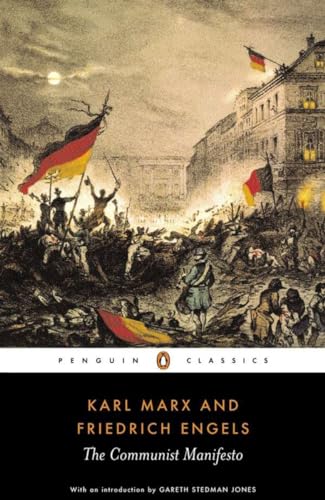
The Communist Manifesto, Marx and Engels' revolutionary 1848 summons to the working classes, is one of the most influential political theories ever formulated. After four years of collaboration, the authors produced this incisive account of their idea of Communism, in which they envisage a society without classes, private property or a state. They argue that increasing exploitation of industrial workers will eventually lead to a revolution in which capitalism is overthrown. Their vision transformed the world irrevocably, and remains relevant as a depiction of global capitalism today.
Edited with an Introduction by GARETH STEDMAN JONES
Die Inhaltsangabe kann sich auf eine andere Ausgabe dieses Titels beziehen.
Über die Autorin bzw. den Autor
Gareth Stedman Jones (External Editor)
Gareth Stedman Jones is currently Professor of the History of Ideas at Queen Mary, University of London. He is a Fellow of King's College, Cambridge and taught at the university for many years, becoming Professor of Political Science in 1997. He is the author of Outcast London, Languages of Class and An End to Poverty? as well as being the editor of the Penguin Classics edition of The Communist Manifesto.
Auszug. © Genehmigter Nachdruck. Alle Rechte vorbehalten.
MANIFESTO OF THE COMMUNIST PARTY
A SPECTRE is haunting Europe--the spectre of Communism. All the Powers of old Europe have entered into a holy alliance to exorcise this spectre: Pope and Czar, Metternich and Guizot, French Radicals and German police-spies.
Where is the party in opposition that has not been decried as Communistic by its opponents in power? Where the Opposition that has not hurled back the branding reproach of Communism, against the more advanced opposition parties, as well as against its reactionary adversaries?
Two things result from this fact.
I. Communism is already acknowledged by all European Powers to be itself a Power.
II. It is high time that Communists should openly, in the face of the whole world, publish their views, their aims, their tendencies, and meet this nursery tale of the Spectre of Communism with a Manifesto of the party itself.
To this end, Communists of various nationalities have assembled in London, and sketched the following Manifesto, to be published in the English, French, German, Italian, Flemish and Danish languages.
I. BOURGEOIS AND PROLETARIANS*
The history of all hitherto existing society is the history of class struggles.
Freeman and slave, patrician and plebeian, lord and serf, guild-master* and journeyman, in a word, oppressor and oppressed, stood in constant opposition to one another, carried on an uninterrupted, now hidden, now open fight, a fight that each time ended, either in a revolutionary re-constitution of society at large, or in the common ruin of the contending classes.
In the earlier epochs of history, we find almost everywhere a complicated arrangement of society into various orders, a manifold gradation of social rank. In ancient Rome we have patricians, knights, plebeians, slaves; in the Middle Ages, feudal lords, vassals, guild-masters, journeymen, apprentices, serfs; in almost all of these classes, again, subordinate gradations.
The modern bourgeois society that has sprouted from the ruins of feudal society has not done away with class antagonisms. It has but established new classes, new conditions of oppression, new forms of struggle in place of the old ones.
Our epoch, the epoch of the bourgeoisie, possesses, however, this distinctive feature: it has simplified the class antagonisms: Society as a whole is more and more splitting up into two great hostile camps, into two great classes directly facing each other: Bourgeoisie and Proletariat.
From the serfs of the Middle Ages sprang the chartered burghers of the earliest towns. From these burgesses the first elements of the bourgeoisie were developed.
The discovery of America, the rounding of the Cape, opened up fresh ground for the rising bourgeoisie. The East-Indian and Chinese markets, the colonisation of America, trade with the colonies, the increase in the means of exchange and in commodities generally, gave to commerce, to navigation, to industry, an impulse never before known, and thereby, to the revolutionary element in the tottering feudal society, a rapid development.
The feudal system of industry, under which industrial production was monopolised by closed guilds, now no longer sufficed for the growing wants of the new markets. The manufacturing system took its place. The guild-masters were pushed on one side by the manufacturing middle class; division of labour between the different corporate guilds vanished in the face of division of labour in each single workshop.
Meantime the markets kept ever growing, the demand ever rising. Even manufacture no longer sufficed. Thereupon, steam and machinery revolutionized industrial production. The place of manufacture was taken by the giant, Modern Industry, the place of the industrial middle class, by industrial millionaires, the leaders of whole industrial armies, the modern bourgeois.
Modern industry has established the world-market, for which the discovery of America paved the way. This market has given an immense development to commerce, to navigation, to communication by land. This development has, in its turn, reacted on the extension of industry; and in proportion as industry, commerce, navigation, railways extended, in the same proportion the bourgeoisie developed, increased its capital, and pushed into the background every class handed down from the Middle Ages.
We see, therefore, how the modern bourgeoisie is itself the product of a long course of development, of a series of revolutions in the modes of production and of exchange.
Each step in the development of the bourgeoisie was accompanied by a corresponding political advance of that class. An oppressed class under the sway of the feudal nobility, an armed and self-governing association in the mediaeval commune,* here independent urban republic (as in Italy and Germany), there taxable "third estate" of the monarchy (as in France), afterwards, in the period of manufacture proper, serving either the semi-feudal or the absolute monarchy as a counterpoise against the nobility, and, in fact, corner-stone of the great monarchies in general, the bourgeoisie has at last, since the establishment of Modern Industry and of the world-market, conquered for itself, in the modern representative State, exclusive political sway. The executive of the modern State is but a committee for managing the common affairs of the whole bourgeoisie.
The bourgeoisie, historically, has played a most revolutionary part.
The bourgeoisie, wherever it has got the upper hand, has put an end to all feudal, patriarchal, idyllic relations. It has pitilessly torn asunder the motley feudal ties that bound man to his "natural superiors," and has left remaining no other nexus between man and man than naked self-interest, than callous "cash payment." It has drowned the most heavenly ecstasies of religious fervour, of chivalrous enthusiasm, of philistine sentimentalism, in the icy water of egotistical calculation. It has resolved personal worth into exchange value, and in place of the numberless indefeasible chartered freedoms, has set up that single, unconscionable freedom--Free Trade. In one word, for exploitation, veiled by religious and political illusions, it has substituted naked, shameless, direct, brutal exploitation.
The bourgeoisie has stripped of its halo every occupation hitherto honoured and looked up to with reverent awe. It has converted the physician, the lawyer, the priest, the poet, the man of science, into its paid wage-labourers.
The bourgeoisie has torn away from the family its sentimental veil, and has reduced the family relation to a mere money relation.
The bourgeoisie has disclosed how it came to pass that the brutal display of vigour in the Middle Ages, which Reactionists so much admire, found its fitting complement in the most slothful indolence. It has been the first to show what man's activity can bring about. It has accomplished wonders far surpassing Egyptian pyramids, Roman aqueducts, and Gothic cathedrals; it has conducted expeditions that put in the shade all former Exoduses of nations and crusades.
The bourgeoisie cannot exist without constantly revolutionizing the instruments of production, and thereby the relations of production, and with them the whole relations of society. Conservation of the old modes of production in unaltered form, was, on the contrary, the first condition of existence for all earlier industrial classes. Constant revolutionizing of production, uninterrupted disturbance of all social conditions, everlasting uncertainty and agitation distinguish the bourgeois epoch from all earlier ones. All fixed, fast-frozen relations, with their train of ancient and venerable prejudices and opinions, are swept away, all new-formed ones become antiquated before they can ossify. All that is...
„Über diesen Titel“ kann sich auf eine andere Ausgabe dieses Titels beziehen.
Suchergebnisse für The Communist Manifesto (Penguin Classics)

Beispielbild für diese ISBN
The Communist Manifesto (Penguin Classics)
Verlag:
Penguin Classics (edition Revised ed.), 2002
ISBN 10: 0140447571
ISBN 13: 9780140447576
Gebraucht
Paperback
Anbieter: BooksRun, Philadelphia, PA, USA
Verkäuferbewertung 5 von 5 Sternen

Paperback. Zustand: Fair. Revised ed. The item might be beaten up but readable. May contain markings or highlighting, as well as stains, bent corners, or any other major defect, but the text is not obscured in any way. Bestandsnummer des Verkäufers 0140447571-7-1
Gebraucht kaufen
EUR 5,42
Versand gratis
Versand innerhalb von USA
Versand innerhalb von USA
Anzahl: 2 verfügbar
Beispielbild für diese ISBN
The Communist Manifesto (Penguin Classics)
Anbieter: Indiana Book Company, Marion, IN, USA
Verkäuferbewertung 5 von 5 Sternen
Zustand: Acceptable. Ships same or next business day with delivery confirmation. Acceptable condition. Contains highlighting. Expedited shipping available. Bestandsnummer des Verkäufers 1000011493164-100
Gebraucht kaufen
EUR 3,69
EUR 2,91 Versand
Versand innerhalb von USA
Versand innerhalb von USA
Anzahl: 11 verfügbar
Beispielbild für diese ISBN
The Communist Manifesto (Penguin Classics)
Anbieter: HPB-Emerald, Dallas, TX, USA
Verkäuferbewertung 5 von 5 Sternen
Paperback. Zustand: Very Good. Connecting readers with great books since 1972! Used books may not include companion materials, and may have some shelf wear or limited writing. We ship orders daily and Customer Service is our top priority! Bestandsnummer des Verkäufers S_489304140
Gebraucht kaufen
EUR 3,68
EUR 3,36 Versand
Versand innerhalb von USA
Versand innerhalb von USA
Anzahl: 1 verfügbar
Beispielbild für diese ISBN
The Communist Manifesto (Penguin Classics)
Anbieter: HPB-Diamond, Dallas, TX, USA
Verkäuferbewertung 5 von 5 Sternen
Paperback. Zustand: Very Good. Connecting readers with great books since 1972! Used books may not include companion materials, and may have some shelf wear or limited writing. We ship orders daily and Customer Service is our top priority! Bestandsnummer des Verkäufers S_489174528
Gebraucht kaufen
EUR 3,68
EUR 3,36 Versand
Versand innerhalb von USA
Versand innerhalb von USA
Anzahl: 1 verfügbar
Beispielbild für diese ISBN
The Communist Manifesto
Anbieter: World of Books (was SecondSale), Montgomery, IL, USA
Verkäuferbewertung 5 von 5 Sternen
Paperback. Zustand: Good. The Communist Manifesto (1848), Marx and Engels's revolutionary summons to the working classes, is one of the most important and influential political theories ever formulated. After four years of collaboration the authors produced this incisive account of their idea of Communism, in which they envisage a society without classes, private property or a state. They argue that increasing exploitation of industrial workers will eventually lead to a revolution in which Capitalism is overthrown. This vision provided the theoretical basis of political systems in Russia, China, Cuba and Eastern Europe, affecting the lives of millions. The Communist Manifesto still remains a landmark text: a work that continues to influence and provoke debate on capitalism and class. Bestandsnummer des Verkäufers 00110863824
Gebraucht kaufen
EUR 8,19
Versand gratis
Versand innerhalb von USA
Versand innerhalb von USA
Anzahl: 1 verfügbar
Beispielbild für diese ISBN
The Communist Manifesto (Penguin Classics)
Anbieter: A Team Books, Conway, AR, USA
Verkäuferbewertung 5 von 5 Sternen
paperback. Zustand: Acceptable. Used books may not include access codes or one time use codes. Proven Seller with Excellent Customer Service. Choose expedited shipping and get it FAST. Bestandsnummer des Verkäufers sun0000009780
Gebraucht kaufen
EUR 5,53
EUR 2,69 Versand
Versand innerhalb von USA
Versand innerhalb von USA
Anzahl: 1 verfügbar
Foto des Verkäufers
The Communist Manifesto
Anbieter: eCampus, Lexington, KY, USA
Verkäuferbewertung 4 von 5 Sternen

Zustand: Very Good. Bestandsnummer des Verkäufers U:9780140447576:ONHAND
Gebraucht kaufen
EUR 5,08
EUR 3,58 Versand
Versand innerhalb von USA
Versand innerhalb von USA
Anzahl: 1 verfügbar
Foto des Verkäufers
Communist Manifesto
Anbieter: GreatBookPrices, Columbia, MD, USA
Verkäuferbewertung 5 von 5 Sternen
Zustand: New. Bestandsnummer des Verkäufers 638043-n
Neu kaufen
EUR 6,71
EUR 2,37 Versand
Versand innerhalb von USA
Versand innerhalb von USA
Anzahl: Mehr als 20 verfügbar
Foto des Verkäufers
The Communist Manifesto
Anbieter: Rarewaves USA, HEBRON, KY, USA
Verkäuferbewertung 5 von 5 Sternen
Paperback. Zustand: New. 'An astonishing masterpiece . a political classic . has an almost biblical force' Eric HobsbawmThe Communist Manifesto, Marx and Engels' revolutionary 1848 summons to the working classes, is one of the most influential political theories ever formulated. After four years of collaboration, the authors produced this incisive account of their idea of Communism, in which they envisage a society without classes, private property or a state. They argue that increasing exploitation of industrial workers will eventually lead to a revolution in which capitalism is overthrown. Their vision transformed the world irrevocably, and remains relevant as a depiction of global capitalism today.Edited with an Introduction by GARETH STEDMAN JONES. Bestandsnummer des Verkäufers LU-9780140447576
Beispielbild für diese ISBN
The Communist Manifesto (Penguin Classics)
Anbieter: Lakeside Books, Benton Harbor, MI, USA
Verkäuferbewertung 5 von 5 Sternen
Zustand: New. Brand New! Not Overstocks or Low Quality Book Club Editions! Direct From the Publisher! We're not a giant, faceless warehouse organization! We're a small town bookstore that loves books and loves it's customers! Buy from Lakeside Books! Bestandsnummer des Verkäufers OTF-Y-9780140447576
Neu kaufen
EUR 5,68
EUR 3,58 Versand
Versand innerhalb von USA
Versand innerhalb von USA
Anzahl: Mehr als 20 verfügbar