
Verwandte Artikel zu Where Angels Fear to Tread: Edited with notes by Oliver...
Inhaltsangabe
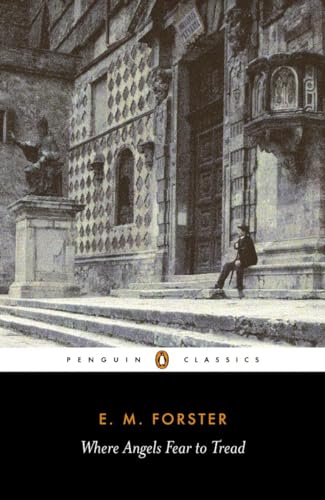
E.M. Forster's Where Angels Fear to Tread is amongst the greatest twentieth-century literary explorations of vice, virtue and the nature of prejudice, edited with notes by Oliver Stallybrass and an introduction by Ruth Padel in Penguin Classics.
On travelling to Italy with her friend Caroline Abbott, the impulsive English widow Lilia Herriton outrages her dead husband's family by meeting and quickly becoming engaged to Gino, a dashing but deeply unsuitable Italian man twelve years her junior. Infuriated, her ex-brother-in-law Philip sets off from England to her new home in the Tuscan town of Monteriano - but, finding himself unable to persuade Lilia to leave her handsome, uncouth new lover, returns to England without her. When Lilia's marriage leads to sudden tragedy, however, Philip and Caroline feel compelled to return once more to Italy, where they are forced to examine their own lives.
This edition reproduces the Abinger text, and also includes further reading, notes, a chronology, an introduction by Ruth Padel discussing division and culture clash in the novel and an appendix detailing an exchange about the novel between Forster and the poet R.C. Trevelyan.
E. M. Forster (1879-1970) was a noted English author and critic and a member of the Bloomsbury group. His first novel, Where Angels Fear To Tread appeared in 1905. The Longest Journey appeared in 1907, followed by A Room With A View (1908), based partly on the material from extended holidays in Italy with his mother. Howards End (1910) was a story that centered on an English country house and dealt with the clash between two families, one interested in art and literature, the other only in business. Maurice was revised several times during his life, and finally published posthumously in 1971.
If you enjoyed Where Angels Fear to Tread, you might enjoy Forster's A Room With a View, also available in Penguin Classics.
Die Inhaltsangabe kann sich auf eine andere Ausgabe dieses Titels beziehen.
Über die Autorin bzw. den Autor
Edward Morgan Forster was born in London in 1879. He wrote six novels, four of which appeared before the First World War: Where Angels Fear to Tread (1905), The Longest Journey (1907), A Room with a View (1908), and Howard’s End (1910). An interval of fourteen years elapsed before he published A Passage to India. Maurice, his novel on a homosexual theme, finished in 1914, was published posthumously in 1971. He died in June 1970.
Ruth Padel is a British poet, a Fellow of the Royal Society of Literature. She has won the UK National Poetry Competition and published six collections of poetry. Voodoo Shop (2002) was shortlisted for the T. S. Eliot and Whitbread Prizes. The Soho Leopard (2004) is a Poetry Book Society Choice. She wrote the popular "Sunday Poem" column for the Independent on Sunday for three years.
Auszug. © Genehmigter Nachdruck. Alle Rechte vorbehalten.
1They were all at Charing Cross to see Lilia off—Philip, Harriet, Irma, Mrs. Herriton herself. Even Mrs. Theobald, squired by Mr. Kingcroft, had braved the journey from Yorkshire to bid her only daughter good-bye. Miss Abbott was likewise attended by numerous relatives, and the sight of so many people talking at once and saying such different things caused Lilia to break into ungovernable peals of laughter."Quite an ovation," she cried, sprawling out of her first-class carriage. "They'll take us for royalty. Oh, Mr. Kingcroft, get us footwarmers."The good-natured young man hurried away, and Philip, taking his place, flooded her with a final stream of advice and injunctions—where to stop, how to learn Italian, when to use mosquito-nets, what pictures to look at. "Remember," he concluded, "that it is only by going off the track that you get to know the country. See the little towns—Gubbio, Pienza, Cortona, San Gemignano, Monteriano. And don't, let me beg you, go with that awful tourist idea that Italy's only a museum of antiquities and art. Love and understand the Italians, for the people are more marvellous than the land.""How I wish you were coming, Philip," she said, flattered at the unwonted notice her brother-in-law was giving her."I wish I were." He could have managed it without great difficulty, for his career at the Bar was not so intense as to prevent occasional holidays. But his family disliked his continual visits to the Continent, and he himself often found pleasure in the idea that he was too busy to leave town."Good-bye, dear every one. What a whirl!" She caught sight of her little daughter Irma, and felt that a touch of maternal solemnity was required. "Good-bye, darling. Mind you're always good, and do what Granny tells you."She referred not to her own mother, but to her mother-in-law, Mrs. Herriton, who hated the title of Granny.Irma lifted a serious face to be kissed, and said cautiously, "I'll do my best.""She is sure to be good," said Mrs. Herriton, who was standing pensively a little out of the hubbub. But Lilia was already calling to Miss Abbott, a tall, grave, rather nice-looking young lady who was conducting her adieus in a more decorous manner on the platform."Caroline, my Caroline! Jump in, or your chaperon will go off without you."And Philip, whom the idea of Italy always intoxicated, had started again, telling her of the supreme moments of her coming journey—the Campanile of Airolo, which would burst on her when she emerged from the St. Gothard tunnel, presaging the future; the view of the Ticino and Lago Maggiore as the train climbed the slopes of Monte Cenere; the view of Lugano, the view of Como—Italy gathering thick around her now—the arrival at her first resting-place, when, after long driving through dark and dirty streets, she should at last behold, amid the roar of trams and the glare of arc lamps, the buttresses of the cathedral of Milan."Handkerchiefs and collars," screamed Harriet, "in my inlaid box! I've lent you my inlaid box.""Good old Harry!" She kissed every one again, and there was a moment's silence. They all smiled steadily, excepting Philip, who was choking in the fog, and old Mrs. Theobald, who had begun to cry. Miss Abbott got into the carriage. The guard himself shut the door, and told Lilia that she would be all right. Then the train moved, and they all moved with it a couple of steps, and waved their handkerchiefs, and uttered cheerful little cries. At that moment Mr. Kingcroft reappeared, carrying a footwarmer by both ends, as if it was a tea-tray. He was sorry that he was too late, and called out in a quivering voice, "Good-bye, Mrs. Charles. May you enjoy yourself, and may God bless you."Lilia smiled and nodded, and then the absurd position of the footwarmer overcame her, and she began to laugh again."Oh, I am so sorry," she cried back, "but you do look so funny. Oh, you all look so funny waving! Oh, pray!" And laughing helplessly, she was carried out into the fog."High spirits to begin so long a journey," said Mrs. Theobald, dabbing her eyes.Mr. Kingcroft solemnly moved his head in token of agreement. "I wish," said he, "that Mrs. Charles had gotten the footwarmer. These London porters won't take heed to a country chap.""But you did your best," said Mrs. Herriton. "And I think it simply noble of you to have brought Mrs. Theobald all the way here on such a day as this." Then, rather hastily, she shook hands, and left him to take Mrs. Theobald all the way back.Sawston, her own home, was within easy reach of London, and they were not late for tea. Tea was in the dining-room, with an egg for Irma, to keep up the child's spirits. The house seemed strangely quiet after a fortnight's bustle, and their conversation was spasmodic and subdued. They wondered whether the travellers had got to Folkestone, whether it would be at all rough, and if so what would happen to poor Miss Abbott."And, Granny, when will the old ship get to Italy?" asked Irma." 'Grandmother,' dear; not 'Granny,' " said Mrs. Herriton, giving her a kiss. "And we say 'a boat' or 'a steamer,' not 'a ship.' Ships have sails. And mother won't go all the way by sea. You look at the map of Europe, and you'll see why. Harriet, take her. Go with Aunt Harriet, and she'll show you the map.""Righto!" said the little girl, and dragged the reluctant Harriet into the library. Mrs. Herriton and her son were left alone. There was immediately confidence between them."Here beginneth the New Life," said Philip."Poor child, how vulgar!" murmured Mrs. Herriton. "It's surprising that she isn't worse. But she has got a look of poor Charles about her.""And—alas, alas!—a look of old Mrs. Theobald. What appalling apparition was that! I did think the lady was bedridden as well as imbecile. Why ever did she come?""Mr. Kingcroft made her. I am certain of it. He wanted to see Lilia again, and this was the only way.""I hope he is satisfied. I did not think my sister-in-law distinguished herself in her farewells."Mrs. Herriton shuddered. "I mind nothing, so long as she has gone—and gone with Miss Abbott. It is mortifying to think that a widow of thirty-three requires a girl ten years younger to look after her.""I pity Miss Abbott. Fortunately one admirer is chained to England. Mr. Kingcroft cannot leave the crops or the climate or something. I don't think, either, he improved his chances today. He, as well as Lilia, has the knack of being absurd in public."Mrs. Herriton replied, "When a man is neither well bred, nor well connected, nor handsome, nor clever, nor rich, even Lilia may discard him in time.""No. I believe she would take any one. Right up to the last, when her boxes were packed, she was 'playing' the chinless curate. Both the curates are chinless, but hers had the dampest hands. I came on them in the Park. They were speaking of the Pentateuch.""My dear boy! If possible, she has got worse and worse. It was your idea of Italian travel that saved us!"Philip brightened at the little compliment. "The odd part is that she was quite eager—always asking me for information; and of coure I was very glad to give it. I admit she is a Philistine, appallingly ignorant, and her taste in art is false. Still, to have any taste at all is something. And I do believe that Italy really purifies and ennobles all who visit her. She is the school as well as the playground of the world. It is really to Lilia's credit that she wants to go there.""She would go anywhere," said his mother, who had heard enough of the praises of Italy. "I...
„Über diesen Titel“ kann sich auf eine andere Ausgabe dieses Titels beziehen.
Suchergebnisse für Where Angels Fear to Tread: Edited with notes by Oliver...

Beispielbild für diese ISBN
Where Angels Fear to Tread (Penguin Classics)
Anbieter: Wonder Book, Frederick, MD, USA
Verkäuferbewertung 5 von 5 Sternen

Zustand: Good. Good condition. A copy that has been read but remains intact. May contain markings such as bookplates, stamps, limited notes and highlighting, or a few light stains. Bestandsnummer des Verkäufers M11O-1355
Gebraucht kaufen
EUR 6,43
Versand gratis
Versand innerhalb von USA
Versand innerhalb von USA
Anzahl: 1 verfügbar
Beispielbild für diese ISBN
Where Angels Fear to Tread
Verlag:
Penguin Publishing Group, 2008
ISBN 10: 0141441453
ISBN 13: 9780141441450
Gebraucht
Softcover
Anbieter: Better World Books, Mishawaka, IN, USA
Verkäuferbewertung 5 von 5 Sternen
Zustand: Good. Former library copy. Pages intact with minimal writing/highlighting. The binding may be loose and creased. Dust jackets/supplements are not included. Includes library markings. Stock photo provided. Product includes identifying sticker. Better World Books: Buy Books. Do Good. Bestandsnummer des Verkäufers 6539398-6
Gebraucht kaufen
EUR 7,21
Versand gratis
Versand innerhalb von USA
Versand innerhalb von USA
Anzahl: 1 verfügbar
Beispielbild für diese ISBN
Where Angels Fear to Tread (Penguin Classics)
Anbieter: Half Price Books Inc., Dallas, TX, USA
Verkäuferbewertung 5 von 5 Sternen
Paperback. Zustand: Very Good. Connecting readers with great books since 1972! Used books may not include companion materials, and may have some shelf wear or limited writing. We ship orders daily and Customer Service is our top priority! Bestandsnummer des Verkäufers S_483341850
Gebraucht kaufen
EUR 4,78
EUR 3,35 Versand
Versand innerhalb von USA
Versand innerhalb von USA
Anzahl: 1 verfügbar
Beispielbild für diese ISBN
Where Angels Fear to Tread
Anbieter: ThriftBooks-Atlanta, AUSTELL, GA, USA
Verkäuferbewertung 5 von 5 Sternen
Paperback. Zustand: Fair. No Jacket. Former library book; Readable copy. Pages may have considerable notes/highlighting. ~ ThriftBooks: Read More, Spend Less. Bestandsnummer des Verkäufers G0141441453I5N10
Gebraucht kaufen
EUR 8,13
Versand gratis
Versand innerhalb von USA
Versand innerhalb von USA
Anzahl: 1 verfügbar
Beispielbild für diese ISBN
Where Angels Fear to Tread
Anbieter: ThriftBooks-Atlanta, AUSTELL, GA, USA
Verkäuferbewertung 5 von 5 Sternen
Paperback. Zustand: Fair. No Jacket. Readable copy. Pages may have considerable notes/highlighting. ~ ThriftBooks: Read More, Spend Less. Bestandsnummer des Verkäufers G0141441453I5N00
Gebraucht kaufen
EUR 8,13
Versand gratis
Versand innerhalb von USA
Versand innerhalb von USA
Anzahl: 1 verfügbar
Foto des Verkäufers
Where Angels Fear to Tread (Penguin Classics)
Anbieter: Blue Vase Books, Interlochen, MI, USA
Verkäuferbewertung 5 von 5 Sternen
Zustand: acceptable. The item is very worn but is perfectly usable. Signs of wear can include aesthetic issues such as scratches, dents, worn and creased covers, folded page corners and minor liquid stains. All pages and the cover are intact, but the dust cover may be missing. Pages may include moderate to heavy amount of notes and highlighting, but the text is not obscured or unreadable. Page edges may have foxing age related spots and browning . May NOT include discs, access code or other supplemental materials. Bestandsnummer des Verkäufers BVV.0141441453.A
Gebraucht kaufen
EUR 8,27
Versand gratis
Versand innerhalb von USA
Versand innerhalb von USA
Anzahl: 1 verfügbar
Beispielbild für diese ISBN
Where Angels Fear to Tread (Penguin Classics)
Anbieter: AwesomeBooks, Wallingford, Vereinigtes Königreich
Verkäuferbewertung 5 von 5 Sternen
paperback. Zustand: Very Good. Where Angels Fear to Tread (Penguin Classics) This book is in very good condition and will be shipped within 24 hours of ordering. The cover may have some limited signs of wear but the pages are clean, intact and the spine remains undamaged. This book has clearly been well maintained and looked after thus far. Money back guarantee if you are not satisfied. See all our books here, order more than 1 book and get discounted shipping. Bestandsnummer des Verkäufers 7719-9780141441450
Gebraucht kaufen
EUR 3,74
EUR 4,92 Versand
Versand von Vereinigtes Königreich nach USA
Versand von Vereinigtes Königreich nach USA
Anzahl: 2 verfügbar
Beispielbild für diese ISBN
Where Angels Fear to Tread (Penguin Classics)
Verlag:
Penguin Books Ltd, United Kingdom, London, 2007
ISBN 10: 0141441453
ISBN 13: 9780141441450
Gebraucht
Paperback
Anbieter: WorldofBooks, Goring-By-Sea, WS, Vereinigtes Königreich
Verkäuferbewertung 5 von 5 Sternen
Paperback. Zustand: Very Good. E.M. Forster's Where Angels Fear to Tread is amongst the greatest twentieth-century literary explorations of vice, virtue and the nature of prejudice, edited with notes by Oliver Stallybrass and an introduction by Ruth Padel in Penguin Classics.On travelling to Italy with her friend Caroline Abbott, the impulsive English widow Lilia Herriton outrages her dead husband's family by meeting and quickly becoming engaged to Gino, a dashing but deeply unsuitable Italian man twelve years her junior. Infuriated, her ex-brother-in-law Philip sets off from England to her new home in the Tuscan town of Monteriano - but, finding himself unable to persuade Lilia to leave her handsome, uncouth new lover, returns to England without her. When Lilia's marriage leads to sudden tragedy, however, Philip and Caroline feel compelled to return once more to Italy, where they are forced to examine their own lives.This edition reproduces the Abinger text, and also includes further reading, notes, a chronology, an introduction by Ruth Padel discussing division and culture clash in the novel and an appendix detailing an exchange about the novel between Forster and the poet R.C. Trevelyan.E. M. Forster (1879-1970) was a noted English author and critic and a member of the Bloomsbury group. His first novel, Where Angels Fear To Tread appeared in 1905. The Longest Journey appeared in 1907, followed by A Room With A View (1908), based partly on the material from extended holidays in Italy with his mother. Howards End (1910) was a story that centered on an English country house and dealt with the clash between two families, one interested in art and literature, the other only in business. Maurice was revised several times during his life, and finally published posthumously in 1971.If you enjoyed Where Angels Fear to Tread, you might enjoy Forster's A Room With a View, also available in Penguin Classics. The book has been read, but is in excellent condition. Pages are intact and not marred by notes or highlighting. The spine remains undamaged. Bestandsnummer des Verkäufers GOR001470803
Gebraucht kaufen
EUR 3,99
EUR 6,69 Versand
Versand von Vereinigtes Königreich nach USA
Versand von Vereinigtes Königreich nach USA
Anzahl: 7 verfügbar
Foto des Verkäufers
Where Angels Fear to Tread (Penguin Classics)
Anbieter: Goodwill of Greater Milwaukee and Chicago, Racine, WI, USA
Verkäuferbewertung 5 von 5 Sternen
Zustand: acceptable. Book is considered to be in acceptable condition. The actual cover image may not match the stock photo. Book may have one or more of the following defects: noticeable wear on the cover dust jacket or spine; curved, dog eared or creased page s ; writing or highlighting inside or on the edges; sticker s or other adhesive on cover; CD DVD may not be included; and book may be a former library copy. Bestandsnummer des Verkäufers SEWV.0141441453.A
Gebraucht kaufen
EUR 8,26
EUR 2,68 Versand
Versand innerhalb von USA
Versand innerhalb von USA
Anzahl: 1 verfügbar
Beispielbild für diese ISBN
Where Angels Fear to Tread
Verlag:
Penguin Publishing Group, 2008
ISBN 10: 0141441453
ISBN 13: 9780141441450
Gebraucht
Softcover
Anbieter: Better World Books Ltd, Dunfermline, Vereinigtes Königreich
Verkäuferbewertung 5 von 5 Sternen
Zustand: Good. Former library copy. Pages intact with minimal writing/highlighting. The binding may be loose and creased. Dust jackets/supplements are not included. Includes library markings. Stock photo provided. Product includes identifying sticker. Better World Books: Buy Books. Do Good. Bestandsnummer des Verkäufers 6539398-6
Gebraucht kaufen
EUR 5,76
EUR 5,97 Versand
Versand von Vereinigtes Königreich nach USA
Versand von Vereinigtes Königreich nach USA
Anzahl: 3 verfügbar