
Verwandte Artikel zu The Procedure
Inhaltsangabe
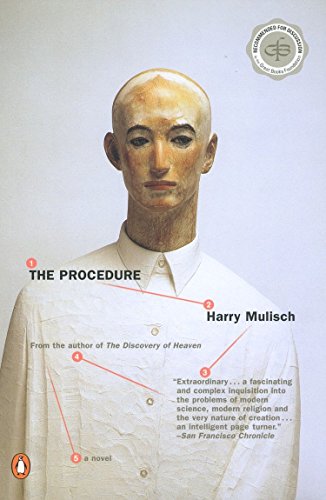
Internationally renowned novelist Harry Mulisch's The Procedure is a haunting and fascinating novel about two men who try to create life but fail. In the late sixteenth century, Rabbi Jehudah Löw, in order to guarantee the safety of the Jews in Prague, creates a golem by following a procedure outlined in a third-century cabalist text. Four hundred years later, Victor Werker, a Dutch biologist mourning the loss of his stillborn daughter, causes an international uproar when he creates a complex organic clay crystal that can reproduce and has a metabolism. But his unsettling discovery takes its toll as his inner and outer demons pursue him around the world, from California to Venice, Cairo, and Jerusalem.
Die Inhaltsangabe kann sich auf eine andere Ausgabe dieses Titels beziehen.
Über die Autorin bzw. den Autor
Harry Mulisch is author of the international bestsellers The Assault, The Discovery of Heaven, and The Procedure, as well as other novels, short stories, essays, poetry, plays, and philosophical works.
Auszug. © Genehmigter Nachdruck. Alle Rechte vorbehalten.
The Procedure, Chapter One
DEED A
SPEAKING
So cleverly did his art conceal its art
P. Ovidius Naso,
Metamorphoses, X. 252
FIRST DOCUMENT
MAN
yes, of course I can come straight to the point and start with a sentence like: The telephone rang. Who's ringing whom? Why? It must be something important, otherwise the file wouldn't open with it. Suspense! Action! But I can't do it that way this time. On the contrary. Before anything can come to life here, we must both prepare ourselves through introspection and prayer. Anyone who wants to be swept along immediately, in order to kill time, would do better to close this book at once, put the television on, and sink back on the settee as one does in a hot foam bath. So before writing and reading any further we're going to fast for a day, and then bathe in cool, pure water, after which we will shroud ourselves in robes of the finest white linen.
I've switched the telephone and the front doorbell off and turned the clock on my desk away from me; everything in my study is waiting for the events to come. The first luminous words have appeared in the ultramarine of the computer screen, while outside the dazzling, setting autumn sun shines over the square. From the blazing western sky tram rails stream like molten gold from a blast furnace; between the black trees cars appear from the chaos, disappear into it, people walk at the tips of shadows that are yards long. From the position of the sun in my room I can see what time it is: the light is falling diagonally, it's six o'clock, rush hour, for most people the day's work is over.
The origin of man was a complicated affair. Much of it is still obscure, not only in biological, but also in theological circles. In the Bible, indeed, this creature is actually created twice, and to a certain extent three times. Genesis 1:27 tells us that on the sixth and last day of creation the following happened: "So God created man in his own image, in the image of God created he him; male and female created he them." So there were two of them; immediately afterward God says: "Be fruitful, and multiply." So the man was Adam, but the woman wasn't Eve, because the primeval mother of us all saw the light of day only later, when the week of creation was long since over; she wasn't created separately, but came forth from a rib of Adam's. The latter was very pleased about this, because in Genesis 2:23 he declares: "This is now bone of my bones, and flesh of my flesh." At last! This also shows that Eve was his second wife. But what about the first? Who was she? Fortunately experts have been able to ascertain this: Lilith.
Very self-assured, because created just as independently as Adam, she did not wish to subordinate herself to him. Consequently the rift between them centered on the manner of "reproduction": she was reluctant to be the party underneath. Another element in their conflict over sexual technicalities may have been the fact that Adam was already carrying Eve and so at that stage must have been a rather effeminate type. The row flared up in any case and Lilith finally did something terrible: she cursed. That is, she spoke the ineffable, seventy-two-letter name of JHVH, instantly turned into a demon and flew off. Immediately JHVH sent the angels SNVJ, SNSNVJ, and SMNGLPH in pursuit, who intercepted her over the Red Sea. But they couldn't eliminate her. Ever since, she has preyed on single men and strangled children in childbirth. In brief, in every respect Lilith is the opposite of the later Eve, the primeval mother, who through her creation finally made a real man of Adam.
But by that time-after the week of creation, that is-this Adam had been created for the second time. Anyone who still owns a Bible (otherwise he should just look in a bedside table at the nearest hotel), can read in Genesis 2:7: "And the Lord God formed man of the dust of the ground, and breathed into his nostrils the breath of life; and man became a living soul." The difference between this and the first time is that we are now given some concrete details, but too little to be able to make use of it for ourselves. Fortunately there are other sources besides the Bible. Over the centuries, without distinction between the first and second creation of Adam, a number of scholars have reconstructed the course of events on the sixth and last day of creation from hour to hour, but the timetables they have presented differ. According to one of them Adam appeared in JHVH's thoughts in the first hour. In the second hour JHVH discussed his brainwave with the cabinet of archangels. Some of them thought it a good idea, others were opposed; but while the angels were still debating and squabbling, in the third hour JHVH began collecting red, black, white, and brown earth. This was, of course, not just any old dust, but the finest dust from all corners of the earth, and particularly from the spot where subsequently the Temple of Solomon was to arise. In the fourth hour, using the purest water, he kneaded it into clay. In the fifth hour he formed Adam's body. In the sixth hour he made a golem of him, an "earth germ": an entity that was no longer inorganic, but was not yet a human being either. In the seventh hour, on the same Temple Mount where so many memorable events were later to take place, he breathed a soul into the embryonic creature, after which in the eighth hour he finally set Adam ("Earth") in Paradise, where the latter showed himself capable of speech by giving names to the animals: "chimpanzee," "orangutan..."
In heaven the archangels were meanwhile still quarreling about the desirability of man, but JHVH said, "Why are you still talking? He has already been created." He seems to have had other problems with his ministers for that matter, because according to some sources Adam was initially as large as the whole universe, which they saw as a threat. Thereupon God reduced him to more moderate, although still gigantic proportions. Only after the fall did he and his Eve acquire the dimensions still customary today.
In this way we learn more and more. I myself am-professionally-curious to know further details about that mysterious sixth hour. What did JHVH actually get up to in it? Intermediate stages, origins, decay, twilights, metamorphoses, are always more interesting than what's already there, is not yet there, or is no longer there. The transition in the seventh hour from organic matter to man through the divine breath of life is less essential than the transition from dead to living matter in the sixth hour. The difference between an amoeba and a human being is less than that between a crystal and an amoeba, because in the latter case the difference is almost 100 percent. (Almost? Not 100 percent? What then? 99.999...percent? Patience!) So that during that transition, in the sixth hour, something really fundamental happened. What exactly?
I have great news. In the virtually endless twists and turns of Scripture there is a piece of writing that tells us something about this: Sefer Yetsirah, The Book of Creation. It was written in Hebrew, presumably in about the third century in Palestine, by an anonymous Jewish neo-Pythagorean, and is the complete antithesis of what is regarded at the end of the twentieth century as a readable text. I doubt whether at this moment more than a hundred people in the entire world are poring over that mysterious book; it's rather like a secret, metaphysical royal chamber in the pyramid of the written word. For that matter, "book" is too grand a word; it consists of six short chapters, divided into eighty-one sections, all in all less than two thousand words, that is, scarcely five A4 sheets. I must confess that this fills me with immeasurable jealousy: five A4 sheets! Since quantity is also quality, every writer wants to write a book of a thousand pages-but a...
„Über diesen Titel“ kann sich auf eine andere Ausgabe dieses Titels beziehen.
Suchergebnisse für The Procedure

Beispielbild für diese ISBN
The Procedure
Verlag:
Penguin Publishing Group (edition Reprint), 2002
ISBN 10: 0142001279
ISBN 13: 9780142001271
Gebraucht
Paperback
Anbieter: BooksRun, Philadelphia, PA, USA
Verkäuferbewertung 5 von 5 Sternen

Paperback. Zustand: Very Good. Reprint. It's a well-cared-for item that has seen limited use. The item may show minor signs of wear. All the text is legible, with all pages included. It may have slight markings and/or highlighting. Bestandsnummer des Verkäufers 0142001279-8-1
Gebraucht kaufen
EUR 4,87
Versand gratis
Versand innerhalb von USA
Versand innerhalb von USA
Anzahl: 1 verfügbar
Beispielbild für diese ISBN
The Procedure
Anbieter: Open Books, Chicago, IL, USA
Verkäuferbewertung 5 von 5 Sternen
Paperback. Zustand: Good. Ex-library book with usual markings. Open Books is a nonprofit social venture that provides literacy experiences for thousands of readers each year through inspiring programs and creative capitalization of books. Bestandsnummer des Verkäufers mon0000681355
Gebraucht kaufen
EUR 2,87
EUR 3,56 Versand
Versand innerhalb von USA
Versand innerhalb von USA
Anzahl: 1 verfügbar
Beispielbild für diese ISBN
The Procedure
Verlag:
Penguin Publishing Group, 2002
ISBN 10: 0142001279
ISBN 13: 9780142001271
Gebraucht
Paperback
Anbieter: ThriftBooks-Atlanta, AUSTELL, GA, USA
Verkäuferbewertung 5 von 5 Sternen
Paperback. Zustand: Fair. No Jacket. Readable copy. Pages may have considerable notes/highlighting. ~ ThriftBooks: Read More, Spend Less. Bestandsnummer des Verkäufers G0142001279I5N00
Gebraucht kaufen
EUR 6,53
Versand gratis
Versand innerhalb von USA
Versand innerhalb von USA
Anzahl: 1 verfügbar
Beispielbild für diese ISBN
The Procedure
Verlag:
Penguin Publishing Group, 2002
ISBN 10: 0142001279
ISBN 13: 9780142001271
Gebraucht
Paperback
Anbieter: ThriftBooks-Dallas, Dallas, TX, USA
Verkäuferbewertung 5 von 5 Sternen
Paperback. Zustand: Fair. No Jacket. Readable copy. Pages may have considerable notes/highlighting. ~ ThriftBooks: Read More, Spend Less. Bestandsnummer des Verkäufers G0142001279I5N00
Gebraucht kaufen
EUR 6,53
Versand gratis
Versand innerhalb von USA
Versand innerhalb von USA
Anzahl: 1 verfügbar
Beispielbild für diese ISBN
The Procedure
Verlag:
Penguin Publishing Group, 2002
ISBN 10: 0142001279
ISBN 13: 9780142001271
Gebraucht
Paperback
Anbieter: ThriftBooks-Atlanta, AUSTELL, GA, USA
Verkäuferbewertung 5 von 5 Sternen
Paperback. Zustand: Very Good. No Jacket. May have limited writing in cover pages. Pages are unmarked. ~ ThriftBooks: Read More, Spend Less. Bestandsnummer des Verkäufers G0142001279I4N00
Gebraucht kaufen
EUR 6,53
Versand gratis
Versand innerhalb von USA
Versand innerhalb von USA
Anzahl: 1 verfügbar
Foto des Verkäufers
The Procedure
Anbieter: WeBuyBooks, Rossendale, LANCS, Vereinigtes Königreich
Verkäuferbewertung 5 von 5 Sternen
paperback. Zustand: Good. Most items will be dispatched the same or the next working day. A copy that has been read but remains in clean condition. All of the pages are intact and the cover is intact and the spine may show signs of wear. The book may have minor markings which are not specifically mentioned. Bestandsnummer des Verkäufers rev7737929736
Gebraucht kaufen
EUR 2,71
EUR 5,80 Versand
Versand von Vereinigtes Königreich nach USA
Versand von Vereinigtes Königreich nach USA
Anzahl: 1 verfügbar
Beispielbild für diese ISBN
The Procedure
Verlag:
Penguin Publishing Group, 2002
ISBN 10: 0142001279
ISBN 13: 9780142001271
Gebraucht
Softcover
Anbieter: Better World Books, Mishawaka, IN, USA
Verkäuferbewertung 5 von 5 Sternen
Zustand: Good. Reprint. Pages intact with minimal writing/highlighting. The binding may be loose and creased. Dust jackets/supplements are not included. Stock photo provided. Product includes identifying sticker. Better World Books: Buy Books. Do Good. Bestandsnummer des Verkäufers 2225379-6
Gebraucht kaufen
EUR 10,11
Versand gratis
Versand innerhalb von USA
Versand innerhalb von USA
Anzahl: 2 verfügbar
Beispielbild für diese ISBN
The Procedure
Verlag:
Penguin Publishing Group, 2002
ISBN 10: 0142001279
ISBN 13: 9780142001271
Gebraucht
Paperback
Anbieter: WorldofBooks, Goring-By-Sea, WS, Vereinigtes Königreich
Verkäuferbewertung 5 von 5 Sternen
Paperback. Zustand: Fine. Bestandsnummer des Verkäufers GOR014627776
Gebraucht kaufen
EUR 3,65
EUR 6,62 Versand
Versand von Vereinigtes Königreich nach USA
Versand von Vereinigtes Königreich nach USA
Anzahl: 1 verfügbar
Beispielbild für diese ISBN
The Procedure
Anbieter: Book Alley, Pasadena, CA, USA
Verkäuferbewertung 4 von 5 Sternen

paperback. Zustand: Very Good. Very Good. Gently used with NO markings in text; binding is tight. Some age toning to pages. Pasadena's finest independent new and used bookstore since 1992. Bestandsnummer des Verkäufers mon0000631135
Gebraucht kaufen
EUR 6,44
EUR 5,36 Versand
Versand innerhalb von USA
Versand innerhalb von USA
Anzahl: 1 verfügbar
Beispielbild für diese ISBN
The Procedure
Verlag:
Penguin Publishing Group, 2002
ISBN 10: 0142001279
ISBN 13: 9780142001271
Gebraucht
paperback
Anbieter: Textbooks_Source, Columbia, MO, USA
Verkäuferbewertung 5 von 5 Sternen
paperback. Zustand: Good. Reprint. Ships in a BOX from Central Missouri! May not include working access code. Will not include dust jacket. Has used sticker(s) and some writing or highlighting. UPS shipping for most packages, (Priority Mail for AK/HI/APO/PO Boxes). Bestandsnummer des Verkäufers 000581969U
Gebraucht kaufen
EUR 9,66
EUR 3,56 Versand
Versand innerhalb von USA
Versand innerhalb von USA
Anzahl: 6 verfügbar