
Verwandte Artikel zu How to Build a Time Machine
Inhaltsangabe
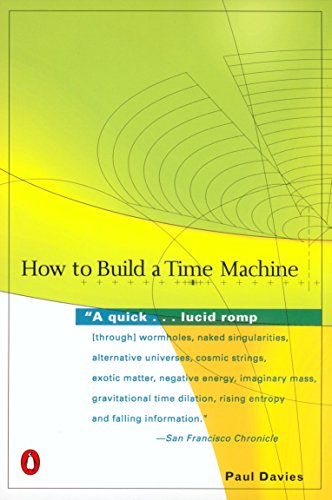
With his unique knack for making cutting-edge theoretical science effortlessly accessible, world-renowned physicist Paul Davies now tackles an issue that has boggled minds for centuries: Is time travel possible? The answer, insists Davies, is definitely yes—once you iron out a few kinks in the space-time continuum. With tongue placed firmly in cheek, Davies explains the theoretical physics that make visiting the future and revisiting the past possible, then proceeds to lay out a four-stage process for assembling a time machine and making it work. Wildly inventive and theoretically sound, How to Build a Time Machine is creative science at its best—illuminating, entertaining, and thought provoking.
Die Inhaltsangabe kann sich auf eine andere Ausgabe dieses Titels beziehen.
Über die Autorinnen und Autoren
Paul Davies is an internationally acclaimed theoretical physicist and the author of God and the New Physics, The Mind of God, and many other popular books. In 1995 he won the prestigious Templeton Prize for his work on the philosophical meaning of science and was recently awarded the Kelvin Medal by the UK Institute of Physics. Davies lives in Australia and frequently travels, teaches, and lectures in the United States.
Paul Davies is an internationally acclaimed theoretical physicist and the author ofGod and the New Physics, The Mind of God, and many other popular books. In 1995 he won the prestigious Templeton Prize for his work on the philosophical meaning of science and was recently awarded the Kelvin Medal by the UK Institute of Physics. Davies lives in Australia and frequently travels, teaches, and lectures in the United States.
Auszug. © Genehmigter Nachdruck. Alle Rechte vorbehalten.
How to Build a Time Machine
By Paul DaviesPenguin Publishing Group
Copyright © 2003 Paul Davies
All rights reserved.
ISBN: 978-0-14-200186-8All rights reserved.
Prologue
What if it were possible to build a machine that could transport a human being through time?
Is that credible?
A hundred years ago, few people believed it possible for humans to travel through outer space. Time travel, like space travel, was merely science fiction. Today, spaceflight is almost commonplace. Might time travel one day become commonplace too?
Traveling in time is certainly easy to envisage. You step into the time machine, press a few buttons, and step out again, not just somewhere else, but somewhen else-another time altogether. Writers of science fiction have exploited this theme again and again since H. G. Wells blazed the trail with his famous 1895 story The Time Machine. British audiences (the author included) thrilled to the adventures of the time lord Doctor Who and his attractive lady accomplices. Hollywood movies such as Back to the Future and books such as Timeline make it all seem so easy.
So can it really be done? Is time travel a scientific possibility?
A moment's thought uncovers some tricky questions. Where exactly are the past and future? Surely the past has disappeared and cannot be re-trieved, while the future hasn't yet come into being. How can a person go to a world that doesn't exist? Sidestepping that, what about the inevitable paradoxes that come from visiting the past and changing it? What does that do to the present? And if time travel were feasible, where are all the time tourists from the future, coming back to peer curiously at twenty-first-century society?
There is no doubt that time travel poses some serious problems, even for physicists used to thinking about outlandish concepts like antimatter and black holes. But maybe that is because we are looking at time in the wrong way. After all, our view of time has changed dramatically over the years. In ancient cultures it was associated with process and change, and rooted in the cycles and rhythms of nature. Later, Sir Isaac Newton took a more abstract and mechanistic view. "Absolute, true and mathematical time, flowing equably without relation to anything external" was the way he expressed it, and this became the accepted notion among scientists for two hundred years.
Everyone assumed without question that, whatever one's preferred definition, time is the same everywhere and for everybody. In other words, it is absolute and universal. True, we might feel time passing differently according to our moods, but time itself is simply time. The purpose of a clock is to circumvent mental distortions and record, objectively, the time. Implicit in this view is that time can be chopped up into three parts: past, present, and future. The present-now-is supposed to be the fleeting moment of true reality, with the past banished to history-mere shadowy memory-and the future still hazy and unformed. And that all-important now is taken to be the same moment throughout the universe: your now and my now are identical wherever we are and whatever we are doing.
Such is the commonsense picture of time, the one we use in daily life. Few people think about time any differently. But it's wrong-deeply and seriously wrong.
That it couldn't be right became apparent about the turn of the twentieth century. The credit for exposing the flaws in the everyday notion of time is largely associated with the name of Albert Einstein and the theory of relativity. At a stroke, Einstein's work demolished Newton's view of both space and time, rendered meaningless the universal division of time into past, present, and future, and paved the way for time travel. The theory of relativity is nearly a century old. Following publication of the so-called special theory of relativity in 1905, it was accepted by physicists almost immediately. Over the decades it has been exhaustively tested in many experiments. Today, the scientific community is unanimous that "time is relative" and the commonsense notion of an absolute time with a universal "now" is a fiction. Yet among the general public, the relativity of time still comes as something of a shock. Many people seem not to have heard about it at all. Some of them refuse flatly to believe it when told, in spite of the clear experimental evidence.
In the coming chapters we shall see how the theory of relativity implies that a limited form of time travel is certainly possible, while unrestricted time travel-to any epoch, past or future-might just be possible too. If this seems hard to swallow, remind yourself of J. B. S. Haldane's famous dictum: "The universe is not only queerer than we think, it is queerer than we can think."
1. How to Visit the Future
In an obvious sense we are all time travelers. Do nothing, and you will be conveyed inexorably into the future at the stately pace of one second per second. But this is of limited interest. A true time traveler needs to leap forward dramatically in time and reach the future sooner than everyone else.
Can it be done?
Indeed it can. Scientists have no doubt whatever that it is possible to build a time machine to visit the future. And they've known the formula for nearly a century.
[ Time and Motion
It was in 1905 that Albert Einstein first demonstrated the possibility of time travel. He did this by first demolishing the commonsense picture of time dating back to Newton and replacing it with his own concept of relative time.
Einstein was twenty-six when he published his special theory of relativity. He was then not the pipe-smoking disheveled sage with tousled gray hair who provided the role model for many a fictional nutty professor, but a dapper young man in a suit working at the Swiss patent office. In his spare time, the young Einstein was studying the way light moves. In doing so, he noticed an inconsistency between the motion of light and that of material objects. Using only high-school mathematics, he demonstrated that if light behaves the way that physicists supposed, Newton's straightforward idea of time must be flawed.
The trail of reasoning that leads from the motion of light to this startling conclusion about time has been discussed thoroughly elsewhere and need not concern us here. What matters for our purposes is the central claim of the special theory of relativity, which is that Time is elastic. It can be stretched and shrunk. How? Simply by moving very fast.
What precisely do I mean by "stretching time"? Let me state it more carefully. According to the special theory of relativity, the exact duration of time between two specified events will depend on how the observer is moving. The interval between successive chimes on my clock might be one hour when I am sitting still in my living room, but it will be less than one hour if I spend that time moving about.
To express the same thing in a more practical manner, suppose I board an airplane in New York and fly to Rio and back while you stay at Kennedy Airport. Then the duration of the journey according to me isn't the same as the duration according to you. In fact, it is a bit less for me.
Two points need to be made at the outset. First, I'm not talking about the apparent duration of the journey. Your experience of being bored at the airport with the hours seeming to drag by, while I am happily occupied watching airline movies, is not the effect being discussed here. Mental time is a fascinating topic in psychology, but my concern is with physical time, the sort measured by mindless clocks. The second point is that the time discrepancy for the...
„Über diesen Titel“ kann sich auf eine andere Ausgabe dieses Titels beziehen.
Suchergebnisse für How to Build a Time Machine

Beispielbild für diese ISBN
How to Build a Time Machine
Verlag:
Penguin Publishing Group, 2003
ISBN 10: 0142001864
ISBN 13: 9780142001868
Gebraucht
Softcover
Anbieter: More Than Words, Waltham, MA, USA
Verkäuferbewertung 5 von 5 Sternen

Zustand: Good. . No Dust Jacket. All orders guaranteed and ship within 24 hours. Before placing your order for please contact us for confirmation on the book's binding. Check out our other listings to add to your order for discounted shipping. Bestandsnummer des Verkäufers WAL-U-1h-01787
Gebraucht kaufen
EUR 0,93
EUR 3,57 Versand
Versand innerhalb von USA
Versand innerhalb von USA
Anzahl: 1 verfügbar
Beispielbild für diese ISBN
How to Build a Time Machine
Anbieter: World of Books (was SecondSale), Montgomery, IL, USA
Verkäuferbewertung 5 von 5 Sternen
Paperback. Zustand: Fair. With his unique knack for making cutting-edge theoretical science effortlessly accessible, world-renowned physicist Paul Davies now tackles an issue that has boggled minds for centuries: Is time travel possible? The answer, insists Davies, is definitely yes--once you iron out a few kinks in the space-time continuum. With tongue placed firmly in cheek, Davies explains the theoretical physics that make visiting the future and revisiting the past possible, then proceeds to lay out a four-stage process for assembling a time machine and making it work. Wildly inventive and theoretically sound, How to Build a Time Machine is creative science at its best--illuminating, entertaining, and thought provoking. Bestandsnummer des Verkäufers 00094963102
Gebraucht kaufen
EUR 4,53
Versand gratis
Versand innerhalb von USA
Versand innerhalb von USA
Anzahl: 3 verfügbar
Beispielbild für diese ISBN
How to Build a Time Machine
Anbieter: World of Books (was SecondSale), Montgomery, IL, USA
Verkäuferbewertung 5 von 5 Sternen
Paperback. Zustand: Good. With his unique knack for making cutting-edge theoretical science effortlessly accessible, world-renowned physicist Paul Davies now tackles an issue that has boggled minds for centuries: Is time travel possible? The answer, insists Davies, is definitely yes--once you iron out a few kinks in the space-time continuum. With tongue placed firmly in cheek, Davies explains the theoretical physics that make visiting the future and revisiting the past possible, then proceeds to lay out a four-stage process for assembling a time machine and making it work. Wildly inventive and theoretically sound, How to Build a Time Machine is creative science at its best--illuminating, entertaining, and thought provoking. Bestandsnummer des Verkäufers 00102760572
Gebraucht kaufen
EUR 4,53
Versand gratis
Versand innerhalb von USA
Versand innerhalb von USA
Anzahl: 2 verfügbar
Foto des Verkäufers
How to Build a Time Machine
Verlag:
Penguin Publishing Group, 2003
ISBN 10: 0142001864
ISBN 13: 9780142001868
Gebraucht
Softcover
Anbieter: Greenworld Books, Arlington, TX, USA
Verkäuferbewertung 5 von 5 Sternen
Zustand: good. Fast Free Shipping â" Good condition. It may show normal signs of use, such as light writing, highlighting, or library markings, but all pages are intact and the book is fully readable. A solid, complete copy that's ready to enjoy. Bestandsnummer des Verkäufers GWV.0142001864.G
Gebraucht kaufen
EUR 4,54
Versand gratis
Versand innerhalb von USA
Versand innerhalb von USA
Anzahl: 1 verfügbar
Beispielbild für diese ISBN
How to Build a Time Machine
Verlag:
Penguin Publishing Group, 2003
ISBN 10: 0142001864
ISBN 13: 9780142001868
Gebraucht
Softcover
Anbieter: Better World Books, Mishawaka, IN, USA
Verkäuferbewertung 5 von 5 Sternen
Zustand: Very Good. Reprint. Former library copy. Pages intact with possible writing/highlighting. Binding strong with minor wear. Dust jackets/supplements may not be included. Includes library markings. Stock photo provided. Product includes identifying sticker. Better World Books: Buy Books. Do Good. Bestandsnummer des Verkäufers 10698217-6
Gebraucht kaufen
EUR 6,20
Versand gratis
Versand innerhalb von USA
Versand innerhalb von USA
Anzahl: 1 verfügbar
Beispielbild für diese ISBN
How to Build a Time Machine
Verlag:
Penguin Publishing Group, 2003
ISBN 10: 0142001864
ISBN 13: 9780142001868
Gebraucht
Softcover
Anbieter: Better World Books: West, Reno, NV, USA
Verkäuferbewertung 5 von 5 Sternen
Zustand: Good. Reprint. Former library copy. Pages intact with minimal writing/highlighting. The binding may be loose and creased. Dust jackets/supplements are not included. Includes library markings. Stock photo provided. Product includes identifying sticker. Better World Books: Buy Books. Do Good. Bestandsnummer des Verkäufers 8177497-6
Gebraucht kaufen
EUR 6,20
Versand gratis
Versand innerhalb von USA
Versand innerhalb von USA
Anzahl: 1 verfügbar
Beispielbild für diese ISBN
How to Build a Time Machine
Anbieter: World of Books Inc, Montgomery, IL, USA
Verkäuferbewertung 4 von 5 Sternen

Paperback. Zustand: Good. With his unique knack for making cutting-edge theoretical science effortlessly accessible, world-renowned physicist Paul Davies now tackles an issue that has boggled minds for centuries: Is time travel possible? The answer, insists Davies, is definitely yes--once you iron out a few kinks in the space-time continuum. With tongue placed firmly in cheek, Davies explains the theoretical physics that make visiting the future and revisiting the past possible, then proceeds to lay out a four-stage process for assembling a time machine and making it work. Wildly inventive and theoretically sound, How to Build a Time Machine is creative science at its best--illuminating, entertaining, and thought provoking. Bestandsnummer des Verkäufers CIN0142001864G
Gebraucht kaufen
EUR 6,37
Versand gratis
Versand innerhalb von USA
Versand innerhalb von USA
Anzahl: 2 verfügbar
Beispielbild für diese ISBN
How to Build a Time Machine
Anbieter: World of Books Inc, Montgomery, IL, USA
Verkäuferbewertung 4 von 5 Sternen
Paperback. Zustand: Fair. With his unique knack for making cutting-edge theoretical science effortlessly accessible, world-renowned physicist Paul Davies now tackles an issue that has boggled minds for centuries: Is time travel possible? The answer, insists Davies, is definitely yes--once you iron out a few kinks in the space-time continuum. With tongue placed firmly in cheek, Davies explains the theoretical physics that make visiting the future and revisiting the past possible, then proceeds to lay out a four-stage process for assembling a time machine and making it work. Wildly inventive and theoretically sound, How to Build a Time Machine is creative science at its best--illuminating, entertaining, and thought provoking. Bestandsnummer des Verkäufers CIN0142001864A
Gebraucht kaufen
EUR 6,37
Versand gratis
Versand innerhalb von USA
Versand innerhalb von USA
Anzahl: 3 verfügbar
Beispielbild für diese ISBN
How to Build a Time Machine
Verlag:
Penguin Publishing Group, 2003
ISBN 10: 0142001864
ISBN 13: 9780142001868
Gebraucht
Softcover
Anbieter: Wonder Book, Frederick, MD, USA
Verkäuferbewertung 5 von 5 Sternen
Zustand: Good. Good condition. A copy that has been read but remains intact. May contain markings such as bookplates, stamps, limited notes and highlighting, or a few light stains. Bestandsnummer des Verkäufers Q15B-02831
Gebraucht kaufen
EUR 6,44
Versand gratis
Versand innerhalb von USA
Versand innerhalb von USA
Anzahl: 1 verfügbar
Beispielbild für diese ISBN
How to Build a Time Machine
Verlag:
Penguin Publishing Group, 2003
ISBN 10: 0142001864
ISBN 13: 9780142001868
Gebraucht
Softcover
Anbieter: Wonder Book, Frederick, MD, USA
Verkäuferbewertung 5 von 5 Sternen
Zustand: Very Good. Very Good condition. A copy that may have a few cosmetic defects. May also contain light spine creasing or a few markings such as an owner's name, short gifter's inscription or light stamp. Bestandsnummer des Verkäufers U14P-00023
Gebraucht kaufen
EUR 6,44
Versand gratis
Versand innerhalb von USA
Versand innerhalb von USA
Anzahl: 1 verfügbar