
Verwandte Artikel zu Jihad: The Rise of Militant Islam in Central Asia
Inhaltsangabe
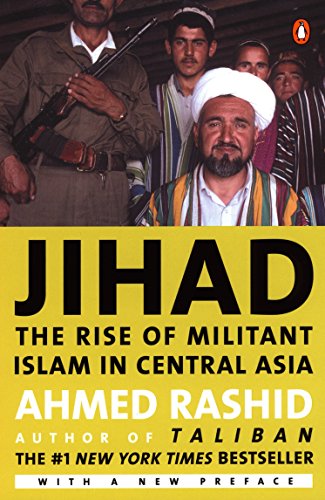
Ahmed Rashid, whose masterful account of Afghanistan's Taliban regime became required reading after September 11, turns his legendary skills as an investigative journalist to five adjacent Central Asian Republics—Kazakhstan, Kyrgyzstan, Tajikistan, Turkmenistan, and Uzbekistan—where religious repression, political corruption, and extreme poverty have created a fertile climate for militant Islam. Based on groundbreaking research and numerous interviews, Rashid explains the roots of fundamentalist rage in Central Asia, describes the goals and activities of its militant organizations, including Osama bin Laden's al-Qaeda, and suggests ways of neutralizing the threat and bringing stability to the troubled region. A timely and pertinent work, Jihad is essential reading for anyone who seeks to gain a better understanding of a region we overlook at our peril.
Die Inhaltsangabe kann sich auf eine andere Ausgabe dieses Titels beziehen.
Über die Autorin bzw. den Autor
Ahmed Rashid is a journalist who has been covering Afghanistan, Pakistan, and Central Asia for more than twenty years. He is a correspondent for the Wall Street Journal, Far Eastern Economic Review, Daily Telegraph, and The Nation, a leading newspaper in Pakistan. His #1 New York Times bestseller Taliban has been translated into more than twenty languages.
Auszug. © Genehmigter Nachdruck. Alle Rechte vorbehalten.
Chapter One
Introduction: Central
Asia's Islamic Warriors
THE HISTORY OF ISLAM is a story of change and adaptation. Throughout Muslim history, movements have arisen periodically that seek to transform both the nature of Islamic belief and the political and social lives of their adherents. Since the seventh century, followers of The Prophet Muhammad have fanned out to spread His message throughout the known world. Muslim nomadic tribes—often originating in Central Asia—carried the word across the steppes and mountains of the vast Eurasian landmass, some peacefully as they drove their caravans of goods along the ancient Silk Route, others by conquest. The conquerors would transform the vanquished empire, but in time their empires would change and become urbanized, until each was in its turn conquered by new nomadic Muslim tribes. The changes the conquerors wrought—religious, political, social—have often been driven by the concept of jihad.
In Western thought, heavily influenced by the medieval Christian Crusaders—with their own ideas about "holy war"—jihad has always been portrayed as an Islamic war against unbelievers. Westerners point to the conquest of Spain in the eighth century by the Moors and the vast Ottoman Empire of the thirteen through twentieth centuries, and focus on the bloodshed, ignoring not only the enormous achievements in science and art and the basic tolerance of these empires, but also the true idea of jihad that spread peacefully throughout these realms. Militancy is not the essence ofjihad.
The greater jihad as explained by The Prophet Muhammad is first inward-seeking: it involves the effort of each Muslim to become a better human being, to struggle to improve him- or herself. In doing so the follower of jihad can also benefit his or her community. In addition, jihad is a test of each Muslim's obedience to God and willingness to implement His commands on earth. As Barbara Metcalf described it, "Jihad is the inner struggle of moral discipline and commitment to Islam and political action." It is also true that Islam sanctions rebellion against an unjust ruler, whether Muslim or not, and jihad can become the means to mobilize that political and social struggle. This is the lesser jihad. Thus, Muslims revere the life of The Prophet Muhammad because it exemplified both the greater and the lesser jihad—The Prophet struggled lifelong to improve Himself as a Muslim in order both to set an example to those around Him and to demonstrate His complete commitment to God. But He also fought against the corrupt Arab society He was living in, and He used every means—including but not exclusively militant ones—to transform it.
Today's global jihadi movements, from the Taliban in Afghanistan to Osama bin Laden's worldwide Al Qaeda to the Islamic Movement of Uzbekistan (IMU), ignore the greater jihad advocated by The Prophet and adopt the lesser jihad as a complete political and social philosophy. Yet nowhere in Muslim writings or tradition does jihad sanction the killing of innocent non-Muslim men, women, and children, or even fellow Muslims, on the basis of ethnicity, sect, or belief. It is this perversion of jihad—as a justification to slaughter the innocent—which in part defines the radical new fundamentalism of today's most extreme Islamic movements.
These new Islamic fundamentalists are not interested in transforming a corrupt society into a just one, nor do they care about providing jobs, education, or social benefits to their followers or creating harmony between the various ethnic groups that inhabit many Muslim countries. The new jihadi groups have no economic manifesto, no plan for better governance and the building of political institutions, and no blueprint for creating democratic participation in the decision-making process of their future Islamic states. They depend on a single charismatic leader, an amir, rather than a more democratically constituted organization or party for governance. They believe that the character, piety, and purity of their leader rather than his political abilities, education, or experience will enable him to lead the new society. Thus has emerged the phenomenon of the cults of Mullah Muhammad Omar of the Taliban, Osama bin Laden of Al Qaeda, and Juma Namangani of the Islamic Movement of Uzbekistan.
The new jihadi groups are equally obsessed with implementing sharia (Islamic law). However, they see sharia not as a way of creating a just society but simply as a means to regulate personal behavior and dress codes for Muslims—a concept that distorts centuries of tradition, culture, history, and even the religion of Islam itself. The hallmark of the Taliban, Al Qaeda (The Base), and the IMU is the rejection of all historical experience, scientific experiment, and other forms of knowledge that Muslims (and other societies) have developed over the past 1,400 years. Thus the Taliban have tried to rewrite Afghan history in order to justify their repression of women and minority ethnic groups or their destruction of statues of Buddha. The new Islamic order for these jihadi groups is reduced to a harsh, repressive penal code for their citizens that strips Islam of its values, humanism, and spirituality. If God and the Islam of The Prophet Muhammad offer sustenance for devout Muslims to search their souls and seek meaning in today's ever-changing, complex world, the new jihadi groups reduce Islam to the length of one's beard and the question of whether burka-clad women are allowed to expose their ankles.
Before September 11, 2001, this new phase in the long history of Islamic fundamentalism had gone largely unnoticed in the Western world. The unprecedented events of that day in New York and Washington, D.C.—when nineteen Al Qaeda militants trained in Afghanistan took over the controls of four aircraft and flew three of them into the commercial and military heart of America, killing close to six thousand people—changed the world forever. The civilized nations' battle against terrorism may well define the twenty-first century just as Nazism and the Cold War defined the twentieth.
But to define these attacks solely as acts of terrorism misses the point of the new political phenomenon at work amongst small groups of extremists around the Muslim world. When a U.S.-led military alliance began bombing Taliban defenses and Al Qaeda training camps on October 7, few reports of the defenders mentioned that the man who was reputedly commanding the Taliban forces in Taloqan, in northeastern Afghanistan, was Juma Namangani, the military leader of the IMU. Still largely unnoticed amongst the many Islamic fundamentalist groups that have set up operational bases with the Taliban over the past few years, the IMU presents one of the biggest threats, for it aims to topple the regime of neighboring Uzbekistan's President Islam Karimov as part of a jihad that will reach across Central Asia.
Comprising the republics of Kazakhstan, Kyrgyzstan, Tajikistan, Turkmenistan, and Uzbekistan, Central Asia is almost certain to become the new global battleground. Its history has been marked by more than two thousand years of conflict, as the great empires of the past fought to control the commercial lifeline linking Europe and Asia, the Silk Route. (Almost the only empire that did not at one time or another rule part or all of Central Asia was the Roman Empire.) But today's conflicts differ from the struggles of the past, and they stem largely from the changes wrought in the region by the Soviet Union—and from the chaos that accompanied its dissolution in 1991.
For the majority of the...
„Über diesen Titel“ kann sich auf eine andere Ausgabe dieses Titels beziehen.
Suchergebnisse für Jihad: The Rise of Militant Islam in Central Asia

Beispielbild für diese ISBN
Jihad: The Rise of Militant Is
Anbieter: World of Books (was SecondSale), Montgomery, IL, USA
Verkäuferbewertung 5 von 5 Sternen

Zustand: Good. Item in good condition. Textbooks may not include supplemental items i.e. CDs, access codes etc. Bestandsnummer des Verkäufers 00094388697
Gebraucht kaufen
EUR 3,64
Versand gratis
Versand innerhalb von USA
Versand innerhalb von USA
Anzahl: 7 verfügbar
Beispielbild für diese ISBN
Jihad: The Rise of Militant Islam in Central Asia
Anbieter: Gulf Coast Books, Cypress, TX, USA
Verkäuferbewertung 5 von 5 Sternen
Paperback. Zustand: Good. Bestandsnummer des Verkäufers 0142002607-3-21770064
Gebraucht kaufen
EUR 3,65
Versand gratis
Versand innerhalb von USA
Versand innerhalb von USA
Anzahl: 1 verfügbar
Foto des Verkäufers
Jihad: The Rise of Militant Islam in Central Asia
Anbieter: ZBK Books, Carlstadt, NJ, USA
Verkäuferbewertung 5 von 5 Sternen
Zustand: very_good. Fast & Free Shipping â" Very Good condition book with a firm cover and clean pages. Shows normal use and some light wear or limited notes markings. A solid, nice copy to enjoy. Bestandsnummer des Verkäufers ZWV.0142002607.VG
Gebraucht kaufen
EUR 4,84
Versand gratis
Versand innerhalb von USA
Versand innerhalb von USA
Anzahl: 1 verfügbar
Beispielbild für diese ISBN
Jihad: The Rise of Militant Islam in Central Asia
Verlag:
Penguin Books (edition Reprint), 2002
ISBN 10: 0142002607
ISBN 13: 9780142002605
Gebraucht
Paperback
Anbieter: BooksRun, Philadelphia, PA, USA
Verkäuferbewertung 5 von 5 Sternen
Paperback. Zustand: Very Good. Reprint. It's a well-cared-for item that has seen limited use. The item may show minor signs of wear. All the text is legible, with all pages included. It may have slight markings and/or highlighting. Bestandsnummer des Verkäufers 0142002607-11-22
Gebraucht kaufen
EUR 5,02
Versand gratis
Versand innerhalb von USA
Versand innerhalb von USA
Anzahl: 1 verfügbar
Beispielbild für diese ISBN
Jihad: The Rise of Militant Islam in Central Asia
Anbieter: Once Upon A Time Books, Siloam Springs, AR, USA
Verkäuferbewertung 4 von 5 Sternen

paperback. Zustand: Very Good. Bestandsnummer des Verkäufers mon0003531251
Gebraucht kaufen
EUR 1,92
EUR 3,45 Versand
Versand innerhalb von USA
Versand innerhalb von USA
Anzahl: 1 verfügbar
Beispielbild für diese ISBN
Jihad: The Rise of Militant Islam in Central Asia
Anbieter: HPB-Diamond, Dallas, TX, USA
Verkäuferbewertung 5 von 5 Sternen
paperback. Zustand: Very Good. Connecting readers with great books since 1972! Used books may not include companion materials, and may have some shelf wear or limited writing. We ship orders daily and Customer Service is our top priority! Bestandsnummer des Verkäufers S_463007803
Gebraucht kaufen
EUR 2,70
EUR 3,27 Versand
Versand innerhalb von USA
Versand innerhalb von USA
Anzahl: 1 verfügbar
Beispielbild für diese ISBN
Jihad: The Rise of Militant Islam in Central Asia
Anbieter: Half Price Books Inc., Dallas, TX, USA
Verkäuferbewertung 5 von 5 Sternen
paperback. Zustand: Very Good. Connecting readers with great books since 1972! Used books may not include companion materials, and may have some shelf wear or limited writing. We ship orders daily and Customer Service is our top priority! Bestandsnummer des Verkäufers S_469583543
Gebraucht kaufen
EUR 2,70
EUR 3,27 Versand
Versand innerhalb von USA
Versand innerhalb von USA
Anzahl: 1 verfügbar
Beispielbild für diese ISBN
Jihad: The Rise of Militant Islam in Central Asia
Anbieter: HPB-Emerald, Dallas, TX, USA
Verkäuferbewertung 5 von 5 Sternen
paperback. Zustand: Very Good. Connecting readers with great books since 1972! Used books may not include companion materials, and may have some shelf wear or limited writing. We ship orders daily and Customer Service is our top priority! Bestandsnummer des Verkäufers S_473785683
Gebraucht kaufen
EUR 2,70
EUR 3,27 Versand
Versand innerhalb von USA
Versand innerhalb von USA
Anzahl: 1 verfügbar
Foto des Verkäufers
Jihad: The Rise of Militant Islam in Central Asia
Anbieter: Blue Vase Books, Interlochen, MI, USA
Verkäuferbewertung 5 von 5 Sternen
Zustand: good. The item shows wear from consistent use, but it remains in good condition and works perfectly. All pages and cover are intact including the dust cover, if applicable . Spine may show signs of wear. Pages may include limited notes and highlighting. May NOT include discs, access code or other supplemental materials. Bestandsnummer des Verkäufers BVV.0142002607.G
Gebraucht kaufen
EUR 6,01
Versand gratis
Versand innerhalb von USA
Versand innerhalb von USA
Anzahl: 1 verfügbar
Beispielbild für diese ISBN
Jihad: The Rise of Militant Islam in Central Asia
Anbieter: Wonder Book, Frederick, MD, USA
Verkäuferbewertung 5 von 5 Sternen
Zustand: Very Good. Very Good condition. A copy that may have a few cosmetic defects. May also contain light spine creasing or a few markings such as an owner's name, short gifter's inscription or light stamp. Bundled media such as CDs, DVDs, floppy disks or access codes may not be included. Bestandsnummer des Verkäufers H08O-00744
Gebraucht kaufen
EUR 6,28
Versand gratis
Versand innerhalb von USA
Versand innerhalb von USA
Anzahl: 1 verfügbar