
Verwandte Artikel zu Choice Cuts: A Savory Selection of Food Writing from...
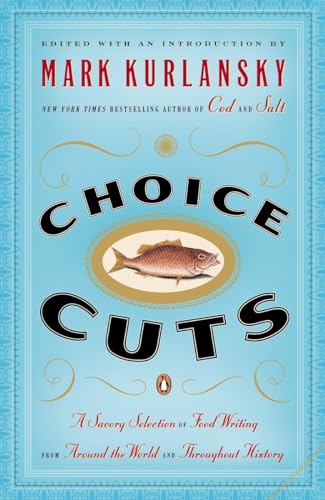
Choice Cuts: A Savory Selection of Food Writing from Around the World and Throughout History - Softcover
Inhaltsangabe
Mark Kurlansky, bestselling author of Salt and Cod, serves up a smorgasbord of food writing through the ages, from Plato to Louis Prima
Choice Cuts offers more than two hundred mouth-watering selections, including Brillat-Savarin on chocolate; Waverley Root on truffles; M. F. K. Fish on gingerbread; Pablo Neruda on French fries; Alexandre Dumas on coffee; and a vast variety by Escoffier, Elizabeth David, A. J. Liebling, Ernest Hemingway, Virginia Woolf, Dickens, Balzac, Chekhov, Orwell, and Alice B. Toklas, among others. Filled throughout with recipes, menus, classic photographs, and Kurlansky’s own original drawings, Choice Cuts is a must-have for any serious lover of food.
“The most outrageously broad, gregarious food writing anthology.” –Saveur
Mark Kurlansky is the author of many books including Salt, The Basque History of the World, 1968, and The Big Oyster. His newest book is Birdseye.
Die Inhaltsangabe kann sich auf eine andere Ausgabe dieses Titels beziehen.
Über die Autorin bzw. den Autor
Mark Kurlansky is the New York Times bestselling author of many books, including The Food of a Younger Land, Cod: A Biography of the Fish That Changed the World; Salt: A World History; 1968: The Year That Rocked the World; and The Big Oyster: History on the Half Shell. He lives in New York City.
Auszug. © Genehmigter Nachdruck. Alle Rechte vorbehalten.
chapter one
Gourmets and Gourmands
Mark Kurlansky on Gourmets
No one ever knows when he is well-off. Whenever I was called a gourmet, I suspected I was being accused of something at least slightly unpleasant. But that was before I heard the term "foodie." I am still not sure that a gourmet is a good thing to be, but it must be better than a foodie.
Although I cannot say exactly what a gourmet is, like Justice Stewart said of pornography, I know it when I see it, and I am slipping into contemplation of the meaning of the word "gourmet" because I am clearly in the company of a couple of them. The two gourmets who have invited me to lunch in a rural Basque restaurant in the green mountains of Vizcaya province are a small, red-faced, and energetic author of a popular Spanish food guide and an enormously round and well-fed man of unclear profession whose business card labels him as "gastronomic adviser."
The enthusiastic author rates all his food from one to ten. He wants all of us to do the same. He gives the lomo, the thinly sliced burgundy-colored prime cut of cured pork, only an eight. The gastronomic adviser had ventured a nine, and so they turned to me, the indecisive Hamlet of the group, who requested clearer definitions of both eight and nine.
A gourmet, according to Webster's dictionary, is "a judge of choice foods." It comes from an old French word for a wine-tasting servant and is generally confused with the word "gourmand"--an old French word meaning glutton. From this it appears that medieval Frenchmen knew the difference between a judge--someone guided by intellect--and a glutton--someone guided by appetite. But contemporary Americans are somehow getting the two notions confused. In French, by the way, the two words are still distinct. When I wrote for the International Herald Tribune in Paris, the French accountant who processed my expenses used to delight in pointedly calling me "Monsieur Gourmand."
Is it a lingering Puritanism that causes Americans to suspect the analysis of a physical pleasure? In 1901, Picasso depicted in blue paint a little girl reaching up to a table to scrape a bowl. It is usually labeled by its French title, le gourmet. But at a recent show in New York it was translated into English as The Greedy Child. Is a gourmet greedy? In truth, most people who are labeled gourmets, like my two lunch companions, go beyond the act of judging and analyzing. They are arriving at their judgments by eating a lot of food. Is the discussion an excuse for the real act, which is eating? Picasso's little girl did eat all the contents of the bowl.
My gourmets are discussing the lobster. The red-faced author has given it a ten and is trying to get me to concede that these tough little clawed creatures shipped from northern Europe are far better than the lobster that come from what he does not realize is my native New England, which in fact they are not.
Plato would not have thought much of these two. He mistrusted any interest in the preparation or presentation of food. In The Republic he states that the enjoyment of food is not a true pleasure because the purpose of eating is to relieve pain--hunger. To turn it into more than that through culinary skills, to him, was the use of artifice to disguise the true nature of food and eating. In Gorgias he states that cooking "is a form of flattery . . . a mischievous, deceitful, mean and ignoble activity, which cheats us by shapes and colors, by smoothing and draping. . . ." Was Plato right that gourmetism is morally and intellectually suspect or was he simply one of those unfortunates with a rubber palate incapable of appreciating food's pleasures? Or both?
Gourmet is a word with dangerous boundaries. In itself it may be a worthwhile pursuit. Food is a central activity of mankind and one of the single most significant trademarks of a culture. Shouldn't someone be examining it? But the discipline risks perilous proximity to both physical and intellectual overindulgence. In his 1996 novel The Debt to Pleasure, John Lancaster toys with our suspicion of gourmets. The narrator of the book is a man who, as the character himself puts it, is engaged in "the application of intelligence to pleasure." While telling the story of his life he rambles on about soups, stocks, and curry. Discussion of the perfect vinaigrette leads to analysis of the perfect seven-to-one martini. The perfect everything must be espoused, declared, and examined. By instinct, the reader does not like this rambling dilettante full of unsolicited opinions. The beauty of this novel is that the writer makes the readers doubt themselves. At first we struggle to like him and the book, but we find him pompous, then unbearable. Just as we are growing angry with this book and its smug narrator, we start to realize that he is obsessive. The fault is not with the book nor with the reader. There truly is something "not right" about this man. His gourmetism is not about a universal pleasure, the common human experience of eating, but about setting himself apart, eating special foods, having special pleasures, being answerable only to special laws. Finally we realize that we were right to have suspected this gourmet, that he truly is deranged, in fact, a dangerous psychopath.
My tablemates don't like the monkfish, and only give it a five.
What should a gourmet look like? I'm afraid most Chinese would not accept my friend the fat gastronomic adviser as a gourmet. A true gourmet--a judge--has the wisdom to know when to stop eating. From Confucius to Mao, most Chinese philosophy has contended that excess is unnatural, wasteful, and alien to proper dining. Chinese food writing emphasizes the healthiness of gourmets and their choices. Otherwise gourmetism is suspect. The contemporary Chinese writer Lu Wenfu in his novella "The Gourmet" writes: "The word gourmet is pleasing to the ear, perhaps also to the eye. If you explain it in simple everyday language, however, its not so appealing. A gourmet is a person who is totally devoted to eating."
Karl Friedrich von Rumohr, an early-nineteenth-century gourmet, known in his language as a feinschmecker, literally a fine taster, not only separated gourmands and gourmets but perhaps shed some light on Plato when he wrote in 1822, "Dull witted brooding people love to stuff themselves with quantities of heavy food, just like animals for fattening. Bubbly intellectual people love foods which stimulate the taste buds without overloading the belly. Profound, meditative people prefer neutral foods which do not have an assertive flavor and are not difficult to digest, and therefore do not demand too much attention."
Jean Anthelme Brillat-Savarin, the French lawyer, politician, and self-declared gourmet, also insisted that a true gourmet was health conscious. It is interesting to note that in France, gourmets, like intellectuals, are often self-declared. Curiously Brillat-Savarin rejected any distinction between the words "gourmet" and "gourmand," consistently calling the epicurean judges of food gourmands but denying that it had anything to do with gluttony. He did not have the American awkwardness about celebrating physical pleasure.
But plump men were of little appeal to Brillat-Savarin and so he denounced overeating by men while stating that women gourmets "are plump, chubby, pretty rather than beautiful, with a slight tendency to fullness of figure." In another work he wrote, "Gourmandism is far from unbecoming to women," and so we have a good idea of how Brillat-Savarin liked his gourmets.
Having finished and rated a light fruity young Basque Rioja, my well-fed, arithmetical lunch-mates opened a big imposing garnet-colored Rioja just as a...
„Über diesen Titel“ kann sich auf eine andere Ausgabe dieses Titels beziehen.
Weitere beliebte Ausgaben desselben Titels

Suchergebnisse für Choice Cuts: A Savory Selection of Food Writing from...

Beispielbild für diese ISBN
Choice Cuts A Savory Selection
Anbieter: World of Books (was SecondSale), Montgomery, IL, USA
Verkäuferbewertung 5 von 5 Sternen

Zustand: Good. Item in good condition. Textbooks may not include supplemental items i.e. CDs, access codes etc. Bestandsnummer des Verkäufers 00104464141
Gebraucht kaufen
EUR 3,89
Versand gratis
Versand innerhalb von USA
Versand innerhalb von USA
Anzahl: 3 verfügbar
Beispielbild für diese ISBN
Choice Cuts A Savory Selection
Anbieter: World of Books (was SecondSale), Montgomery, IL, USA
Verkäuferbewertung 5 von 5 Sternen
Zustand: Very Good. Item in very good condition! Textbooks may not include supplemental items i.e. CDs, access codes etc. Bestandsnummer des Verkäufers 00105978557
Gebraucht kaufen
EUR 3,89
Versand gratis
Versand innerhalb von USA
Versand innerhalb von USA
Anzahl: 1 verfügbar
Foto des Verkäufers
Choice Cuts: A Savory Selection of Food Writing from Around the World and Throughout History
Verlag:
Penguin Publishing Group, 2004
ISBN 10: 0142004936
ISBN 13: 9780142004937
Gebraucht
Softcover
Anbieter: Zoom Books Company, Lynden, WA, USA
Verkäuferbewertung 5 von 5 Sternen
Zustand: very_good. Book is in very good condition and may include minimal underlining highlighting. The book can also include "From the library of" labels. May not contain miscellaneous items toys, dvds, etc. . We offer 100% money back guarantee and 24 7 customer service. Bestandsnummer des Verkäufers ZBV.0142004936.VG
Gebraucht kaufen
EUR 3,90
Versand gratis
Versand innerhalb von USA
Versand innerhalb von USA
Anzahl: 1 verfügbar
Foto des Verkäufers
Choice Cuts: A Savory Selection of Food Writing from Around the World and Throughout History
Verlag:
Penguin Publishing Group, 2004
ISBN 10: 0142004936
ISBN 13: 9780142004937
Gebraucht
Softcover
Anbieter: Greenworld Books, Arlington, TX, USA
Verkäuferbewertung 5 von 5 Sternen
Zustand: good. Fast Free Shipping â" Good condition. It may show normal signs of use, such as light writing, highlighting, or library markings, but all pages are intact and the book is fully readable. A solid, complete copy that's ready to enjoy. Bestandsnummer des Verkäufers GWV.0142004936.G
Gebraucht kaufen
EUR 4,34
Versand gratis
Versand innerhalb von USA
Versand innerhalb von USA
Anzahl: 1 verfügbar
Beispielbild für diese ISBN
Choice Cuts: A Savory Selection of Food Writing from Around the World and Throughout History
Verlag:
Penguin Publishing Group, 2004
ISBN 10: 0142004936
ISBN 13: 9780142004937
Gebraucht
paperback
Anbieter: Evergreen Goodwill, Seattle, WA, USA
Verkäuferbewertung 5 von 5 Sternen
paperback. Zustand: Good. Bestandsnummer des Verkäufers mon0000512867
Gebraucht kaufen
EUR 1,22
EUR 3,42 Versand
Versand innerhalb von USA
Versand innerhalb von USA
Anzahl: 1 verfügbar
Beispielbild für diese ISBN
Choice Cuts: A Savory Selection of Food Writing from Around the World and Throughout History
Verlag:
Penguin Publishing Group, 2004
ISBN 10: 0142004936
ISBN 13: 9780142004937
Gebraucht
paperback
Anbieter: Open Books, Chicago, IL, USA
Verkäuferbewertung 5 von 5 Sternen
paperback. Zustand: Very Good. Open Books is a nonprofit social venture that provides literacy experiences for thousands of readers each year through inspiring programs and creative capitalization of books. Bestandsnummer des Verkäufers mon0000828651
Gebraucht kaufen
EUR 1,31
EUR 3,42 Versand
Versand innerhalb von USA
Versand innerhalb von USA
Anzahl: 1 verfügbar
Beispielbild für diese ISBN
Choice Cuts: A Savory Selection of Food Writing from Around the World and Throughout History
Verlag:
Penguin Publishing Group (edition Reprint), 2004
ISBN 10: 0142004936
ISBN 13: 9780142004937
Gebraucht
Paperback
Anbieter: BooksRun, Philadelphia, PA, USA
Verkäuferbewertung 5 von 5 Sternen
Paperback. Zustand: Very Good. Reprint. It's a well-cared-for item that has seen limited use. The item may show minor signs of wear. All the text is legible, with all pages included. It may have slight markings and/or highlighting. Bestandsnummer des Verkäufers 0142004936-11-1
Gebraucht kaufen
EUR 4,94
Versand gratis
Versand innerhalb von USA
Versand innerhalb von USA
Anzahl: 1 verfügbar
Beispielbild für diese ISBN
Choice Cuts: A Savory Selection of Food Writing from Around the World and Throughout History
Anbieter: ThriftBooks-Phoenix, Phoenix, AZ, USA
Verkäuferbewertung 5 von 5 Sternen
Paperback. Zustand: Good. No Jacket. Pages can have notes/highlighting. Spine may show signs of wear. ~ ThriftBooks: Read More, Spend Less. Bestandsnummer des Verkäufers G0142004936I3N00
Gebraucht kaufen
EUR 5,95
Versand gratis
Versand innerhalb von USA
Versand innerhalb von USA
Anzahl: 1 verfügbar
Beispielbild für diese ISBN
Choice Cuts: A Savory Selection of Food Writing from Around the World and Throughout History
Anbieter: ThriftBooks-Reno, Reno, NV, USA
Verkäuferbewertung 5 von 5 Sternen
Paperback. Zustand: Good. No Jacket. Pages can have notes/highlighting. Spine may show signs of wear. ~ ThriftBooks: Read More, Spend Less. Bestandsnummer des Verkäufers G0142004936I3N00
Gebraucht kaufen
EUR 5,95
Versand gratis
Versand innerhalb von USA
Versand innerhalb von USA
Anzahl: 1 verfügbar
Beispielbild für diese ISBN
Choice Cuts: A Savory Selection of Food Writing from Around the World and Throughout History
Anbieter: ThriftBooks-Dallas, Dallas, TX, USA
Verkäuferbewertung 5 von 5 Sternen
Paperback. Zustand: Good. No Jacket. Pages can have notes/highlighting. Spine may show signs of wear. ~ ThriftBooks: Read More, Spend Less. Bestandsnummer des Verkäufers G0142004936I3N00
Gebraucht kaufen
EUR 5,97
Versand gratis
Versand innerhalb von USA
Versand innerhalb von USA
Anzahl: 1 verfügbar