
Verwandte Artikel zu World War I in 100 Objects
Inhaltsangabe
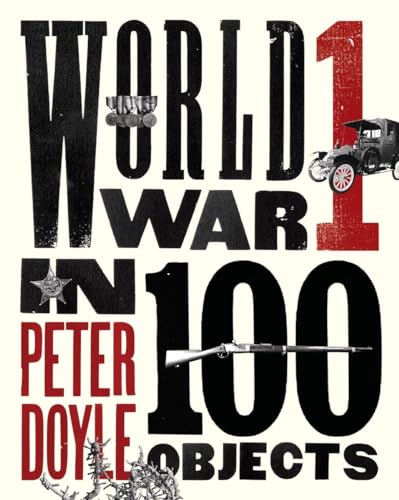
World War I in 100 Objects by Peter Doyle is a dynamic social history and perfect gift for history lovers.
General readers and history buffs alike have made bestsellers of books like A History of the World in 100 Objects. In that tradition, this handsome commemorative volume gives a unique perspective on one of the most pivotal and volatile events of modern history.
In World War I in 100 Objects, military historian Peter Doyle shares a fascinating collection of items, from patriotic badges worn by British citizens to field equipment developed by the United States. Beautifully photographed, each item is accompanied by the unique story it tells about the war, its strategy, its innovations, and the people who fought it.
Die Inhaltsangabe kann sich auf eine andere Ausgabe dieses Titels beziehen.
Über die Autorin bzw. den Autor
Peter Doyle is a military historian and geologist, specializing in battlefield terrain. He is currently Visiting Professor at University College London.
Auszug. © Genehmigter Nachdruck. Alle Rechte vorbehalten.
World War I in 100 Objects
By Peter DoylePenguin Publishing Group
Copyright © 2014 Peter Doyle
All rights reserved.
ISBN: 978-0-14-218159-1All rights reserved.
British recruiting posters issued as cigarette cards.
100 Objects
THE OUTCOME OF the Great War of 1914–18 has shaped the world we live in, yet it is difficult to understand. One hundred years after this cataclysmic episode erupted from the confines of “a little problem in the Balkans,” it continues to both shock and fascinate in equal measure. The war that followed it, ignited from its dying embers—though both complex and grandiose in scale—can at least be reduced and distilled into a crusade against evil, of the rights of human beings to escape bondage and repression. These concepts are more complex in the Great War, discussion of which still promotes argument and dissent.
For example, while most of us are at ease with the idea of an armada of landing craft dispatching its living cargo onto the beaches of Normandy on D-day, June 6, 1944, few of us really understand the motivations behind the landings at Gallipoli on April 25, 1915. And it is difficult for us to escape from the present and consider the past with a wholly objective viewpoint; typically, we have difficulty coming to terms with the sheer number of casualties from this terrible war. So while the Allied dead from El Alamein are around 2,350, those from the first day of the Somme are 19,240. The reason why the scale of suffering on the battlefield should be so high is still something with which people have difficulty coming to terms.
At a personal level, one of the advantages we have in considering the Second World War is that we perhaps have more sympathy with the time frame. Things seem reasonably familiar to us. With the creation of the Jazz Age came the development of modernism—houses were sleeker, their contents functional, their residents’ lives not a million miles away from our own. Images of London high streets in 1940 differ dramatically from those of 1910; there are fewer horses, a greater number of motor vehicles, more garish shop signs, and fewer uniformed people. And it helps that we have a direct connection with people who lived through rationing, the formation of the welfare state, the era of make do and mend, and the chirpy voices of chipper radio comedians and music hall stars. But when we peer at films of the imperial powers in the run-up to the Great War, it is difficult for us to make a direct comparison of our lives with those of our forebears. The everyday life of the average citizen seems so different, with its class structures and food and clothing that are so different to our own; the average person in the street seems so remote to us. And our direct connection with those who lived during the Great War is very nearly extinguished—the few people still around who were alive at the time were too young to understand its significance and are now perhaps too old to recall with understanding that life, so remote 100 years on.
But the Great War has left us with a rich legacy of writing, art, music, and poetry. This legacy allows us to perceive what life was like during the period. By their nature, many of these records present a very particular view of the war, one informed by the natural antiwar reaction of that generation. Much of the writing from participants in the Great War that appeared in the fertile ten-year period after the war is disillusioned with it, distanced from its purpose, disassociated with the ideals that led people to join the forces and serve their country.
For many today, jaundiced with conflict and high ideals, the idea of mass recruitment to fight “for King and Country” seems alien. Seeking to understand the lives of our families, to connect with their experiences, is how many people now connect with the past that is the First World War. In many cases, their starting points are the creased photographs, the fading postcards, and the tarnished medals. In the United Kingdom, soldiers, sailors, and airmen were awarded campaign medals that, fortunately, were named. This act of naming allows the narrative of both the medal group and the person who was awarded it to be interpreted and read. Each campaign medal is essentially the same yet ultimately different. This fact, coupled with the availability of records through archives and the Internet, allows family historians to unlock the stories of their objects and the actions of their forebears.
As one writer has put it, “Objects hold within themselves the worlds of their creators.” They represent a time capsule, a direct link with the time in which they were made. But they are also mute witnesses to events, recording devices that might allow a clearer understanding of a time or event—if only we can read them. Each object has a story, a unique narrative that is there to be interpreted, to be read. For many of the objects associated with war, that narrative is plain to see: machine guns were intended to kill, gas masks to protect. But like any story, there are subtexts—the suitability of these objects for the job at hand and the value that was placed on them by their user or captor. While objects in a pristine state might tell of storage and disengagement, others with wear relate to us that they were there—soldiers’ equipment with regimental numbers, spoons sharpened to take on more than one role, abandoned and excavated objects found on the battlefield. Each of these allows us to explore a narrative of their creation but also of their subsequent use.
As Nick Saunders and Paul Cornish have put it, “The objects of the Great War have a curious and unique character. More than any other kind of matter they seem to exist in a seemingly infinite number of . . . worlds simultaneously, and so can appear as worthless trash, cherished heirloom, historical artefact, memory item or commercially valuable souvenir.” The objects selected for this book fall into one or all of these categories.
The basis for the book is an examination of surviving objects and the interpretation of their individual narratives. The number of objects selected—100—is an arbitrary one and constraining; there are so many objects to choose from, each of which would add to the patchwork of our understanding. The objects had to be extant: on public display, in a national museum or local collection or dug from the ground from an archaeological investigation. They had to be individual—in my view, it was not good enough to be generic—as each individual object has its own story to relate. Scale and rarity were not significant factors. While some, like the Douaumont Ossuary or the Loos football, are unique, others, such as the Adrian helmet or Mills grenade, are common. But the discussion relates directly to the object illustrated.
Can an exploration of 100 objects be sufficient to bind together a coherent story of the tumultuous episodes of 1914 to 1918? It is a hard task, and the selection of the objects was difficult (though guided by the principles set out above). I had to cover the many fronts, nations, and phases of the war, the war on land and in the air, the war on the home front. But what can be achieved is an examination of the high points, of way markers that allow us to connect directly with the events and times of this war. And that is why this book is set out in the manner it is.
The book opens with “Nations to War,” the descent of the European nations into war, examining rivalries, arms races, and imperial ambitions. With almost 10...
„Über diesen Titel“ kann sich auf eine andere Ausgabe dieses Titels beziehen.
Suchergebnisse für World War I in 100 Objects

Beispielbild für diese ISBN
World War I in 100 Objects
Anbieter: World of Books (was SecondSale), Montgomery, IL, USA
Verkäuferbewertung 5 von 5 Sternen

Zustand: Very Good. Item in very good condition! Textbooks may not include supplemental items i.e. CDs, access codes etc. Bestandsnummer des Verkäufers 00089183571
Gebraucht kaufen
EUR 6,82
Versand gratis
Versand innerhalb von USA
Versand innerhalb von USA
Anzahl: 1 verfügbar
Beispielbild für diese ISBN
World War I in 100 Objects
Anbieter: Wonder Book, Frederick, MD, USA
Verkäuferbewertung 5 von 5 Sternen
Zustand: Good. Good condition. A copy that has been read but remains intact. May contain markings such as bookplates, stamps, limited notes and highlighting, or a few light stains. Bestandsnummer des Verkäufers E03K-00781
Gebraucht kaufen
EUR 6,83
Versand gratis
Versand innerhalb von USA
Versand innerhalb von USA
Anzahl: 1 verfügbar
Beispielbild für diese ISBN
World War I in 100 Objects
Verlag:
Penguin Publishing Group, 2014
ISBN 10: 0142181595
ISBN 13: 9780142181591
Gebraucht
Hardcover
Anbieter: Better World Books, Mishawaka, IN, USA
Verkäuferbewertung 5 von 5 Sternen
Zustand: Very Good. Former library copy. Pages intact with possible writing/highlighting. Binding strong with minor wear. Dust jackets/supplements may not be included. Includes library markings. Stock photo provided. Product includes identifying sticker. Better World Books: Buy Books. Do Good. Bestandsnummer des Verkäufers 9370879-6
Gebraucht kaufen
EUR 7,57
Versand gratis
Versand innerhalb von USA
Versand innerhalb von USA
Anzahl: 1 verfügbar
Beispielbild für diese ISBN
World War I in 100 Objects
Verlag:
Penguin Publishing Group, 2014
ISBN 10: 0142181595
ISBN 13: 9780142181591
Gebraucht
Hardcover
Anbieter: Better World Books, Mishawaka, IN, USA
Verkäuferbewertung 5 von 5 Sternen
Zustand: Good. Former library copy. Pages intact with minimal writing/highlighting. The binding may be loose and creased. Dust jackets/supplements are not included. Includes library markings. Stock photo provided. Product includes identifying sticker. Better World Books: Buy Books. Do Good. Bestandsnummer des Verkäufers 7557203-6
Gebraucht kaufen
EUR 7,57
Versand gratis
Versand innerhalb von USA
Versand innerhalb von USA
Anzahl: 1 verfügbar
Beispielbild für diese ISBN
World War I in 100 Objects
Verlag:
Penguin Publishing Group, 2014
ISBN 10: 0142181595
ISBN 13: 9780142181591
Gebraucht
Hardcover
Anbieter: Better World Books, Mishawaka, IN, USA
Verkäuferbewertung 5 von 5 Sternen
Zustand: Very Good. Pages intact with possible writing/highlighting. Binding strong with minor wear. Dust jackets/supplements may not be included. Stock photo provided. Product includes identifying sticker. Better World Books: Buy Books. Do Good. Bestandsnummer des Verkäufers 9393899-6
Gebraucht kaufen
EUR 7,57
Versand gratis
Versand innerhalb von USA
Versand innerhalb von USA
Anzahl: 1 verfügbar
Beispielbild für diese ISBN
World War I in 100 Objects
Verlag:
Plume Books - Penguin, New York, 2014
ISBN 10: 0142181595
ISBN 13: 9780142181591
Gebraucht
Hardcover
Erstausgabe
Anbieter: Antiquarius Booksellers, Falkland, BC, Kanada
Verkäuferbewertung 4 von 5 Sternen

Hardcover. Zustand: Fine. 1st Edition. In World War I in 100 Objects, military historian Peter Doyle shares a fascinating collection of items, from patriotic badges worn by British citizens to field equipment developed by the United States. Beautifully photographed, each item is accompanied by the unique story it tells about the war, its strategy, its innovations, and the people who fought it. [ Provided by publisher]. 351 pages : illustrations ; 24 cm. Almost 'as new'. Postage, at Cost, to be determined when location of potential buyer is known and when type/s of postage required are known. Uniform postal charges usually do not work. Amounts shown with this Listing are usually incorrect as they are a 'one price fits all' estimate. When cost is determined, buyer can then freely accept or decline the charges. We ship to so many different locations and to over 60 different countries, a single pre-determined amount makes little sense. Bestandsnummer des Verkäufers 059012
Gebraucht kaufen
EUR 12,41
EUR 11,15 Versand
Versand von Kanada nach USA
Versand von Kanada nach USA
Anzahl: 1 verfügbar
Foto des Verkäufers
World War I in 100 Objects
Anbieter: WeBuyBooks, Rossendale, LANCS, Vereinigtes Königreich
Verkäuferbewertung 5 von 5 Sternen
hardcover. Zustand: Very Good. Most items will be dispatched the same or the next working day. A copy that has been read, but is in excellent condition. Pages are intact and not marred by notes or highlighting. The spine remains undamaged. Bestandsnummer des Verkäufers rev7509344458
Gebraucht kaufen
EUR 22,81
EUR 11,15 Versand
Versand von Vereinigtes Königreich nach USA
Versand von Vereinigtes Königreich nach USA
Anzahl: 1 verfügbar
Beispielbild für diese ISBN
World War I in 100 Objects
Anbieter: Books Puddle, Woodside, NY, USA
Verkäuferbewertung 4 von 5 Sternen
Zustand: New. pp. 352. Bestandsnummer des Verkäufers 26105041447
Neu kaufen
EUR 51,89
EUR 3,56 Versand
Versand innerhalb von USA
Versand innerhalb von USA
Anzahl: 1 verfügbar
Beispielbild für diese ISBN
World War I in 100 Objects
Anbieter: Majestic Books, Hounslow, Vereinigtes Königreich
Verkäuferbewertung 4 von 5 Sternen
Zustand: New. pp. 352. Bestandsnummer des Verkäufers 104165880
Neu kaufen
EUR 48,40
EUR 7,67 Versand
Versand von Vereinigtes Königreich nach USA
Versand von Vereinigtes Königreich nach USA
Anzahl: 1 verfügbar
Foto des Verkäufers
World War I in 100 Objects
Anbieter: Rarewaves.com UK, London, Vereinigtes Königreich
Verkäuferbewertung 5 von 5 Sternen
Hardback. Zustand: New. Bestandsnummer des Verkäufers LU-9780142181591
Neu kaufen
EUR 53,87
EUR 76,69 Versand
Versand von Vereinigtes Königreich nach USA
Versand von Vereinigtes Königreich nach USA
Anzahl: Mehr als 20 verfügbar