
Inhaltsangabe
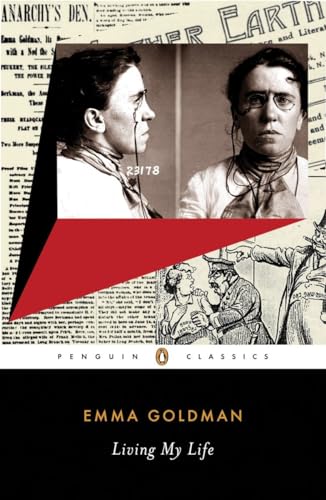
Anarchist, journalist, drama critic, advocate of birth control and free love, Emma Goldman was the most famous—and notorious—woman in the early twentieth century. This abridged version of her two-volume autobiography takes her from her birthplace in czarist Russia to the socialist enclaves of Manhattan’s Lower East Side. Against a dramatic backdrop of political argument, show trials, imprisonment, and tempestuous romances, Goldman chronicles the epoch that she helped shape: the reform movements of the Progressive Era, the early years of and later disillusionment with Lenin’s Bolshevik experiment, and more. Sounding a call still heard today, Living My Life is a riveting account of political ferment and ideological turbulence.
First time in Penguin Classics
Condensed to half the length of Goldman's original work, this edition is accessible to those interested in the activist and her extraordinary era
Die Inhaltsangabe kann sich auf eine andere Ausgabe dieses Titels beziehen.
Über die Autorin bzw. den Autor
Emma Goldman (1869-1940) came to America from Russia when she was sixteen. As a political activist, publisher, lecturer, and writer, she was a central figure in the radical social movements of her age.
Miriam Brody has written biographies of Mary Wollstonecraft and Victoria Woodhull.
Auszug. © Genehmigter Nachdruck. Alle Rechte vorbehalten.
Introduction
I. “RED EMMA” WRITES HER LIFE
“The most dangerous woman in America,” as J. Edgar Hoover described her, took pen in hand in June 1928 to write the events of her tumultuous life. “Red Emma” Goldman, who the popular press claimed owned no God, had no religion, would kill all rulers, and overthrow all laws, chose to begin her autobiography on her fifty-ninth birthday, a task she would later say was the “hardest and most painful” she had ever undertaken (Goldman, Nowhere at Home, 145). As she wrote about her life, she confronted not only her own loneliness but also the disappointment of her political hopes, the dream that anarchism, which she called her “beautiful ideal,” would take root in her lifetime among the people whose benefit she believed she served.
Others had urged her to begin her memoir years before, but she had been busy traversing the country, lecturing, organizing, writing, or if in prison, forging bonds with other inmates, protesting conditions, or alerting vast networks of supporters and friends to crises imminent or arrived. Now in a borrowed cottage in the south of France, years advancing, living on funds raised by friends and a generous advance from her American publisher, Emma Goldman began a labor that would require three years to complete, writing in longhand by night and dictating to a typist by day. “I am anxious to reach the mass of the American reading public,” she wrote to a friend, “not so much because of the royalties, but because I have always worked for the mass” (Drinnon, 269). In fact, she was writing also in her own interest, hoping to win the sympathy of American readers who might help reverse the decision to deport her that had left her a stateless exile.
Eight years earlier, in 1920, America, her adopted country, had deported her as a subversive, leaving her feeling “an alien everywhere,” as she wrote to her friend in exile Alexander Berkman (Nowhere at Home, 170). A permanent, often unwelcome guest in someone else’s country, she would infuse her writing with a sense of loneliness and despair. To Berkman she wrote “hardly anything has come of our years of effort” (ibid., 49). On the eve of fascist victories in Europe, she felt as well the nearness of catastrophe, the likelihood that once again, as it had in 1914, Europe would be convulsed by war.
Underlying this sense of impending disaster, she was aware that political radicals on the left were embracing the Bolshevik Revolution in Russia, a revolution she believed had betrayed the expectations of the Russian peasants and workers in whose name Lenin’s government served. She had spent two years in the new Soviet state, having gone there as an anarchist victim of the infamous Palmer raids that launched the first widespread “red scare” at the time of America’s entry into World War I. Instead of meeting the intoxication of a liberated society that had thrown off the shackles of czarist autocracy, Emma Goldman found, she believed, a dispirited and growing Bolshevik state. To her dismay, the state was consolidating its powers, responding, she felt, incompetently and calamitously to its economic and political crises and, to compound the disaster, imprisoning and executing its dissidents.
Russia had been her birthplace in 1869, but more important, Russia had nurtured the revolutionary beliefs she had taken as a young immigrant girl to America. At sixteen, she had joined the thousands of refugees from eastern Europe, many fleeing the Russian anti-Semitism that broke out in violent pogroms in the eastern “pale of settlement” after terrorists assassinated Czar Alexander II. Now disappointed by Russia, Emma Goldman trained her hopes once more on the American shores, where she had left behind friends and family.
Writing her life story might have proved difficult. She had kept no diary. Although there had been a vast record of her writing and lecturing stored in the offices of Mother Earth, the journal she founded in 1905 and maintained through many busy years, these records had been destroyed by federal agents who systematically ransacked and looted the property of political radicals. Fortunately she had been a faithful and copious letter writer, and in response to her request more than a thousand of these were returned to her. Some letters to friends were meticulous accounts of her prison years—what she read, what she was fed, the gifts sent to her by loyal supporters, the campaigns she carried on for better conditions, the relations formed with other inmates. Other letters could provide testimony enough for her to recall her public life, years in which she was both witness to and a principal actor in the political convulsions that defined her time—workers’ strikes, riots, assassinations, the women’s rights movement, political repression, revolution, and exile. Five hundred more letters came from Ben Reitman, the man who had been for many years her publicist, road manager, and lover. In these she chronicled a response to a love affair in which she berated Reitman for betrayal, soothed his vanity when he was snubbed by the anarchist luminaries he hoped to impress, or frankly recalled the pleasures of his bed.
Goldman’s was a rich life to chronicle, the story of an intellectual and emotional journey of a Russian woman who became an American original, someone who combined the radical political traditions of nineteenth-century Europe with the insurgent individualism of the young American republic. The fusion she sought was an anarchism responsive to the changes in America in the early twentieth century, an anarchism that would transform the conditions of public and private life. To the call for radical reorganization of work life she inherited from European political tradition and to the conviction in the supremacy of individual liberty she found in the American literature of Emerson, Thoreau, and Whitman, Goldman added advocacy of the birth control and free-love movements that had emerged out of nineteenth-century American anarchist and utopian communities. Without such reforms, she would argue, there would be no egalitarian emancipation of the whole of humanity.
The foundations of these beliefs, Goldman claimed in her autobiography, were laid in her earliest years in Russia when, as a child, her sympathies were stirred by the oppression of the peasants of her native Lithuania and the suffering of the political rebels, communists or anarchists, imprisoned or executed by the czars. While a young teenager in Russia, Emma Goldman had read Nikolai Chernyshevsky’s widely influential 1863 novel, What Is to Be Done?, in which a young woman from the propertied Russian gentry escapes from the constraints of bourgeois marriage to claim romantic love and economic independence. Chernyshevsky’s heroine allies herself with the young radicals influenced by the European revolutions of 1848, rebels who sought to redress the great disparities of wealth in their own native Russia. To the young Emma Goldman, this sexually and materially emancipated model of womanhood was inspiring, chafing as Goldman was under the authoritarian rule of a patriarchal and often violent father.
In 1886, after she joined some of her family who had come earlier to Rochester, New York, Goldman’s sympathy for victims of social injustice was stirred into a lifelong commitment to political action by events in Chicago that became known to the world as the Haymarket Massacre. Four American anarchist revolutionaries, hanged in Chicago, had been held responsible without evidence for throwing a bomb that killed seven policemen. As the police opened fire, perhaps three times as many more workers who were rallying for the...
„Über diesen Titel“ kann sich auf eine andere Ausgabe dieses Titels beziehen.
Weitere beliebte Ausgaben desselben Titels

Suchergebnisse für Living My Life (Penguin Classics)

Foto des Verkäufers
Living My Life (Penguin Classics)
Anbieter: Zoom Books Company, Lynden, WA, USA
Verkäuferbewertung 5 von 5 Sternen

Zustand: very_good. Book is in very good condition and may include minimal underlining highlighting. The book can also include "From the library of" labels. May not contain miscellaneous items toys, dvds, etc. . We offer 100% money back guarantee and 24 7 customer service. Bestandsnummer des Verkäufers ZBV.0142437859.VG
Gebraucht kaufen
EUR 11,57
Versand gratis
Versand innerhalb von USA
Versand innerhalb von USA
Anzahl: 1 verfügbar
Beispielbild für diese ISBN
Living My Life Penguin Classic
Anbieter: World of Books (was SecondSale), Montgomery, IL, USA
Verkäuferbewertung 5 von 5 Sternen
Zustand: Good. Item in good condition. Textbooks may not include supplemental items i.e. CDs, access codes etc. Bestandsnummer des Verkäufers 00104803460
Gebraucht kaufen
EUR 11,63
Versand gratis
Versand innerhalb von USA
Versand innerhalb von USA
Anzahl: 1 verfügbar
Beispielbild für diese ISBN
Living My Life Penguin Classic
Anbieter: World of Books (was SecondSale), Montgomery, IL, USA
Verkäuferbewertung 5 von 5 Sternen
Zustand: Very Good. Item in very good condition! Textbooks may not include supplemental items i.e. CDs, access codes etc. Bestandsnummer des Verkäufers 00104944503
Gebraucht kaufen
EUR 11,63
Versand gratis
Versand innerhalb von USA
Versand innerhalb von USA
Anzahl: 1 verfügbar
Beispielbild für diese ISBN
Living My Life
Anbieter: ThriftBooks-Atlanta, AUSTELL, GA, USA
Verkäuferbewertung 5 von 5 Sternen
Paperback. Zustand: Fair. No Jacket. Readable copy. Pages may have considerable notes/highlighting. ~ ThriftBooks: Read More, Spend Less. Bestandsnummer des Verkäufers G0142437859I5N00
Gebraucht kaufen
EUR 12,43
Versand gratis
Versand innerhalb von USA
Versand innerhalb von USA
Anzahl: 1 verfügbar
Foto des Verkäufers
Living My Life (Penguin Classics)
Anbieter: Goodwill Books, Hillsboro, OR, USA
Verkäuferbewertung 5 von 5 Sternen
Zustand: good. Signs of wear and consistent use. Bestandsnummer des Verkäufers GICWV.0142437859.G
Gebraucht kaufen
EUR 9,65
EUR 3,45 Versand
Versand innerhalb von USA
Versand innerhalb von USA
Anzahl: 1 verfügbar
Foto des Verkäufers
Living My Life (Penguin Classics)
Anbieter: Goodwill Books, Hillsboro, OR, USA
Verkäuferbewertung 5 von 5 Sternen
Zustand: acceptable. Fairly worn, but readable and intact. If applicable: Dust jacket, disc or access code may not be included. Bestandsnummer des Verkäufers GICWV.0142437859.A
Gebraucht kaufen
EUR 9,65
EUR 3,45 Versand
Versand innerhalb von USA
Versand innerhalb von USA
Anzahl: 2 verfügbar
Beispielbild für diese ISBN
Living My Life (Penguin Classics)
Anbieter: Books From California, Simi Valley, CA, USA
Verkäuferbewertung 4 von 5 Sternen

Paperback. Zustand: Good. Bestandsnummer des Verkäufers mon0004114846
Gebraucht kaufen
EUR 9,29
EUR 4,31 Versand
Versand innerhalb von USA
Versand innerhalb von USA
Anzahl: 1 verfügbar
Beispielbild für diese ISBN
Living My Life
Anbieter: GreatBookPrices, Columbia, MD, USA
Verkäuferbewertung 5 von 5 Sternen
Zustand: New. Bestandsnummer des Verkäufers 3524726-n
Neu kaufen
EUR 13,42
EUR 2,28 Versand
Versand innerhalb von USA
Versand innerhalb von USA
Anzahl: Mehr als 20 verfügbar
Beispielbild für diese ISBN
Living My Life (Penguin Classics)
Anbieter: Lakeside Books, Benton Harbor, MI, USA
Verkäuferbewertung 5 von 5 Sternen
Zustand: New. Brand New! Not Overstocks or Low Quality Book Club Editions! Direct From the Publisher! We're not a giant, faceless warehouse organization! We're a small town bookstore that loves books and loves it's customers! Buy from Lakeside Books! Bestandsnummer des Verkäufers OTF-S-9780142437858
Neu kaufen
EUR 12,30
EUR 3,45 Versand
Versand innerhalb von USA
Versand innerhalb von USA
Anzahl: Mehr als 20 verfügbar
Beispielbild für diese ISBN
Living My Life Format: Paperback
Anbieter: INDOO, Avenel, NJ, USA
Verkäuferbewertung 5 von 5 Sternen
Zustand: New. Bestandsnummer des Verkäufers 9780142437858
Neu kaufen
EUR 15,78
Versand gratis
Versand innerhalb von USA
Versand innerhalb von USA
Anzahl: Mehr als 20 verfügbar