
Verwandte Artikel zu The Myth of Solid Ground: Earthquakes, Prediction,...
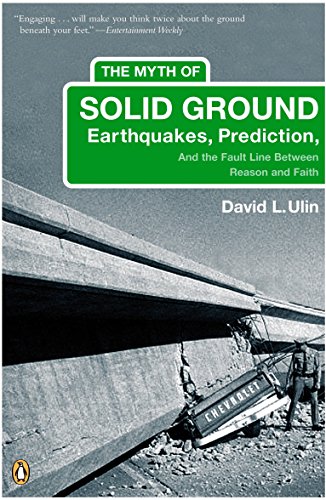
The Myth of Solid Ground: Earthquakes, Prediction, and the Fault Line Between Reason and Faith - Softcover
Inhaltsangabe
Earthquakes are one of the great unsolved geological mysteries. Attempts to predict them have ranged from studies of California’s fault lines by USGS geologists to the work of an odd assortment of psychics and apocalyptics who base their sometimes startlingly accurate forecasts on everything from changes in the earth’s magnetic fields to the behavior of whales. The Myth of Solid Ground is a journey, both personal and cultural, through the world of earthquakes and earthquake prediction, one that seeks a middle ground between science and superstition, while also looking for a larger context in which seismicity might make sense. An excellent primer on the science of seismology, The Myth of Solid Ground looks at earthquakes as the ultimate metaphor for living with impending disaster.
Die Inhaltsangabe kann sich auf eine andere Ausgabe dieses Titels beziehen.
Über die Autorin bzw. den Autor
David L. Ulin is a regular contributor to the Los Angeles Times and LA Weekly. His work has also appeared in GQ, the Nation, New York Times Book Review, and Atlantic Monthly. Ulin is the editor of two acclaimed anthologies of writing about Los Angeles, where he lives.
Auszug. © Genehmigter Nachdruck. Alle Rechte vorbehalten.
THREE APRIL EARTHQUAKES
Let me tell you about the earliest earthquake I remember. It happened in the spring of 1980, when I was eighteen years old and living in my first apartment, on Haight Street in San Francisco, with two friends from high school, a collection of Grateful Dead tapes, and a glorious sense of aimlessness, of being adrift in a magical universe, where virtually everything I confronted in my daily life could be construed to harbor a hidden message of some kind. Later that year, over the Fourth of July holiday, I would ask for a sign of God’s existence; two days afterwards, a car in which I was a passenger went out of control on the 101 just south of Novato, slamming into a guardrail and rolling once, end over end, onto the highway shoulder, yet somehow leaving all five of us who’d been inside miraculously unhurt. I mention this neither to support nor debunk the God story, but simply as an illustration, to show the kind of boy I was, the things I thought about, the way I saw the world. It was a period in which I spent a lot of time considering connections, pondering synchronicity and the heady, if inaccessible, question of truth, awash in the quest for ultimate answers and the meaning that, I felt sure, was waiting, if only I could peel back the surface of the earth.
Among the more self-aggrandizing legends to swirl through San Francisco in the days I lived there was one claiming that the city was a modern re-creation of the lost kingdom of Atlantis; both places, or so the story went, were ringed by water and anchored by large white pyramids with red blinking eyes at their apexes, and both (here’s the self- aggrandizing part) represented landscapes of enlightenment in a universe of human darkness, zones of fulfillment where people could exist as their most heightened, elemental selves. From the perspective of the present, I now see this story for the provincial fantasy it was, but I remain struck by just how often, during the spring of 1980, I happened to hear it, from people who didn’t know one another, people who had nothing in common, whose definitions of enlightenment could never have encompassed one another’s points of view. For one friend, it was a matter of mass reincarnation: San Francisco, she told me, was filling up with reborn Atlanteans—which, according to her scattershot cosmology, meant anyone who had ever been drawn to the city, or, in other words, nearly all of us. Another friend took things a step further, insisting that when all the Atlanteans finally reached San Francisco, the city would be destroyed by earthquake and tidal wave, just as Atlantis itself purportedly had been. The year this would happen, she told me, was 1982, although she couldn’t explain why, exactly, other than to say she’d heard it somewhere, from someone else along the never-ending daisy chain of myth. When pressed, she’d shrug her shoulders and point at the fog-swept hills or the bulge of Mount Tamalpais, reclining like a sleeping Indian princess in the soft green distance past the Golden Gate Bridge, and say in a voice marked equally by wistfulness and wonder, “It makes sense when you think about it. This place is just too beautiful to exist.”
In the midst of all this legend making, I was asked by another friend, a girl named Lauren, to spend Easter Sunday in Marin County, at her grandparents’ house. Easter was not a holiday to which I paid much attention—too fetishistic, too stained by blood and obligation, not to mention that I was Jewish—but living three thousand miles from home, I missed the rootedness of family, the quality of belonging, of a past that extended further back in time than yesterday or last week. Because of that, when Easter finally rolled around, my roommates and I accompanied Lauren and her parents across the Golden Gate, through the rainbow tunnel at the north end of Sausalito, and up into the hills of Mill Valley, where her grandparents lived in one of those cantilevered California contemporary cottages, all blond wood and sheeted glass, with small, neat rooms like ships’ cabins, and a redwood deck projected on four ridiculously skinny stilts a hundred feet above the slope of a shaded ravine. What impressed me about the house—what always impressed me about houses like that—was the sheer impossibility of it, the way it not so much occupied a physical space as hung suspended above one; airy, ethereal, less a residence than a promise or a prayer. Inside, however, the place felt far more tangible, recognizable even: the heavy floors and thickly braided carpets, the linen napkins and crystal goblets, the ease with which Lauren’s parents and grandparents sipped drinks and talked of absent relatives, while we, the teenaged visitors, remained polite but slightly distanced, as if we didn’t want to give ourselves away. More than anything, I found myself reminded of holidays at my own home, substantial gatherings marked by generations, by a continuity that made me feel connected to the world. It was as if, here in this improbable structure, I had stumbled across a piece of ground that turned out to be solid, rather than one that existed, almost literally, in thin air.
I don’t remember very much about that Easter Sunday, just a few scattered impressions here and there. I know that we had lunch, and that, caught again in the pull of family gravity, I made a phone call to my parents; I also know that, during the course of the afternoon, Lauren and my roommates and I slid down the hill beneath the house and smoked a joint, shadowed by the weight of that deck jutting out above us like a canopy of dreams. It was still light when we got back to San Francisco, or so my memory dictates, even if, thinking about it now, that seems impossible to me. Either way, at the end of the day I was alone in our studio apartment, looking out the kitchen window at the unkempt slope of Buena Vista Park where it crawled up the other side of Haight Street, and talking on the phone. Somewhere in the middle of the conversation, I felt a slight pitch and yaw, like a hiccup in the floor beneath me, and the whole room started to rock, gently, even easily, as if the world had been cast on rollers and was being shaken by a giant hand. Our apartment was on the third floor of an old wood-framed structure covered with what looked like pale green linoleum, and as the beams in the ceiling began beating out a distinct rat-tat-tatting rhythm, I found myself facing a strange dislocation, as if I’d been caught between moments, between “normal” reality and a new territory I didn’t understand. “What?” I said, and then I turned, and—this I recall as distinctly as if it were happening this very instant—noticed our collection of motley thrift-store coffee cups start to dance upon the shelves. In some strange way, it was like what would later happen in that rolling car, the idea that I was in the grip of something, that time had stopped and the simplest things—my name, my sense of self, the position of my body—had been suspended, cast aside. “Do you feel that?” I heard through the telephone receiver, but before I could answer, the shaking stopped, leaving in its aftermath something like total stillness: no birds chirping, no wind rustling, not the sound of breathing even, just the squeak, squeak, squeak of my chandelier as it slowed its swaying, and the fine, high hum of the phone connection buzzing in my ear.
Given who I was and how I saw the universe, you might think I’d have taken my first earthquake as portentous, as a harbinger of things to come. But the truth is that, as soon as the temblor was over, it didn’t even take a second for reality to snap back into position, as if nothing extraordinary had occurred. Out the window, I could see cars...
„Über diesen Titel“ kann sich auf eine andere Ausgabe dieses Titels beziehen.
Suchergebnisse für The Myth of Solid Ground: Earthquakes, Prediction,...

Beispielbild für diese ISBN
The Myth of Solid Ground: Earthquakes, Prediction, and the Fault Line Between Reason and Faith
Verlag:
Penguin Publishing Group (edition Reprint), 2005
ISBN 10: 0143035258
ISBN 13: 9780143035251
Gebraucht
Paperback
Anbieter: BooksRun, Philadelphia, PA, USA
Verkäuferbewertung 5 von 5 Sternen

Paperback. Zustand: Fair. Reprint. The item might be beaten up but readable. May contain markings or highlighting, as well as stains, bent corners, or any other major defect, but the text is not obscured in any way. Bestandsnummer des Verkäufers 0143035258-7-1
Gebraucht kaufen
EUR 4,12
Versand gratis
Versand innerhalb von USA
Versand innerhalb von USA
Anzahl: 1 verfügbar
Beispielbild für diese ISBN
The Myth of Solid Ground : Earthquakes, Prediction, and the Fault Line Between Reason and Faith
Verlag:
Penguin Publishing Group, 2005
ISBN 10: 0143035258
ISBN 13: 9780143035251
Gebraucht
Softcover
Anbieter: Better World Books, Mishawaka, IN, USA
Verkäuferbewertung 5 von 5 Sternen
Zustand: Good. Pages intact with minimal writing/highlighting. The binding may be loose and creased. Dust jackets/supplements are not included. Stock photo provided. Product includes identifying sticker. Better World Books: Buy Books. Do Good. Bestandsnummer des Verkäufers 15917302-6
Gebraucht kaufen
EUR 5,98
Versand gratis
Versand innerhalb von USA
Versand innerhalb von USA
Anzahl: 1 verfügbar
Beispielbild für diese ISBN
The Myth of Solid Ground : Earthquakes, Prediction, and the Fault Line Between Reason and Faith
Verlag:
Penguin Publishing Group, 2005
ISBN 10: 0143035258
ISBN 13: 9780143035251
Gebraucht
Softcover
Anbieter: Better World Books, Mishawaka, IN, USA
Verkäuferbewertung 5 von 5 Sternen
Zustand: Very Good. Former library copy. Pages intact with possible writing/highlighting. Binding strong with minor wear. Dust jackets/supplements may not be included. Includes library markings. Stock photo provided. Product includes identifying sticker. Better World Books: Buy Books. Do Good. Bestandsnummer des Verkäufers 2225506-75
Gebraucht kaufen
EUR 5,98
Versand gratis
Versand innerhalb von USA
Versand innerhalb von USA
Anzahl: 1 verfügbar
Beispielbild für diese ISBN
The Myth of Solid Ground: Earthquakes, Prediction, and the Fault Line Between Reason and Faith
Verlag:
Penguin Publishing Group, 2005
ISBN 10: 0143035258
ISBN 13: 9780143035251
Gebraucht
paperback
Anbieter: HPB-Movies, Dallas, TX, USA
Verkäuferbewertung 5 von 5 Sternen
paperback. Zustand: Very Good. Connecting readers with great books since 1972! Used books may not include companion materials, and may have some shelf wear or limited writing. We ship orders daily and Customer Service is our top priority! Bestandsnummer des Verkäufers S_475860355
Gebraucht kaufen
EUR 7,80
EUR 3,24 Versand
Versand innerhalb von USA
Versand innerhalb von USA
Anzahl: 1 verfügbar
Beispielbild für diese ISBN
The Myth of Solid Ground: Earthquakes, Prediction, and the Fault Line Between Reason and Faith
Verlag:
Penguin Publishing Group, 2005
ISBN 10: 0143035258
ISBN 13: 9780143035251
Gebraucht
paperback
Anbieter: HPB-Emerald, Dallas, TX, USA
Verkäuferbewertung 5 von 5 Sternen
paperback. Zustand: Very Good. Connecting readers with great books since 1972! Used books may not include companion materials, and may have some shelf wear or limited writing. We ship orders daily and Customer Service is our top priority! Bestandsnummer des Verkäufers S_482428600
Gebraucht kaufen
EUR 10,66
EUR 3,24 Versand
Versand innerhalb von USA
Versand innerhalb von USA
Anzahl: 1 verfügbar
Beispielbild für diese ISBN
The Myth of Solid Ground: Earthquakes, Prediction, and the Fault Line Between Reason and Faith
Verlag:
Penguin Publishing Group, 2005
ISBN 10: 0143035258
ISBN 13: 9780143035251
Gebraucht
paperback
Anbieter: Books From California, Simi Valley, CA, USA
Verkäuferbewertung 4 von 5 Sternen

paperback. Zustand: Very Good. Bestandsnummer des Verkäufers mon0003905067
Gebraucht kaufen
EUR 9,66
EUR 4,31 Versand
Versand innerhalb von USA
Versand innerhalb von USA
Anzahl: 1 verfügbar
Beispielbild für diese ISBN
The Myth Of Solid Ground: Earthquakes, Prediction, and the Fault Line Between Reason and Faith
Verlag:
Penguin Group USA, E Rutherford, New Jersey, U.S.A., 2005
ISBN 10: 0143035258
ISBN 13: 9780143035251
Gebraucht
Softcover
Anbieter: Ghost River Rare and Used Books, Cremona, AB, Kanada
Verkäuferbewertung 5 von 5 Sternen
Zustand: Good. E Rutherford, New Jersey, U.S.A.: Penguin Group USA, 2005. 290 pages includes index. ".a journey throught this world of earthquakes and earthquake prediction, one that seeks a middle ground between science and superstition, while also looking for a larger context in which seismicity might make sense." Soft cover is bright and clean, minimal edge rubbing. No former owner's name. Text is clean and unmarked. Trade Good. Remainder. Bestandsnummer des Verkäufers 107045
Gebraucht kaufen
EUR 8,45
EUR 13,38 Versand
Versand von Kanada nach USA
Versand von Kanada nach USA
Anzahl: 1 verfügbar
Foto des Verkäufers
Myth Of Solid Ground : Earthquakes, Prediction, and the Fault Line Between Reason and Faith
Anbieter: GreatBookPrices, Columbia, MD, USA
Verkäuferbewertung 5 von 5 Sternen
Zustand: New. Bestandsnummer des Verkäufers 3317797-n
Neu kaufen
EUR 20,50
EUR 2,28 Versand
Versand innerhalb von USA
Versand innerhalb von USA
Anzahl: Mehr als 20 verfügbar
Foto des Verkäufers
The Myth of Solid Ground: Earthquakes, Prediction, and the Fault Line Between Reason and Faith (Paperback or Softback)
Verlag:
Penguin Books 7/26/2005, 2005
ISBN 10: 0143035258
ISBN 13: 9780143035251
Neu
Paperback or Softback
Anbieter: BargainBookStores, Grand Rapids, MI, USA
Verkäuferbewertung 5 von 5 Sternen
Paperback or Softback. Zustand: New. The Myth of Solid Ground: Earthquakes, Prediction, and the Fault Line Between Reason and Faith. Book. Bestandsnummer des Verkäufers BBS-9780143035251
Foto des Verkäufers
Myth Of Solid Ground : Earthquakes, Prediction, and the Fault Line Between Reason and Faith
Verlag:
Penguin Publishing Group, 2005
ISBN 10: 0143035258
ISBN 13: 9780143035251
Gebraucht
Softcover
Anbieter: GreatBookPrices, Columbia, MD, USA
Verkäuferbewertung 5 von 5 Sternen
Zustand: As New. Unread book in perfect condition. Bestandsnummer des Verkäufers 3317797
Gebraucht kaufen
EUR 21,89
EUR 2,28 Versand
Versand innerhalb von USA
Versand innerhalb von USA
Anzahl: Mehr als 20 verfügbar