
Verwandte Artikel zu The Reformation: A History
Inhaltsangabe
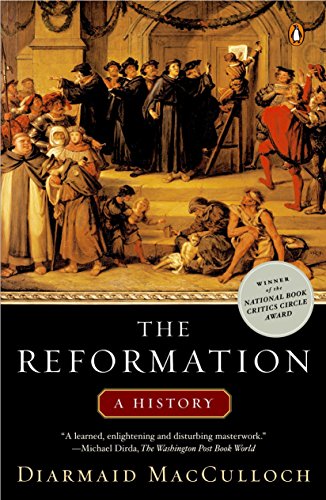
The National Book Critics Circle Award–winning history of the Reformation—from the New York Times bestselling author of Christianity
At a time when men and women were prepared to kill—and be killed—for their faith, the Protestant Reformation tore the Western world apart. Acclaimed as the definitive account of these epochal events, Diarmaid MacCulloch's award-winning history brilliantly re-creates the religious battles of priests, monarchs, scholars, and politicians—from the zealous Martin Luther and his Ninety-Five Theses to the polemical John Calvin to the radical Igantius Loyola, from the tortured Thomas Cranmer to the ambitious Philip II.
Drawing together the many strands of the Reformation and Counter-Reformation, and ranging widely across Europe and the New World, MacCulloch reveals as never before how these dramatic upheavals affected everyday lives—overturning ideas of love, sex, death, and the supernatural, and shaping the modern age.
Die Inhaltsangabe kann sich auf eine andere Ausgabe dieses Titels beziehen.
Über die Autorin bzw. den Autor
Diarmaid MacCulloch is Professor of the History of the Church at Oxford University. He is the author of Thomas Cranmer, winner of the Whitbread Prize, the James Tait Black Prize, and the Duff Cooper Prize; Christianity, a New York Times bestseller that won the Cundill Prize in History and was chosen by The New Yorker and The New York Times as a Best Book of the Year; and Silence: A Christian History. The Reformation won the National Book Critics Circle Award, the Wolfson Prize, and the British Academy Prize A Fellow of the British Academy and the Royal Historical Society, he was knighted by the Queen for his services to scholarship.
Auszug. © Genehmigter Nachdruck. Alle Rechte vorbehalten.
Who or what is a Catholic? This Greek word has become one of the chief battlegrounds in western Latin Christianity, for it is used in different ways that outside observers of Christian foibles find thoroughly confusing. The word ‘Catholic’ is the linguistic equivalent of a Russian doll. It may describe the whole Christian Church founded two thousand years ago in Palestine, or the western half of the Church that split from mainstream eastern Christianity a thousand years ago, or that part of the western half that remained loyal to the bishop of Rome (the pope) after the sixteenth century, or a Protestant European Christian who thought that the bishop of Rome was the Antichrist, or a modern Anglo-Catholic faction within the Anglican Communion. How can the word describe all of these things and still have any meaning? I have written this book about the sixteenth-century Reformation in part to answer that question. The Reformation introduced many more complications to the word; in fact, there were very many different Reformations, nearly all of which would have said that they were aimed simply at recreating authentic Catholic Christianity. For simplicity’s sake I will take for granted that this book examines multiple Reformations, some of which were directed by the pope. From now on I will continue to use the shorthand term “Reformation,” but readers should note that this is often intended to embrace both Protestantism and the religious movements commonly known as Tridentine Catholicism, the Catholic Reformation, or the Counter-Reformation, which revitalized part of the old Church that remained loyal to the pope.
“Catholic” is clearly a word a lot of people want to possess. By contrast, it is remarkable how many religious labels started life as a sneer. The Reformation was full of angry words: “Calvinist” was at first a term of abuse to describe those who believed more or less what John Calvin believed; the nickname gradually forced out the rival contemptuous term “Picard,” which referred to Calvin’s birthplace in Noyon, in Picardy. No Anabaptists ever described themselves as Anabaptist, since “Anabaptist” means “rebaptizer,” and these radical folk believed that their adult baptism was the only authentic Christian initiation, with infant baptism signifying nothing. Even that slippery term Anglican appears to have been first spoken with disapproval by King James VI of Scotland, when in 1598 he was trying to convince the Church of Scotland how unenthusiastic he was for the Church of England.
One of the most curious usages is the growth of the word “Protestant.” It originally related to a specific occasion, in 1529, when at the Holy Roman Empire’s Diet (imperial assembly) held in the city of Speyer, the group of princes and cities who supported the programs of reformation promoted by Martin Luther and Huldrych Zwingli found themselves in a voting minority: To keep their solidarity, they issued a protestatio, affirming the reforming beliefs that they shared. The label “Protestant” thereafter was part of German or imperial politics for decades, and did not have a wider reference than that. ‘When the coronation of little King Edward VI was being organized in London in 1547, the planners putting in order the procession of dignitaries through the city appointed a place for “the Protestants,” by whom they meant the diplomatic representatives of these reforming Germans who were staying in the capital. Only rather later did the word gain a broader reference. It is therefore problematic to use Protestant as a simple description for sympathizers with reform in the first half of the sixteenth century, and the reader will find that often in this book I use a different word, “evangelical.” That word has the advantage that it was widely used and recognized at the time, and it also encapsulates what was most important to this collection of activists: the good news of the Gospel, in Latinized Greek, the evangelium.
Reformation disputes were passionate about words because words were myriad refractions of a God whose names included Word: a God encountered in a library of books, itself simply called the Book—the Bible. It is impossible to understand modem Europe without understanding these sixteenth-century upheavals in Latin Christianity. They represented the greatest fault line to appear in Christian culture since the Latin and Greek halves of the Roman Empire went their separate ways a thousand years before; they produced a house divided. The fault line is the business of this book. It is not a study of the whole of Europe as a whole: It largely neglects Orthodox Europe, the half or more of the continent that stretches from Greece, Serbia, Romania, and Ukraine through the lands of Russia as far east as the Urals. I will not deal with these except when the Orthodox story touches on or is intertwined with that of the Latin West. There is a simple reason for this: So far, the Orthodox churches have not experienced a Reformation. Back in the eighth and ninth centuries many of them were convulsed by an “iconoclastic controversy,” which hinged on one of the great issues to reappear in the sixteenth-century Reformation. But in the case of the Orthodox, the status quo was restored and not partially overthrown as it was in the West. We will return to this issue of images frequently in the course of this book.
My subject, then, is the Church which, when united, might most accurately be described (though clumsily and in narrow technical ecclesiological jargon) as the Western Church of the Latin Rite; I shall more commonly call it the western Church or the Latin Church, and refer to the culture that it sustained as Latin or western Christendom. Latin was inherited from the western Roman Empire formally dismantled in 476; Latin remained the language which united the peoples of this society, and in which they made their official approaches to God. During the sixteenth century this western society, previously unified by the pope’s symbolic leadership and by possession of that common Latin culture, was torn apart by deep disagreements about how human beings should exercise the power of God in the world, arguments even about what it was to be human. It was a process of extreme physical and mental violence. The historian of the German Reformation Peter Matheson compares the effect to the strategy of Berthold Brecht in his plays: Brecht talked of “alienation,” Verfremdung, a process of making the familiar unfamiliar in order to shock his theater audiences into taking control of their perceptions of what was going on in the drama. The reformers, suddenly finding the pope to be the devil’s agent and the miracle of the Mass the most evil moment in their earthly experience, would have known exactly what Brecht was trying to say.
The resulting division between Catholic and Protestant still marks Europe west of the lands of Orthodox (Greek, Russian, and oriental) Christianity, in a host of attitudes, assumptions, and habits of life which distinguish, for in stance, the remaining territories of Protestant Prussia from neighboring Catholic Poland, or the Protestant Netherlands from the Catholicism of the modern kingdom of Belgium. Sometimes the two communities nurse ancient grievances side by side, as in Northern Ireland. The Protestant communities, which for a variety of reasons and motives cut themselves off from Rome, also cut themselves off from many possible devotional roads to God, because they saw such routes as part of Roman corruption. In one sense, therefore, the Re formation conflicts stifled diversity. Rome closed down options by the decisions of the Council of Trent; Protestants, too, were anxious to weed out rival versions of Protestantism where princes and...
„Über diesen Titel“ kann sich auf eine andere Ausgabe dieses Titels beziehen.
Suchergebnisse für The Reformation: A History

Beispielbild für diese ISBN
The Reformation
Anbieter: HPB-Diamond, Dallas, TX, USA
Verkäuferbewertung 5 von 5 Sternen

Paperback. Zustand: Very Good. Connecting readers with great books since 1972! Used books may not include companion materials, and may have some shelf wear or limited writing. We ship orders daily and Customer Service is our top priority! Bestandsnummer des Verkäufers S_476853611
Gebraucht kaufen
EUR 4,30
EUR 3,29 Versand
Versand innerhalb von USA
Versand innerhalb von USA
Anzahl: 1 verfügbar
Foto des Verkäufers
The Reformation: A History
Anbieter: Greenworld Books, Arlington, TX, USA
Verkäuferbewertung 5 von 5 Sternen
Zustand: good. Fast Free Shipping â" Good condition. It may show normal signs of use, such as light writing, highlighting, or library markings, but all pages are intact and the book is fully readable. A solid, complete copy that's ready to enjoy. Bestandsnummer des Verkäufers GWV.014303538X.G
Gebraucht kaufen
EUR 7,97
Versand gratis
Versand innerhalb von USA
Versand innerhalb von USA
Anzahl: 1 verfügbar
Foto des Verkäufers
The Reformation: A History
Anbieter: Goodwill Books, Hillsboro, OR, USA
Verkäuferbewertung 5 von 5 Sternen
Zustand: acceptable. Fairly worn, but readable and intact. If applicable: Dust jacket, disc or access code may not be included. Bestandsnummer des Verkäufers 3IIK10005XAG_ns
Gebraucht kaufen
EUR 4,63
EUR 3,50 Versand
Versand innerhalb von USA
Versand innerhalb von USA
Anzahl: 1 verfügbar
Beispielbild für diese ISBN
The Reformation: A History
Anbieter: HPB-Red, Dallas, TX, USA
Verkäuferbewertung 5 von 5 Sternen
Paperback. Zustand: Very Good. Connecting readers with great books since 1972! Used textbooks may not include companion materials such as access codes, etc. May have some wear or limited writing/highlighting. We ship orders daily and Customer Service is our top priority! Bestandsnummer des Verkäufers S_482304709
Gebraucht kaufen
EUR 4,84
EUR 3,29 Versand
Versand innerhalb von USA
Versand innerhalb von USA
Anzahl: 1 verfügbar
Foto des Verkäufers
The Reformation: A History
Anbieter: Goodwill, Brooklyn Park, MN, USA
Verkäuferbewertung 4 von 5 Sternen

Zustand: good. All pages and cover are intact including the dust cover, if applicable . Spine may show signs of wear. Pages may include limited notes and highlighting. May include "From the library of" labels. Shrink wrap, dust covers, or boxed set case may be missing. Item may be missing bundled media. Bestandsnummer des Verkäufers MINV.014303538X.G
Gebraucht kaufen
EUR 4,71
EUR 3,50 Versand
Versand innerhalb von USA
Versand innerhalb von USA
Anzahl: 1 verfügbar
Beispielbild für diese ISBN
The Reformation: A History
Anbieter: HPB-Ruby, Dallas, TX, USA
Verkäuferbewertung 5 von 5 Sternen
Paperback. Zustand: Very Good. Connecting readers with great books since 1972! Used books may not include companion materials, and may have some shelf wear or limited writing. We ship orders daily and Customer Service is our top priority! Bestandsnummer des Verkäufers S_473087411
Gebraucht kaufen
EUR 5,58
EUR 3,29 Versand
Versand innerhalb von USA
Versand innerhalb von USA
Anzahl: 1 verfügbar
Foto des Verkäufers
The Reformation: A History
Anbieter: Goodwill of Central and Coastal Virginia, Richmond, VA, USA
Verkäuferbewertung 4 von 5 Sternen
Zustand: acceptable. Bestandsnummer des Verkäufers CCVV.014303538X.A
Gebraucht kaufen
EUR 4,14
EUR 5,04 Versand
Versand innerhalb von USA
Versand innerhalb von USA
Anzahl: 1 verfügbar
Beispielbild für diese ISBN
The Reformation: A History
Anbieter: World of Books (was SecondSale), Montgomery, IL, USA
Verkäuferbewertung 5 von 5 Sternen
Zustand: Acceptable. Item in acceptable condition! Textbooks may not include supplemental items i.e. CDs, access codes etc. Bestandsnummer des Verkäufers 00106516649
Gebraucht kaufen
EUR 10,03
Versand gratis
Versand innerhalb von USA
Versand innerhalb von USA
Anzahl: 1 verfügbar
Beispielbild für diese ISBN
The Reformation: A History
Anbieter: World of Books (was SecondSale), Montgomery, IL, USA
Verkäuferbewertung 5 von 5 Sternen
Paperback. Zustand: Good. The National Book Critics Circle Award-winning history of the Reformation--from the New York Times bestselling author of Christianity At a time when men and women were prepared to kill--and be killed--for their faith, the Protestant Reformation tore the Western world apart. Acclaimed as the definitive account of these epochal events, Diarmaid MacCulloch's award-winning history brilliantly re-creates the religious battles of priests, monarchs, scholars, and politicians--from the zealous Martin Luther and his Ninety-Five Theses to the polemical John Calvin to the radical Igantius Loyola, from the tortured Thomas Cranmer to the ambitious Philip II. Drawing together the many strands of the Reformation and Counter-Reformation, and ranging widely across Europe and the New World, MacCulloch reveals as never before how these dramatic upheavals affected everyday lives--overturning ideas of love, sex, death, and the supernatural, and shaping the modern age. Bestandsnummer des Verkäufers 00107769881
Gebraucht kaufen
EUR 10,03
Versand gratis
Versand innerhalb von USA
Versand innerhalb von USA
Anzahl: 10 verfügbar
Beispielbild für diese ISBN
The Reformation
Anbieter: HPB Inc., Dallas, TX, USA
Verkäuferbewertung 5 von 5 Sternen
Paperback. Zustand: Very Good. Connecting readers with great books since 1972! Used books may not include companion materials, and may have some shelf wear or limited writing. We ship orders daily and Customer Service is our top priority! Bestandsnummer des Verkäufers S_478758822
Gebraucht kaufen
EUR 6,87
EUR 3,29 Versand
Versand innerhalb von USA
Versand innerhalb von USA
Anzahl: 1 verfügbar