
Verwandte Artikel zu The Mind at Work: Valuing the Intelligence of the American...
Inhaltsangabe
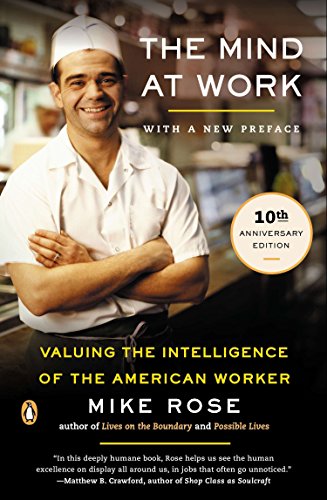
Featuring a new preface for the 10th anniversary
As did the national bestseller Nickel and Dimed, Mike Rose’s revelatory book demolishes the long-held notion that people who work with their hands make up a less intelligent class. He shows us waitresses making lightning-fast calculations, carpenters handling complex spatial mathematics, and hairdressers, plumbers, and electricians with their aesthetic and diagnostic acumen. Rose, an educator who is himself the son of a waitress, explores the intellectual repertory of everyday workers and the terrible social cost of undervaluing the work they do. Deftly combining research, interviews, and personal history, this is one of those rare books that has the capacity both to shape public policy and to illuminate general readers.
Die Inhaltsangabe kann sich auf eine andere Ausgabe dieses Titels beziehen.
Über die Autorin bzw. den Autor
Mike Rose is a professor in the UCLA Graduate School of Education and Information Studies. He has taught in a wide range of educational settings, from elementary school to adult literacy and job training programs. He is a member of the National Academy of Education and the recipient of a Guggenheim Fellowship, the Grawemeyer Award in Education, and awards from the Spencer Foundation, the National Council of Teachers of English, the Modern Language Association, and the American Educational Research Association. He also received the Commonwealth Club of California’s Award for Literary Excellence in Nonfiction. His books include Lives on the Boundary: The Struggles and Achievements of America’s Educationally Underprepared, Possible Lives: The Promise of Public Education in America, The Mind at Work: Valuing the Intelligence of the American Worker, Why School?: Reclaiming Education for All of Us, and Back to School: Why Everyone Deserves a Second Chance at Education.
Auszug. © Genehmigter Nachdruck. Alle Rechte vorbehalten.
INTRODUCTION: MIND AND WORK
I grew up a witness to the intelligence of the waitress in motion, the reflective welder, the strategy of the guy on the assembly line. This, then, is something I know: the thought it takes to do physical work. Such work put food on our table, gave shape to stories of affliction and ability, framed how I saw the world. I come from a family of immigrants who, with two exceptions, did not finish high school, and who worked in blue-collar or service jobs all their lives. I did not do so well in school myself, spent several years in the vocational track, and squeaked my way into a small college on probation—the first in the family to go beyond high school. Measures of intellectual ability and assumptions about it are woven throughout this history. So I’ve been thinking about this business of intelligence for a long time: the way we decide who’s smart and who isn’t, the way the work someone does feeds into that judgment, and the effect such judgment has on our sense of who we are and what we can do.
It was tough work that my family did. I would later come to understand the dynamics of occupational status and social class, but I could sense early on how difficult the work was, and that without it, we’d starve. I also saw that people knew things through work. And they used what they learned. This experience was all very specific to me, not abstract, emerging from the lived moments of work I had witnessed, from all sorts of objects and images, from sound and smell, from rhythms of the body. These sensory particulars stay with me, resonant.
There was a table covered with slick plastic in the center of my grandmother’s kitchen. Anyone who visited drank a cup of coffee there, wooden chair turned sideways to talk to her as she cooked. All meals were eaten at this table. My uncle Frank, a welder for the Pennsylvania Railroad, has come in from work, soiled denim, the smell of machinist’s oil in it, his face smeared with soot. He washes at the kitchen sink, sleeves rolled up, scrubbing his arms, full lather, angling them under the faucet. He settles in at the table; there’s a radio at its edge, and he turns it on to hear the evening news. My grandmother sets a large plate of steaming macaroni before him, deep red sauce; there is a bowl of chops, cooked earlier, in the center of the table. Frank’s hands are huge, and as he talks to us—a deep voice that can quickly rise in amazement—he tears off a big chunk of Italian bread and begins to eat with a focus and capacity that made its way into the comic tales told about him by his brothers, stories I would acquire through the hearing. After a while, he pushes the chair back, but not too far, unbuttons the top of his trousers, says he’s eaten way too much, dear Lord, and reaches for a chop, or for that loaf of bread, and leans in again, a deep pleasure against the bitter cold and exhaustion of the roundhouse.
Frank was a guy who made it a point to know things; he read a lot and inquired until he understood how something worked. It felt good to be with him. I remember him, his well-spoken voice, guiding me through the Railroader’s Museum: cutaways of running gear; diagrams and technical information on steam, diesel, and electric locomotives; photos of wooden freight cars, cabooses, the interiors of luxury passenger cars; posed workmen; lots of repair equipment; an operational model railroad. I knew of Frank’s many complaints about the railroad: layoffs and erratic scheduling, the brutal hours, the biting cold or sweltering heat, the burns over his arms and legs. But Frank also saw himself as a “railroad man,” someone who had made his contribution to this major American industry. Doing a job well mattered. “Work hard,” he wrote to his son, away in the army. “No one likes a half-assed man.” One of the moments I remember from that day at the museum, a simple but lasting one, is Frank standing before a display case, pointing to some miniature assembly of cable and gear, explaining in detail how it worked, taking his time until I got it. Many testaments have been written, both in fiction and memoir, about the physical labor of our forebears: from accounts of the prairie farm, the mills, and the mines to tales of immigrant life—the Lower East Side to the agricultural fields of Central and Southern California. One of the most stirring moments in Mario Cuomo’s keynote address to the 1984 Democratic National Convention is the memory of his father working long and hard hours in the family grocery store, teaching the young Mario “all I needed to know about faith and hard work by the simple eloquence of his example.” Such invocation speaks powerfully to Americans, stirs things deep in our cultural and personal histories. How interesting it is, though, that our testaments to physical work are so often focused on the values such work exhibits rather than on the thought it requires. It is a subtle but pervasive omission. Yet there is a mind at work in dignity, and values are intimately related to thought and action.
It is as though in our cultural iconography we are given the muscled arm, sleeve rolled tight against biceps, but no thought bright behind the eye, no image that links hand and brain. I find myself here wondering about Cuomo’s father. I imagine the many decisions he had to make, the alternatives large and small he weighed, the moments when he had to think quickly through his fatigue.
My mother shaped her adult identity in the restaurant business and, all the while I was growing up, worked as a waitress in coffee shops and family-style restaurants. My father and I would sometimes visit her at Coffee Dan’s, waiting for her shift to end, riding the bus home together, her feet killing her. When she worked the counter and took cash, we would find two stools by the register; when she had the main room, we sat at the back booth where the waitresses took their break. We would pass the time with her once the lunch or dinner rush had faded. There wasn’t much for a child to do, the hours stretched out, so I listened to the cooks and waitresses. They talked about the customers, or the boss, or each other; about the things going on at home with their kids; about how tired they were. And I watched what they did.
I remember particular people, like my mother’s coworker Rose Goldstein, a gentle woman whose house across town we visited, and Bobbi, the new hire just out of high school, on whom I had a desperate crush. And there was a cook whose name I’ve forgotten, but who would sit in the booth on break, smoking, solemn, food splattered all over his white uniform, down to the shoes. At the back booth, you would catch the thick smell of the grill and the whiff of stale food and cigarettes, scraped and dumped. These odors hung in my mother’s uniform and hair. When things got busy, there was a heightened clatter of kitchen and dishwasher, and I could feel the rise in the pulse of the place: the cacophony of customers’ voices; waitresses weaving in and out, warning “behind you” in a voice both impassive and urgent; all these people eating separately in one big public space.
I remember the restaurant’s lingo, remember liking the code of it. Tables were labeled by the number of chairs—and, thus, customers—around them: deuces, four-tops, six-tops. Areas of the restaurant had names: the racetrack was the speedy front section. Orders were abbreviated for the cook: fry four on two, my mother would call out as she clipped a check onto that little rotating wheel. To speak this language gave you a certain authority, signaled know-how.
I have many images of my mother at work, distinct from the other domains of her life: her walking...
„Über diesen Titel“ kann sich auf eine andere Ausgabe dieses Titels beziehen.
Suchergebnisse für The Mind at Work: Valuing the Intelligence of the American...

Beispielbild für diese ISBN
The Mind at Work : Valuing the Intelligence of the American Worker
Anbieter: NW Book Rescue, Hubbard, OR, USA
Verkäuferbewertung 2 von 5 Sternen

paperback. Zustand: Very Good. Pages are clean with no markings. Very little, if any, shelf wear. Any images shown are stock photographs and product may differ from what is shown. Bestandsnummer des Verkäufers *-STAY-20260810-0186-527K-D6788
Gebraucht kaufen
EUR 4,70
Versand gratis
Versand innerhalb von USA
Versand innerhalb von USA
Anzahl: 1 verfügbar
Beispielbild für diese ISBN
The Mind at Work: Valuing the Intelligence of the American Worker
Anbieter: Half Price Books Inc., Dallas, TX, USA
Verkäuferbewertung 5 von 5 Sternen

Paperback. Zustand: Very Good. Connecting readers with great books since 1972! Used books may not include companion materials, and may have some shelf wear or limited writing. We ship orders daily and Customer Service is our top priority! Bestandsnummer des Verkäufers S_473156453
Gebraucht kaufen
EUR 2,68
EUR 3,34 Versand
Versand innerhalb von USA
Versand innerhalb von USA
Anzahl: 1 verfügbar
Beispielbild für diese ISBN
The Mind at Work: Valuing the Intelligence of the American Worker
Anbieter: World of Books (was SecondSale), Montgomery, IL, USA
Verkäuferbewertung 5 von 5 Sternen
Paperback. Zustand: Very Good. Featuring a new preface for the 10th anniversary As did the national bestseller Nickel and Dimed, Mike Rose?s revelatory book demolishes the long-held notion that people who work with their hands make up a less intelligent class. He shows us waitresses making lightning-fast calculations, carpenters handling complex spatial mathematics, and hairdressers, plumbers, and electricians with their aesthetic and diagnostic acumen. Rose, an educator who is himself the son of a waitress, explores the intellectual repertory of everyday workers and the terrible social cost of undervaluing the work they do. Deftly combining research, interviews, and personal history, this is one of those rare books that has the capacity both to shape public policy and to illuminate general readers. Bestandsnummer des Verkäufers CIN0143035576VG
Gebraucht kaufen
EUR 6,17
Versand gratis
Versand innerhalb von USA
Versand innerhalb von USA
Anzahl: 1 verfügbar
Beispielbild für diese ISBN
The Mind at Work: Valuing the Intelligence of the American Worker
Anbieter: World of Books (was SecondSale), Montgomery, IL, USA
Verkäuferbewertung 5 von 5 Sternen
Paperback. Zustand: Good. Featuring a new preface for the 10th anniversary As did the national bestseller Nickel and Dimed, Mike Rose?s revelatory book demolishes the long-held notion that people who work with their hands make up a less intelligent class. He shows us waitresses making lightning-fast calculations, carpenters handling complex spatial mathematics, and hairdressers, plumbers, and electricians with their aesthetic and diagnostic acumen. Rose, an educator who is himself the son of a waitress, explores the intellectual repertory of everyday workers and the terrible social cost of undervaluing the work they do. Deftly combining research, interviews, and personal history, this is one of those rare books that has the capacity both to shape public policy and to illuminate general readers. Bestandsnummer des Verkäufers 00105406950
Gebraucht kaufen
EUR 6,17
Versand gratis
Versand innerhalb von USA
Versand innerhalb von USA
Anzahl: 3 verfügbar
Beispielbild für diese ISBN
The Mind at Work : Valuing the Intelligence of the American Worker
Verlag:
Penguin Publishing Group, 2005
ISBN 10: 0143035576
ISBN 13: 9780143035572
Gebraucht
Softcover
Anbieter: Better World Books: West, Reno, NV, USA
Verkäuferbewertung 5 von 5 Sternen
Zustand: Good. Reprint. Former library copy. Pages intact with minimal writing/highlighting. The binding may be loose and creased. Dust jackets/supplements are not included. Includes library markings. Stock photo provided. Product includes identifying sticker. Better World Books: Buy Books. Do Good. Bestandsnummer des Verkäufers 8046538-6
Gebraucht kaufen
EUR 6,18
Versand gratis
Versand innerhalb von USA
Versand innerhalb von USA
Anzahl: 1 verfügbar
Beispielbild für diese ISBN
The Mind at Work : Valuing the Intelligence of the American Worker
Verlag:
Penguin Publishing Group, 2005
ISBN 10: 0143035576
ISBN 13: 9780143035572
Gebraucht
Softcover
Anbieter: Better World Books, Mishawaka, IN, USA
Verkäuferbewertung 5 von 5 Sternen
Zustand: Good. Reprint. Pages intact with minimal writing/highlighting. The binding may be loose and creased. Dust jackets/supplements are not included. Stock photo provided. Product includes identifying sticker. Better World Books: Buy Books. Do Good. Bestandsnummer des Verkäufers 5196882-6
Gebraucht kaufen
EUR 6,18
Versand gratis
Versand innerhalb von USA
Versand innerhalb von USA
Anzahl: 2 verfügbar
Beispielbild für diese ISBN
The Mind at Work: Valuing the Intelligence of the American Worker
Anbieter: ThriftBooks-Atlanta, AUSTELL, GA, USA
Verkäuferbewertung 5 von 5 Sternen
Paperback. Zustand: Good. No Jacket. Pages can have notes/highlighting. Spine may show signs of wear. ~ ThriftBooks: Read More, Spend Less. Bestandsnummer des Verkäufers G0143035576I3N00
Gebraucht kaufen
EUR 6,40
Versand gratis
Versand innerhalb von USA
Versand innerhalb von USA
Anzahl: 1 verfügbar
Beispielbild für diese ISBN
The Mind at Work: Valuing the Intelligence of the American Worker
Anbieter: ThriftBooks-Atlanta, AUSTELL, GA, USA
Verkäuferbewertung 5 von 5 Sternen
Paperback. Zustand: Fair. No Jacket. Missing dust jacket; Readable copy. Pages may have considerable notes/highlighting. ~ ThriftBooks: Read More, Spend Less. Bestandsnummer des Verkäufers G0143035576I5N01
Gebraucht kaufen
EUR 6,40
Versand gratis
Versand innerhalb von USA
Versand innerhalb von USA
Anzahl: 1 verfügbar
Beispielbild für diese ISBN
The Mind at Work: Valuing the Intelligence of the American Worker
Anbieter: ThriftBooks-Reno, Reno, NV, USA
Verkäuferbewertung 5 von 5 Sternen
Paperback. Zustand: Very Good. No Jacket. May have limited writing in cover pages. Pages are unmarked. ~ ThriftBooks: Read More, Spend Less. Bestandsnummer des Verkäufers G0143035576I4N00
Gebraucht kaufen
EUR 6,40
Versand gratis
Versand innerhalb von USA
Versand innerhalb von USA
Anzahl: 1 verfügbar
Beispielbild für diese ISBN
The Mind at Work: Valuing the Intelligence of the American Worker
Anbieter: ThriftBooks-Dallas, Dallas, TX, USA
Verkäuferbewertung 5 von 5 Sternen
Paperback. Zustand: Fair. No Jacket. Readable copy. Pages may have considerable notes/highlighting. ~ ThriftBooks: Read More, Spend Less. Bestandsnummer des Verkäufers G0143035576I5N00
Gebraucht kaufen
EUR 6,40
Versand gratis
Versand innerhalb von USA
Versand innerhalb von USA
Anzahl: 1 verfügbar