Inhaltsangabe
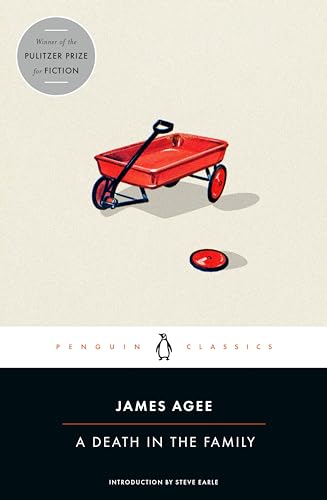
The classic American novel—winner of the 1958 Pulitzer Prize—now re-published for the 100th anniversary of James Agee’s birth
One of Time’s All-Time 100 Best Novels
A Penguin Classic
Published in 1957, two years after its author's death at the age of forty-five, A Death in the Family remains a near-perfect work of art, an autobiographical novel that contains one of the most evocative depictions of loss and grief ever written. As Jay Follet hurries back to his home in Knoxville, Tennessee, he is killed in a car accident—a tragedy that destroys not only a life, but also the domestic happiness and contentment of a young family. A novel of great courage, lyric force, and powerful emotion, A Death in the Family is a masterpiece of American literature.
Die Inhaltsangabe kann sich auf eine andere Ausgabe dieses Titels beziehen.
Über die Autorin bzw. den Autor
James Agee (1909–1955) is the author of Let Us Now Praise Famous Men, the renowned study of Alabama sharecroppers during the Depression. Born in Tennessee, he died two years before the publication of A Death in the Family, his most famous work.
Steve Earle (introducer) is an American singer-songwriter, political activist, and author of the short story collection Doghouse Roses. Born in Virginia, he lives with his wife in New York City.
Auszug. © Genehmigter Nachdruck. Alle Rechte vorbehalten.
Chapter 1
AT SUPPER THAT NIGHT, as many times before, his father said, “Well, spose we go to the picture show.”
“Oh, Jay!” his mother said. “That horrid little man!”
“What’s wrong with him?” his father asked, not because he didn’t know what she would say, but so she would say it.
“He’s so nasty!” she said, as she always did. “So vulgar! With his nasty little cane; hooking up skirts and things, and that nasty little walk!”
His father laughed, as he always did, and Rufus felt that it had become rather an empty joke; but as always the laughter also cheered him; he felt that the laughter enclosed him with his father.
They walked downtown in the light of mother-of-pearl, to the Majestic, and found their way to seats by the light of the screen, in the exhilarating smell of stale tobacco, rank sweat, perfume and dirty drawers, while the piano played fast music and galloping horses raised a grandiose flag of dust. And there was William S. Hart with both guns blazing and his long, horse face and his long, hard lip, and the great country rode away behind him as wide as the world. Then he made a bashful face at a girl and his horse raised its upper lip and everybody laughed, and then the screen was filled with a city and with the sidewalk of a side street of a city, a long line of palms and there was Charlie; everyone laughed the minute they saw him squattily walking with his toes out and his knees wide apart, as if he were chafed; Rufus’ father laughed, and Rufus laughed too. This time Charlie stole a whole bag of eggs and when a cop came along he hid them in the seat of his pants. Then he caught sight of a pretty woman and he began to squat and twirl his cane and make silly faces. She tossed her head and walked away with her chin up high and her dark mouth as small as she could make it and he followed her very busily, doing all sorts of things with his cane that made everybody laugh, but she paid no attention. Finally she stopped at a corner to wait for a streetcar, turning her back to him, and pretending he wasn’t even there, and after trying to get her attention for a while, and not succeeding, he looked out at the audience, shrugged his shoulders, and acted as if she wasn’t there. But after tapping his foot for a little, pretending he didn’t care, he became interested again, and with a charming smile, tipped his derby; but she only stiffened, and tossed her head again, and everybody laughed. Then he walked back and forth behind her, looking at her and squatting a little while he walked very quietly, and everybody laughed again; then he flicked hold of the straight end of his cane and, with the crooked end, hooked up her skirt to the knee, in exactly the way that disgusted Mama, looking very eagerly at her legs, and everybody laughed loudly; but she pretended she had not noticed. Then he twirled his cane and suddenly squatted, bending the cane and hitching up his pants, and again hooked up her skirt so that you could see the panties she wore, ruffled almost like the edges of curtains, and everybody whooped with laughter, and she suddenly turned in rage and gave him a shove in the chest, and he sat down straight-legged, hard enough to hurt, and everybody whooped again; and she walked haughtily away up the street, forgetting about the streetcar, “mad as a hornet!” as his father exclaimed in delight; and there was Charlie, flat on his bottom on the sidewalk, and the way he looked, kind of sickly and disgusted, you could see that he suddenly remembered those eggs, and suddenly you remembered them too. The way his face looked, with the lip wrinkled off the teeth and the sickly little smile, it made you feel just the way those broken eggs must feel against your seat, as queer and awful as that time in the white pekay suit, when it ran down out of the pants-legs and showed all over your stockings and you had to walk home that way with people looking; and Rufus’ father nearly tore his head off laughing and so did everybody else, and Rufus was sorry for Charlie, having been so recently in a similar predicament, but the contagion of laughter was too much for him, and he laughed too. And then it was even funnier when Charlie very carefully got himself up from the sidewalk, with that sickly look even worse on his face, and put his cane under one arm, and began to pick up his pants, front and back, very carefully, with his little fingers crooked, as if it were too dirty to touch, picking the sticky cloth away from his skin. Then he reached behind him and took out the wet bag of broken eggs and opened it and peered in; and took out a broken egg and pulled the shell disgustedly apart, letting the elastic yolk slump from one half shell into the other, and dropped it, shuddering. Then he peered in again and fished out a whole egg, all slimy with broken yolk, and polished it off carefully on his sleeve, and looked at it, and wrapped it in his dirty handkerchief, and put it carefully into the vest pocket of his little coat. Then he whipped out his cane from under his armpit and took command of it again, and with a final look at everybody, still sickly but at the same time cheerful, shrugged his shoulders and turned his back and scraped backward with his big shoes at the broken shells and the slimy bag, just like a dog, and looked back at the mess (everybody laughed again at that) and started to walk away, bending his cane deep with every shuffle, and squatting deeper, with his knees wider apart, than ever before, constantly picking at the seat of his pants with his left hand, and shaking one foot, then the other, and once gouging deep into his seat and then pausing and shaking his whole body, like a wet dog, and then walking on; while the screen shut over his small image a sudden circle of darkness: then the player-piano changed its tune, and the ads came in motionless color. They sat on into the William S. Hart feature to make sure why he had killed the man with the fancy vest—it was as they had expected by her frightened, pleased face after the killing; he had insulted a girl and cheated her father as well—and Rufus’ father said, “Well, reckon this is where we came in,” but they watched him kill the man all over again; then they walked out.
It was full dark now, but still early; Gay Street was full of absorbed faces; many of the store windows were still alight. Plaster people, in ennobled postures, stiffly wore untouchably new clothes; there was even a little boy, with short, straight pants, bare knees and high socks, obviously a sissy: but he wore a cap, all the same, not a hat like a baby. Rufus’ whole insides lifted and sank as he looked at the cap and he looked up at his father; but his father did not notice; his face was wrapped in good humor, the memory of Charlie. Remembering his rebuff of a year ago, even though it had been his mother, Rufus was afraid to speak of it. His father wouldn’t mind, but she wouldn’t want him to have a cap, yet. If he asked his father now, his father would say no, Charlie Chaplin was enough. He watched the absorbed faces pushing past each other and the great bright letters of the signs: “Sterchi’s.” “George’s.” I can read them now, he reflected. I even know how to say “Sturkeys.” But he thought it best not to say so; he remembered how his father had said, “Don’t you brag,” and he had been puzzled and rather stupid in school for several days, because of the stern tone in his voice.
What was bragging? It was bad.
They turned aside into a darker street, where the fewer faces looked more secret, and came into the odd, shaky light of Market Square. It was almost empty at this hour, but here and there, along the...
„Über diesen Titel“ kann sich auf eine andere Ausgabe dieses Titels beziehen.
Weitere beliebte Ausgaben desselben Titels

Suchergebnisse für A Death in the Family (Penguin Classics)

Foto des Verkäufers
A Death in the Family (Penguin Classics)
Anbieter: ZBK Books, Carlstadt, NJ, USA
Verkäuferbewertung 5 von 5 Sternen

Zustand: acceptable. Fast & Free Shipping â" A well-used but reliable copy with all text fully readable. Pages and cover remain intact, though wear such as notes, highlighting, bends, or library marks may be present. Supplemental items like CDs or access codes may not be included. Bestandsnummer des Verkäufers ZWV.014310571X.A
Foto des Verkäufers
A Death in the Family (Penguin Classics)
Anbieter: Dream Books Co., Denver, CO, USA
Verkäuferbewertung 5 von 5 Sternen
Zustand: acceptable. This copy has clearly been enjoyedâ"expect noticeable shelf wear and some minor creases to the cover. Binding is strong, and all pages are legible. May contain previous library markings or stamps. Bestandsnummer des Verkäufers 4EKGRJ00D5S1_ns
Beispielbild für diese ISBN
A Death in the Family
Anbieter: ThriftBooks-Phoenix, Phoenix, AZ, USA
Verkäuferbewertung 5 von 5 Sternen
Paperback. Zustand: Fair. No Jacket. Readable copy. Pages may have considerable notes/highlighting. ~ ThriftBooks: Read More, Spend Less. Bestandsnummer des Verkäufers G014310571XI5N00
Beispielbild für diese ISBN
A Death in the Family
Anbieter: ThriftBooks-Reno, Reno, NV, USA
Verkäuferbewertung 5 von 5 Sternen
Paperback. Zustand: Fair. No Jacket. Readable copy. Pages may have considerable notes/highlighting. ~ ThriftBooks: Read More, Spend Less. Bestandsnummer des Verkäufers G014310571XI5N00
Beispielbild für diese ISBN
A Death in the Family
Anbieter: ThriftBooks-Atlanta, AUSTELL, GA, USA
Verkäuferbewertung 5 von 5 Sternen
Paperback. Zustand: Fair. No Jacket. Former library book; Readable copy. Pages may have considerable notes/highlighting. ~ ThriftBooks: Read More, Spend Less. Bestandsnummer des Verkäufers G014310571XI5N10
Beispielbild für diese ISBN
A Death in the Family
Anbieter: ThriftBooks-Dallas, Dallas, TX, USA
Verkäuferbewertung 5 von 5 Sternen
Paperback. Zustand: Fair. No Jacket. Readable copy. Pages may have considerable notes/highlighting. ~ ThriftBooks: Read More, Spend Less. Bestandsnummer des Verkäufers G014310571XI5N00
Beispielbild für diese ISBN
A Death in the Family
Anbieter: ThriftBooks-Dallas, Dallas, TX, USA
Verkäuferbewertung 5 von 5 Sternen
Paperback. Zustand: Good. No Jacket. Pages can have notes/highlighting. Spine may show signs of wear. ~ ThriftBooks: Read More, Spend Less. Bestandsnummer des Verkäufers G014310571XI3N00
Beispielbild für diese ISBN
A Death in the Family
Anbieter: ThriftBooks-Atlanta, AUSTELL, GA, USA
Verkäuferbewertung 5 von 5 Sternen
Paperback. Zustand: Fair. No Jacket. Readable copy. Pages may have considerable notes/highlighting. ~ ThriftBooks: Read More, Spend Less. Bestandsnummer des Verkäufers G014310571XI5N00
Foto des Verkäufers
A Death in the Family (Penguin Classics)
Anbieter: Blue Vase Books, Interlochen, MI, USA
Verkäuferbewertung 5 von 5 Sternen
Zustand: good. The item shows wear from consistent use, but it remains in good condition and works perfectly. All pages and cover are intact including the dust cover, if applicable . Spine may show signs of wear. Pages may include limited notes and highlighting. May NOT include discs, access code or other supplemental materials. Bestandsnummer des Verkäufers BVV.014310571X.G
Beispielbild für diese ISBN
A Death in the Family (Penguin Classics)
Anbieter: HPB Inc., Dallas, TX, USA
Verkäuferbewertung 5 von 5 Sternen
Paperback. Zustand: Very Good. Connecting readers with great books since 1972! Used books may not include companion materials, and may have some shelf wear or limited writing. We ship orders daily and Customer Service is our top priority! Bestandsnummer des Verkäufers S_449345998