
Verwandte Artikel zu The Brontë Sisters: Three Novels: Jane Eyre, Wuthering...
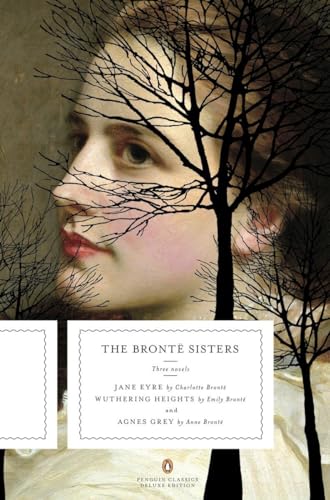
The Brontë Sisters: Three Novels: Jane Eyre, Wuthering Heights, and Agnes Grey: Three Novels: Jane Eyre; Wuthering Heights; and Agnes Grey (Penguin Classics Deluxe Edition) - Softcover
Inhaltsangabe
The Brontë family was a literary phenomenon unequalled before or since. Both Charlotte's Jane Eyre and Emily's Wuthering Heights have won lofty places in the pantheon and stirred the romantic sensibilities of generations of readers. For the first time ever, Penguin Classics unites these two enduring favorites with the lesser known but no less powerful work by their youngest sister, Anne. Drawn from Anne's own experiences as a governess, Agnes Grey offers a compelling view of Victorian chauvinism and materialism. Its inclusion makes The Brontë Sisters a must-have volume for anyone fascinated by this singularly talented family.
Die Inhaltsangabe kann sich auf eine andere Ausgabe dieses Titels beziehen.
Über die Autorin bzw. den Autor
Charlotte Brontë (1816-1855) and Emily Brontë (1818-1848) were sisters and novelists who wrote some of the most poignant romantic novels in the English language. Anne Brontë (1820-1849), their youngest sister, was also a novelist and poet, who works were influenced by issues of social injustice.
Auszug. © Genehmigter Nachdruck. Alle Rechte vorbehalten.
PENGUIN CLASSICS DELUXE EDITION
Three Novels
Jane Eyre by Charlotte Brontë
Wuthering Heights by Emily Brontë
and
Agnes Grey by Anne Brontë
A NOTE ON THE TEXTS
The texts of these novels have been reset from the individual volumes published in Penguin Classics, which are edited from the first editions.
Jane Eyre
CHAPTER I
There was no possibility of taking a walk that day. We had been wandering, indeed, in the leafless shrubbery an hour in the morning; but since dinner (Mrs Reed, when there was no company, dined early) the cold winter wind had brought with it clouds so sombre, and a rain so penetrating, that further outdoor exercise was now out of the question.
I was glad of it; I never liked long walks, especially on chilly afternoons: dreadful to me was the coming home in the raw twilight, with nipped fingers and toes, and a heart saddened by the chidings of Bessie, the nurse, and humbled by the consciousness of my physical inferiority to Eliza, John, and Georgiana Reed.
The said Eliza, John, and Georgiana were now clustered round their mamma in the drawing-room: she lay reclined on a sofa by the fireside, and with her darlings about her (for the time neither quarrelling nor crying) looked perfectly happy. Me, she had dispensed from joining the group: saying, ‘She regretted to be under the necessity of keeping me at a distance; but that until she heard from Bessie, and could discover by her own observation that I was endeavouring in good earnest to acquire a more sociable and child-like disposition, a more attractive and sprightly manner – something lighter, franker, more natural as it were – she really must exclude me from privileges intended only for contented, happy little children.’
‘What does Bessie say I have done?’ I asked.
‘Jane, I don’t like cavillers or questioners; besides, there is something truly forbidding in a child taking up her elders in that manner. Be seated somewhere; and until you can speak pleasantly, remain silent.’
A small breakfast-room adjoined the drawing-room, I slipped in there. It contained a bookcase; I soon possessed myself of a volume, taking care that it should be one stored with pictures. I mounted into the window-seat: gathering up my feet, I sat cross-legged, like a Turk; and, having drawn the red moreen curtain nearly close, I was shrined in double retirement.
Folds of scarlet drapery shut in my view to the right hand; to the left were the clear panes of glass, protecting, but not separating me from the drear November day. At intervals, while turning over the leaves in my book, I studied the aspect of that winter afternoon. Afar, it offered a pale blank of mist and cloud; near, a scene of wet lawn and storm-beat shrub, with ceaseless rain sweeping away wildly before a long and lamentable blast.
I returned to my book – Bewick’s ‘History of British Birds:’ the letterpress thereof I cared little for, generally speaking; and yet there were certain introductory pages that, child as I was, I could not pass quite as a blank. They were those which treat of the haunts of sea-fowl; of ‘the solitary rocks and promontories’ by them only inhabited; of the coast of Norway, studded with isles from its southern extremity, the Lindeness, or Naze, to the North Cape –
‘Where the Northern Ocean, in vast whirls,
Boils round the naked, melancholy isles
Of farthest Thule; and the Atlantic surge
Pours in among the stormy Hebrides.’
Nor could I pass unnoticed the suggestion of the bleak shores of Lapland, Siberia, Spitzbergen, Nova Zembla, Iceland, Greenland, with ‘the vast sweep of the Arctic Zone, and those forlorn regions of dreary space – that reservoir of frost and snow, where firm fields of ice, the accumulation of centuries of winters, glazed in Alpine heights above heights, surround the pole, and concentre the multiplied rigours of extreme cold.’ Of these death-white realms I formed an idea of my own: shadowy, like all the half-comprehended notions that float dim through children’s brains, but strangely impressive. The words in these introductory pages connected themselves with the succeeding vignettes, and gave significance to the rock standing up alone in a sea of billow and spray; to the broken boat stranded on a desolate coast; to the cold and ghastly moon glancing through bars of cloud at a wreck just sinking.
I cannot tell what sentiment haunted the quite solitary churchyard, with its inscribed headstone; its gate, its two trees, its low horizon, girdled by a broken wall, and its newly risen crescent, attesting the hour of eventide.
The two ships becalmed on a torpid sea, I believed to be marine phantoms.
The fiend pinning down the thief’s pack behind him, I passed over quickly: it was an object of terror.
So was the black, horned thing seated aloof on a rock, surveying a distant crowd surrounding a gallows.
Each picture told a story; mysterious often to my undeveloped understanding and imperfect feelings, yet ever profoundly interesting: as interesting as the tales Bessie sometimes narrated on winter evenings, when she chanced to be in good humour; and when, having brought her ironing-table to the nursery-hearth, she allowed us to sit about it, and while she got up Mrs Reed’s lace frills, and crimped her nightcap borders, fed our eager attention with passages of love and adventure taken from old fairy tales and older ballads; or (as at a later period I discovered) from the pages of ‘Pamela,’ and ‘Henry, Earl of Moreland.’
With Bewick on my knee, I was then happy: happy at least in my way. I feared nothing but interruption, and that came too soon. The breakfast-room door opened.
‘Boh! Madam Mope!’ cried the voice of John Reed; then he paused: he found the room apparently empty.
‘Where the dickens is she?’ he continued. ‘Lizzy? Georgy! (calling to his sisters) Joan is not here: tell mamma she is run out into the rain – bad animal!’
‘It is well I drew the curtain,’ thought I, and I wished fervently he might not discover my hiding-place: nor would John Reed have found it out himself; he was not quick either of vision or conception; but Eliza just put her head in at the door, and said at once: ‘she is in the window-seat, to be sure, Jack.’
And I came out immediately, for I trembled at the idea of being dragged forth by the said Jack.
‘What do you want?’ I asked with awkward diffidence.
‘Say, “what do you want, Master Reed,”’ was the answer.
‘I want you to come here;’ and seating himself in an armchair, he intimated by a gesture that I was to approach and stand before him.
John Reed was a schoolboy of fourteen years old; four years older than I, for I was but ten; large and stout for his age, with a dingy and unwholesome skin; thick lineaments in a spacious visage, heavy limbs and large extremities. He gorged himself habitually at table, which made him bilious, and gave him a dim and bleared eye and flabby cheeks. He ought now to have been at school; but his mamma had taken him home for a month or two, ‘on account of his delicate health.’ Mr Miles, the master, affirmed that he would do very well if he had fewer cakes and sweetmeats sent him from home; but the mother’s heart turned from an opinion so harsh, and inclined rather to the more refined idea that John’s sallowness was owing to over-application, and, perhaps, to pining after home.
John had...
„Über diesen Titel“ kann sich auf eine andere Ausgabe dieses Titels beziehen.
Suchergebnisse für The Brontë Sisters: Three Novels: Jane Eyre, Wuthering...

Beispielbild für diese ISBN
The Bronte Sisters: Three Novels: Jane Eyre; Wuthering Heights; and Agnes Grey (Penguin Classics Deluxe Edition)
Anbieter: World of Books (was SecondSale), Montgomery, IL, USA
Verkäuferbewertung 5 von 5 Sternen

Paperback. Zustand: Good. Offers a view of Victorian chauvinism and materialism. Bestandsnummer des Verkäufers 00109566312
Gebraucht kaufen
EUR 5,54
Versand gratis
Versand innerhalb von USA
Versand innerhalb von USA
Anzahl: 1 verfügbar
Beispielbild für diese ISBN
The Bronte Sisters: Three Novels: Jane Eyre; Wuthering Heights; and Agnes Grey (Penguin Classics Deluxe Edition)
Anbieter: World of Books (was SecondSale), Montgomery, IL, USA
Verkäuferbewertung 5 von 5 Sternen
Paperback. Zustand: Fair. Offers a view of Victorian chauvinism and materialism. Bestandsnummer des Verkäufers 00109734222
Gebraucht kaufen
EUR 5,54
Versand gratis
Versand innerhalb von USA
Versand innerhalb von USA
Anzahl: 1 verfügbar
Beispielbild für diese ISBN
The Bronte Sisters: Three Novels: Jane Eyre; Wuthering Heights; and Agnes Grey (Penguin Classics Deluxe Edition)
Verlag:
Penguin Classics (edition Combined), 2009
ISBN 10: 0143105833
ISBN 13: 9780143105831
Gebraucht
Paperback
Anbieter: BooksRun, Philadelphia, PA, USA
Verkäuferbewertung 5 von 5 Sternen
Paperback. Zustand: Very Good. Combined. It's a well-cared-for item that has seen limited use. The item may show minor signs of wear. All the text is legible, with all pages included. It may have slight markings and/or highlighting. Bestandsnummer des Verkäufers 0143105833-8-1
Gebraucht kaufen
EUR 7,98
Versand gratis
Versand innerhalb von USA
Versand innerhalb von USA
Anzahl: 1 verfügbar
Foto des Verkäufers
The Bronte Sisters: Three Novels: Jane Eyre; Wuthering Heights; and Agnes Grey (Penguin Classics Deluxe Edition)
Anbieter: Goodwill of Colorado, COLORADO SPRINGS, CO, USA
Verkäuferbewertung 5 von 5 Sternen
Zustand: good. All pages and cover are intact. Dust jacket included if applicable, though it may be missing on hardcover editions. Spine and cover may show minor signs of wear including scuff marks, curls or bends to corners as well as cosmetic blemishes including stickers. Pages may contain limited notes or highlighting. "From the library of" labels may be present. Shrink wrap, dust covers, or boxed set packaging may be missing. Bundled media e.g., CDs, DVDs, access codes may not be included. Bestandsnummer des Verkäufers COLV.0143105833.G
Gebraucht kaufen
EUR 8,33
Versand gratis
Versand innerhalb von USA
Versand innerhalb von USA
Anzahl: 1 verfügbar
Beispielbild für diese ISBN
The Bronte Sisters: Three Novels: Jane Eyre; Wuthering Heights; and Agnes Grey (Penguin Classics Deluxe Edition)
Anbieter: HPB-Diamond, Dallas, TX, USA
Verkäuferbewertung 5 von 5 Sternen
Paperback. Zustand: Very Good. Connecting readers with great books since 1972! Used books may not include companion materials, and may have some shelf wear or limited writing. We ship orders daily and Customer Service is our top priority! Bestandsnummer des Verkäufers S_482198743
Gebraucht kaufen
EUR 8,04
EUR 3,33 Versand
Versand innerhalb von USA
Versand innerhalb von USA
Anzahl: 1 verfügbar
Foto des Verkäufers
The Bronte Sisters: Three Novels: Jane Eyre; Wuthering Heights; and Agnes Grey (Penguin Classics Deluxe Edition)
Anbieter: Goodwill of Greater Milwaukee and Chicago, Racine, WI, USA
Verkäuferbewertung 5 von 5 Sternen
Zustand: good. Book is considered to be in good or better condition. The actual cover image may not match the stock photo. Hard cover books may show signs of wear on the spine, cover or dust jacket. Paperback book may show signs of wear on spine or cover as well as having a slight bend, curve or creasing to it. Book should have minimal to no writing inside and no highlighting. Pages should be free of tears or creasing. Stickers should not be present on cover or elsewhere, and any CD or DVD expected with the book is included. Book is not a former library copy. Bestandsnummer des Verkäufers SEWV.0143105833.G
Gebraucht kaufen
EUR 9,63
EUR 2,67 Versand
Versand innerhalb von USA
Versand innerhalb von USA
Anzahl: 2 verfügbar
Foto des Verkäufers
The Bronte Sisters: Three Novels: Jane Eyre; Wuthering Heights; and Agnes Grey (Penguin Classics Deluxe Edition)
Anbieter: Goodbookscafe, Macon, GA, USA
Verkäuferbewertung 5 von 5 Sternen
Zustand: good. The Cover is Clean. Heavy Crease Down Back Cover. Bestandsnummer des Verkäufers MGV.0143105833.G
Gebraucht kaufen
EUR 9,35
EUR 3,55 Versand
Versand innerhalb von USA
Versand innerhalb von USA
Anzahl: 1 verfügbar
Foto des Verkäufers
The Bronte Sisters: Three Novels: Jane Eyre; Wuthering Heights; and Agnes Grey (Penguin Classics Deluxe Edition)
Anbieter: MERS Goodwill, Saint Louis, MO, USA
Verkäuferbewertung 5 von 5 Sternen
Zustand: acceptable. Used - Acceptable: All pages and the cover are intact, but shrink wrap, dust covers, or boxed set case may be missing. Pages may include limited notes, highlighting, or minor water damage but the text is readable. Pages may include limited notes and highlighting, but the text cannot be obscured or unreadable. Any access codes or passwords originally included with the book may be expired, used or no longer valid. Image is stock photo and cover art edition may be different than pictured. Bestandsnummer des Verkäufers MERV.0143105833.A
Gebraucht kaufen
EUR 9,37
EUR 3,55 Versand
Versand innerhalb von USA
Versand innerhalb von USA
Anzahl: 1 verfügbar
Beispielbild für diese ISBN
The Bronte Sisters: Three Novels: Jane Eyre; Wuthering Heights; and Agnes Grey (Penguin Classics Deluxe Edition)
Anbieter: Borden's Book Shoppe, Astoria, IL, USA
Verkäuferbewertung 4 von 5 Sternen

paperback. Zustand: Very Good. Bestandsnummer des Verkäufers V-20260409-AB1S50067
Gebraucht kaufen
EUR 14,76
EUR 3,55 Versand
Versand innerhalb von USA
Versand innerhalb von USA
Anzahl: 1 verfügbar
Beispielbild für diese ISBN
The Bronte Sisters: Three Novels: Jane Eyre; Wuthering Heights; and Agnes Grey (Penguin Classics Deluxe Edition)
Anbieter: Lakeside Books, Benton Harbor, MI, USA
Verkäuferbewertung 5 von 5 Sternen
Zustand: New. Brand New! Not Overstocks or Low Quality Book Club Editions! Direct From the Publisher! We're not a giant, faceless warehouse organization! We're a small town bookstore that loves books and loves it's customers! Buy from Lakeside Books! Bestandsnummer des Verkäufers OTF-S-9780143105831
Neu kaufen
EUR 16,28
EUR 3,55 Versand
Versand innerhalb von USA
Versand innerhalb von USA
Anzahl: 4 verfügbar