
Inhaltsangabe
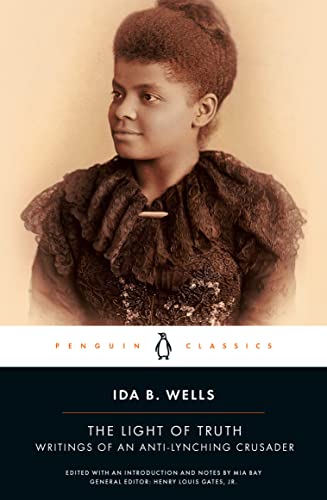
In this collection, Wells's anti-lynching crusade comes alive. Through brilliant social analysis, she exposed lynching as part of a larger framework of subjugation in which white people used violence as a deliberate tactic to combat black economic progress in the southern USA. Wells won international renown for her investigative journalism, leading her on lecture tours around the Northern States and Europe, where she rallied support against lynching.
Wells established herself as an advocate for social justice and human dignity by combining irrefutable evidence with deeply personal emotional appeal.
This volume is edited and introduced by Wells biographer Mia Bay.
Die Inhaltsangabe kann sich auf eine andere Ausgabe dieses Titels beziehen.
Über die Autorin bzw. den Autor
Born a slave in Mississippi in 1862, Ida B. Wells began a career as a journalist reporting on major social and political issues. After the lynching of a close friend, she devoted the rest of her life to civil rights, becoming a co-founder of the NAACP.
Mia Bay is the author of two books on African American history and a biography of Ida B. Wells.
Auszug. © Genehmigter Nachdruck. Alle Rechte vorbehalten.
What Is an African American Classic?
I have long nurtured a deep and abiding affection for the Penguin Classics, at least since I was an undergraduate at Yale. I used to imagine that my attraction for these books—grouped together, as a set, in some independent bookstores when I was a student, and perhaps even in some today—stemmed from the fact that my first-grade classmates, for some reason that I can’t recall, were required to dress as penguins in our annual all-school pageant, and perform a collective side-to-side motion that our misguided teacher thought she could choreograph into something meant to pass for a “dance.” Piedmont, West Virginia, in 1956, was a very long way from Penguin Nation, wherever that was supposed to be! But penguins we were determined to be, and we did our level best to avoid wounding each other with our orange-colored cardboard beaks while stomping out of rhythm in our matching orange, veined webbed feet. The whole scene was madness, one never to be repeated at the Davis Free School. But I never stopped loving penguins. And I have never stopped loving the very audacity of the idea of the Penguin Classics, an affordable, accessible library of the most important and compelling texts in the history of civilization, their black-and-white spines and covers and uniform type giving each text a comfortable, familiar feel, as if we have encountered it, or its cousins, before. I think of the Penguin Classics as the very best and most compelling in human thought, an Alexandrian library in paperback, enclosed in black and white.
I still gravitate to the Penguin Classics when killing time in an airport bookstore, deferring the slow torture of the security lines. Sometimes I even purchase two or three, fantasizing that I can speed-read one of the shorter titles, then make a dent in the longer one, vainly attempting to fill the holes in the liberal arts education that our degrees suggest we have, over the course of a plane ride! Mark Twain once quipped that a classic is “something that everybody wants to have read and nobody wants to read,” and perhaps that applies to my airport purchasing habits. For my generation, these titles in the Penguin Classics form the canon—the canon of the texts that a truly well-educated person should have read, and read carefully and closely, at least once. For years I rued the absence of texts by black authors in this series, and longed to be able to make even a small contribution to the diversification of this astonishingly universal list. I watched with great pleasure as titles by African American and African authors began to appear, some two dozen over the past several years. So when Elda Rotor approached me about editing a series of African American classics and collections for Penguin’s Portable Series, I eagerly accepted.
Thinking about the titles appropriate for inclusion in these series led me, inevitably, to think about what, for me, constitutes a “classic.” And thinking about this led me, in turn, to the wealth of reflections on what defines a work of literature or philosophy somehow speaking to the human condition beyond time and place, a work somehow endlessly compelling, generation upon generation, a work whose author we don’t have to look like to identify with, to feel at one with, as we find ourselves transported through the magic of a textual time machine; a work that refracts the image of ourselves that we project onto it, regardless of our ethnicity, our gender, our time, our place. This is what centuries of scholars and writers have meant when they use the wordclassic, and—despite all that we know about the complex intersubjectivity of the production of meaning in the wondrous exchange between a reader and a text—it remains true that classic texts, even in the most conventional, conservative sense of the wordclassic, do exist, and these books will continue to be read long after the generation the text reflects and defines, the generation of readers contemporary with the text’s author, is dead and gone. Classic texts speak from their authors’ graves, in their names, in their voices. As Italo Calvino once remarked, “A classic is a book that has never finished saying what it has to say.”
Faulkner put this idea in an interesting way: “The aim of every artist is to arrest motion, which is life, by artificial means, and hold it fixed so that a hundred years later, when a stranger looks at it, it moves again since it is life.” That, I am certain, must be the desire of every writer. But what about the reader? What makes a book a classic to a reader? Here, perhaps, Hemingway said it best: “All good books are alike in that they are truer than if they had really happened and after you are finished reading one you will feel that all that happened to you, and afterwards it belongs to you, the good and the bad, the ecstasy, the remorse and sorrow, the people and the places and how the weather was.”
I have been reading black literature since I was fifteen, yanked into the dark discursive universe by an Episcopal priest at a church camp near my home in West Virginia in August 1965, during the terrifying days of the Watts Riots in Los Angeles. Eventually, by fits and starts, studying the literature written by black authors became my avocation; ultimately, it has become my vocation. And, in my own way, I have tried to be an evangelist for it, to a readership larger than my own people, people who, as it were, look like these texts. Here, I am reminded of something W. S. Merwin said about the books he most loved: “Perhaps a classic is a work that one imagines should be common knowledge, but more and more often isn’t.” I would say, of African and African American literature, that perhaps classic works by black writers are works that one imagines should be common knowledge among the broadest possible readership but that less and less are, as the teaching of reading to understand how words can create the worlds into which books can transport us yields to classroom instruction geared toward passing a state-authorized standardized exam. All literary texts suffer from this wrongheaded approach to teaching, mind you; but it especially affects texts by people of color, and texts by women—texts still struggling, despite enormous gains over the last twenty years, to gain a solid foothold in anthologies and syllabi. For every anthology, every syllabus, every publishing series such as the Penguin Classics constitutes a distinct “canon,” an implicit definition of all that is essential for a truly educated person to read.
James Baldwin, who has pride of place in my personal canon of African American authors since it was one of his books that that Episcopal priest gave me to read in that dreadful summer of 1965, argued that “the responsibility of a writer is to excavate the experience of the people who produced him.” But surely Baldwin would have agreed with E. M. Forster that the books that we remember, the books that have truly influenced us, are those that “have gone a little further down our particular path than we have yet ourselves.” Excavating the known is a worthy goal of the writer as cultural archaeologist; yet, at the same time, so is unveiling the unknown, the unarticulated yet shared experience of the colorless things that make us human: “something we have always known (or thought we knew),” as Calvino puts it, “but without knowing that this author said it first.” We might think of the difference between Forster and Baldwin, on the one hand, and Calvino, on the other, as the difference between an author representing what has happened (Forster, Baldwin) in the history of a people whose stories, whose...
„Über diesen Titel“ kann sich auf eine andere Ausgabe dieses Titels beziehen.
Suchergebnisse für The Light of Truth: Writings of an Anti-Lynching Crusader

Foto des Verkäufers
The Light of Truth: Writings of an Anti-Lynching Crusader
Anbieter: Greenworld Books, Arlington, TX, USA
Verkäuferbewertung 5 von 5 Sternen

Zustand: good. Fast Free Shipping â" Good condition. It may show normal signs of use, such as light writing, highlighting, or library markings, but all pages are intact and the book is fully readable. A solid, complete copy that's ready to enjoy. Bestandsnummer des Verkäufers GWV.0143106821.G
Gebraucht kaufen
EUR 8,74
Versand gratis
Versand innerhalb von USA
Versand innerhalb von USA
Anzahl: 2 verfügbar
Foto des Verkäufers
The Light of Truth: Writings of an Anti-Lynching Crusader
Anbieter: Greenworld Books, Arlington, TX, USA
Verkäuferbewertung 5 von 5 Sternen
Zustand: very_good. Fast Free Shipping â" Very Good condition book with a firm cover and clean pages. Shows normal use and some light wear or limited notes markings. A solid, nice copy to enjoy. Bestandsnummer des Verkäufers GWV.0143106821.VG
Gebraucht kaufen
EUR 8,74
Versand gratis
Versand innerhalb von USA
Versand innerhalb von USA
Anzahl: 1 verfügbar
Beispielbild für diese ISBN
The Light of Truth: Writings of an Anti-Lynching Crusader
Anbieter: HPB-Emerald, Dallas, TX, USA
Verkäuferbewertung 5 von 5 Sternen
Paperback. Zustand: Very Good. Connecting readers with great books since 1972! Used books may not include companion materials, and may have some shelf wear or limited writing. We ship orders daily and Customer Service is our top priority! Bestandsnummer des Verkäufers S_463231573
Gebraucht kaufen
EUR 6,43
EUR 3,26 Versand
Versand innerhalb von USA
Versand innerhalb von USA
Anzahl: 1 verfügbar
Beispielbild für diese ISBN
The Light of Truth: Writings of an Anti-Lynching Crusader
Anbieter: BookOutlet, St. Catharines, ON, Kanada
Verkäuferbewertung 5 von 5 Sternen
Paperback. Zustand: New. Paperback. Publisher overstock, may contain remainder mark on edge. Bestandsnummer des Verkäufers 9780143106821B
Neu kaufen
EUR 9,17
EUR 2,82 Versand
Versand von Kanada nach USA
Versand von Kanada nach USA
Anzahl: 2 verfügbar
Beispielbild für diese ISBN
The Light of Truth: Writings of an Anti-Lynching Crusader
Anbieter: Marlton Books, Bridgeton, NJ, USA
Verkäuferbewertung 5 von 5 Sternen
Zustand: New. New- Great shape. paperback New 2014. Bestandsnummer des Verkäufers SC-0002357
Neu kaufen
EUR 10,03
EUR 2,60 Versand
Versand innerhalb von USA
Versand innerhalb von USA
Anzahl: 7 verfügbar
Foto des Verkäufers
Light of Truth : Writings of an Anti-Lynching Crusader
Anbieter: GreatBookPrices, Columbia, MD, USA
Verkäuferbewertung 5 von 5 Sternen
Zustand: New. Bestandsnummer des Verkäufers 21001626-n
Neu kaufen
EUR 10,35
EUR 2,29 Versand
Versand innerhalb von USA
Versand innerhalb von USA
Anzahl: 1 verfügbar
Foto des Verkäufers
The Light of Truth
Anbieter: Rarewaves.com USA, London, LONDO, Vereinigtes Königreich
Verkäuferbewertung 5 von 5 Sternen
Paperback. Zustand: New. In this collection, Wells's anti-lynching crusade comes alive. Through brilliant social analysis, she exposed lynching as part of a larger framework of subjugation in which white people used violence as a deliberate tactic to combat black economic progress in the southern USA. Wells won international renown for her investigative journalism, leading her on lecture tours around the Northern States and Europe, where she rallied support against lynching.Wells established herself as an advocate for social justice and human dignity by combining irrefutable evidence with deeply personal emotional appeal. This volume is edited and introduced by Wells biographer Mia Bay. Bestandsnummer des Verkäufers LU-9780143106821
Neu kaufen
EUR 15,07
Versand gratis
Versand von Vereinigtes Königreich nach USA
Versand von Vereinigtes Königreich nach USA
Anzahl: 2 verfügbar
Beispielbild für diese ISBN
The Light of Truth
Anbieter: PBShop.store US, Wood Dale, IL, USA
Verkäuferbewertung 5 von 5 Sternen
PAP. Zustand: New. New Book. Shipped from UK. Established seller since 2000. Bestandsnummer des Verkäufers GB-9780143106821
Beispielbild für diese ISBN
The Light of Truth: Writings of an Anti-Lynching Crusader
Anbieter: Lakeside Books, Benton Harbor, MI, USA
Verkäuferbewertung 5 von 5 Sternen
Zustand: New. Brand New! Not Overstocks or Low Quality Book Club Editions! Direct From the Publisher! We're not a giant, faceless warehouse organization! We're a small town bookstore that loves books and loves it's customers! Buy from Lakeside Books! Bestandsnummer des Verkäufers OTF-S-9780143106821
Neu kaufen
EUR 12,35
EUR 3,46 Versand
Versand innerhalb von USA
Versand innerhalb von USA
Anzahl: Mehr als 20 verfügbar
Foto des Verkäufers
The Light of Truth: Writings of an Anti-Lynching Crusader (Paperback or Softback)
Verlag:
Penguin Books 11/25/2014, 2014
ISBN 10: 0143106821
ISBN 13: 9780143106821
Neu
Paperback or Softback
Anbieter: BargainBookStores, Grand Rapids, MI, USA
Verkäuferbewertung 5 von 5 Sternen
Paperback or Softback. Zustand: New. The Light of Truth: Writings of an Anti-Lynching Crusader. Book. Bestandsnummer des Verkäufers BBS-9780143106821