
Verwandte Artikel zu Eleven Rings: The Soul of Success
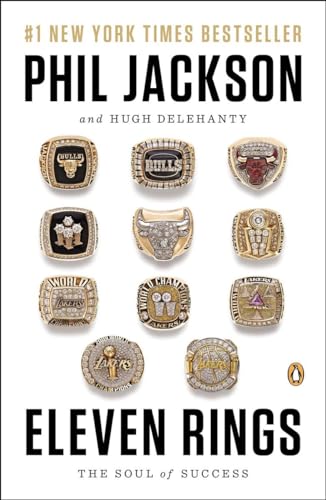
Inhaltsangabe
"Through candor and comprehensiveness, Jackson writes a convincing revisionist take, in which he emerges as an excellent coach . . . highly readable . . . reflects Jackson’s polymathy." —The New York Times Book Review
"Part sports memoir, part New Age spirit quest, part pseudo-management tract . . . But the primary thing with Jackson—as with all the old bards, who were also known for repeating themselves—is the voice." —Sam Anderson, The New York Times Magazine
A New York Times Bestseller
The inside story of one of basketball's most legendary and game-changing figures
During his storied career as head coach of the Chicago Bulls and Los Angeles Lakers, Phil Jackson won more championships than any coach in the history of professional sports. Even more important, he succeeded in never wavering from coaching his way, from a place of deep values. Jackson was tagged as the “Zen master” half in jest by sportswriters, but the nickname speaks to an important truth: this is a coach who inspired, not goaded; who led by awakening and challenging the better angels of his players’ nature, not their egos, fear, or greed.
This is the story of a preacher’s kid from North Dakota who grew up to be one of the most innovative leaders of our time. In his quest to reinvent himself, Jackson explored everything from humanistic psychology and Native American philosophy to Zen meditation. In the process, he developed a new approach to leadership based on freedom, authenticity, and selfless teamwork that turned the hypercompetitive world of professional sports on its head.
In Eleven Rings, Jackson candidly describes how he:
• Learned the secrets of mindfulness and team chemistry while playing for the champion New York Knicks in the 1970s
• Managed Michael Jordan, the greatest player in the world, and got him to embrace selflessness, even if it meant losing a scoring title
• Forged successful teams out of players of varying abilities by getting them to trust one another and perform in sync
• Inspired Dennis Rodman and other “uncoachable” personalities to devote themselves to something larger than themselves
• Transformed Kobe Bryant from a rebellious teenager into a mature leader of a championship team.
Eleven times, Jackson led his teams to the ultimate goal: the NBA championship—six times with the Chicago Bulls and five times with the Los Angeles Lakers. We all know the legendary stars on those teams, or think we do. What Eleven Rings shows us, however, is that when it comes to the most important lessons, we don’t know very much at all. This book is full of revelations: about fascinating personalities and their drive to win; about the wellsprings of motivation and competition at the highest levels; and about what it takes to bring out the best in ourselves and others.
Die Inhaltsangabe kann sich auf eine andere Ausgabe dieses Titels beziehen.
Über die Autorin bzw. den Autor
PHIL JACKSON is arguably the greatest coach in the history of the NBA. His reputation was established as head coach of the Chicago Bulls from 1989-1998; during his tenure, Chicago won six NBA titles. His next team, the Los Angeles Lakers, won five NBA titles, from 2000 to 2010. He holds the record for the most championships in NBA history as a player and a head coach. He also has the highest winning percentage of any NBA coach (.704). Jackson was a player on the 1970 and 1973 NBA champion New York Knicks. In 2007 Jackson was inducted into the Basketball Hall of Fame.
A former editor for Sports Illustrated and People, HUGH DELEHANTY is the co-author with Phil Jackson of the bestselling memoir, Sacred Hoops.
Auszug. © Genehmigter Nachdruck. Alle Rechte vorbehalten.
1
THE CIRCLE OF LOVE
Life is a journey. Time is a river. The door is ajar.
JIM BUTCHER
Cecil B. DeMille would have loved this moment.
Here I was sitting in a limo at the ramp leading into the Los Angeles Memorial Coliseum, waiting for my team to arrive, while an ecstatic crowd of ninety-five thousand plus fans, dressed in every possible combination of Lakers purple and gold, marched into the stadium. Women in tutus, men in Star Wars storm-trooper costumes, toddlers waving “Kobe Diem” signs. Yet despite all the zaniness, there was something inspiring about this ancient ritual with a decidedly L.A. twist. As Jeff Weiss, a writer for LA Weekly, put it: “It was the closest any of us will ever know what it was like to watch the Roman Legions returning home after a tour of Gaul.”
Truth be told, I’ve never really felt that comfortable at victory celebrations, which is strange given my chosen profession. First of all, I’m phobic about large crowds. It doesn’t bother me during games, but it can make me queasy in less controlled situations. I’ve also never really loved being the center of attention. Perhaps it’s my inherent shyness or the conflicting messages I got as a kid from my parents, who were both ministers. In their view, winning was fine—in fact, my mother was one of the most fiercely competitive people I’ve ever met—but reveling in your own success was considered an insult to God. Or as they would say, “The glory belongs to Him.”
This celebration wasn’t about me, though. It was about the remarkable transformation the players had undergone en route to the 2009 NBA championship. You could see it in their faces as they descended the long purple and gold staircase into the coliseum dressed in rally caps and championship T-shirts, laughing, jostling, beaming with joy, while the crowd roared with delight. Four years earlier the Lakers hadn’t even made the playoffs. Now they were masters of the basketball universe. Some coaches are obsessed with winning trophies; others like to see their faces on TV. What moves me is watching young men bond together and tap into the magic that arises when they focus—with their whole heart and soul—on something greater than themselves. Once you’ve experienced that, it’s something you never forget.
—
The symbol is the ring.
In the NBA, rings symbolize status and power. No matter how gaudy or cumbersome a championship ring may be, the dream of winning one is what motivates players to put themselves through the trials of a long NBA season. Jerry Krause, the former general manager of the Chicago Bulls, understood this. When I joined the team as an assistant coach in 1987, he asked me to wear one of the two championship rings I’d earned playing for the New York Knicks as a way to inspire the young Bulls players. This is something I used to do during the playoffs when I was a coach in the Continental Basketball Association, but the idea of sporting such a big chunk of bling on my finger every day seemed a bit much. One month into Jerry’s grand experiment the ring’s centerpiece rock fell out while I was dining at Bennigan’s in Chicago, and it was never recovered. After that I went back to wearing the rings only during the playoffs and on special occasions like this triumphant gathering at the coliseum.
On a psychological level, the ring symbolizes something profound: the quest of the self to find harmony, connection, and wholeness. In Native American culture, for instance, the unifying power of the circle was so meaningful that whole nations were conceived as a series of interconnected rings (or hoops). The tepee was a ring, as were the campfire, the village, and the layout of the nation itself—circles within circles, having no beginning or end.
Most of the players weren’t that familiar with Native American psychology, but they understood intuitively the deeper meaning of the ring. Early in the season, the players had created a chant they would shout before each game, their hands joined together in a circle.
One, two, three—RING!
After the players had taken their places on the stage—the Lakers’ portable basketball court from the Staples Center—I stood and addressed the crowd. “What was our motto on this team? The ring,” I said, flashing my ring from the last championship we won, in 2002. “The ring. That was the motto. It’s not just the band of gold. It’s the circle that’s made a bond between all these players. A great love for one another.”
Circle of love.
That’s not the way most basketball fans think of their sport. But after more than forty years involved in the game at the highest level, both as a player and as a coach, I can’t think of a truer phrase to describe the mysterious alchemy that joins players together and unites them in pursuit of the impossible.
Obviously, we’re not talking romantic love here or even brotherly love in the traditional Christian sense. The best analogy I can think of is the intense emotional connection that great warriors experience in the heat of battle.
Several years ago journalist Sebastian Junger embedded himself with a platoon of American soldiers stationed in one of the most dangerous parts of Afghanistan to learn what enabled these incredibly brave young men to fight in such horrifying conditions. What he discovered, as chronicled in his book War, was that the courage needed to engage in battle was indistinguishable from love. Because of the strong brotherhood the soldiers had formed, they were more concerned about what happened to their buddies than about what happened to themselves. Junger recalls one soldier telling him that he would throw himself on a grenade for any one of his platoonmates, even those he didn’t like all that much. When Junger asked why, the soldier replied, “Because I actually love my brothers. I mean, it’s a brotherhood. Being able to save their life so they can live, I think is rewarding. Any of them would do it for me.”
That kind of bond, which is virtually impossible to replicate in civilian life, is critical to success, says Junger, because without it nothing else is possible.
I don’t want to take the analogy too far. Basketball players don’t risk their lives every day like soldiers in Afghanistan, but in many ways the same principle applies. It takes a number of critical factors to win an NBA championship, including the right mix of talent, creativity, intelligence, toughness, and, of course, luck. But if a team doesn’t have the most essential ingredient—love—none of those other factors matter.
—
Building that kind of consciousness doesn’t happen overnight. It takes years of nurturing to get young athletes to step outside their egos and fully engage in a group experience. The NBA is not exactly the friendliest environment for teaching selflessness. Even though the game itself is a five-person sport, the culture surrounding it celebrates egoistic behavior and stresses individual achievement over team bonding.
This wasn’t the case when I started playing for the Knicks in 1967. In those days most players were paid modestly and had to take part-time jobs in the summer to make ends meet. The games were rarely televised and none of us had ever heard of a highlight reel, let alone Twitter. That shifted in the 1980s, fueled in large part by the popularity of the Magic Johnson–Larry Bird rivalry and the emergence of Michael Jordan as a global phenomenon. Today the game has grown into a multibillion-dollar industry, with fans all over the world and a sophisticated media machine...
„Über diesen Titel“ kann sich auf eine andere Ausgabe dieses Titels beziehen.
Suchergebnisse für Eleven Rings: The Soul of Success

Beispielbild für diese ISBN
Eleven Rings: The Soul of Success
Anbieter: World of Books (was SecondSale), Montgomery, IL, USA
Verkäuferbewertung 5 von 5 Sternen

Paperback. Zustand: Very Good. "Through candor and comprehensiveness, Jackson writes a convincing revisionist take, in which he emerges as an excellent coach . . . highly readable . . . reflects Jackson's polymathy." --The New York Times Book Review "Part sports memoir, part New Age spirit quest, part pseudo-management tract . . . But the primary thing with Jackson--as with all the old bards, who were also known for repeating themselves--is the voice." --Sam Anderson, The New York Times Magazine The inside story of one of basketball's most legendary and game-changing figures During his storied career as head coach of the Chicago Bulls and Los Angeles Lakers, Phil Jackson won more championships than any coach in the history of professional sports. Even more important, he succeeded in never wavering from coaching his way, from a place of deep values. Jackson was tagged as the "Zen master" half in jest by sportswriters, but the nickname speaks to an important truth: this is a coach who inspired, not goaded; who led by awakening and challenging the better angels of his players' nature, not their egos, fear, or greed. This is the story of a preacher's kid from North Dakota who grew up to be one of the most innovative leaders of our time. In his quest to reinvent himself, Jackson explored everything from humanistic psychology and Native American philosophy to Zen meditation. In the process, he developed a new approach to leadership based on freedom, authenticity, and selfless teamwork that turned the hypercompetitive world of professional sports on its head. In Eleven Rings, Jackson candidly describes how he: * Learned the secrets of mindfulness and team chemistry while playing for the champion New York Knicks in the 1970s * Managed Michael Jordan, the greatest player in the world, and got him to embrace selflessness, even if it meant losing a scoring title * Forged successful teams out of players of varying abilities by getting them to trust one another and perform in sync * Inspired Dennis Rodman and other "uncoachable" personalities to devote themselves to something larger than themselves * Transformed Kobe Bryant from a rebellious teenager into a mature leader of a championship team. Eleven times, Jackson led his teams to the ultimate goal: the NBA championship--six times with the Chicago Bulls and five times with the Los Angeles Lakers. We all know the legendary stars on those teams, or think we do. What Eleven Rings shows us, however, is that when it comes to the most important lessons, we don't know very much at all. This book is full of revelations: about fascinating personalities and their drive to win; about the wellsprings of motivation and competition at the highest levels; and about what it takes to bring out the best in ourselves and others. Bestandsnummer des Verkäufers CIN0143125346VG
Gebraucht kaufen
EUR 4,11
Versand gratis
Versand innerhalb von USA
Versand innerhalb von USA
Anzahl: 1 verfügbar
Beispielbild für diese ISBN
Eleven Rings: The Soul of Success
Verlag:
Penguin Books (edition Reprint), 2014
ISBN 10: 0143125346
ISBN 13: 9780143125341
Gebraucht
Paperback
Anbieter: BooksRun, Philadelphia, PA, USA
Verkäuferbewertung 5 von 5 Sternen
Paperback. Zustand: Very Good. Reprint. It's a well-cared-for item that has seen limited use. The item may show minor signs of wear. All the text is legible, with all pages included. It may have slight markings and/or highlighting. Bestandsnummer des Verkäufers 0143125346-11-1
Gebraucht kaufen
EUR 4,82
Versand gratis
Versand innerhalb von USA
Versand innerhalb von USA
Anzahl: 1 verfügbar
Foto des Verkäufers
Eleven Rings: The Soul of Success
Anbieter: Greenworld Books, Arlington, TX, USA
Verkäuferbewertung 5 von 5 Sternen
Zustand: very_good. Fast Free Shipping â" Very Good condition book with a firm cover and clean pages. Shows normal use and some light wear or limited notes markings. A solid, nice copy to enjoy. Bestandsnummer des Verkäufers GWV.0143125346.VG
Gebraucht kaufen
EUR 5,57
Versand gratis
Versand innerhalb von USA
Versand innerhalb von USA
Anzahl: 1 verfügbar
Beispielbild für diese ISBN
Eleven Rings: The Soul of Success
Anbieter: World of Books Inc, Montgomery, IL, USA
Verkäuferbewertung 4 von 5 Sternen

Paperback. Zustand: Very Good. "Through candor and comprehensiveness, Jackson writes a convincing revisionist take, in which he emerges as an excellent coach . . . highly readable . . . reflects Jackson's polymathy." --The New York Times Book Review "Part sports memoir, part New Age spirit quest, part pseudo-management tract . . . But the primary thing with Jackson--as with all the old bards, who were also known for repeating themselves--is the voice." --Sam Anderson, The New York Times Magazine The inside story of one of basketball's most legendary and game-changing figures During his storied career as head coach of the Chicago Bulls and Los Angeles Lakers, Phil Jackson won more championships than any coach in the history of professional sports. Even more important, he succeeded in never wavering from coaching his way, from a place of deep values. Jackson was tagged as the "Zen master" half in jest by sportswriters, but the nickname speaks to an important truth: this is a coach who inspired, not goaded; who led by awakening and challenging the better angels of his players' nature, not their egos, fear, or greed. This is the story of a preacher's kid from North Dakota who grew up to be one of the most innovative leaders of our time. In his quest to reinvent himself, Jackson explored everything from humanistic psychology and Native American philosophy to Zen meditation. In the process, he developed a new approach to leadership based on freedom, authenticity, and selfless teamwork that turned the hypercompetitive world of professional sports on its head. In Eleven Rings, Jackson candidly describes how he: * Learned the secrets of mindfulness and team chemistry while playing for the champion New York Knicks in the 1970s * Managed Michael Jordan, the greatest player in the world, and got him to embrace selflessness, even if it meant losing a scoring title * Forged successful teams out of players of varying abilities by getting them to trust one another and perform in sync * Inspired Dennis Rodman and other "uncoachable" personalities to devote themselves to something larger than themselves * Transformed Kobe Bryant from a rebellious teenager into a mature leader of a championship team. Eleven times, Jackson led his teams to the ultimate goal: the NBA championship--six times with the Chicago Bulls and five times with the Los Angeles Lakers. We all know the legendary stars on those teams, or think we do. What Eleven Rings shows us, however, is that when it comes to the most important lessons, we don't know very much at all. This book is full of revelations: about fascinating personalities and their drive to win; about the wellsprings of motivation and competition at the highest levels; and about what it takes to bring out the best in ourselves and others. Bestandsnummer des Verkäufers CIN0143125346VG
Gebraucht kaufen
EUR 5,95
Versand gratis
Versand innerhalb von USA
Versand innerhalb von USA
Anzahl: 1 verfügbar
Beispielbild für diese ISBN
Eleven Rings: The Soul of Success
Anbieter: ThriftBooks-Reno, Reno, NV, USA
Verkäuferbewertung 5 von 5 Sternen
Paperback. Zustand: Very Good. No Jacket. May have limited writing in cover pages. Pages are unmarked. ~ ThriftBooks: Read More, Spend Less. Bestandsnummer des Verkäufers G0143125346I4N00
Gebraucht kaufen
EUR 6,08
Versand gratis
Versand innerhalb von USA
Versand innerhalb von USA
Anzahl: 2 verfügbar
Beispielbild für diese ISBN
Eleven Rings: The Soul of Success
Anbieter: ThriftBooks-Dallas, Dallas, TX, USA
Verkäuferbewertung 5 von 5 Sternen
Paperback. Zustand: Very Good. No Jacket. May have limited writing in cover pages. Pages are unmarked. ~ ThriftBooks: Read More, Spend Less. Bestandsnummer des Verkäufers G0143125346I4N00
Gebraucht kaufen
EUR 6,08
Versand gratis
Versand innerhalb von USA
Versand innerhalb von USA
Anzahl: 2 verfügbar
Beispielbild für diese ISBN
Eleven Rings: The Soul of Success
Anbieter: ThriftBooks-Phoenix, Phoenix, AZ, USA
Verkäuferbewertung 5 von 5 Sternen
Paperback. Zustand: Good. No Jacket. Pages can have notes/highlighting. Spine may show signs of wear. ~ ThriftBooks: Read More, Spend Less. Bestandsnummer des Verkäufers G0143125346I3N00
Gebraucht kaufen
EUR 6,08
Versand gratis
Versand innerhalb von USA
Versand innerhalb von USA
Anzahl: 6 verfügbar
Beispielbild für diese ISBN
Eleven Rings: The Soul of Success
Anbieter: ThriftBooks-Atlanta, AUSTELL, GA, USA
Verkäuferbewertung 5 von 5 Sternen
Paperback. Zustand: Fair. No Jacket. Former library book; Readable copy. Pages may have considerable notes/highlighting. ~ ThriftBooks: Read More, Spend Less. Bestandsnummer des Verkäufers G0143125346I5N10
Gebraucht kaufen
EUR 6,08
Versand gratis
Versand innerhalb von USA
Versand innerhalb von USA
Anzahl: 1 verfügbar
Beispielbild für diese ISBN
Eleven Rings: The Soul of Success
Anbieter: ThriftBooks-Dallas, Dallas, TX, USA
Verkäuferbewertung 5 von 5 Sternen
Paperback. Zustand: Fair. No Jacket. Readable copy. Pages may have considerable notes/highlighting. ~ ThriftBooks: Read More, Spend Less. Bestandsnummer des Verkäufers G0143125346I5N00
Gebraucht kaufen
EUR 6,08
Versand gratis
Versand innerhalb von USA
Versand innerhalb von USA
Anzahl: 2 verfügbar
Beispielbild für diese ISBN
Eleven Rings: The Soul of Success
Anbieter: ThriftBooks-Reno, Reno, NV, USA
Verkäuferbewertung 5 von 5 Sternen
Paperback. Zustand: Fair. No Jacket. Readable copy. Pages may have considerable notes/highlighting. ~ ThriftBooks: Read More, Spend Less. Bestandsnummer des Verkäufers G0143125346I5N00
Gebraucht kaufen
EUR 6,08
Versand gratis
Versand innerhalb von USA
Versand innerhalb von USA
Anzahl: 2 verfügbar