
Verwandte Artikel zu The Map and the Territory 2.0: Risk, Human Nature,...
Inhaltsangabe
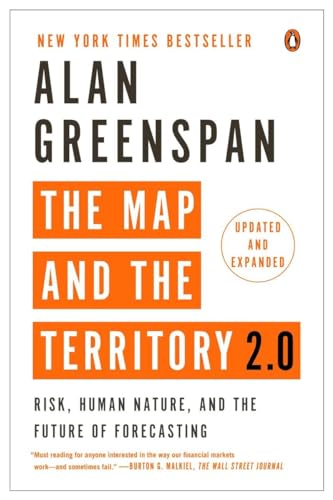
Like all of us, though few so visibly, Alan Greenspan was forced by the financial crisis of 2008 to question some fundamental assumptions about risk management and economic forecasting. No one with any meaningful role in economic decision making in the world saw beforehand the storm for what it was. How had our models so utterly failed us?
To answer this question, Alan Greenspan embarked on a rigorous and far-reaching multiyear examination of how Homo economicus predicts the economic future, and how it can predict it better. Economic risk is a fact of life in every realm, from home to business to government at all levels. Whether we’re conscious of it or not, we make wagers on the future virtually every day, one way or another. Very often, however, we’re steering by out-of-date maps, when we’re not driven by factors entirely beyond our conscious control.
The Map and the Territory is nothing less than an effort to update our forecasting conceptual grid. It integrates the history of economic prediction, the new work of behavioral economists, and the fruits of the author’s own remarkable career to offer a thrillingly lucid and empirically based grounding in what we can
know about economic forecasting and what we can’t.The book explores how culture is and isn't destiny and probes what we can predict about the world's biggest looming challenges, from debt and the reform of the welfare state to natural disasters in an age of global warming.
No map is the territory, but Greenspan’s approach, grounded in his trademark rigor, wisdom, and unprecedented context, ensures that this particular map will assist in safe journeys down many different roads, traveled by individuals, businesses, and the state.
Die Inhaltsangabe kann sich auf eine andere Ausgabe dieses Titels beziehen.
Über die Autorin bzw. den Autor
Alan Greenspan was born in 1926 and reared in the Washington Heights neighborhood of New York City. After studying the clarinet at Juilliard and working as a professional musician, he earned his B.A., M.A., and Ph.D. in economics from New York University. In 1954, he cofounded the economic consulting firm Townsend-Greenspan & Co. From 1974 to 1977, he served as chair of the Council of Economic Advisors under President Gerald Ford. In 1987, President Ronald Reagan appointed him chairman of the Federal Reserve Board, a position he held until his retirement in 2006. He is the author of the number one New York Times bestseller The Age of Turbulence.
Auszug. © Genehmigter Nachdruck. Alle Rechte vorbehalten.
INTRODUCTION
It was a call I never expected to receive. I had just returned home from indoor tennis on the chilly, windy Sunday afternoon of March 16, 2008. A senior official of the Federal Reserve Board was on the phone to alert me of the board’s just-announced invocation, for the first time in decades, of the obscure but explosive section 13 (3) of the Federal Reserve Act. Broadly interpreted, section 13 (3) empowered the Federal Reserve to lend nearly unlimited cash to virtually anybody.1 On March 16, it empowered the Federal Reserve Bank of New York to lend $29 billion to facilitate the acquisition of Bear Stearns by JPMorgan.
Bear Stearns, the smallest of the major investment banks, founded in 1923, was on the edge of bankruptcy, having run through nearly $20 billion of cash just the previous week. Its demise was the beginning of a six-month erosion in global financial stability that would culminate with the Lehman Brothers failure on September 15, 2008, triggering possibly the greatest financial crisis ever. To be sure, the Great Depression of the 1930s involved a far greater collapse in economic activity. But never before had short-term financial markets, the facilitators of everyday commerce, shut down on so global a scale. The drying up of deeply liquid markets, literally overnight, as investors swung from euphoria to fear, dismantled vast financial complexes and led to a worldwide contraction in economic activity. The role of human nature in economic affairs was never more apparent than on that fateful day in September and in the weeks that followed.
On the face of it, the financial crisis also represented an existential crisis for economic forecasting. I began my postcrisis investigations, culminating in this book, in an effort to understand how we all got it so wrong, and what we can learn from the fact that we did. At its root, then, this is a book about forecasting human nature, what we think we know about the future and what we decide we should do about it. It’s about the short term and the long term and, perhaps most important, about the foggy place where the one turns into the other. We are at this moment faced with a number of serious long-term economic problems, all in a sense having to do with underinvesting in our economic future. My most worrisome concern is our broken political system. It is that system on which we rely to manage our rule of law, defined in our Constitution (see Chapter 15). My fondest hope for this book is that some of the insights my investigations have yielded will be of some use in bolstering the case for taking action now, in the short term, which is in our long-term collective self-interest despite the unavoidable short-term pain it will bring. The only alternative is incalculably worse pain and human suffering later. There is little time to waste.
THE FORECASTING IMPERATIVE
As always, though we wish it were otherwise, economic forecasting is a discipline of probabilities. The degree of certainty with which the so-called hard sciences are able to identify the metrics of the physical world appears to be out of the reach of the economic disciplines. But forecasting, irrespective of its failures, will never be abandoned. It is an inbred necessity of human nature. The more we can anticipate the course of events in the world in which we live, the better prepared we are to react to those events in a manner that can improve our lives.
Introspectively, we know that we have a limited capability to see much beyond our immediate horizon. That realization has prompted us, no doubt from before recorded history, to look for ways to compensate for this vexing human “shortcoming.” In ancient Greece, kings and generals sought out the advice of the oracle of Delphi before embarking on political or military ventures. Two millennia later, Europe was enthralled by the cryptic prognostications of Nostradamus. Today, both fortune-tellers and stock pickers continue to make a passable living. Even repeated forecasting failure will not deter the unachievable pursuit of prescience, because our nature demands it.
ECONOMETRICS
A key plot point in the history of our efforts to see the future has been the development over the past eight decades of the discipline of model-based economic forecasting. That discipline has embraced many of the same mathematical tools employed in the physical sciences, tools used by almost all economic forecasters, both in government and in the private sector, largely to build models that “explain” the past, and perhaps, as a consequence, make the future more comprehensible.
I was drawn to the sophistication of the then-new mathematical economics as a graduate student at Columbia University in the early 1950s. My professors Jacob Wolfowitz and Abraham Wald were pioneers in mathematical statistics.2 But my early fascination was increasingly tempered over the years by a growing skepticism about its relevance to a world in which the state of seemingly unmodelable animal spirits is so critical a factor in economic outcomes.
John Maynard Keynes, in his groundbreaking 1936 opus, The General Theory of Employment, Interest and Money, set the framework for much of modern-day macromodeling. The Keynesian model, as it came to be known, to this day governs much government macroeconomic policy. Keynes’s model was a complete though simplified version of how the major pieces of a market economy fit together. The class of models that today we still call Keynesian is widely employed in the public and private sectors, especially to judge the impact of various governmental policies on the levels of GDP and employment.
Keynes’s approach was a direct challenge to classical economists’ belief that market economies were always self-correcting and would, when disturbed, return to full employment in relatively short order. By contrast, Keynes argued that there were circumstances in which those self-equilibrating mechanisms became dysfunctional, creating an “underemployment equilibrium.” In those circumstances, he advocated government deficit spending to offset shortfalls in aggregate demand. Remarkably, more than seventy-five years later, economists continue to debate the pros and cons of that policy.
Economic forecasting of all varieties, Keynesian and otherwise, has always been fraught with never-ending challenges. Models, by their nature, are vast simplifications of a complex economic reality. There are literally millions of relationships that interact every day to create aggregate GDP, even for a relatively simple market economy. Because only a very small fraction of these interactions can be represented in any model, economists are continually seeking sets of equations that, while few in number, nonetheless are presumed to capture the fundamental forces that drive modern economies.
In practice, model builders (myself included) keep altering the set of chosen variables and equation specifications until we get a result that appears to replicate the historical record in an economically credible manner. Every forecaster must decide which relative handful of “equations” he or she believes most effectively captures the essence of an economy’s overall dynamics.
For the most part, the modeling of the nonfinancial sectors of market economies has worked tolerably well. Vast amounts of research have increasingly enhanced our understanding of how those markets function.3 Finance, however, as we repeatedly learn, operates in a different leveraged environment where risk is of a significantly larger magnitude than in the rest of the economy. Risk taking and avoiding is at the root of almost all financial decisions. Nonfinancial business is more oriented to engineering, technology, and management organization.
Nonfinancial businesses do...
„Über diesen Titel“ kann sich auf eine andere Ausgabe dieses Titels beziehen.
Suchergebnisse für The Map and the Territory 2.0: Risk, Human Nature,...

Beispielbild für diese ISBN
The Map and the Territory 2.0: Risk, Human Nature, and the Future of Forecasting
Anbieter: World of Books (was SecondSale), Montgomery, IL, USA
Verkäuferbewertung 5 von 5 Sternen

Paperback. Zustand: Good. The New York Times bestseller "Must reading for anyone interested in the way our financial markets work - and sometimes fail." --The Wall Street Journal Like all of us, though few so visibly, Alan Greenspan was forced by the financial crisis of 2008 to question some fundamental assumptions about risk management and economic forecasting. No one with any meaningful role in economic decision making in the world saw beforehand the storm for what it was. How had our models so utterly failed us? To answer this question, Alan Greenspan embarked on a rigorous and far-reaching multiyear examination of how Homo economicus predicts the economic future, and how it can predict it better. Economic risk is a fact of life in every realm, from home to business to government at all levels. Whether we're conscious of it or not, we make wagers on the future virtually every day, one way or another. Very often, however, we're steering by out-of-date maps, when we're not driven by factors entirely beyond our conscious control. The Map and the Territory is nothing less than an effort to update our forecasting conceptual grid. It integrates the history of economic prediction, the new work of behavioral economists, and the fruits of the author's own remarkable career to offer a thrillingly lucid and empirically based grounding in what we can know about economic forecasting and what we can't. The book explores how culture is and isn't destiny and probes what we can predict about the world's biggest looming challenges, from debt and the reform of the welfare state to natural disasters in an age of global warming. No map is the territory, but Greenspan's approach, grounded in his trademark rigor, wisdom, and unprecedented context, ensures that this particular map will assist in safe journeys down many different roads, traveled by individuals, businesses, and the state. Bestandsnummer des Verkäufers 00099981901
Gebraucht kaufen
EUR 4,03
Versand gratis
Versand innerhalb von USA
Versand innerhalb von USA
Anzahl: 2 verfügbar
Beispielbild für diese ISBN
The Map and the Territory 2.0: Risk, Human Nature, and the Future of Forecasting
Anbieter: World of Books (was SecondSale), Montgomery, IL, USA
Verkäuferbewertung 5 von 5 Sternen
Paperback. Zustand: Very Good. The New York Times bestseller "Must reading for anyone interested in the way our financial markets work - and sometimes fail." --The Wall Street Journal Like all of us, though few so visibly, Alan Greenspan was forced by the financial crisis of 2008 to question some fundamental assumptions about risk management and economic forecasting. No one with any meaningful role in economic decision making in the world saw beforehand the storm for what it was. How had our models so utterly failed us? To answer this question, Alan Greenspan embarked on a rigorous and far-reaching multiyear examination of how Homo economicus predicts the economic future, and how it can predict it better. Economic risk is a fact of life in every realm, from home to business to government at all levels. Whether we're conscious of it or not, we make wagers on the future virtually every day, one way or another. Very often, however, we're steering by out-of-date maps, when we're not driven by factors entirely beyond our conscious control. The Map and the Territory is nothing less than an effort to update our forecasting conceptual grid. It integrates the history of economic prediction, the new work of behavioral economists, and the fruits of the author's own remarkable career to offer a thrillingly lucid and empirically based grounding in what we can know about economic forecasting and what we can't. The book explores how culture is and isn't destiny and probes what we can predict about the world's biggest looming challenges, from debt and the reform of the welfare state to natural disasters in an age of global warming. No map is the territory, but Greenspan's approach, grounded in his trademark rigor, wisdom, and unprecedented context, ensures that this particular map will assist in safe journeys down many different roads, traveled by individuals, businesses, and the state. Bestandsnummer des Verkäufers 00110294989
Gebraucht kaufen
EUR 4,03
Versand gratis
Versand innerhalb von USA
Versand innerhalb von USA
Anzahl: 1 verfügbar
Foto des Verkäufers
The Map and the Territory 2.0: Risk, Human Nature, and the Future of Forecasting
Anbieter: Zoom Books East, Glendale Heights, IL, USA
Verkäuferbewertung 5 von 5 Sternen
Zustand: very_good. Book is in very good condition and may include minimal underlining highlighting. The book can also include "From the library of" labels. May not contain miscellaneous items toys, dvds, etc. . We offer 100% money back guarantee and 24 7 customer service. Bestandsnummer des Verkäufers ZEV.0143125915.VG
Gebraucht kaufen
EUR 4,04
Versand gratis
Versand innerhalb von USA
Versand innerhalb von USA
Anzahl: 1 verfügbar
Beispielbild für diese ISBN
The Map and the Territory 2.0: Risk, Human Nature, and the Future of Forecasting
Verlag:
Penguin Books (edition Revised), 2014
ISBN 10: 0143125915
ISBN 13: 9780143125914
Gebraucht
Paperback
Anbieter: BooksRun, Philadelphia, PA, USA
Verkäuferbewertung 5 von 5 Sternen
Paperback. Zustand: Very Good. Revised. It's a well-cared-for item that has seen limited use. The item may show minor signs of wear. All the text is legible, with all pages included. It may have slight markings and/or highlighting. Bestandsnummer des Verkäufers 0143125915-8-1
Gebraucht kaufen
EUR 4,44
Versand gratis
Versand innerhalb von USA
Versand innerhalb von USA
Anzahl: 1 verfügbar
Foto des Verkäufers
The Map and the Territory 2.0: Risk, Human Nature, and the Future of Forecasting
Anbieter: Greenworld Books, Arlington, TX, USA
Verkäuferbewertung 5 von 5 Sternen
Zustand: good. Fast Free Shipping â" Good condition. It may show normal signs of use, such as light writing, highlighting, or library markings, but all pages are intact and the book is fully readable. A solid, complete copy that's ready to enjoy. Bestandsnummer des Verkäufers GWV.0143125915.G
Gebraucht kaufen
EUR 4,99
Versand gratis
Versand innerhalb von USA
Versand innerhalb von USA
Anzahl: 1 verfügbar
Beispielbild für diese ISBN
The Map and the Territory 2.0: Risk, Human Nature, and the Future of Forecasting
Anbieter: Idaho Youth Ranch Books, Boise, ID, USA
Verkäuferbewertung 5 von 5 Sternen
Zustand: Good. A copy that has been read, but remains in clean condition. All pages are intact, and the cover is intact (including dust cover, if applicable). The spine may show signs of wear. Pages can include limited notes and highlighting, and the copy can include "From the library of" labels or limited small stickers. Book may have a remainder mark or be a price cutter. Bestandsnummer des Verkäufers C-03-02-06-0780
Gebraucht kaufen
EUR 1,57
EUR 3,55 Versand
Versand innerhalb von USA
Versand innerhalb von USA
Anzahl: 1 verfügbar
Beispielbild für diese ISBN
The Map and the Territory 2.0: Risk, Human Nature, and the Future of Forecasting
Verlag:
Penguin Books (edition Revised), 2014
ISBN 10: 0143125915
ISBN 13: 9780143125914
Gebraucht
Paperback
Anbieter: BooksRun, Philadelphia, PA, USA
Verkäuferbewertung 5 von 5 Sternen
Paperback. Zustand: Very Good. Revised. It's a well-cared-for item that has seen limited use. The item may show minor signs of wear. All the text is legible, with all pages included. It may have slight markings and/or highlighting. Bestandsnummer des Verkäufers 0143125915-11-1
Gebraucht kaufen
EUR 5,33
Versand gratis
Versand innerhalb von USA
Versand innerhalb von USA
Anzahl: 1 verfügbar
Beispielbild für diese ISBN
The Map and the Territory 2.0: Risk, Human Nature, and the Future of Forecasting
Anbieter: World of Books Inc, Montgomery, IL, USA
Verkäuferbewertung 4 von 5 Sternen

Paperback. Zustand: Good. The New York Times bestseller "Must reading for anyone interested in the way our financial markets work - and sometimes fail." --The Wall Street Journal Like all of us, though few so visibly, Alan Greenspan was forced by the financial crisis of 2008 to question some fundamental assumptions about risk management and economic forecasting. No one with any meaningful role in economic decision making in the world saw beforehand the storm for what it was. How had our models so utterly failed us? To answer this question, Alan Greenspan embarked on a rigorous and far-reaching multiyear examination of how Homo economicus predicts the economic future, and how it can predict it better. Economic risk is a fact of life in every realm, from home to business to government at all levels. Whether we're conscious of it or not, we make wagers on the future virtually every day, one way or another. Very often, however, we're steering by out-of-date maps, when we're not driven by factors entirely beyond our conscious control. The Map and the Territory is nothing less than an effort to update our forecasting conceptual grid. It integrates the history of economic prediction, the new work of behavioral economists, and the fruits of the author's own remarkable career to offer a thrillingly lucid and empirically based grounding in what we can know about economic forecasting and what we can't. The book explores how culture is and isn't destiny and probes what we can predict about the world's biggest looming challenges, from debt and the reform of the welfare state to natural disasters in an age of global warming. No map is the territory, but Greenspan's approach, grounded in his trademark rigor, wisdom, and unprecedented context, ensures that this particular map will assist in safe journeys down many different roads, traveled by individuals, businesses, and the state. Bestandsnummer des Verkäufers CIN0143125915G
Gebraucht kaufen
EUR 5,87
Versand gratis
Versand innerhalb von USA
Versand innerhalb von USA
Anzahl: 2 verfügbar
Beispielbild für diese ISBN
The Map and the Territory 2.0: Risk, Human Nature, and the Future of Forecasting
Anbieter: Wonder Book, Frederick, MD, USA
Verkäuferbewertung 5 von 5 Sternen
Zustand: Good. Good condition. A copy that has been read but remains intact. May contain markings such as bookplates, stamps, limited notes and highlighting, or a few light stains. Bestandsnummer des Verkäufers O08E-02116
Gebraucht kaufen
EUR 6,40
Versand gratis
Versand innerhalb von USA
Versand innerhalb von USA
Anzahl: 1 verfügbar
Beispielbild für diese ISBN
The Map and the Territory 2.0: Risk, Human Nature, and the Future of Forecasting
Anbieter: ThriftBooks-Reno, Reno, NV, USA
Verkäuferbewertung 5 von 5 Sternen
Paperback. Zustand: Very Good. No Jacket. May have limited writing in cover pages. Pages are unmarked. ~ ThriftBooks: Read More, Spend Less. Bestandsnummer des Verkäufers G0143125915I4N00
Gebraucht kaufen
EUR 6,42
Versand gratis
Versand innerhalb von USA
Versand innerhalb von USA
Anzahl: 1 verfügbar