
Verwandte Artikel zu The Sense of Style: The Thinking Person's Guide...
Inhaltsangabe
“Charming and erudite," from the author of Rationality and Enlightenment Now, "The wit and insight and clarity he brings . . . is what makes this book such a gem.” —Time.com
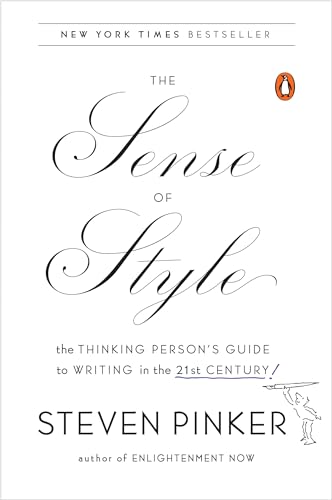
Why is so much writing so bad, and how can we make it better? Is the English language being corrupted by texting and social media? Do the kids today even care about good writing—and why should we care? From the author of The Better Angels of Our Nature and Enlightenment Now.
In this entertaining and eminently practical book, the cognitive scientist, dictionary consultant, and New York Times–bestselling author Steven Pinker rethinks the usage guide for the twenty-first century. Using examples of great and gruesome modern prose while avoiding the scolding tone and Spartan tastes of the classic manuals, he shows how the art of writing can be a form of pleasurable mastery and a fascinating intellectual topic in its own right. The Sense of Style is for writers of all kinds, and for readers who are interested in letters and literature and are curious about the ways in which the sciences of mind can illuminate how language works at its best.
Die Inhaltsangabe kann sich auf eine andere Ausgabe dieses Titels beziehen.
Über die Autorin bzw. den Autor
Steven Pinker is the Johnstone Professor of Psychology at Harvard University. He has been listed among Foreign Policy magazine’s “Top 100 Public Intellectuals” and Time’s “The 100 Most Influential People in the World.” He was the chair of the Usage Panel of The American Heritage Dictionary 2008-2018.
Auszug. © Genehmigter Nachdruck. Alle Rechte vorbehalten.
Prologue
I love style manuals. Ever since I was assigned Strunk and White’s The Elements of Style in an introductory psychology course, the writing guide has been among my favorite literary genres. It’s not just that I welcome advice on the lifelong challenge of perfecting the craft of writing. It’s also that credible guidance on writing must itself be well written, and the best of the manuals are paragons of their own advice. William Strunk’s course notes on writing, which his student E. B. White turned into their famous little book, was studded with gems of self-exemplification such as “Write with nouns and verbs,” “Put the emphatic words of a sentence at the end,” and best of all, his prime directive, “Omit needless words.” Many eminent stylists have applied their gifts to explaining the art, including Kingsley Amis, Jacques Barzun, Ambrose Bierce, Bill Bryson, Robert Graves, Tracy Kidder, Stephen King, Elmore Leonard, F. L. Lucas, George Orwell, William Safire, and of course White himself, the beloved author of Charlotte’s Web and Stuart Little. Here is the great essayist reminiscing about his teacher:
I like to read style manuals for another reason, the one that sends botanists to the garden and chemists to the kitchen: it’s a practical application of our science. I am a psycholinguist and a cognitive scientist, and what is style, after all, but the effective use of words to engage the human mind? It’s all the more captivating to someone who seeks to explain these fields to a wide readership. I think about how language works so that I can best explain how language works.
But my professional acquaintance with language has led me to read the traditional manuals with a growing sense of unease. Strunk and White, for all their intuitive feel for style, had a tenuous grasp of grammar.2 They misdefined terms such as phrase, participle, and relative clause, and in steering their readers away from passive verbs and toward active transitive ones they botched their examples of both. There were a great number of dead leaves lying on the ground, for instance, is not in the passive voice, nor does The cock’s crow came with dawn contain a transitive verb. Lacking the tools to analyze language, they often struggled when turning their intuitions into advice, vainly appealing to the writer’s “ear.” And they did not seem to realize that some of the advice contradicted itself: “Many a tame sentence . . . can be made lively and emphatic by substituting a transitive in the active voice” uses the passive voice to warn against the passive voice. George Orwell, in his vaunted “Politics and the English Language,” fell into the same trap when, without irony, he derided prose in which “the passive voice is wherever possible used in preference to the active.”3
Self-contradiction aside, we now know that telling writers to avoid the passive is bad advice. Linguistic research has shown that the passive construction has a number of indispensable functions because of the way it engages a reader’s attention and memory. A skilled writer should know what those functions are and push back against copy editors who, under the influence of grammatically naïve style guides, blue-pencil every passive construction they spot into an active one.
Style manuals that are innocent of linguistics also are crippled in dealing with the aspect of writing that evokes the most emotion: correct and incorrect usage. Many style manuals treat traditional rules of usage the way fundamentalists treat the Ten Commandments: as unerring laws chiseled in sapphire for mortals to obey or risk eternal damnation. But skeptics and freethinkers who probe the history of these rules have found that they belong to an oral tradition of folklore and myth. For many reasons, manuals that are credulous about the inerrancy of the traditional rules don’t serve writers well. Although some of the rules can make prose better, many of them make it worse, and writers are better off flouting them. The rules often mash together issues of grammatical correctness, logical coherence, formal style, and standard dialect, but a skilled writer needs to keep them straight. And the orthodox stylebooks are ill equipped to deal with an inescapable fact about language: it changes over time. Language is not a protocol legislated by an authority but rather a wiki that pools the contributions of millions of writers and speakers, who ceaselessly bend the language to their needs and who inexorably age, die, and get replaced by their children, who adapt the language in their turn.
Yet the authors of the classic manuals wrote as if the language they grew up with were immortal, and failed to cultivate an ear for ongoing change. Strunk and White, writing in the early and middle decades of the twentieth century, condemned then-new verbs like personalize, finalize, host, chair, and debut, and warned writers never to use fix for “repair” or claim for “declare.” Worse, they justified their peeves with cockamamie rationalizations. The verb contact, they argued, is “vague and self-important. Do not contact people; get in touch with them, look them up, phone them, find them, or meet them.” But of course the vagueness of to contact is exactly why it caught on: sometimes a writer doesn’t need to know how one person will get in touch with another, as long as he does so. Or consider this head-scratcher, concocted to explain why a writer should never use a number word with people, only with persons: “If of ‘six people’ five went away, how many people would be left? Answer: one people.” By the same logic, writers should avoid using numbers with irregular plurals such as men, children, and teeth (“If of ‘six children’ five went away . . .”).
In the last edition published in his lifetime, White did acknowledge some changes to the language, instigated by “youths” who “speak to other youths in a tongue of their own devising: they renovate the language with a wild vigor, as they would a basement apartment.” White’s condescension to these “youths” (now in their retirement years) led him to predict the passing of nerd, psyched, ripoff, dude, geek, and funky, all of which have become entrenched in the language.
The graybeard sensibilities of the style mavens come not just from an underappreciation of the fact of language change but from a lack of reflection on their own psychology. As people age, they confuse changes in themselves with changes in the world, and changes in the world with moral decline—the illusion of the good old days.4 And so every generation believes that the kids today are degrading the language and taking civilization down with it:5
The common language is disappearing. It is slowly being crushed to death under the weight of verbal conglomerate, a pseudospeech at once both pretentious and feeble, that is created daily by millions of blunders and inaccuracies in grammar, syntax, idiom, metaphor, logic, and common sense. . . . In the history of modern English there is no period in which such victory over thought-in-speech has been so widespread.—1978
Recent graduates, including those with university degrees, seem to have no mastery of the language at all. They cannot construct a simple declarative sentence, either orally or in writing. They cannot spell common, everyday words. Punctuation is apparently no longer taught. Grammar is a complete mystery to almost all recent graduates.—1961
From...
„Über diesen Titel“ kann sich auf eine andere Ausgabe dieses Titels beziehen.
Suchergebnisse für The Sense of Style: The Thinking Person's Guide...

Beispielbild für diese ISBN
The Sense of Style The Thinkin
Anbieter: World of Books (was SecondSale), Montgomery, IL, USA
Verkäuferbewertung 5 von 5 Sternen

Zustand: Good. Item in good condition. Textbooks may not include supplemental items i.e. CDs, access codes etc. Bestandsnummer des Verkäufers 00106665196
Gebraucht kaufen
EUR 4,71
Versand gratis
Versand innerhalb von USA
Versand innerhalb von USA
Anzahl: 15 verfügbar
Beispielbild für diese ISBN
The Sense of Style The Thinkin
Anbieter: World of Books (was SecondSale), Montgomery, IL, USA
Verkäuferbewertung 5 von 5 Sternen
Zustand: Very Good. Item in very good condition! Textbooks may not include supplemental items i.e. CDs, access codes etc. Bestandsnummer des Verkäufers 00110451781
Gebraucht kaufen
EUR 4,71
Versand gratis
Versand innerhalb von USA
Versand innerhalb von USA
Anzahl: 1 verfügbar
Beispielbild für diese ISBN
The Sense of Style The Thinkin
Anbieter: World of Books (was SecondSale), Montgomery, IL, USA
Verkäuferbewertung 5 von 5 Sternen
Zustand: Acceptable. Item in acceptable condition! Textbooks may not include supplemental items i.e. CDs, access codes etc. Bestandsnummer des Verkäufers 00110325466
Gebraucht kaufen
EUR 4,71
Versand gratis
Versand innerhalb von USA
Versand innerhalb von USA
Anzahl: 1 verfügbar
Foto des Verkäufers
The Sense of Style: The Thinking Person's Guide to Writing in the 21st Century
Anbieter: Bay State Book Company, North Smithfield, RI, USA
Verkäuferbewertung 5 von 5 Sternen
Zustand: good. The book is in good condition with all pages and cover intact, including the dust jacket if originally issued. The spine may show light wear. Pages may contain some notes or highlighting, and there might be a "From the library of" label. Boxed set packaging, shrink wrap, or included media like CDs may be missing. Bestandsnummer des Verkäufers BSM.1DEP6
Gebraucht kaufen
EUR 4,72
Versand gratis
Versand innerhalb von USA
Versand innerhalb von USA
Anzahl: 1 verfügbar
Beispielbild für diese ISBN
The Sense of Style: The Thinking Person's Guide to Writing in the 21st Century
Anbieter: Evergreen Goodwill, Seattle, WA, USA
Verkäuferbewertung 5 von 5 Sternen
paperback. Zustand: Good. Bestandsnummer des Verkäufers mon0000129720
Gebraucht kaufen
EUR 2,17
EUR 3,47 Versand
Versand innerhalb von USA
Versand innerhalb von USA
Anzahl: 1 verfügbar
Foto des Verkäufers
The Sense of Style: The Thinking Person's Guide to Writing in the 21st Century
Anbieter: Austin Goodwill 1101, Austin, TX, USA
Verkäuferbewertung 5 von 5 Sternen
Zustand: good. Book shows general signs of use and handling. May have light wear on the cover or edges and minimal writing or highlighting. Binding remains tight, and pages are clean and readable. Bestandsnummer des Verkäufers CTXV.0143127799.G
Gebraucht kaufen
EUR 2,86
EUR 2,87 Versand
Versand innerhalb von USA
Versand innerhalb von USA
Anzahl: 1 verfügbar
Beispielbild für diese ISBN
The Sense of Style: The Thinking Person's Guide to Writing in the 21st Century
Anbieter: ThriftBooks-Phoenix, Phoenix, AZ, USA
Verkäuferbewertung 5 von 5 Sternen
Paperback. Zustand: Fair. No Jacket. Readable copy. Pages may have considerable notes/highlighting. ~ ThriftBooks: Read More, Spend Less. Bestandsnummer des Verkäufers G0143127799I5N00
Gebraucht kaufen
EUR 5,84
Versand gratis
Versand innerhalb von USA
Versand innerhalb von USA
Anzahl: 2 verfügbar
Beispielbild für diese ISBN
The Sense of Style: The Thinking Person's Guide to Writing in the 21st Century
Anbieter: ThriftBooks-Reno, Reno, NV, USA
Verkäuferbewertung 5 von 5 Sternen
Paperback. Zustand: Fair. No Jacket. Readable copy. Pages may have considerable notes/highlighting. ~ ThriftBooks: Read More, Spend Less. Bestandsnummer des Verkäufers G0143127799I5N00
Gebraucht kaufen
EUR 5,84
Versand gratis
Versand innerhalb von USA
Versand innerhalb von USA
Anzahl: 2 verfügbar
Beispielbild für diese ISBN
The Sense of Style: The Thinking Person's Guide to Writing in the 21st Century
Anbieter: ThriftBooks-Reno, Reno, NV, USA
Verkäuferbewertung 5 von 5 Sternen
Paperback. Zustand: Good. No Jacket. Pages can have notes/highlighting. Spine may show signs of wear. ~ ThriftBooks: Read More, Spend Less. Bestandsnummer des Verkäufers G0143127799I3N00
Gebraucht kaufen
EUR 5,84
Versand gratis
Versand innerhalb von USA
Versand innerhalb von USA
Anzahl: 1 verfügbar
Foto des Verkäufers
The Sense of Style: The Thinking Person's Guide to Writing in the 21st Century
Anbieter: Dream Books Co., Denver, CO, USA
Verkäuferbewertung 5 von 5 Sternen
Zustand: acceptable. This copy has clearly been enjoyedâ"expect noticeable shelf wear and some minor creases to the cover. Binding is strong, and all pages are legible. May contain previous library markings or stamps. Bestandsnummer des Verkäufers DBV.0143127799.A
Gebraucht kaufen
EUR 5,84
Versand gratis
Versand innerhalb von USA
Versand innerhalb von USA
Anzahl: 2 verfügbar