
Verwandte Artikel zu The Crucible: (Penguin Orange Collection)
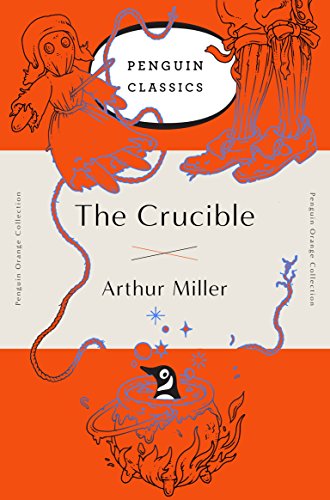
Inhaltsangabe
Part of the Penguin Orange Collection, a limited-run series of twelve influential and beloved American classics in a bold series design offering a modern take on the iconic Penguin paperback
Winner of the 2016 AIGA + Design Observer 50 Books | 50 Covers competition
For the seventieth anniversary of Penguin Classics, the Penguin Orange Collection celebrates the heritage of Penguin’s iconic book design with twelve influential American literary classics representing the breadth and diversity of the Penguin Classics library. These collectible editions are dressed in the iconic orange and white tri-band cover design, first created in 1935, while french flaps, high-quality paper, and striking cover illustrations provide the cutting-edge design treatment that is the signature of Penguin Classics Deluxe Editions today.
The Crucible
One of the true masterpieces of twentieth-century American theater, The Crucible brilliantly explores the threshold between individual guilt and mass hysteria, personal spite and collective evil. It is a play that is not only relentlessly suspenseful and vastly moving, but that compels readers to fathom their hearts and consciences in ways that only the greatest theatre can.
Die Inhaltsangabe kann sich auf eine andere Ausgabe dieses Titels beziehen.
Über die Autorin bzw. den Autor
Arthur Miller (1915–2005) was born in New York City and studied at the University of Michigan. His remarkable creative output includes plays, fiction, memoir, and screenplays. Among other honors, he received the Pulitzer Prize for Drama and the John F. Kennedy Lifetime Achievement Award.
Auszug. © Genehmigter Nachdruck. Alle Rechte vorbehalten.
THE CRUCIBLE
ARTHUR MILLER was born in New York City in 1915 and studied at the University of Michigan. His plays include All My Sons (1947), Death of a Salesman (1949), The Crucible (1953), A View from the Bridge and A Memory of Two Mondays (1955), After the Fall (1964), Incident at Vichy (1965), The Price (1968), The Creation of the World and Other Business (1972), and The American Clock (1980). He has also written two novels, Focus (1945) and The Misfits, which was filmed in 1960, and the text for In Russia (1969), In the Country (1977), and Chinese Encounters (1979), three books of photographs by Inge Morath. His most recent works include a memoir, Timebends (1987), the plays The Ride Down Mt. Morgan (1991), The Last Yankee (1993), Broken Glass (1994), and Mr. Peters’ Connections (1999), Echoes Down the Corridor: Collected Essays, 1944-2000, and On Politics and the Art of Acting (2001). He has twice won the New York Drama Critics Circle Award, and in 1949 he was awarded the Pulitzer Prize.
CHRISTOPHER BIGSBY has published more than twenty books on British and American culture. His works include studies of African-American writing, American theater, English drama, and popular culture. He is the author of two novels, Hester and Pearl, and he has written plays for radio and television. He is also a regular broadcaster for the BBC. He is currently professor of American Studies at the University of East Anglia, in Norwich, England.
BY ARTHUR MILLER
DRAMA
The Golden Years
The Man Who Had All the Luck
All My Sons
Death of a Salesman
An Enemy of the People (adaptation of a play by Ibsen)
The Crucible
A View from the Bridge
After the Fall
Incident at Vichy
The Price
The American Clock
The Creation of the World and Other Business
The Archbishop’s Ceiling
The Ride Down Mt. Morgan
Broken Glass
Mr. Peters’ Connections
ONE-ACT PLAYS
A View from the Bridge, one act version, with A Memory of Two Mondays
Elegy for a Lady (in Two-Way Mirror)
Some Kind of Love Story (in Two-Way Mirror)
I Can’t Remember Anything (in Danger: Memory!)
Clara (in Danger: Memory!)
The Last Yankee
OTHER WORKS
Situation Normal
The Misfits (a cinema novel)
Focus (a novel)
I Don’t Need You Anymore (short stories)
In the Country (reportage with Inge Morath photographs)
Chinese Encounters (reportage with Inge Morath photographs)
In Russia (reportage with Inge Morath photographs)
Salesman in Beijing (a memoir)
Timebends (autobiography)
Homely Girl, A Life (novella)
Echoes Down the Corridor (essays)
On Politics and the Art of Acting
COLLECTIONS
Arthur Miller’s Collected Plays (Volumes I and II)
The Portable Arthur Miller
The Theater Essays of Arthur Miller (Robert Marin, editor)
VIKING CRITICAL LIBRARY EDITIONS
Death of a Salesman (edited by Gerald Weales)
The Crucible (edited by Gerald Weales)
TELEVISION WORKS
Playing for Time
SCREENPLAYS
The Misfits
Everybody Wins
The Crucible
Table of Contents
Cover
About the Authors
Also by Arthur Miller
Title Page
Copyright Page
Introduction
A Note on the Historical Accuracy of This Play
ACT ONE - (AN OVERTURE)
ACT TWO
ACT THREE
ACT FOUR
ECHOES DOWN THE CORRIDOR
THE CRUCIBLE
APPENDIX - ACT Two, SCENE 2
INTRODUCTION
In 1692 nineteen men and women and two dogs were convicted and hanged for witchcraft in a small village in eastern Massachusetts. By the standards of our own time, if not of that, it was a minor event, a spasm of judicial violence that was concluded within a matter of months. The bodies were buried in shallow graves or not at all, as a further indication that the convicted had not only forfeited participation in the community of man in this life, but in the community of saints in the next. Just how shallow those graves were, however, is evident from the fact that the people buried there were not eradicated from history: their names remain with us to this day, not least because of Arthur Miller, for whom past events and present realities have always been pressed together by a moral logic. In his hands the ghosts of those who died have proved real enough even if the witches they were presumed to be were little more than fantasies conjured by a mixture of fear, ambition, frustration, jealousy, and perverted pride.
In 1957 the Massachusetts General Court passed a resolution stating that “No disgrace or cause for distress” attached itself to the descendants of those indicted, tried, and sentenced. Declaring the proceedings to be “the result of popular hysterical fear of the Devil,” the resolution noted that “more civilized laws” had superseded those under which the accused had been tried. It did not, however, include by name all those who had suffered, and it was not until 1992 that the omissions were rectified in a further resolution of the court. It had taken exactly three hundred years for the state to acknowledge its responsibility for all those who died.
This was the long-delayed end of a story whose beginnings lay in the woods that surrounded the village of Salem when, in 1692, a number of young girls were discovered, with a West Indian slave called Tituba, dancing and playing at conjuring. To deflect punishment from themselves they accused others, and those who listened, themselves insecure in their authority, acquiesced, partly because it served their interests to do so and partly because they inhabited a world in which witchcraft formed a part of their cosmology. Their universe was absolute, lacking in ambivalence. There was only one text to consult, and that text reserved only one fate for witches.
Why should it have taken so long to acknowledge error? More significantly, why offer apology at all for an event so long in the past? Perhaps because the needs of justice and the necessity for sustaining the authority of the court have not always been coincident and because there will always be those who defend the latter, believing that by doing so they sustain the possibility of the former. Perhaps because there are those who believe that authority is all of a piece and that to challenge it anywhere is to threaten it everywhere.
It was not the first such apology. In 1711 the governor of Massachusetts, acting on behalf of the general court of the province, set his hand to a reversal of attainder that offered restitution for this miscarriage of justice. In particular he granted one hundred and fifty pounds damages to John and Elizabeth Proctor. Elizabeth had survived, by virtue of the child she carried. Her husband was not so lucky; he was executed on August 19, 1692. His accusers were young girls, barely on the verge of puberty. Perversely, damages were paid not only to the victims but also to such people as William Good, who was his wife’s accuser, and Abigail Hobbs, a “confessed witch” who became a hostile witness. The affair, it seemed, was to be treated as a general calamity from which all suffered and in which the state was essentially innocent. Indeed the incident was ascribed to “The Influence and Energy of the Evil Spirits so great at that time,” a time that, despite the declared purpose of the document, was described as being “Infested with a horrible Witchcraft.”
Arthur Miller first encountered the story of Salem and its witches while a student at the University of Michigan. It stayed in his mind, but only as one of those mysterious incidents from a past separated from us by more than time: “It never occurred to me that I would ever deal with it ... because I had never formulated an aesthetic idea of this tragedy.” Then, in 1949, he came upon a new book about the trials, by Marion Starkey, called The Devil in Massachusetts.
Not the least fascinating aspect of the book lay in the fact that the author recognized the dramatic potential of the events. Claiming to have tried to “uncover the classic dramatic form of the story itself” Starkey insisted that “here is real Greek tragedy,” with “a beginning, a middle and an end.” Interestingly, in the notebook Arthur Miller started at this time, he noted that “It must be ‘tragic’” and, when The Crucible opened in New York, in 1953, he remarked, “Salem is one of the few dramas in history with a beginning, a middle and an end.”
Starkey recognized, too, a truth that has always lain at the center of Miller’s own approach to theater and the public world it shadows:
The human reality of what happens to millions is only for God to grasp; but what happens to individuals is another matter and within the range of mortal understanding. The Salem story has the virtue of being a highly individualized affair. Witches in the abstract were not hanged in Salem; but one by one were brought to the gallows such diverse personalities as a decent grandmother grown too hard of hearing to understand a crucial question from the jurors, a rakish, pipe-smoking female tramp, a plain farmer who thought only to save his wife from molestation, a lame old man whose toothless gums did not deny expression to a very salty vocabulary.... And after you have studied their lives faithfully, a remarkable thing happens; you discover that if you really know the few, you are on your way to understanding the millions. By grasping the local, the parochial even, it is possible to make a beginning at understanding the universal.
Starkey also acknowledged the wider implications of Salem, implications Miller would choose to amplify. For the witch hunt was scarcely a product only of the distant past. “It has been revived,” Starkey insisted, “on a colossal scale by replacing the medieval idea of malefic witchcraft by a pseudo-scientific concept like ‘race,’ ‘nationality’ and by substituting for theological dissension a whole complex of warring ideologies. Accordingly the story of 1692 is of far more than antiquarian interest; it is an allegory of our times.”
It was as an allegory of our times that Miller seized upon it, and though it was to be the McCarthyite witch-hunts of the House Un-American Activities Committee that seemed to offer the most direct parallel, he, like Starkey, recognized other parallels, in a war then only four years behind them, for the Nazis, too, had their demons and deployed a systematic pseudo-science to identify those they regarded as tainted and impure.
But for the moment it was the domestic danger that commanded Miller’s imagination. It was “the maturation of the hysteria at the time which pulled the trigger; without the latter I’d never have launched.” As he remarked at the time, to his friend and colleague Elia Kazan, director of All My Sons and Death of a Salesman, the Salem trials offered a persuasive parallel: “It’s all here... every scene.” And certainly Miller’s own account suggests that what had once struck him as an impenetrable mystery had now begun to make psychological and social sense. As he has explained in his autobiography,
At first I rejected the idea of a play on the subject.... But gradually, over weeks, a living connection between myself and Salem, and between Salem and Washington, was made in my mind—for whatever else they might be, I saw that the hearings in Washington were profoundly and even avowedly ritualistic. ... The main point of the hearings, precisely as in seventeenth-century Salem, was that the accused make public confession, damn his confederates as well as his Devil master, and guarantee his sterling new allegiance by breaking disgusting old vows-whereupon he was let loose to rejoin the society of extremely decent people. In other words, the same spiritual nugget lay folded within both procedures-an act of contrition done not in solemn privacy but out in the public air.
Molly Kazan objected, feeling that the parallel was a false one, since witches manifestly did not exist, but Communists did. It was an objection later echoed by others, but not one accepted by Miller. For, as he has pointed out, not only was Tituba in all probability practicing voodoo on that night in 1692, but witchcraft was accepted as a fact by virtually every secular and religious authority. To that end he quotes the eighteenth-century British jurist Sir William Blackstone as insisting that it “is a truth to which every nation in the world hath in its turn borne testimony,” and John Wesley, founder of Methodism, as stating, “The giving up of witchcraft is, in effect, giving up the Bible.” Indeed, by the end of the seventeenth century an estimated two hundred thousand people worldwide had been executed as witches. The question is not the reality of witches but the power of authority to define the nature of the real, and the desire, on the part of individuals and the state, to identify those whose purging will relieve a sense of anxiety and guilt. What lay behind the procedures of both witch trial and political hearing was a familiar American need to assert a recoverable innocence even if the only guarantee of such innocence lay in the displacement of guilt onto others. To sustain the integrity of their own names, the accused were invited to offer the names of others, even though to do so would be to make them complicit in procedures they despised and hence to damage their sense of themselves. And here is the root of a theme that connects virtually all of Miller’s plays: betrayal, of the self no less than of others.
Nor was the parallel a product of Miller’s fanciful imagination. In 1948 Congressman George A. Dondero, in the House debate on the Mundt-Nixon bill, to “protect the United States against Un-American and subversive activities,” observed that “the world is dividing into two camps, freedom versus Communism, Christian civilization versus paganism.” More directly Judge Irving Kaufman, who presided over the Rosenberg espionage trial in 1951, accused those before him of “diabolical conspiracy” and “denial of God.” Interestingly, on the night the Rosenbergs were executed, the cast and audience of The Crucible stood in silence as a gesture of respect.
The past had attractions for Miller because a rational analysis and dramatic presentation of the political realities of early-fifties America presented problems. He has said,
The reason I think that I moved in that direction was that it was simply impossible any longer to discuss what was happening to us in contemporary terms. There had to be some distance, given the phenomena. We were all going slightly crazy trying to be honest and trying to see straight and trying to be safe. Sometimes there are conflicts in these three urges. I had known this story since my college years and I’d never understood why it was so attractive to me. Now it suddenly made sense. It seemed to me that the hysteria in Salem had a certain inner procedure or several which we were duplicating once again, and that perhaps by revealing the nature of that procedure some light could be thrown on what we were doing to ourselves. And that’s how that play came to be.
The hostility of the Kazans toward the project came from Elia Kazan’s decision to be a cooperative witness before the Committee and thus to identify by name those who, in his judgment, had been members of the Communist party in the 1930s. By a strange irony Miller was returning from Salem, where he had been researching the play, when he heard on his car radio news of Kazan’s testimony before the Committee. Kazan had offered names: Harry Elion, John Bonn, Alice Evans, Anne Howe. He was the first of a number of Miller’s colleagues and friends to capitulate to the Committee’s demands and blandishments. The following month Miller’s role model, the radical playwright Clifford Odets, also named names; in June of the following year, six months after The Crucible opened, so did Lee J. Cobb, who originated the role of Willy Loman on Broadway. They did so partly out of fear for their careers—uncooperative witnesses would almost inevitably find themselves dismissed from their jobs-and partly because they genuinely felt guilty about the naïveté of their earlier commitments. The Committee thus offered what religion offers: the opportunity for confession and the grace of redemption.
The irony lay not only in the fact that in doing so they replicated the processes of the 1692 trials, where the children cried out against Sarah Good, Bridget Bishop, George Jacobs, Martha Bellows, Alice Barrow, but that in Miller’s plays there usually comes a moment when the central character cries out his own name, determined to invest it with meaning and integrity. Almost invariably this moment occurs when he is on the point of betraying himself and others. A climactic scene in The Crucible comes when John Proctor, on the point of trading his integrity for his life, finally refuses to pay the price, which is to offer the names of others to buy his life. “I like not to spoil their names. ... I speak my own sins; I cannot judge another. I have no tongue for it.” He thus recovers his own name by refusing to name others: “... now I do think I see some shred of goodness in John Proctor.” Three years later, Miller himself was called before the Committee. His reply, when asked to betray others, was a virtual paraphrase of the one offered by Proctor. He announced, “I am trying to, and I will, protect my sense of myself. I could not use the name of another person and bring trouble on him.” Asked to comment on this, thirty years later, he replied, “Well, there’s only one thing to say to them. You don’t have much choice.”
Salem in 1692 was in turmoil. The Royal Charter had been revoked. Original land titles had been canceled and others not yet secured. Neighbor accordingly looked on neighbor with some suspicion, for fear that land might be reassigned. It was also a community riven with schisms, which centered on the person of the Reverend Parris, whose materialism and self-concern were more than many could stomach, including a landowner and inn-keeper called John Proctor.
Miller observed in his notebook, “It is Shakespearean. Parties and counter-parties. There must be a counter-party. Proctor and others.” John Proctor quickly emerged as the center of the story Miller wished to tell, though not of the trials, where he was one among many. But to Miller, as he wrote in the notebook, “It has got to be basically Proctor’s story. The important thing-the process whereby a man, feeling guilt for A, sees himself as guilty of B and thus belies himself,—accommodates his credo to believe in what he knows is not true.” Before this could become a tragedy for the community it had to be a tragedy for an individual : “A difficulty. This hanging must be ‘tragic‘-i.e. must [be] result of an opportunity not grasped when it should have been, due to ‘flaw.’ ”
That flaw, as so often in Miller’s work, was to be sexual, not least because there seemed a sexual flavor to the language of those who confessed to possession by the devil and who were accused of dancing naked in a community in which both dancing and nakedness were themselves seen as signs of corruption. But that hardly seemed possible when Abigail Williams and John Proctor, who were to become the central characters in Miller’s drama, were eleven and sixty, respectively. Accordingly, at Miller’s bidding she becomes seventeen and he thirty-five, and so they begin to move toward each other, the gap narrowing until a sexual flame is lit. Elizabeth Proctor, who had managed an inn, now becomes a solitary farmer’s wife, cut off from communion not only with her errant husband, who has strayed from her side, but also in some degree from the society of Salem.
Other changes are made. Giles Corey, a cantankerous old man who carelessly damns his wife by commenting on her fondness for books, was killed, pressed to death by stones, on September 19, 1692, a month after Proctor’s death. Miller brings that death forward so that it can prove exemplary. By the same token John Hale’s growing conversion to skepticism did not come to its climax with Proctor’s death, but only later, when his own wife was accused. The event is advanced in order to keep Proctor as the focus. At the same time the playwright resisted an aspect of the story that would have damaged the parallel to fifties America, though it would have struck a chord with people in many other countries who were later to seize on The Crucible as an account of their own situation. For the fact is that John Proctor’s son was tortured. Proctor wrote in a petition, “My son William Proctor, when he was examin’d, because he would not confess that he was Guilty, when he was Innocent, they tied him Neck and Heels till the Blood gushed out of his Nose.” The effect on the play of including this detail would have been to transform Proctor’s motivation and diminish the significance of the sexual guilt that disables him.
Historically, John Proctor did not immediately intervene on learning of the trials and does not do so in the play. The historical account offers no explanation. In the notebooks Miller searched for one: “Proctor—guilt stays his hand (against what action?).” The guilt derives from his adultery; the action becomes his decision to expose Abigail.
In his original plan Miller toyed with making Proctor a leader of the anti-Parris faction, who backtracks on that role and equivocates in his dealings with Hale. He toyed, too, with the notion that Proctor should half wish his wife dead. He abandoned both ideas. If Proctor emerges as a leader, it is inadvertently as he fights to defend the wife he has wronged and whose life he has placed in jeopardy because of his affair with Abigail.
What is at stake in The Crucible is the survival of Salem-which is to say, the survival of a sense of community. On a literal level the village ceased to operate. The trials took precedence over all other activities. They took the farmer from his field and his wife from the milk shed. In the screenplay for the film version Miller has the camera observe the depredations of the countryside: unharvested crops, untended animals, houses in disrepair. But, more fundamentally than this, Miller is concerned with the breaking of the social contract that binds a community together, as love and mutual respect bind individuals. What took him to Salem was not, finally, an obsession with McCarthyism nor even a concern with a bizarre and, at the time, obscure historical incident, but a fascination with “the most common experience of humanity, the shifts of interest that turned loving husbands and wives into stony enemies, loving parents into indifferent supervisors or even exploiters of their children ... what they called the breaking of charity with one another.” There was evidence for all of these in seventeenth-century Salem but, as Miller implies, the breaking of charity was scarcely restricted to a small New England settlement in a time distant from our own. For him the parallel between Salem in 1692 and America in 1953 was clear:
People were being torn apart, their loyalty to one another crushed and ... common human decency was going down the drain. It’s indescribable, really, because you’d get the feeling that nothing was going to be sacred anymore. The situations were so exact it was quite amazing. The ritual was the same. What they were demanding of Proctor was that he expose this conspiracy of witches whose aim was to bring down the rule of the Church, of Christianity. If he gave them a couple of names he could go home. And if he didn’t he was going to hang for it. It was quite the same excepting we weren’t hanged, but the ritual was exactly the same. You told them anyone you knew had been a left-winger or a Communist and you went home. But I wasn’t going to do that.
Neither was John Proctor.
One dictionary definition of a crucible is a place of extreme heat, “a severe test.” John Proctor and the others summoned before the court in Salem discovered the meaning of that. Yet such tests, less formal, less judicial, less public, are the small change of daily life. Betrayal, denial, rash judgment, self-justification are remote neither in time nor place.
The Crucible, then, is not finally concerned with reanimating history or even merely with implying contemporary analogies for past crimes. It is Arthur Miller’s most frequently produced play not, I think, because it addresses affairs of state nor even because it offers us the tragic sight of a man who dies to save his conception of himself and the world, but because audiences understand all too well that the breaking of charity is no less a truth of their own lives than it is an account of historical process.
There is, thus, more than one mystery here. Beyond the question of witchcraft lies the more fundamental question of human nature, for which betrayal seems an ever-present possibility. The Crucible reminds us how fragile is our grasp on those shared values that are the foundation of any society. It is a play written not only at a time when America seemed to sanction the abandonment of the normal decencies and legalities of civilized life but in the shadow of a still greater darkness, for Miller has acknowledged that the fact of the Holocaust was in his mind, as it had been in the mind of Marion Starkey.
What replaces the sense of natural community in The Crucible, as perhaps in Nazi Germany and, on a different scale, 1950s America, is a sense of participating in a ritual, of conformity to a ruling orthodoxy and hence a hostility to those who threaten it. The purity of one’s religious principles is confirmed by collaborating, at least by proxy, in the punishment of those who reject them. Racial identity is reinforced by eliminating those who might “contaminate” it, as one’s Americanness is underscored by identifying those who could be said to be un-American. In the film version of his play, Miller, free now to expand and deepen the social context of the drama, chose to emphasize the illusory sense of community: “The CROWD’s urging rises to angry crescendo. HANGMAN pulls a crude lever and the trap drops and the two fall. THE CROWD is delirious with joyful, gratifying unity.”
Alexis de Tocqueville identified the pressure toward conformity even in the early years of the Republic. It was a pressure acknowledged equally by Hawthorne, Melville, Emerson, and Thoreau. When Sinclair Lewis’s Babbitt abandons his momentary rebellion to return to his conformist society, he is described as being “almost tearful with joy.” Miller’s alarm, then, is not his alone, nor is his sense of the potentially tyrannical power of shared myths that appear to offer absolution to those who accept them. If his faith in individual conscience as a corrective is also not unique, it is, perhaps, harder to sustain in the second half of a century that has seen collective myths exercising a coercive power, in America and Europe.
„Über diesen Titel“ kann sich auf eine andere Ausgabe dieses Titels beziehen.
Suchergebnisse für The Crucible: (Penguin Orange Collection)

Foto des Verkäufers
The Crucible: (Penguin Orange Collection)
Anbieter: Greenworld Books, Arlington, TX, USA
Verkäuferbewertung 5 von 5 Sternen

Zustand: very_good. Fast Free Shipping â" Very Good condition book with a firm cover and clean pages. Shows normal use and some light wear or limited notes markings. A solid, nice copy to enjoy. Bestandsnummer des Verkäufers GWV.0143129473.VG
Gebraucht kaufen
EUR 5,29
Versand gratis
Versand innerhalb von USA
Versand innerhalb von USA
Anzahl: 2 verfügbar
Beispielbild für diese ISBN
The Crucible: (Penguin Orange Collection)
Anbieter: ThriftBooks-Reno, Reno, NV, USA
Verkäuferbewertung 5 von 5 Sternen
Paperback. Zustand: Very Good. No Jacket. May have limited writing in cover pages. Pages are unmarked. ~ ThriftBooks: Read More, Spend Less. Bestandsnummer des Verkäufers G0143129473I4N00
Gebraucht kaufen
EUR 5,93
Versand gratis
Versand innerhalb von USA
Versand innerhalb von USA
Anzahl: 1 verfügbar
Beispielbild für diese ISBN
The Crucible: (Penguin Orange Collection)
Anbieter: ThriftBooks-Dallas, Dallas, TX, USA
Verkäuferbewertung 5 von 5 Sternen
Paperback. Zustand: Fair. No Jacket. Readable copy. Pages may have considerable notes/highlighting. ~ ThriftBooks: Read More, Spend Less. Bestandsnummer des Verkäufers G0143129473I5N00
Gebraucht kaufen
EUR 5,93
Versand gratis
Versand innerhalb von USA
Versand innerhalb von USA
Anzahl: 5 verfügbar
Beispielbild für diese ISBN
The Crucible: (Penguin Orange Collection)
Anbieter: ThriftBooks-Dallas, Dallas, TX, USA
Verkäuferbewertung 5 von 5 Sternen
Paperback. Zustand: Very Good. No Jacket. May have limited writing in cover pages. Pages are unmarked. ~ ThriftBooks: Read More, Spend Less. Bestandsnummer des Verkäufers G0143129473I4N00
Gebraucht kaufen
EUR 5,93
Versand gratis
Versand innerhalb von USA
Versand innerhalb von USA
Anzahl: 1 verfügbar
Beispielbild für diese ISBN
The Crucible: (Penguin Orange Collection)
Anbieter: ThriftBooks-Reno, Reno, NV, USA
Verkäuferbewertung 5 von 5 Sternen
Paperback. Zustand: Fair. No Jacket. Readable copy. Pages may have considerable notes/highlighting. ~ ThriftBooks: Read More, Spend Less. Bestandsnummer des Verkäufers G0143129473I5N00
Gebraucht kaufen
EUR 5,93
Versand gratis
Versand innerhalb von USA
Versand innerhalb von USA
Anzahl: 4 verfügbar
Beispielbild für diese ISBN
The Crucible: (Penguin Orange Collection)
Anbieter: ThriftBooks-Atlanta, AUSTELL, GA, USA
Verkäuferbewertung 5 von 5 Sternen
Paperback. Zustand: Fair. No Jacket. Missing dust jacket; Readable copy. Pages may have considerable notes/highlighting. ~ ThriftBooks: Read More, Spend Less. Bestandsnummer des Verkäufers G0143129473I5N01
Gebraucht kaufen
EUR 5,93
Versand gratis
Versand innerhalb von USA
Versand innerhalb von USA
Anzahl: 1 verfügbar
Beispielbild für diese ISBN
The Crucible: (Penguin Orange Collection)
Anbieter: ThriftBooks-Atlanta, AUSTELL, GA, USA
Verkäuferbewertung 5 von 5 Sternen
Paperback. Zustand: Good. No Jacket. Former library book; Pages can have notes/highlighting. Spine may show signs of wear. ~ ThriftBooks: Read More, Spend Less. Bestandsnummer des Verkäufers G0143129473I3N10
Gebraucht kaufen
EUR 5,93
Versand gratis
Versand innerhalb von USA
Versand innerhalb von USA
Anzahl: 1 verfügbar
Beispielbild für diese ISBN
The Crucible: (Penguin Orange Collection)
Anbieter: ThriftBooks-Dallas, Dallas, TX, USA
Verkäuferbewertung 5 von 5 Sternen
Paperback. Zustand: Fair. No Jacket. Former library book; Readable copy. Pages may have considerable notes/highlighting. ~ ThriftBooks: Read More, Spend Less. Bestandsnummer des Verkäufers G0143129473I5N10
Gebraucht kaufen
EUR 5,93
Versand gratis
Versand innerhalb von USA
Versand innerhalb von USA
Anzahl: 1 verfügbar
Beispielbild für diese ISBN
The Crucible: (Penguin Orange Collection)
Anbieter: ThriftBooks-Atlanta, AUSTELL, GA, USA
Verkäuferbewertung 5 von 5 Sternen
Paperback. Zustand: Fair. No Jacket. Readable copy. Pages may have considerable notes/highlighting. ~ ThriftBooks: Read More, Spend Less. Bestandsnummer des Verkäufers G0143129473I5N00
Gebraucht kaufen
EUR 5,93
Versand gratis
Versand innerhalb von USA
Versand innerhalb von USA
Anzahl: 4 verfügbar
Beispielbild für diese ISBN
The Crucible: (Penguin Orange Collection)
Anbieter: ThriftBooks-Phoenix, Phoenix, AZ, USA
Verkäuferbewertung 5 von 5 Sternen
Paperback. Zustand: Fair. No Jacket. Readable copy. Pages may have considerable notes/highlighting. ~ ThriftBooks: Read More, Spend Less. Bestandsnummer des Verkäufers G0143129473I5N00
Gebraucht kaufen
EUR 5,93
Versand gratis
Versand innerhalb von USA
Versand innerhalb von USA
Anzahl: 4 verfügbar