Inhaltsangabe
“’The history of its Post Office is nothing less than the story of America,’ Ms. Gallagher’s opening sentence declares, and in this lively book she makes the case well.”—Wall Street Journal
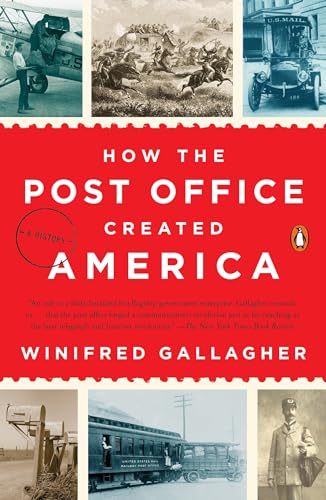
A masterful history of a long underappreciated institution, How the Post Office Created America examines the surprising role of the postal service in our nation’s political, social, economic, and physical development.
The founders established the post office before they had even signed the Declaration of Independence, and for a very long time, it was the U.S. government’s largest and most important endeavor—indeed, it was the government for most citizens. This was no conventional mail network but the central nervous system of the new body politic, designed to bind thirteen quarrelsome colonies into the United States by delivering news about public affairs to every citizen—a radical idea that appalled Europe’s great powers. America’s uniquely democratic post powerfully shaped its lively, argumentative culture of uncensored ideas and opinions and made it the world’s information and communications superpower with astonishing speed.
Winifred Gallagher presents the history of the post office as America’s own story, told from a fresh perspective over more than two centuries. The mandate to deliver the mail—then “the media”—imposed the federal footprint on vast, often contested parts of the continent and transformed a wilderness into a social landscape of post roads and villages centered on post offices. The post was the catalyst of the nation’s transportation grid, from the stagecoach lines to the airlines, and the lifeline of the great migration from the Atlantic to the Pacific. It enabled America to shift from an agrarian to an industrial economy and to develop the publishing industry, the consumer culture, and the political party system. Still one of the country’s two major civilian employers, the post was the first to hire women, African Americans, and other minorities for positions in public life.
Starved by two world wars and the Great Depression, confronted with the country’s increasingly anti-institutional mind-set, and struggling with its doubled mail volume, the post stumbled badly in the turbulent 1960s. Distracted by the ensuing modernization of its traditional services, however, it failed to transition from paper mail to email, which prescient observers saw as its logical next step. Now the post office is at a crossroads. Before deciding its future, Americans should understand what this grand yet overlooked institution has accomplished since 1775 and consider what it should and could contribute in the twenty-first century.
Gallagher argues that now, more than ever before, the imperiled post office deserves this effort, because just as the founders anticipated, it created forward-looking, communication-oriented, idea-driven America.
Die Inhaltsangabe kann sich auf eine andere Ausgabe dieses Titels beziehen.
Über die Autorin bzw. den Autor
Winifred Gallagher's books include Rapt: Attention and the Focused Life (a New York Times bestseller), New: Understanding Our Need for Novelty and Change, House Thinking, Just the Way You Are (a New York Times Notable Book), and The Power of Place. She has written for numerous publications, including the Atlantic, Rolling Stone, and the New York Times. She lives in New York City and Dubois, Wyoming.
Auszug. © Genehmigter Nachdruck. Alle Rechte vorbehalten.
The history of its post office is nothing less than the story of America. Of the nation’s founding institutions, it is the least appreci- ated or studied, and yet for a very long time it was the U.S. govern- ment’s major endeavor. Indeed, it was that government in the experience of most citizens. As radical an experiment as America itself, the post was the incubator of our uniquely lively, disputatious culture of inno- vative ideas and uncensored opinions. With astonishing speed, it established the United States as the world’s information and commu- nications superpower.
After the Revolution, America needed a central nervous system to circulate news throughout the new body politic. Like mail service, knowledge of public affairs had always been limited to an elite, but George Washington, James Madison, and especially Dr. Benjamin Rush (a terrible physician but a wonderful political philosopher) were determined to provide the people of their democratic republic with both. Their novel, uniquely American post didn’t just carry letters for the few. It also subsidized the delivery of newspapers to the entire popula- tion, which created an informed electorate, spurred the fledgling mar- ket economy, and bound thirteen fractious erstwhile colonies into the United States. For more than two centuries, the founders’ grandly envis- aged postal commons has endured as one of the few American institu- tions, public or private, in which we, the people, are treated as equals.
The America of the Early Republic desperately needed physical as well as political and economic development. The government quickly mapped this terra incognita with post routes that connected towns centered on post offices; it also subsidized the nascent transportation industry, then dominated by the stagecoach, by paying its owners to carry the mail. By 1831, French political philosopher and mail coach passenger Alexis de Tocqueville wondered over America’s unparalleled communications system, which brought the latest national and foreign news even to the Michigan outback.
By the time of Tocqueville’s visit, the founders’ ideal of nonpartisan politics had faded, and the post they created to unite opinionated Americans could divide them as well. President Andrew Jackson, a slaveholder, fumed when abolitionists used the network to send their unsolicited publications to Charleston, South Carolina, where irate lo- cals committed a federal crime by burning the mail—a conflagration that illuminated slavery as a national rather than merely regional issue. Yet Jackson himself scandalously politicized the post with his “spoils system,” which allowed the party that won the White House to hire its supporters for postal jobs wrested from the defeated rival’s ranks—a gold mine of patronage that cemented and sustained the country’s two- party system for the next 140 years.
In the 1840s, the post faced the worst crisis in its history. Antebel- lum Americans, including the migrants moving from farms to cities, and increasingly to the western frontier, protested its high letter postage by turning to cheaper private competitors that contested its exclusive right to carry mail. The post responded by turning personal corre- spondence, historically a costly luxury, into a cheap daily staple, which both aided its recovery and transformed Americans’ personal lives. The combination of postage for pennies and the Railway Mail Service—a now forgotten wonder that efficiently processed mail aboard moving trains—later enabled many people to write to a friend in the morning and receive a reply that afternoon.
The post played a crucial role in one of the nineteenth century’s crowning achievements: turning the Atlantic-oriented United States into a Pacific nation as well. The transcontinental telegraph and rail- road of the 1860s usually get the credit, but they followed in the tracks of a post that was already responding to the needs of history’s greatest overland migration. (Most settlers got their mail at post offices in gen- eral stores, much like the one served by the young postmaster Abra- ham Lincoln on the Illinois frontier.) The post subsidized the Overland Mail Company’s western stagecoaches but only paid the Pony Express to carry mail at the end of its short life, when the private service helped to keep distant California slavery-free and connected to the rest of the Union.
Like America itself, the post was transformed by the Civil War. When the Confederacy stole its entire southern network, Montgomery Blair, Lincoln’s brilliant postmaster general, used the savings from the discontinued operations to pay for expensive new services, including Free City Delivery, which brought mail to urban doorsteps, and the postal money order system, which initially enabled Union soldiers to send their salaries back home safely. The post had been the first, and was for a very long time the only, institution to give jobs to disenfran- chised women that offered them rare entrée into public life. Most had been small-town postmasters, but Blair went further, hiring women for prestigious positions as clerks even at the department’s august headquarters in Washington, D.C. The post had long been prohib- ited from using enslaved workers, lest they learn from publications circulated in the mail that all men were created equal. After the war, the victorious Republicans underscored their politics by employing significant numbers of African Americans. As a black woman, sharp- shooting, cigar-smoking “Stagecoach” Mary Fields, a former slave who transported the mail by wagon in the wilds of Montana, broke both barriers.
Around the turn of the twentieth century, the post became a pro- gressive champion for Americans who looked to the government to protect them from the Industrial Revolution’s dark side, notably the
powerful new monopolies that deprived them of affordable, competi- tively priced services. Their fearless if improbable spokesman was Post- master General John Wanamaker, the Republican merchant prince. Critics accused him of running his department like his legendary namesake department store in Philadelphia, but he used his business genius on behalf of average Americans to fight for Rural Free Delivery and broaden the meaning of “postal” to include parcel delivery and even savings banking.
Despite the austerity imposed by two global wars and the Great Depression, the undernourished post nevertheless supported, for many years single-handedly, the infant aviation industry required for its Air Mail Service (an unknown Charles Lindbergh was among its pilots). It also linked citizens at home with their loved ones fighting abroad—in World War II with microfilmed Victory Mail letters (no lipstick kisses allowed). Deprived of funds and stuck with long-obsolete equipment and facilities, the post even managed to cope with the booming middle class’s quadrupling mail volume until 1966, when, amid riots, protests, and burning cities, the institution faced its second crisis, famously il- lustrated by the weeks-long shutdown of Chicago’s post office.
By 1970, America increasingly looked to business rather than gov- ernment for problem-solving strategies, and Congress, now accustomed to focusing on the post’s bottom line, transformed the tax-subsidized Post Office Department into the self-supporting United States Postal Service. This odd government-business hybrid was finally allowed to modernize its facilities for handling traditional mail. Within a decade, however, the post—ruled by a fiscally conservative Congress and ham- pered by its own mismanagement—failed to join, much less lead, the revolution from paper mail to email that was its next...
„Über diesen Titel“ kann sich auf eine andere Ausgabe dieses Titels beziehen.
Weitere beliebte Ausgaben desselben Titels

Suchergebnisse für How the Post Office Created America: A History

Foto des Verkäufers
How the Post Office Created America: A History
Anbieter: Zoom Books East, Glendale Heights, IL, USA
Verkäuferbewertung 5 von 5 Sternen

Zustand: acceptable. Book is in acceptable condition and shows signs of wear. Book may also include underlining highlighting. The book can also include "From the library of" labels. May not contain miscellaneous items toys, dvds, etc. . We offer 100% money back guarantee and 24 7 customer service. Bestandsnummer des Verkäufers ZEV.0143130064.A
Beispielbild für diese ISBN
How the Post Office Created America: A History
Verlag:
Penguin Books (edition Reprint), 2017
ISBN 10: 0143130064
ISBN 13: 9780143130062
Gebraucht
Paperback
Anbieter: BooksRun, Philadelphia, PA, USA
Verkäuferbewertung 5 von 5 Sternen
Paperback. Zustand: Good. Reprint. It's a preowned item in good condition and includes all the pages. It may have some general signs of wear and tear, such as markings, highlighting, slight damage to the cover, minimal wear to the binding, etc., but they will not affect the overall reading experience. Bestandsnummer des Verkäufers 0143130064-11-1
Beispielbild für diese ISBN
How the Post Office Created America: A History
Anbieter: HPB-Ruby, Dallas, TX, USA
Verkäuferbewertung 5 von 5 Sternen
Paperback. Zustand: Very Good. Connecting readers with great books since 1972! Used books may not include companion materials, and may have some shelf wear or limited writing. We ship orders daily and Customer Service is our top priority! Bestandsnummer des Verkäufers S_436989066
Foto des Verkäufers
How the Post Office Created America: A History
Anbieter: Goodwill Books, Hillsboro, OR, USA
Verkäuferbewertung 5 von 5 Sternen
Zustand: good. Signs of wear and consistent use. Bestandsnummer des Verkäufers 3IIT5G000CEB_ns
Foto des Verkäufers
How the Post Office Created America: A History
Anbieter: Blue Vase Books, Interlochen, MI, USA
Verkäuferbewertung 5 von 5 Sternen
Zustand: acceptable. The item is very worn but is perfectly usable. Signs of wear can include aesthetic issues such as scratches, dents, worn and creased covers, folded page corners and minor liquid stains. All pages and the cover are intact, but the dust cover may be missing. Pages may include moderate to heavy amount of notes and highlighting, but the text is not obscured or unreadable. Page edges may have foxing age related spots and browning . May NOT include discs, access code or other supplemental materials. Bestandsnummer des Verkäufers BVV.0143130064.A
Beispielbild für diese ISBN
How the Post Office Created America: A History
Anbieter: Half Price Books Inc., Dallas, TX, USA
Verkäuferbewertung 5 von 5 Sternen
Paperback. Zustand: Very Good. Connecting readers with great books since 1972! Used books may not include companion materials, and may have some shelf wear or limited writing. We ship orders daily and Customer Service is our top priority! Bestandsnummer des Verkäufers S_446538333
Beispielbild für diese ISBN
How the Post Office Created America: A History
Anbieter: HPB-Diamond, Dallas, TX, USA
Verkäuferbewertung 5 von 5 Sternen
Paperback. Zustand: Very Good. Connecting readers with great books since 1972! Used books may not include companion materials, and may have some shelf wear or limited writing. We ship orders daily and Customer Service is our top priority! Bestandsnummer des Verkäufers S_449528600
Beispielbild für diese ISBN
How the Post Office Created America : A History
Verlag:
Penguin Publishing Group, 2017
ISBN 10: 0143130064
ISBN 13: 9780143130062
Gebraucht
Softcover
Anbieter: Better World Books: West, Reno, NV, USA
Verkäuferbewertung 5 von 5 Sternen
Zustand: Good. Used book that is in clean, average condition without any missing pages. Bestandsnummer des Verkäufers 14929012-6
Beispielbild für diese ISBN
How the Post Office Created America: A History
Anbieter: WorldofBooks, Goring-By-Sea, WS, Vereinigtes Königreich
Verkäuferbewertung 5 von 5 Sternen
Paperback. Zustand: Very Good. The book has been read, but is in excellent condition. Pages are intact and not marred by notes or highlighting. The spine remains undamaged. Bestandsnummer des Verkäufers GOR009717936
Gebraucht kaufen
EUR 3,17
Versand:
EUR 6,39
Von Vereinigtes Königreich nach USA
Anzahl: 2 verfügbar
Beispielbild für diese ISBN
How the Post Office Created America: A History
Anbieter: HPB-Emerald, Dallas, TX, USA
Verkäuferbewertung 5 von 5 Sternen
Paperback. Zustand: Very Good. Connecting readers with great books since 1972! Used books may not include companion materials, and may have some shelf wear or limited writing. We ship orders daily and Customer Service is our top priority! Bestandsnummer des Verkäufers S_450905125