
Verwandte Artikel zu Micromastery: Learn Small, Learn Fast, and Unlock Your...
Inhaltsangabe
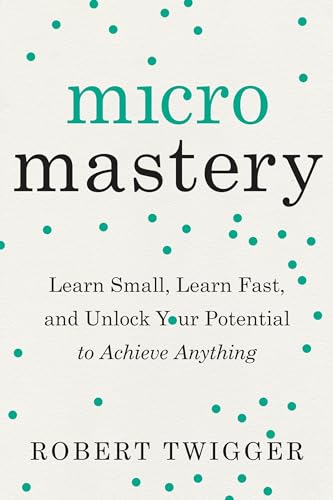
Want to be a lifelong learner? Think small.
Forget spending 10,000 hours in the pursuit of perfecting just one thing. The true path to success and achievement lies in the pursuit of perfecting lots and lots of small things--for a big payoff.
Combining positive psychology, neuroscience, self-help and more, this delightfully illuminating book encourages us to circumvent all the reasons we "can't" learn and grow (we're too busy, it's too complicated, we're not experts, we didn't start when we were young) -- by tackling small, satisfying skills.
Wish you were a seasoned chef? Learn to make a perfect omelette. Dream of being a racecar driver? Perfect a handbrake turn. Wish you could draw? Make Zen circles your first challenge. These small, doable tasks offer a big payoff -- and motivate us to keep learning and growing, with payoffs that include a boost in optimism, confidence, memory, cognitive skills, and more.
Filled with surprising insights and even a compendium of micromastery skills to try yourself, this engaging and inspiring guide reminds us of the simple joy of learning -- and opens the door to limitless, lifelong achievement, one small step at a time.
Micromasteries presented in the book (with illustrations) include: Learn How to Climb a Rope, Surf Standing Up, Talk for Fifteen Minutes about Any Subject, Bake Artisan Bread, Juggle Four Balls, Learn to Read Japanese in Three Hours, and more.
Die Inhaltsangabe kann sich auf eine andere Ausgabe dieses Titels beziehen.
Über die Autorin bzw. den Autor
Robert Twigger is an author, adventure traveler and apprentice micromaster. He lectures on risk management, polymathics and leadership, and lives in London.
Auszug. © Genehmigter Nachdruck. Alle Rechte vorbehalten.
Micromastery
Learn Small, Learn Fast, and Unlock Your Potential to Achieve Anything
By Robert TwiggerPenguin Publishing Group
Copyright © 2018 Robert Twigger
All rights reserved.
ISBN: 978-0-14-313232-5All rights reserved.
What is Micromastery?
Start with the egg, not the chicken
YouTube has clips of The Great Egg Race, a long-running TV show in the 1980s, hosted by an amiable German-born egghead called Dr. Heinz Wolff. Like a forerunner and more inventive version of Scrapheap Challenge, contestants had to build a gadget with limited resources to meet the challenge set out at the start of the show. In the early series all the tasks involved an egg that mustn't be broken, the first task being to make a machine to transport an egg the farthest distance possible using only paper clips, card, and rubber bands. It was such a simple idea, yet it gave rise to incredibly inventive machines. And it all started with an egg, something rather small and humble.
Life can be overwhelming. We want to do as much as we can, see the world, learn new things-and it can all get a bit too much. I reached a point in my life when I felt that I could no longer be interested in everything. I had to shut some of life out, and I didn't like that. I was living under the assumption-the false assumption, as it turned out-that to know anything worthwhile took years of study, so I might as well forget it.
But something inside me rebelled. I still wanted to learn new things and make new things. They didn't have to be big things-I was happy to leave that till later. Start small, start humble.
Start with an egg.
So I was thinking about how long it would take to learn how to cook really well. I recalled a chef telling me that the real test is doing something simple-like making a perfect omelet. Everything you know about cooking comes out in this simple dish. So I decided to switch the order around. Instead of spending 10,000 hours learning the basics of cookery and then showing my expertise in omelet making, I'd start with just making an omelet.
I really focused on making that omelet. I separated it from the basic need that cooking usually fulfills-filling my stomach-so that it now occupied a special, singular place in my life. It had become a micromastery.
A micromastery is a self-contained unit of doing, complete in itself but connected to a greater field. You can perfect that single thing or move on to bigger things-or you can do both. A micromastery is repeatable and has a success payoff. It is pleasing in and of itself. You can experiment with the micromastery because it has a certain elasticity-you can bend it and stretch it, and as you do you learn in a three-dimensional way that appeals to the multisensory neurons in our brain.
It's the way we learn as kids. You never absorb all the fundamentals straight away-you learn one cool thing, then another. You learn a 360 on a skateboard or how to make a crystal radio. My father was a teacher, and he hoped to encourage me when he told me that he would buy me the parts to make a transistor radio when I could explain how a transistor worked. My interest died immediately. I knew how to make the radio and have fun with it, but having to explain it was something difficult, adult, and alien. And wrong. (Dad, I forgive you.)
Hungarian psychologist Mihaly Csikszentmihalyi has written extensively about "flow"-a state in which time seems to be suspended because our interest and involvement in what we're doing are so great. A micromastery, because it is repeatable without being repetitious, has all the elements that allow us to enter a flow state, which produces great contentment and enhances physical and mental health.
Learning a micromastery doesn't commit you in that deadening way that buying a beginner's textbook does. By its limited nature, it gives you permission to remain interested in the world. It doesn't mean you have to commit to doing that thing for what feels like forever, and at the same time it spares you any worries that you've wasted your time.
Do you know the feeling of doing an introductory course on something, which you give up on, and then a few years later you try to tell others what you learned, but you can't remember? A micromastery isn't like that. It's with you forever-and it's nice to have something to show others. For instance if you learn a martial art you need something to shut people up with when they say, "Go on, show us a move."
A micromastery has a structure that connects in a crucial way to important elements in the greater field it is a part of. It reveals relationships and balances in the elements of the task that mere words and explanation, textbook-style, cannot. Its repeatability and gameability-people like that omelet, ask for another, you start to aim higher-turn it into a self-teaching mechanism, where experimentation within certain defined limits greatly increases your learning.
But let's get back to starting with an egg-or two.
A chef gave me the tip about using the fork to bulk up the omelet. I kept practicing. I went online and found more tips. Then a French woman told me about separating the yolk from the white, which allows your omelet to double in thickness and softness. When it's served, people simply go: "Wow!"
This is what I call the "entry trick." Every micromastery has one. It is a way, in one stroke, to elevate your performance at that task and get an immediate payoff-a rush of rewarding neurochemicals, which is a nice warm feeling.
In some micromasteries, the entry trick is huge, an integral part of the whole thing. In others it just gives you enough of a push to get you going. There are lots of big-shot learners out there boasting of their ability to master foreign languages, get calculus down, or absorb C++ programming, but they all seem to miss this point. Learning must not be like school; it must not be boring. It doesn't need to be silly fun, but it mustn't be deadening or dull or too hard. The entry trick, in one fell swoop, sweeps all that away.
A great entry trick is used in stone balancing. Maybe you've seen some stone-sculptor type doing it at the beach. It looks like magic-rounded rocks and mini-boulders balancing on each other in a seemingly impossible way. The first time I saw such a sculpture I thought it had to have glue or metal rods inside it . . . and then I watched a small boy knock it over. When I attempted to help rebuild it, the sculptor showed me the entry trick.
(The pictures are some I made myself on the beach, later, when I had learned how to do it.)
You can balance any stone at all, but you must find three raised bits close together on one side of the supporting stone-three bumps, three nodules, or even three grains. They can be tiny, almost invisible. In fact the smaller they are, the better it looks. These three bumps act as a flat triangle for another curved object to fit into. That's how you make these crazy balances work. People look for flat bits on the stones to make them stand on each other, but that doesn't work because nothing in nature is really flat.
Stone balancing is not only fun,...
Start with the egg, not the chicken
YouTube has clips of The Great Egg Race, a long-running TV show in the 1980s, hosted by an amiable German-born egghead called Dr. Heinz Wolff. Like a forerunner and more inventive version of Scrapheap Challenge, contestants had to build a gadget with limited resources to meet the challenge set out at the start of the show. In the early series all the tasks involved an egg that mustn't be broken, the first task being to make a machine to transport an egg the farthest distance possible using only paper clips, card, and rubber bands. It was such a simple idea, yet it gave rise to incredibly inventive machines. And it all started with an egg, something rather small and humble.
Life can be overwhelming. We want to do as much as we can, see the world, learn new things-and it can all get a bit too much. I reached a point in my life when I felt that I could no longer be interested in everything. I had to shut some of life out, and I didn't like that. I was living under the assumption-the false assumption, as it turned out-that to know anything worthwhile took years of study, so I might as well forget it.
But something inside me rebelled. I still wanted to learn new things and make new things. They didn't have to be big things-I was happy to leave that till later. Start small, start humble.
Start with an egg.
So I was thinking about how long it would take to learn how to cook really well. I recalled a chef telling me that the real test is doing something simple-like making a perfect omelet. Everything you know about cooking comes out in this simple dish. So I decided to switch the order around. Instead of spending 10,000 hours learning the basics of cookery and then showing my expertise in omelet making, I'd start with just making an omelet.
I really focused on making that omelet. I separated it from the basic need that cooking usually fulfills-filling my stomach-so that it now occupied a special, singular place in my life. It had become a micromastery.
A micromastery is a self-contained unit of doing, complete in itself but connected to a greater field. You can perfect that single thing or move on to bigger things-or you can do both. A micromastery is repeatable and has a success payoff. It is pleasing in and of itself. You can experiment with the micromastery because it has a certain elasticity-you can bend it and stretch it, and as you do you learn in a three-dimensional way that appeals to the multisensory neurons in our brain.
It's the way we learn as kids. You never absorb all the fundamentals straight away-you learn one cool thing, then another. You learn a 360 on a skateboard or how to make a crystal radio. My father was a teacher, and he hoped to encourage me when he told me that he would buy me the parts to make a transistor radio when I could explain how a transistor worked. My interest died immediately. I knew how to make the radio and have fun with it, but having to explain it was something difficult, adult, and alien. And wrong. (Dad, I forgive you.)
Hungarian psychologist Mihaly Csikszentmihalyi has written extensively about "flow"-a state in which time seems to be suspended because our interest and involvement in what we're doing are so great. A micromastery, because it is repeatable without being repetitious, has all the elements that allow us to enter a flow state, which produces great contentment and enhances physical and mental health.
Learning a micromastery doesn't commit you in that deadening way that buying a beginner's textbook does. By its limited nature, it gives you permission to remain interested in the world. It doesn't mean you have to commit to doing that thing for what feels like forever, and at the same time it spares you any worries that you've wasted your time.
Do you know the feeling of doing an introductory course on something, which you give up on, and then a few years later you try to tell others what you learned, but you can't remember? A micromastery isn't like that. It's with you forever-and it's nice to have something to show others. For instance if you learn a martial art you need something to shut people up with when they say, "Go on, show us a move."
A micromastery has a structure that connects in a crucial way to important elements in the greater field it is a part of. It reveals relationships and balances in the elements of the task that mere words and explanation, textbook-style, cannot. Its repeatability and gameability-people like that omelet, ask for another, you start to aim higher-turn it into a self-teaching mechanism, where experimentation within certain defined limits greatly increases your learning.
But let's get back to starting with an egg-or two.
A chef gave me the tip about using the fork to bulk up the omelet. I kept practicing. I went online and found more tips. Then a French woman told me about separating the yolk from the white, which allows your omelet to double in thickness and softness. When it's served, people simply go: "Wow!"
This is what I call the "entry trick." Every micromastery has one. It is a way, in one stroke, to elevate your performance at that task and get an immediate payoff-a rush of rewarding neurochemicals, which is a nice warm feeling.
In some micromasteries, the entry trick is huge, an integral part of the whole thing. In others it just gives you enough of a push to get you going. There are lots of big-shot learners out there boasting of their ability to master foreign languages, get calculus down, or absorb C++ programming, but they all seem to miss this point. Learning must not be like school; it must not be boring. It doesn't need to be silly fun, but it mustn't be deadening or dull or too hard. The entry trick, in one fell swoop, sweeps all that away.
A great entry trick is used in stone balancing. Maybe you've seen some stone-sculptor type doing it at the beach. It looks like magic-rounded rocks and mini-boulders balancing on each other in a seemingly impossible way. The first time I saw such a sculpture I thought it had to have glue or metal rods inside it . . . and then I watched a small boy knock it over. When I attempted to help rebuild it, the sculptor showed me the entry trick.
(The pictures are some I made myself on the beach, later, when I had learned how to do it.)
You can balance any stone at all, but you must find three raised bits close together on one side of the supporting stone-three bumps, three nodules, or even three grains. They can be tiny, almost invisible. In fact the smaller they are, the better it looks. These three bumps act as a flat triangle for another curved object to fit into. That's how you make these crazy balances work. People look for flat bits on the stones to make them stand on each other, but that doesn't work because nothing in nature is really flat.
Stone balancing is not only fun,...
„Über diesen Titel“ kann sich auf eine andere Ausgabe dieses Titels beziehen.
Suchergebnisse für Micromastery: Learn Small, Learn Fast, and Unlock Your...

Beispielbild für diese ISBN
Micromastery: Learn Small, Learn Fast, and Unlock Your Potential to Achieve Anything
Anbieter: World of Books (was SecondSale), Montgomery, IL, USA
Verkäuferbewertung 5 von 5 Sternen

Paperback. Zustand: Good. Want to be a lifelong learner? Think small. Forget spending 10,000 hours in the pursuit of perfecting just one thing. The true path to success and achievement lies in the pursuit of perfecting lots and lots of small things--for a big payoff. Combining positive psychology, neuroscience, self-help and more, this delightfully illuminating book encourages us to circumvent all the reasons we "can't" learn and grow (we're too busy, it's too complicated, we're not experts, we didn't start when we were young) -- by tackling small, satisfying skills. Wish you were a seasoned chef? Learn to make a perfect omelette. Dream of being a racecar driver? Perfect a handbrake turn. Wish you could draw? Make Zen circles your first challenge. These small, doable tasks offer a big payoff -- and motivate us to keep learning and growing, with payoffs that include a boost in optimism, confidence, memory, cognitive skills, and more. Filled with surprising insights and even a compendium of micromastery skills to try yourself, this engaging and inspiring guide reminds us of the simple joy of learning -- and opens the door to limitless, lifelong achievement, one small step at a time. Micromasteries presented in the book (with illustrations) include: Learn How to Climb a Rope, Surf Standing Up, Talk for Fifteen Minutes about Any Subject, Bake Artisan Bread, Juggle Four Balls, Learn to Read Japanese in Three Hours, and more. Bestandsnummer des Verkäufers 00068889355
Gebraucht kaufen
EUR 4,05
Versand gratis
Versand innerhalb von USA
Versand innerhalb von USA
Anzahl: 6 verfügbar
Foto des Verkäufers
Micromastery: Learn Small, Learn Fast, and Unlock Your Potential to Achieve Anything
Verlag:
Penguin Publishing Group, 2018
ISBN 10: 0143132326
ISBN 13: 9780143132325
Gebraucht
Softcover
Anbieter: Zoom Books Company, Lynden, WA, USA
Verkäuferbewertung 5 von 5 Sternen
Zustand: very_good. Book is in very good condition and may include minimal underlining highlighting. The book can also include "From the library of" labels. May not contain miscellaneous items toys, dvds, etc. . We offer 100% money back guarantee and 24 7 customer service. Bestandsnummer des Verkäufers ZBV.0143132326.VG
Gebraucht kaufen
EUR 4,06
Versand gratis
Versand innerhalb von USA
Versand innerhalb von USA
Anzahl: 1 verfügbar
Foto des Verkäufers
Micromastery: Learn Small, Learn Fast, and Unlock Your Potential to Achieve Anything
Verlag:
Penguin Publishing Group, 2018
ISBN 10: 0143132326
ISBN 13: 9780143132325
Gebraucht
Softcover
Anbieter: ZBK Books, Carlstadt, NJ, USA
Verkäuferbewertung 5 von 5 Sternen
Zustand: very_good. Fast & Free Shipping â" Very Good condition book with a firm cover and clean pages. Shows normal use and some light wear or limited notes markings. A solid, nice copy to enjoy. Bestandsnummer des Verkäufers ZWV.0143132326.VG
Gebraucht kaufen
EUR 5,17
Versand gratis
Versand innerhalb von USA
Versand innerhalb von USA
Anzahl: 1 verfügbar
Beispielbild für diese ISBN
Micromastery: Learn Small, Learn Fast, and Unlock Your Potential to Achieve Anything
Anbieter: World of Books Inc, Montgomery, IL, USA
Verkäuferbewertung 4 von 5 Sternen

Paperback. Zustand: Good. Want to be a lifelong learner? Think small. Forget spending 10,000 hours in the pursuit of perfecting just one thing. The true path to success and achievement lies in the pursuit of perfecting lots and lots of small things--for a big payoff. Combining positive psychology, neuroscience, self-help and more, this delightfully illuminating book encourages us to circumvent all the reasons we "can't" learn and grow (we're too busy, it's too complicated, we're not experts, we didn't start when we were young) -- by tackling small, satisfying skills. Wish you were a seasoned chef? Learn to make a perfect omelette. Dream of being a racecar driver? Perfect a handbrake turn. Wish you could draw? Make Zen circles your first challenge. These small, doable tasks offer a big payoff -- and motivate us to keep learning and growing, with payoffs that include a boost in optimism, confidence, memory, cognitive skills, and more. Filled with surprising insights and even a compendium of micromastery skills to try yourself, this engaging and inspiring guide reminds us of the simple joy of learning -- and opens the door to limitless, lifelong achievement, one small step at a time. Micromasteries presented in the book (with illustrations) include: Learn How to Climb a Rope, Surf Standing Up, Talk for Fifteen Minutes about Any Subject, Bake Artisan Bread, Juggle Four Balls, Learn to Read Japanese in Three Hours, and more. Bestandsnummer des Verkäufers CIN0143132326G
Gebraucht kaufen
EUR 5,89
Versand gratis
Versand innerhalb von USA
Versand innerhalb von USA
Anzahl: 6 verfügbar
Beispielbild für diese ISBN
Micromastery : Learn Small, Learn Fast, and Unlock Your Potential to Achieve Anything
Verlag:
Penguin Publishing Group, 2018
ISBN 10: 0143132326
ISBN 13: 9780143132325
Gebraucht
Softcover
Anbieter: Better World Books, Mishawaka, IN, USA
Verkäuferbewertung 5 von 5 Sternen
Zustand: Good. Former library copy. Pages intact with minimal writing/highlighting. The binding may be loose and creased. Dust jackets/supplements are not included. Includes library markings. Stock photo provided. Product includes identifying sticker. Better World Books: Buy Books. Do Good. Bestandsnummer des Verkäufers 15480150-6
Gebraucht kaufen
EUR 6,57
Versand gratis
Versand innerhalb von USA
Versand innerhalb von USA
Anzahl: 2 verfügbar
Beispielbild für diese ISBN
Micromastery : Learn Small, Learn Fast, and Unlock Your Potential to Achieve Anything
Verlag:
Penguin Publishing Group, 2018
ISBN 10: 0143132326
ISBN 13: 9780143132325
Gebraucht
Softcover
Anbieter: Better World Books, Mishawaka, IN, USA
Verkäuferbewertung 5 von 5 Sternen
Zustand: Very Good. Former library copy. Pages intact with possible writing/highlighting. Binding strong with minor wear. Dust jackets/supplements may not be included. Includes library markings. Stock photo provided. Product includes identifying sticker. Better World Books: Buy Books. Do Good. Bestandsnummer des Verkäufers 17883627-6
Gebraucht kaufen
EUR 6,57
Versand gratis
Versand innerhalb von USA
Versand innerhalb von USA
Anzahl: 1 verfügbar
Beispielbild für diese ISBN
Micromastery: Learn Small, Learn Fast, and Unlock Your Potential to Achieve Anything
Verlag:
Penguin Publishing Group, 2018
ISBN 10: 0143132326
ISBN 13: 9780143132325
Gebraucht
Paperback
Anbieter: ThriftBooks-Atlanta, AUSTELL, GA, USA
Verkäuferbewertung 5 von 5 Sternen
Paperback. Zustand: Good. No Jacket. Former library book; Pages can have notes/highlighting. Spine may show signs of wear. ~ ThriftBooks: Read More, Spend Less. Bestandsnummer des Verkäufers G0143132326I3N10
Gebraucht kaufen
EUR 6,66
Versand gratis
Versand innerhalb von USA
Versand innerhalb von USA
Anzahl: 1 verfügbar
Beispielbild für diese ISBN
Micromastery: Learn Small, Learn Fast, and Unlock Your Potential to Achieve Anything
Verlag:
Penguin Publishing Group, 2018
ISBN 10: 0143132326
ISBN 13: 9780143132325
Gebraucht
Paperback
Anbieter: ThriftBooks-Dallas, Dallas, TX, USA
Verkäuferbewertung 5 von 5 Sternen
Paperback. Zustand: Good. No Jacket. Former library book; Pages can have notes/highlighting. Spine may show signs of wear. ~ ThriftBooks: Read More, Spend Less. Bestandsnummer des Verkäufers G0143132326I3N10
Gebraucht kaufen
EUR 6,66
Versand gratis
Versand innerhalb von USA
Versand innerhalb von USA
Anzahl: 1 verfügbar
Beispielbild für diese ISBN
Micromastery: Learn Small, Learn Fast, and Unlock Your Potential to Achieve Anything
Verlag:
Penguin Publishing Group, 2018
ISBN 10: 0143132326
ISBN 13: 9780143132325
Gebraucht
Paperback
Anbieter: ThriftBooks-Dallas, Dallas, TX, USA
Verkäuferbewertung 5 von 5 Sternen
Paperback. Zustand: Very Good. No Jacket. May have limited writing in cover pages. Pages are unmarked. ~ ThriftBooks: Read More, Spend Less. Bestandsnummer des Verkäufers G0143132326I4N00
Gebraucht kaufen
EUR 6,66
Versand gratis
Versand innerhalb von USA
Versand innerhalb von USA
Anzahl: 1 verfügbar
Beispielbild für diese ISBN
Micromastery: Learn Small, Learn Fast, and Unlock Your Potential to Achieve Anything
Anbieter: St Vincent de Paul of Lane County, Eugene, OR, USA
Verkäuferbewertung 5 von 5 Sternen
Zustand: Good. PLEASE NOTE EX-LIBRARY Former Library book. paperback This item shows wear from consistent use but remains in good readable condition. It may have marks on or in it, and may show other signs of previous use or shelf wear. May have minor creases or signs of wear on dust jacket. Packed with care, shipped promptly. Bestandsnummer des Verkäufers 2AA-07-2063
Gebraucht kaufen
EUR 3,67
EUR 3,56 Versand
Versand innerhalb von USA
Versand innerhalb von USA
Anzahl: 1 verfügbar