
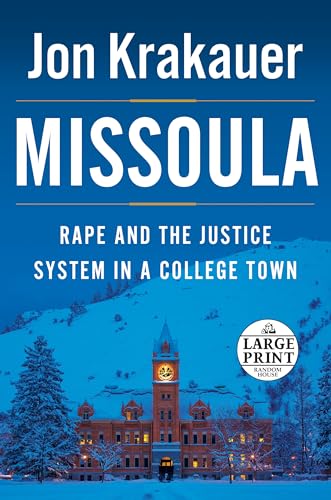
Inhaltsangabe
From bestselling author Jon Krakauer, a stark, powerful, meticulously reported narrative about a series of sexual assaults at the University of Montana — stories that illuminate the human drama behind the national plague of campus rape
Missoula, Montana, is a typical college town, with a highly regarded state university, bucolic surroundings, a lively social scene, and an excellent football team — the Grizzlies — with a rabid fan base.
The Department of Justice investigated 350 sexual assaults reported to the Missoula police between January 2008 and May 2012. Few of these assaults were properly handled by either the university or local authorities. In this, Missoula is also typical.
A DOJ report released in December of 2014 estimates 110,000 women between the ages of eighteen and twenty-four are raped each year. Krakauer’s devastating narrative of what happened in Missoula makes clear why rape is so prevalent on American campuses, and why rape victims are so reluctant to report assault.
Acquaintance rape is a crime like no other. Unlike burglary or embezzlement or any other felony, the victim often comes under more suspicion than the alleged perpetrator. This is especially true if the victim is sexually active; if she had been drinking prior to the assault — and if the man she accuses plays on a popular sports team. The vanishingly small but highly publicized incidents of false accusations are often used to dismiss her claims in the press. If the case goes to trial, the woman’s entire personal life becomes fair game for defense attorneys.
This brutal reality goes a long way towards explaining why acquaintance rape is the most underreported crime in America. In addition to physical trauma, its victims often suffer devastating psychological damage that leads to feelings of shame, emotional paralysis and stigmatization. PTSD rates for rape victims are estimated to be 50%, higher than soldiers returning from war.
In Missoula, Krakauer chronicles the searing experiences of several women in Missoula — the nights when they were raped; their fear and self-doubt in the aftermath; the way they were treated by the police, prosecutors, defense attorneys; the public vilification and private anguish; their bravery in pushing forward and what it cost them.
Some of them went to the police. Some declined to go to the police, or to press charges, but sought redress from the university, which has its own, non-criminal judicial process when a student is accused of rape. In two cases the police agreed to press charges and the district attorney agreed to prosecute. One case led to a conviction; one to an acquittal. Those women courageous enough to press charges or to speak publicly about their experiences were attacked in the media, on Grizzly football fan sites, and/or to their faces. The university expelled three of the accused rapists, but one was reinstated by state officials in a secret proceeding. One district attorney testified for an alleged rapist at his university hearing. She later left the prosecutor’s office and successfully defended the Grizzlies’ star quarterback in his rape trial. The horror of being raped, in each woman’s case, was magnified by the mechanics of the justice system and the reaction of the community.
Krakauer’s dispassionate, carefully documented account of what these women endured cuts through the abstract ideological debate about campus rape. College-age women are not raped because they are promiscuous, or drunk, or send mixed signals, or feel guilty about casual sex, or seek attention. They are the victims of a terrible crime and deserving of compassion from society and fairness from a justice system that is clearly broken.
Die Inhaltsangabe kann sich auf eine andere Ausgabe dieses Titels beziehen.
Über die Autorin bzw. den Autor
Jon Krakauer is the author of Eiger Dreams, Into the Wild, Into Thin Air, Under the Banner of Heaven, Where Men Win Glory, and Three Cups of Deceit, all of which are available in Anchor paperback and eBook editions. He is also the editor of the Modern Library Exploration series.
“Jon Krakauer combines the tenacity and courage of the finest tradition of investigative journalism with the stylish subtlety and profound insight of the born writer.” —American Academy of Arts and Letters Award in Literature citation
Auszug. © Genehmigter Nachdruck. Alle Rechte vorbehalten.
Chapter One
Office Solutions & Services, a Missoula office-products company, didn’t have its 2011 Christmas party until January 6, 2012. As a counterpoint to the chilly Montana evening, the staff decorated the place in a Hawaiian motif. Around 9:00 p.m., thirty or forty people—employees and their families, mostly—were chatting, playing party games, and sipping beverages from red plastic cups in a room overlooking the parking lot when a shiny Chrysler 300 sedan pulled up and rolled to a stop in front of the floor-to-ceiling windows, attracting the attention of the revelers. Two well-dressed men with dour expressions got out of the vehicle and stood beside it. “It was a really nice black car,” recalls Kevin Huguet, the owner of Office Solutions.
As he was admiring the Chrysler, one of Huguet’s salesmen asked, “Who are those guys?”
Huguet had no idea. So he walked outside and asked, “Can I help you?”
“We’re Missoula police detectives,” the man who had been driving the car replied. “I just need to talk to Allison.”
“Allison is my daughter,” Huguet said, his hackles rising. “You’re going to have to tell me a little more than that.”
“Dad, it’s okay,” twenty-two-year-old Allison Huguet interjected, having walked out to the parking lot shortly after her father.
Detective Guy Baker, who is six foot five and weighs 250 pounds, peered down at Allison, a slender woman with bright eyes and a ponytail. “I need to talk to you,” he said. “We don’t have to do this in front of your dad. How do you want us to handle this?” He and Allison walked away from the car to speak privately, while Detective Mark Blood remained behind with Kevin Huguet.
“Hey,” Baker said to Allison in a warmer voice when they’d moved a short distance away. They’d become acquainted four years earlier, during her final year of high school, when she asked him to serve as her mentor for a school project. It had been a positive experience for both of them. Explaining why he’d shown up during the company Christmas party, he said, “I thought it was important to tell you in person as soon as possible: About an hour ago I arrested Beau Donaldson. I got a full confession from him, and he is in jail.”
Allison’s eyes brimmed with tears of relief.
Over by the Chrysler, Kevin Huguet grew impatient as he watched Allison and Baker conferring. “You know what?” he told Detective Blood after a few minutes. “I want to know what’s going on here. This is my daughter, and I want to know what’s going on.” Kevin abruptly strode away and confronted Baker.
“She didn’t do anything bad,” Baker said. “It’s not like that.” Then Baker turned to Allison and said, “I think you really need to talk to your dad and tell him.”
Allison faced her father and, in a shaky voice, declared, “Beau raped me.”
Kevin stood on the cold pavement, gobsmacked. Struggling to make sense of the words his daughter had just spoken, he wrapped his arms around her. As he hugged Allison and began to process what Beau Donaldson had done to her, Kevin’s shock and confusion turned into blinding rage.
“I thought he was going to find Beau and kill him or something,” Allison told me, recalling the events of that night.
Beau Donaldson, a junior at the University of Montana at the time of the assault, was on the school’s football team. Allison Huguet was attending Eastern Oregon University on a track scholarship. They had grown up together in Missoula and had been inseparable friends since the first grade, but the relationship had never been romantic.
Donaldson often referred to Huguet as his “little sister,” and the sentiment was reciprocated. Throughout her childhood and adolescence, Huguet regarded Donaldson as the brother she never had. For the previous sixteen years, Huguet’s parents had welcomed Donaldson into their home as if he were a member of their family. “You spend your whole life, when you have kids, protecting them,” Kevin Huguet told me. “But who thinks their daughter’s trusted friend is actually a monster who is going to hurt them in the night?”
Allison was as angry as her father, but a confounding mix of other emotions had supplanted her rage. Donaldson raped her on September 25, 2010. She had waited fifteen months, suffering in silence, before going to the police. During that period she told nobody beyond her mother and three or four close friends that she had been raped—not even her father or sisters knew about it. Such reticence, it turns out, is common among victims of sexual assault. No more than 20 percent of rapes are reported to the police, a statistic that defies comprehension until one looks closely at how sexual-assault cases are adjudicated in the United States.
Montana is a huge place with relatively few people. Although Missoula is the state’s second largest city, it only has seventy thousand residents. Congenial and picturesque, it’s the kind of community that charms first-time visitors into putting money down on real estate within hours of arriving. Some 42 percent of the population has a bachelor’s degree or higher, compared to 28 percent of the rest of the nation. Good restaurants and lively bars abound. A legendary trout stream, the Clark Fork, runs fast and clear through the heart of downtown, paralleled by an abandoned railroad right-of-way that’s been transformed into a bucolic thoroughfare for cyclists, joggers, and strollers. South of the river, the city’s unpresuming neighborhoods stretch across a broad valley, above which five mountain ranges converge.
From Missoula’s origins in the mid-nineteenth century until the late decades of the twentieth, the local economy depended heavily on timber cut from the surrounding high country. About thirty-five years ago, however, the forest-products industry began to fall on hard times. Most of the sawmills closed, and loggers in calk boots and tin pants became an endangered species. A behemoth pulp mill pumped $45 million annually into the local economy (and at times created a noxious smog that settled so densely over the city that drivers had to turn on their headlights in the middle of the day) until 2009, when it was shuttered and sold for scrap.
Presently the largest employer in the Missoula Valley is the University of Montana, by a large margin. With its 15,000 students and more than 800 faculty members, UM, as it is known, has left a deep imprint on the city. Missoula has a much higher proportion of Democrats, for instance, than the state as a whole. As locals like to joke, one of the things that’s so great about living in Missoula is that it’s only twenty minutes from Montana.
Despite its liberal bent, in many ways Missoula resembles other cities of similar size in the Rocky Mountain region. Its population is 92 percent white, 2 percent Native American, 2 percent Hispanic, and less than 1 percent African American. The median family income is $42,000. Twenty percent of the population lives below the poverty line. Among Missoulians there is strong support for the right to keep and bear arms, and for limiting the role of the federal government in their affairs.
Missoula has a culture uniquely its own, however, thanks to the fusion of its gritty frontier heritage with the university’s myriad impacts. UM has nationally distinguished programs in biology and ecology and is perhaps even more renowned for its literary bona fides. The faculty of the university’s Creative Writing Program,...
„Über diesen Titel“ kann sich auf eine andere Ausgabe dieses Titels beziehen.
Weitere beliebte Ausgaben desselben Titels

Suchergebnisse für Missoula: Rape and the Justice System in a College...

Beispielbild für diese ISBN
Missoula: Rape and the Justice System in a College Town
Verlag:
Random House Large Print Publishing, 2015
ISBN 10: 0147519365
ISBN 13: 9780147519368
Gebraucht
Paperback
Anbieter: ThriftBooks-Phoenix, Phoenix, AZ, USA
Verkäuferbewertung 5 von 5 Sternen

Paperback. Zustand: Good. No Jacket. Pages can have notes/highlighting. Spine may show signs of wear. ~ ThriftBooks: Read More, Spend Less. Bestandsnummer des Verkäufers G0147519365I3N00
Gebraucht kaufen
EUR 6,74
Versand gratis
Versand innerhalb von USA
Versand innerhalb von USA
Anzahl: 1 verfügbar
Beispielbild für diese ISBN
Missoula: Rape and the Justice System in a College Town
Verlag:
Random House Large Print Publishing, 2015
ISBN 10: 0147519365
ISBN 13: 9780147519368
Gebraucht
Paperback
Anbieter: ThriftBooks-Atlanta, AUSTELL, GA, USA
Verkäuferbewertung 5 von 5 Sternen
Paperback. Zustand: Good. No Jacket. Pages can have notes/highlighting. Spine may show signs of wear. ~ ThriftBooks: Read More, Spend Less. Bestandsnummer des Verkäufers G0147519365I3N00
Gebraucht kaufen
EUR 6,74
Versand gratis
Versand innerhalb von USA
Versand innerhalb von USA
Anzahl: 1 verfügbar
Beispielbild für diese ISBN
Missoula: Rape and the Justice System in a College Town
Verlag:
Random House Large Print Publishing, 2015
ISBN 10: 0147519365
ISBN 13: 9780147519368
Gebraucht
Paperback
Anbieter: ThriftBooks-Atlanta, AUSTELL, GA, USA
Verkäuferbewertung 5 von 5 Sternen
Paperback. Zustand: Very Good. No Jacket. Former library book; May have limited writing in cover pages. Pages are unmarked. ~ ThriftBooks: Read More, Spend Less. Bestandsnummer des Verkäufers G0147519365I4N10
Gebraucht kaufen
EUR 6,74
Versand gratis
Versand innerhalb von USA
Versand innerhalb von USA
Anzahl: 1 verfügbar
Beispielbild für diese ISBN
Missoula: Rape and the Justice System in a College Town
Verlag:
Random House Large Print Publishing, 2015
ISBN 10: 0147519365
ISBN 13: 9780147519368
Gebraucht
Paperback
Anbieter: ThriftBooks-Dallas, Dallas, TX, USA
Verkäuferbewertung 5 von 5 Sternen
Paperback. Zustand: Very Good. No Jacket. Former library book; May have limited writing in cover pages. Pages are unmarked. ~ ThriftBooks: Read More, Spend Less. Bestandsnummer des Verkäufers G0147519365I4N10
Gebraucht kaufen
EUR 6,74
Versand gratis
Versand innerhalb von USA
Versand innerhalb von USA
Anzahl: 1 verfügbar
Beispielbild für diese ISBN
Missoula: Rape and the Justice System in a College Town (Random House Large Print)
Verlag:
Random House Large Print, 2015
ISBN 10: 0147519365
ISBN 13: 9780147519368
Gebraucht
paperback
Anbieter: Books From California, Simi Valley, CA, USA
Verkäuferbewertung 4 von 5 Sternen

paperback. Zustand: Good. Ex-library copy with usual markings. General shelf wear. Bestandsnummer des Verkäufers mon0003872579
Gebraucht kaufen
EUR 3,17
EUR 4,37 Versand
Versand innerhalb von USA
Versand innerhalb von USA
Anzahl: 1 verfügbar
Beispielbild für diese ISBN
Missoula: Rape and the Justice System in a College Town (Random House Large Print)
Verlag:
Random House Large Print, 2015
ISBN 10: 0147519365
ISBN 13: 9780147519368
Gebraucht
paperback
Anbieter: One Planet Books, Columbia, MO, USA
Verkäuferbewertung 4 von 5 Sternen
paperback. Zustand: Good. Large Print. Ships in a BOX from Central Missouri! May not include working access code. Will not include dust jacket. Has used sticker(s) and some writing and/or highlighting. UPS shipping for most packages, (Priority Mail for AK/HI/APO/PO Boxes). Bestandsnummer des Verkäufers 001792559U
Gebraucht kaufen
EUR 6,75
EUR 3,49 Versand
Versand innerhalb von USA
Versand innerhalb von USA
Anzahl: 4 verfügbar
Beispielbild für diese ISBN
Missoula: Rape and the Justice System in a College Town (Random House Large Print)
Verlag:
Random House Large Print, 2015
ISBN 10: 0147519365
ISBN 13: 9780147519368
Gebraucht
Paperback
Anbieter: HPB Inc., Dallas, TX, USA
Verkäuferbewertung 5 von 5 Sternen
Paperback. Zustand: Very Good. Connecting readers with great books since 1972! Used books may not include companion materials, and may have some shelf wear or limited writing. We ship orders daily and Customer Service is our top priority! Bestandsnummer des Verkäufers S_420759442
Gebraucht kaufen
EUR 7,21
EUR 3,28 Versand
Versand innerhalb von USA
Versand innerhalb von USA
Anzahl: 1 verfügbar
Beispielbild für diese ISBN
Missoula: Rape and the Justice System in a College Town
Verlag:
Random House Large Print Publishing April 2015, 2015
ISBN 10: 0147519365
ISBN 13: 9780147519368
Gebraucht
Trade Paperback
Anbieter: Burke's Book Store, Memphis, TN, USA
Verkäuferbewertung 5 von 5 Sternen
Trade Paperback. Zustand: Very Good. Minor crease to spine but tight and clean. Large print. Bestandsnummer des Verkäufers 1036751
Gebraucht kaufen
EUR 5,41
EUR 7,88 Versand
Versand innerhalb von USA
Versand innerhalb von USA
Anzahl: 1 verfügbar
Beispielbild für diese ISBN
Missoula: Rape and the Justice System in a College Town (Random House Large Print)
Verlag:
Random House Large Print, 2015
ISBN 10: 0147519365
ISBN 13: 9780147519368
Gebraucht
paperback
Anbieter: Textbooks_Source, Columbia, MO, USA
Verkäuferbewertung 5 von 5 Sternen
paperback. Zustand: Good. Large Print. Ships in a BOX from Central Missouri! May not include working access code. Will not include dust jacket. Has used sticker(s) and some writing or highlighting. UPS shipping for most packages, (Priority Mail for AK/HI/APO/PO Boxes). Bestandsnummer des Verkäufers 001792559U
Gebraucht kaufen
EUR 13,37
EUR 3,49 Versand
Versand innerhalb von USA
Versand innerhalb von USA
Anzahl: 3 verfügbar