
Verwandte Artikel zu The Work of Wolves: A Tense Equestrian Drama of a Horse...
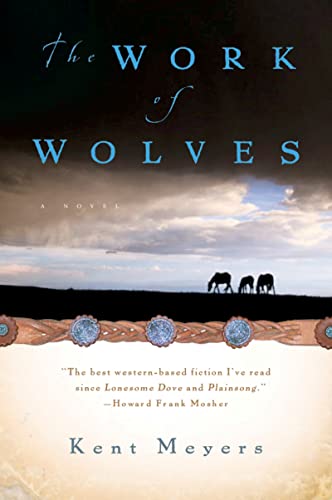
The Work of Wolves: A Tense Equestrian Drama of a Horse Trainer's Forbidden Passion and Moral Reckoning - Softcover
Inhaltsangabe
When fourteen-year-old Carson Fielding bought his first horse from Magnus Yarborough, it became clear that the teenager was a better judge of horses than the rich landowner was of humans. Years later, Carson, now a skilled and respected horse trainer, grudgingly agrees to train Magnus's horses and teach his wife to ride. But as Carson becomes disaffected with the power-hungry Magnus, he also grows more and more attracted to the rancher's wife, and their relationship sets off a violent chain of events that unsettles their quiet reservation border town in South Dakota. Thrown into the drama are Earl Walks Alone, an Indian trying to study his way out of the reservation and into college, and Willi, a German exchange student confronting his family's troubled history.
In this unforgettable story of horses, love, and life, Carson and the entire ensemble of characters learn, in very different ways, about the strong bonds that connect people to each other and to the land on which they live.
In this unforgettable story of horses, love, and life, Carson and the entire ensemble of characters learn, in very different ways, about the strong bonds that connect people to each other and to the land on which they live.
Die Inhaltsangabe kann sich auf eine andere Ausgabe dieses Titels beziehen.
Über die Autorin bzw. den Autor
KENT MEYERS is the author of The Work of Wolves, Light in the Crossing, The River Warren, and The Witness of Combines. He is a recipient of an ALA Alex Award, two Minnesota Book Awards, and a Mountains and Plains Booksellers Association Award. His work has been included in the New York Times list of Notable Books and is published in a wide array of prestigious magazines.
Von der hinteren Coverseite
Winner of the Mountains and Plains Booksellers Association Book Award
When fourteen-year-old Carson Fielding buys his first horse?a run-down,
wild-eyed roan?from the wealthiest rancher in his South Dakota border town,
he learns a hard lesson about dealing with powerful men. Years later and
now completely broke, Carson grudgingly agrees to work for the rancher,
training his horses and teaching his wife, Rebecca, to ride. But Carson and
Rebecca fall in love, angering her vengeful husband and setting off a cruel
chain of events that shock even the most hardened residents of the town.
With help from his friends from the nearby Lakota Indian reservation,
Carson, now wiser to ways of the American west, challenges the rancher's
rule, fiercely determined to protect what he holds most dear.
"Fine characterizations, crisp dialogue and a fully realized sense of place make The Work of Wolves compelling." -Denver Post
"The kind of book that demands and rewards fierce loyalty.... I instantly fell under its spell." -Christian Science Monitor
Kent Meyers is the author of The River Warren, Light in the Crossing, and The Witness of Combines. He lives in Spearfish, South Dakota, where he teaches at Black Hills State University.
When fourteen-year-old Carson Fielding buys his first horse?a run-down,
wild-eyed roan?from the wealthiest rancher in his South Dakota border town,
he learns a hard lesson about dealing with powerful men. Years later and
now completely broke, Carson grudgingly agrees to work for the rancher,
training his horses and teaching his wife, Rebecca, to ride. But Carson and
Rebecca fall in love, angering her vengeful husband and setting off a cruel
chain of events that shock even the most hardened residents of the town.
With help from his friends from the nearby Lakota Indian reservation,
Carson, now wiser to ways of the American west, challenges the rancher's
rule, fiercely determined to protect what he holds most dear.
"Fine characterizations, crisp dialogue and a fully realized sense of place make The Work of Wolves compelling." -Denver Post
"The kind of book that demands and rewards fierce loyalty.... I instantly fell under its spell." -Christian Science Monitor
Kent Meyers is the author of The River Warren, Light in the Crossing, and The Witness of Combines. He lives in Spearfish, South Dakota, where he teaches at Black Hills State University.
Auszug. © Genehmigter Nachdruck. Alle Rechte vorbehalten.
The Work of Wolves
By Kent MeyersHoughton Mifflin Harcourt Publishing Company
Copyright © 2004 Kent Meyers
All rights reserved.
ISBN: 978-0-15-603142-4All rights reserved.
Contents
Title Page,
Contents,
Copyright,
Dedication,
Prologue,
BEHIND LOSTMAN'S LAKE,
The Careful Indian,
A Fall,
Trespassing,
The Rememberer,
The Old House,
An Agreement,
Equilibriums,
Horses and Men,
Hers,
THE PHILOSOPHY OF BROKE,
Angle of Spin,
ROBBING AND STEALING,
Mining Blame,
The Lights of Koblenz,
The Silent Indian,
Substitutes for Speech,
Well of Life,
Stacking Hay,
Conversion,
Manifold,
How to Seduce White Girls,
Goat Man Forms,
GOAT MAN,
Sightings,
Trying to Go Blind,
Beadwork,
Gradations of Intimacy,
Ruination,
Dogs and Spirits,
Nine Hundred an Acre,
A Thing Unsaid,
A Thing Decided,
Another Option,
Abraham and Isaac,
The Badlands,
The Work of Wolves,
Fire and Ice,
The Invisible Cop,
Another Fire,
Wild, Freed,
A Moment of What Remains,
Some Set of Vectors,
Wind,
Acknowledgments,
About the Author,
CHAPTER 1
The Careful Indian
Earl walks alone looked up from the cone of light where his calculus book lay. Through the kitchen doorway, he could see his grandmother at the far end of the living room, watching television and beading. Earl liked to wait until dark to work on calculus, liked the small reading lamp on the kitchen table, the way dark seemed to crowd in upon him and the way the light reflected off the pages, the equations clean and precise there. But he felt restless tonight. The equations jumbled in his brain. Black and meaningless marks. He looked from his island of light through the intervening dark to his grandmother sitting in her own island of light, the soft incandescence of the floor lamp bathing her face.
Her hand dipped, a bird's head, the silver needle a beak, bobbing into the tray of beads, stringing eight of them like droplets of colored ice that slid down the invisible thread. From Earl's view the beads seemed to float in the air, following each other, until his grandmother's hand pulled them taut against the moccasin in her lap, then circled toward the tray again. Earl didn't dance in powwows, but it seemed to him the real dance in those moccasins was what his grandmother did. How could someone not dance well, wearing all that movement she poured into them?
Earl's mother was in her bedroom, preparing to sleep. His grandmother had the television turned so low it was barely a murmur. In the silence Earl heard the wind outside shaking the trees his father had planted around the house. Earl's mother claimed the sighing of those trees was his father's voice. But it sounded to Earl like wind and leaves. What good was a voice you didn't understand? If Earl heard anything at all in that sound, it was just an old, old argument between things that stayed and things that moved. Stone and wind. Inyan and Taku Skanskan. His uncle Norm would claim, of course, that there was no argument. Just different ways of being, the rock that gets kicked into life. But, Earl thought, even if every fall the trees let a part of themselves fly with the wind, rove the world, that part was brown, dead, lifeless. Not a model for leaving a place, Earl thought. Better to leave on your own volition — not pushed, and not dead.
He turned back to his equations. The green line on the graphing calculator his mother had bought him curved upward through its matrix. A green and curving road, approaching something, never reaching it. And the never-reaching was the solution. Everything just an infinite approach. Earl touched the OFF button with the eraser of his pencil. The line dimmed, disappeared. Its reddish afterimage floated for a moment in the air. With the eraser Earl pushed the calculator around, back and forth, then in circles, then in opposite circles. The wind blew, the leaves chattered. It all made Earl restless. He glanced sideways at his grandmother again, far away in her litde light.
"I'm going to go out," he said.
His voice carried across the room. His grandmother turned her face to him. The lenses of her black-rimmed glasses were glazed blue by the television's light, then cleared in an instant as the angle of reflection changed, and her dark eyes shone through. She nodded. Her hands swooped again into the tray of beads. Eyes of their own.
Earl's mother appeared in the living room, holding a hairbrush, a shadow in the darkness. She heard whatever she wanted to hear, no matter where she was in the house. Her long black hair was spread about her shoulders. Earl could barely see her face. She lifted the brush over her head, swept it down and then outward. Earl heard the faint, static sizzle and in the dark saw the myriad sparks within her hair. Then it fell from the end of the brush.
"Be careful, Earl," she said.
Earl closed the calculus book. Careful: that should be his name. Careful Walks Alone. Who else in the senior class, Indian or white, was doing homework on a Friday night? And not even homework he had to do, but extra work because he felt like it. He picked up the book, stuffed the calculator into its case, stood, walked into the living room and past his mother without looking at her. He kept his face impassive. In his bedroom he found a nylon windbreaker, shrugged into it, slipped on Nikes. The wind gusted harder. His mother brushed her long, dark hair every night, but sometimes Earl wanted to ask her why. What was the point? Who was she brushing it for? He knew: his father. Cyrus Walks Alone. Earl knew roads could have sudden endings. He knew if light grew bright enough it could be the hardest thing in the world. But he wanted to tell his mother, sometimes, not to be so careful. And not to expect it so much from him. As far as Earl knew, his father had been careful. What good had it done him?
Earl stopped his thoughts. He meant no disrespect by them. He just got tired of his father's residence in his mother's eyes, his father's story in everything his mother said. Why couldn't Cyrus just be his father — absent father, dead father, even unremembered father if he had to be — instead of always a lesson?
Earl walked back out to the living room. His mother was still standing there. She watched him go to the door. Earl turned the knob, then stopped. Couldn't go out like this.
"I'll be careful, Mom," he said. "I just got to get out, you know?"
She held the brush toward him, made a little circle of concession. He went. Beyond the grove of trees around the house, the wind was snorting through the dark. Huffing. Rising and falling. But here, near the house, the air hardly moved. The trees in their bending took the wind into themselves. Earl glanced up. Even the stars were distorted by the restless atmosphere. He got into his mother's car and drove up the short gravel drive. The moment he left the circle of trees, he felt the wind strike the car, angling across the highway into Twisted Tree. Earl held the steering wheel against it, keeping the car straight. A great blob of white came rolling out of the sky and flattened against the windshield with a sucking sound. Earl jumped, then saw it was only a plastic grocery bag. It reinflated immediately and sailed away, a prairie jellyfish.
Four empty cattle trucks banged down the highway that divided Twisted Tree. North of the highway was county land, south of it...
„Über diesen Titel“ kann sich auf eine andere Ausgabe dieses Titels beziehen.
Suchergebnisse für The Work of Wolves: A Tense Equestrian Drama of a Horse...

Beispielbild für diese ISBN
The Work of Wolves
Anbieter: World of Books (was SecondSale), Montgomery, IL, USA
Verkäuferbewertung 5 von 5 Sternen

Paperback. Zustand: Good. When fourteen-year-old Carson Fielding bought his first horse from Magnus Yarborough, it became clear that the teenager was a better judge of horses than the rich landowner was of humans. Years later, Carson, now a skilled and respected horse trainer, grudgingly agrees to train Magnus's horses and teach his wife to ride. But as Carson becomes disaffected with the power-hungry Magnus, he also grows more and more attracted to the rancher's wife, and their relationship sets off a violent chain of events that unsettles their quiet reservation border town in South Dakota. Thrown into the drama are Earl Walks Alone, an Indian trying to study his way out of the reservation and into college, and Willi, a German exchange student confronting his family's troubled history. In this unforgettable story of horses, love, and life, Carson and the entire ensemble of characters learn, in very different ways, about the strong bonds that connect people to each other and to the land on which they live. Bestandsnummer des Verkäufers 00103835460
Gebraucht kaufen
EUR 4,09
Versand gratis
Versand innerhalb von USA
Versand innerhalb von USA
Anzahl: 4 verfügbar
Beispielbild für diese ISBN
The Work of Wolves
Anbieter: World of Books (was SecondSale), Montgomery, IL, USA
Verkäuferbewertung 5 von 5 Sternen
Paperback. Zustand: Very Good. When fourteen-year-old Carson Fielding bought his first horse from Magnus Yarborough, it became clear that the teenager was a better judge of horses than the rich landowner was of humans. Years later, Carson, now a skilled and respected horse trainer, grudgingly agrees to train Magnus's horses and teach his wife to ride. But as Carson becomes disaffected with the power-hungry Magnus, he also grows more and more attracted to the rancher's wife, and their relationship sets off a violent chain of events that unsettles their quiet reservation border town in South Dakota. Thrown into the drama are Earl Walks Alone, an Indian trying to study his way out of the reservation and into college, and Willi, a German exchange student confronting his family's troubled history. In this unforgettable story of horses, love, and life, Carson and the entire ensemble of characters learn, in very different ways, about the strong bonds that connect people to each other and to the land on which they live. Bestandsnummer des Verkäufers 00047897476
Gebraucht kaufen
EUR 4,09
Versand gratis
Versand innerhalb von USA
Versand innerhalb von USA
Anzahl: 5 verfügbar
Foto des Verkäufers
The Work Of Wolves: A Tense Equestrian Drama of a Horse Trainer's Forbidden Passion and Moral Reckoning
Anbieter: Zoom Books Company, Lynden, WA, USA
Verkäuferbewertung 5 von 5 Sternen
Zustand: very_good. Book is in very good condition and may include minimal underlining highlighting. The book can also include "From the library of" labels. May not contain miscellaneous items toys, dvds, etc. . We offer 100% money back guarantee and 24 7 customer service. Bestandsnummer des Verkäufers ZBV.0156031426.VG
Gebraucht kaufen
EUR 4,10
Versand gratis
Versand innerhalb von USA
Versand innerhalb von USA
Anzahl: 3 verfügbar
Foto des Verkäufers
The Work Of Wolves: A Tense Equestrian Drama of a Horse Trainer's Forbidden Passion and Moral Reckoning
Anbieter: Greenworld Books, Arlington, TX, USA
Verkäuferbewertung 5 von 5 Sternen
Zustand: good. Fast Free Shipping â" Good condition. It may show normal signs of use, such as light writing, highlighting, or library markings, but all pages are intact and the book is fully readable. A solid, complete copy that's ready to enjoy. Bestandsnummer des Verkäufers GWV.0156031426.G
Gebraucht kaufen
EUR 4,72
Versand gratis
Versand innerhalb von USA
Versand innerhalb von USA
Anzahl: 2 verfügbar
Beispielbild für diese ISBN
The Work Of Wolves
Verlag:
Mariner Books (edition Reprint), 2005
ISBN 10: 0156031426
ISBN 13: 9780156031424
Gebraucht
Paperback
Anbieter: BooksRun, Philadelphia, PA, USA
Verkäuferbewertung 5 von 5 Sternen
Paperback. Zustand: Fair. Reprint. The item might be beaten up but readable. May contain markings or highlighting, as well as stains, bent corners, or any other major defect, but the text is not obscured in any way. Bestandsnummer des Verkäufers 0156031426-7-1-13
Gebraucht kaufen
EUR 5,50
Versand gratis
Versand innerhalb von USA
Versand innerhalb von USA
Anzahl: 1 verfügbar
Foto des Verkäufers
The Work Of Wolves: A Tense Equestrian Drama of a Horse Trainer's Forbidden Passion and Moral Reckoning
Anbieter: ZBK Books, Carlstadt, NJ, USA
Verkäuferbewertung 5 von 5 Sternen
Zustand: good. Fast & Free Shipping â" Good condition. It may show normal signs of use, such as light writing, highlighting, or library markings, but all pages are intact and the book is fully readable. A solid, complete copy that's ready to enjoy. Bestandsnummer des Verkäufers ZWV.0156031426.G
Gebraucht kaufen
EUR 5,59
Versand gratis
Versand innerhalb von USA
Versand innerhalb von USA
Anzahl: 1 verfügbar
Beispielbild für diese ISBN
The Work of Wolves
Anbieter: World of Books Inc, Montgomery, IL, USA
Verkäuferbewertung 4 von 5 Sternen

Paperback. Zustand: Very Good. When fourteen-year-old Carson Fielding bought his first horse from Magnus Yarborough, it became clear that the teenager was a better judge of horses than the rich landowner was of humans. Years later, Carson, now a skilled and respected horse trainer, grudgingly agrees to train Magnus's horses and teach his wife to ride. But as Carson becomes disaffected with the power-hungry Magnus, he also grows more and more attracted to the rancher's wife, and their relationship sets off a violent chain of events that unsettles their quiet reservation border town in South Dakota. Thrown into the drama are Earl Walks Alone, an Indian trying to study his way out of the reservation and into college, and Willi, a German exchange student confronting his family's troubled history. In this unforgettable story of horses, love, and life, Carson and the entire ensemble of characters learn, in very different ways, about the strong bonds that connect people to each other and to the land on which they live. Bestandsnummer des Verkäufers CIN0156031426VG
Gebraucht kaufen
EUR 5,93
Versand gratis
Versand innerhalb von USA
Versand innerhalb von USA
Anzahl: 5 verfügbar
Beispielbild für diese ISBN
The Work of Wolves
Anbieter: World of Books Inc, Montgomery, IL, USA
Verkäuferbewertung 4 von 5 Sternen
Paperback. Zustand: Good. When fourteen-year-old Carson Fielding bought his first horse from Magnus Yarborough, it became clear that the teenager was a better judge of horses than the rich landowner was of humans. Years later, Carson, now a skilled and respected horse trainer, grudgingly agrees to train Magnus's horses and teach his wife to ride. But as Carson becomes disaffected with the power-hungry Magnus, he also grows more and more attracted to the rancher's wife, and their relationship sets off a violent chain of events that unsettles their quiet reservation border town in South Dakota. Thrown into the drama are Earl Walks Alone, an Indian trying to study his way out of the reservation and into college, and Willi, a German exchange student confronting his family's troubled history. In this unforgettable story of horses, love, and life, Carson and the entire ensemble of characters learn, in very different ways, about the strong bonds that connect people to each other and to the land on which they live. Bestandsnummer des Verkäufers CIN0156031426G
Gebraucht kaufen
EUR 5,93
Versand gratis
Versand innerhalb von USA
Versand innerhalb von USA
Anzahl: 4 verfügbar
Beispielbild für diese ISBN
The Work of Wolves
Anbieter: ThriftBooks-Reno, Reno, NV, USA
Verkäuferbewertung 5 von 5 Sternen
Paperback. Zustand: Very Good. No Jacket. May have limited writing in cover pages. Pages are unmarked. ~ ThriftBooks: Read More, Spend Less. Bestandsnummer des Verkäufers G0156031426I4N00
Gebraucht kaufen
EUR 6,13
Versand gratis
Versand innerhalb von USA
Versand innerhalb von USA
Anzahl: 1 verfügbar
Beispielbild für diese ISBN
The Work of Wolves
Verlag:
HarperCollins Publishers, 2005
ISBN 10: 0156031426
ISBN 13: 9780156031424
Gebraucht
Softcover
Anbieter: Better World Books, Mishawaka, IN, USA
Verkäuferbewertung 5 von 5 Sternen
Zustand: Good. Reprint. Pages intact with minimal writing/highlighting. The binding may be loose and creased. Dust jackets/supplements are not included. Stock photo provided. Product includes identifying sticker. Better World Books: Buy Books. Do Good. Bestandsnummer des Verkäufers 2873561-75
Gebraucht kaufen
EUR 6,18
Versand gratis
Versand innerhalb von USA
Versand innerhalb von USA
Anzahl: 2 verfügbar