
Verwandte Artikel zu Too Loud a Solitude: A Tragicomic Czech Novella Celebrating...
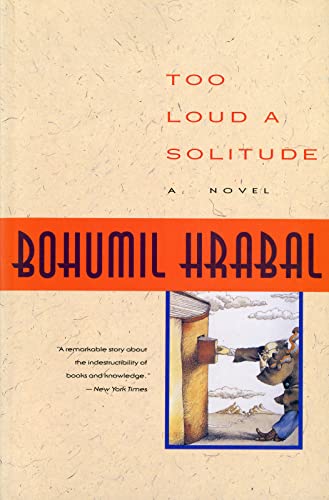
Too Loud a Solitude: A Tragicomic Czech Novella Celebrating Books in a World of Censorship and Political Oppression (Harvest in Translation) - Softcover
Inhaltsangabe
Hantá rescues books from the jaws of his compacting press and carries them home. Hrabal, whom Milan Kundera calls “our very best writer today,” celebrates the power and the indestructibility of the written word. Translated by Michael Henry Heim.
Die Inhaltsangabe kann sich auf eine andere Ausgabe dieses Titels beziehen.
Über die Autorin bzw. den Autor
Bohumil Hrabal (1914–1997) was a Czechoslovakian writer. He was the author of Closely Watched Trains, which gained an international audience both as a novel and as a film, and I Served the King of England.
Auszug. © Genehmigter Nachdruck. Alle Rechte vorbehalten.
Too Loud a Solitude
By Bohumil Hrabal, Michael Henry HeimHoughton Mifflin Harcourt Publishing Company
Copyright © 1976 Bohumil Hrabal
All rights reserved.
ISBN: 978-0-15-690458-2All rights reserved.
CHAPTER 1
For thirty-five years now I've been in wastepaper, and it's my love story. For thirty-five years I've been compacting wastepaper and books, smearing myself with letters until I've come to look like my encyclopedias — and a good three tons of them I've compacted over the years. I am a jug filled with water both magic and plain; I have only to lean over and a stream of beautiful thoughts flows out of me. My education has been so unwitting I can't quite tell which of my thoughts come from me and which from my books, but that's how I've stayed attuned to myself and the world around me for the past thirty-five years. Because when I read, I don't really read; I pop a beautiful sentence into my mouth and suck it like a fruit drop, or I sip it like a liqueur until the thought dissolves in me like alcohol, infusing brain and heart and coursing on through the veins to the root of each blood vessel. In an average month I compact two tons of books, but to muster the strength for my godly labors I've drunk so much beer over the past thirty-five years that it could fill an Olympic pool, an entire fish hatchery. Such wisdom as I have has come to me unwittingly, and I look on my brain as a mass of hydraulically compacted thoughts, a bale of ideas, and my head as a smooth, shiny Aladdin's lamp. How much more beautiful it must have been in the days when the only place a thought could make its mark was the human brain and anybody wanting to squelch ideas had to compact human heads, but even that wouldn't have helped, because real thoughts come from outside and travel with us like the noodle soup we take to work; in other words, inquisitors burn books in vain. If a book has anything to say, it burns with a quiet laugh, because any book worth its salt points up and out of itself. I've just bought one of those minuscule adder-subtractor-square-rooters, a tiny little contraption no bigger than a wallet, and after screwing up my courage I pried open the back with a screwdriver, and was I shocked and tickled to find nothing but an even tinier contraption — smaller than a postage stamp and thinner than ten pages of a book — that and air, air charged with mathematical variations. When my eye lands on a real book and looks past the printed word, what it sees is disembodied thoughts flying through air, gliding on air, living off air, returning to air, because in the end everything is air, just as the host is and is not the blood of Christ.
For thirty-five years now I've been compacting old paper and books, living as I do in a land that has known how to read and write for fifteen generations; living in a onetime kingdom where it was and still is a custom, an obsession, to compact thoughts and images patiently in the heads of the population, thereby bringing them ineffable joy and even greater woe; living among people who will lay down their lives for a bale of compacted thoughts. And now it is all recurring in me. Along with thirty-five years of pushing the red and green buttons on my hydraulic press, I've had thirty-five years of drinking beer — not that I enjoy it, no, I loathe drunkards, I drink to make me think better, to go to the heart of what I read, because what I read I read not for the fun of it or to kill time or fall asleep; I, who live in a land that has known how to read and write for fifteen generations, drink so that what I read will prevent me from falling into everlasting sleep, will give me the d.t.'s, because I share with Hegel the view that a noble-hearted man is not yet a nobleman, nor a criminal a murderer. If I knew how to write, I'd write a book about the greatest of man's joys and sorrows. It is by and from books that I've learned that the heavens are not humane, neither the heavens nor any man with a head on his shoulders — it's not that men don't wish to be humane, it just goes against common sense. Rare books perish in my press 9 under my hands, yet I am unable to stop their flow: I am nothing but a refined butcher. Books have taught me the joy of devastation: I love cloudbursts and demolition crews, I can stand for hours watching the carefully coordinated pumping motions of detonation experts as they blast entire houses, entire streets, into the air while seeming only to fill tires. I can't get enough of that first moment, the one that lifts all the bricks and stones and beams only to cave them in quietly, like clothes dropping, like a steamer sinking swiftly to the ocean floor when its boilers have burst. There I stand in the cloud of dust, in the music of fulmination, thinking of my work deep down in the cellar where I have my press, the one where I've been working for thirty-five years by the light of a few electric bulbs and where above me I hear steps moving across the courtyard, and, through an opening in the ceiling, which is also a hole in the middle of the courtyard, I see heaven-sent horns of plenty in the form of bags, crates, and boxes raining down their old paper, withered flower-shop stalks, wholesalers' wrappings, out-of-date theater programs, ice-cream wrappers, sheets of paint-spattered wallpaper, piles of moist, bloody paper from the butchers', razor-sharp rejects from photographers' studios, insides of office wastepaper baskets, typewriter ribbons included, bouquets from birthdays and namedays long past. Sometimes I find a cobblestone buried in a bundle of newspapers to make it weigh more or a penknife and a pair of scissors disposed of by mistake, or claw hammers or cleavers or cups with dried black coffee still in them or faded wedding nosegays wound round with fresh artificial funeral wreaths.
For thirty-five years I've been compacting it all in my hydraulic press, and three times a week it is transported by truck to train and then on to the paper mill, where they snap the wires and dump my work into alkalis and acids strong enough to dissolve the razor blades I keep gouging my hands with. But just as a beautiful fish will occasionally sparkle in the waters of a polluted river that runs through a stretch of factories, so in the flow of old paper the spine of a rare book will occasionally shine forth, and if for a moment I turn away, dazzled, I always turn back in time to rescue it, and after wiping it off on my apron, opening it wide, and breathing in its print, I glue my eyes to the text and read out the first sentence like a Homeric prophecy; then I place it carefully among my other splendid finds in a small crate lined with the holy cards someone once dropped into my cellar by mistake with a load of prayer books, and then comes my ritual, my mass: not only do I read every one of those books, I take each and put it in a bale, because I have a need to garnish my bales, give them my stamp, my signature, and I always worry about whether I've made a bale distinctive enough: I have to spend two hours overtime in the cellar every working day, I have to get to work an hour early, I sometimes have to come in on Saturdays if I want to work my way through the never-ending mountain of old paper. Last month they delivered nearly fifteen hundred pounds of "Old Masters" reproductions, dropped nearly fifteen hundred pounds of sopping-wet Rembrandts, Halses, Monets, Manets, Klimts, Cézannes, and other big guns of European art into my cellar, so now I frame each of my bales with reproductions, and when evening comes and the bales stand one next to the other waiting in all their splendor for the service elevator, I can't take my eyes off them: now The Night Watch, now...
„Über diesen Titel“ kann sich auf eine andere Ausgabe dieses Titels beziehen.
Suchergebnisse für Too Loud a Solitude: A Tragicomic Czech Novella Celebrating...

Beispielbild für diese ISBN
Too Loud a Solitude
Anbieter: Evergreen Goodwill, Seattle, WA, USA
Verkäuferbewertung 5 von 5 Sternen

paperback. Zustand: Good. Bestandsnummer des Verkäufers mon0000164160
Gebraucht kaufen
EUR 2,55
EUR 3,51 Versand
Versand innerhalb von USA
Versand innerhalb von USA
Anzahl: 1 verfügbar
Beispielbild für diese ISBN
Too Loud a Solitude
Anbieter: HPB-Diamond, Dallas, TX, USA
Verkäuferbewertung 5 von 5 Sternen
Paperback. Zustand: Very Good. Connecting readers with great books since 1972! Used books may not include companion materials, and may have some shelf wear or limited writing. We ship orders daily and Customer Service is our top priority! Bestandsnummer des Verkäufers S_476544479
Gebraucht kaufen
EUR 3,82
EUR 3,29 Versand
Versand innerhalb von USA
Versand innerhalb von USA
Anzahl: 1 verfügbar
Beispielbild für diese ISBN
Too Loud a Solitude
Anbieter: BookOutlet, Jefferson City, TN, USA
Verkäuferbewertung 5 von 5 Sternen
Paperback. Zustand: New. Paperback. Publisher overstock, may contain remainder mark on edge. Bestandsnummer des Verkäufers 9780156904582B
Beispielbild für diese ISBN
Too Loud a Solitude Harvest in
Anbieter: World of Books (was SecondSale), Montgomery, IL, USA
Verkäuferbewertung 5 von 5 Sternen
Zustand: Good. Item in good condition. Textbooks may not include supplemental items i.e. CDs, access codes etc. Bestandsnummer des Verkäufers 00110932454
Gebraucht kaufen
EUR 7,89
Versand gratis
Versand innerhalb von USA
Versand innerhalb von USA
Anzahl: 1 verfügbar
Beispielbild für diese ISBN
Too Loud a Solitude
Anbieter: HPB-Emerald, Dallas, TX, USA
Verkäuferbewertung 5 von 5 Sternen
Paperback. Zustand: Very Good. Connecting readers with great books since 1972! Used books may not include companion materials, and may have some shelf wear or limited writing. We ship orders daily and Customer Service is our top priority! Bestandsnummer des Verkäufers S_485336709
Gebraucht kaufen
EUR 5,87
EUR 3,29 Versand
Versand innerhalb von USA
Versand innerhalb von USA
Anzahl: 1 verfügbar
Beispielbild für diese ISBN
Too Loud a Solitude
Anbieter: HPB Inc., Dallas, TX, USA
Verkäuferbewertung 5 von 5 Sternen
Paperback. Zustand: Very Good. Connecting readers with great books since 1972! Used books may not include companion materials, and may have some shelf wear or limited writing. We ship orders daily and Customer Service is our top priority! Bestandsnummer des Verkäufers S_483372951
Gebraucht kaufen
EUR 5,87
EUR 3,29 Versand
Versand innerhalb von USA
Versand innerhalb von USA
Anzahl: 1 verfügbar
Beispielbild für diese ISBN
Too Loud a Solitude
Anbieter: HPB-Ruby, Dallas, TX, USA
Verkäuferbewertung 5 von 5 Sternen
Paperback. Zustand: Very Good. Connecting readers with great books since 1972! Used books may not include companion materials, and may have some shelf wear or limited writing. We ship orders daily and Customer Service is our top priority! Bestandsnummer des Verkäufers S_485331453
Gebraucht kaufen
EUR 5,87
EUR 3,29 Versand
Versand innerhalb von USA
Versand innerhalb von USA
Anzahl: 1 verfügbar
Beispielbild für diese ISBN
Too Loud a Solitude
Anbieter: Half Price Books Inc., Dallas, TX, USA
Verkäuferbewertung 5 von 5 Sternen
Paperback. Zustand: Very Good. Connecting readers with great books since 1972! Used books may not include companion materials, and may have some shelf wear or limited writing. We ship orders daily and Customer Service is our top priority! Bestandsnummer des Verkäufers S_483217882
Gebraucht kaufen
EUR 5,87
EUR 3,29 Versand
Versand innerhalb von USA
Versand innerhalb von USA
Anzahl: 1 verfügbar
Beispielbild für diese ISBN
Too Loud a Solitude
Anbieter: Isle of Books, Bozeman, MT, USA
Verkäuferbewertung 4 von 5 Sternen

Paper Back. Zustand: Good. Bestandsnummer des Verkäufers 606337
Gebraucht kaufen
EUR 9,51
Versand gratis
Versand innerhalb von USA
Versand innerhalb von USA
Anzahl: 1 verfügbar
Beispielbild für diese ISBN
Too Loud a Solitude
Anbieter: World of Books Inc, Montgomery, IL, USA
Verkäuferbewertung 4 von 5 Sternen
Paperback. Zustand: Good. A short novel by Czech writer Bohumil Hrabal, called "our very best writer today" by Milan Kundera, this eccentric romp celebrates the indestructability--against censorship and political oppression--of the written word. Too Loud a Solitude is a tender and funny story of Hanta--a man who has lived in a Czech police state--for 35 years, working as compactor of wastepaper and books. In the process of compacting, he has acquired an education so unwitting he can't quite tell which of his thoughts are his own and which come from his books. He has rescued many from jaws of hydraulic press and now his house is filled to the rooftops. Destroyer of the written word, he is also its perpetrator. But when a new automatic press makes his job redundant there's only one thing he can do--go down with his ship. Translated by Michael Henry Heim. Bestandsnummer des Verkäufers CIN0156904586G
Gebraucht kaufen
EUR 9,70
Versand gratis
Versand innerhalb von USA
Versand innerhalb von USA
Anzahl: 1 verfügbar