
Verwandte Artikel zu GENESIS OF GRAMMAR SEL C: A Reconstruction (Studies...
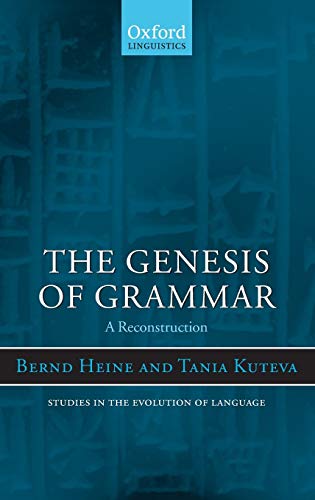
GENESIS OF GRAMMAR SEL C: A Reconstruction (Studies in the Evolution of Language, Band 9) - Hardcover
Inhaltsangabe
Addresses key questions in the origins and evolution of language
Die Inhaltsangabe kann sich auf eine andere Ausgabe dieses Titels beziehen.
Über die Autorin bzw. den Autor
Bernd Heine is Emeritus Professor of Linguistics at the Institute of African Studies, University of Cologne. His 33 books include Possession: Cognitive sources, forces, and grammaticalization (CUP, 1997); Auxiliaries: Cognitive Forces and Grammaticalization (OUP, 1993); Cognitive Foundations of Grammar (USA, 1997); with Derek Nurse, African Languages: An Introduction (CUP, 2000), A Linguistic Geography of Africa (CUP, to appear 2007).
Tania Kuteva is Professor of English Linguistics at the University of Düsseldorf and author of Auxiliation: An Enquiry into the Nature of Grammaticalization (OUP, 2001).
Bernd Heine and Tania Kuteva are the joint authors of World Lexicon of Grammaticalization (CUP, 2002) and Language Contact and Grammatical Change (CUP, 2005), and The Changing Languages of Europe (OUP, 2006).
„Über diesen Titel“ kann sich auf eine andere Ausgabe dieses Titels beziehen.
Suchergebnisse für GENESIS OF GRAMMAR SEL C: A Reconstruction (Studies...

Foto des Verkäufers
The Genesis of Grammar - A Reconstruction
Verlag:
Oxford University Press, New York, 2007
ISBN 10: 0199227764
ISBN 13: 9780199227761
Gebraucht
Soft cover
Erstausgabe
Anbieter: Oxfam Bookshop Gent, Gent, Belgien
Verkäuferbewertung 5 von 5 Sternen

Soft cover. Zustand: Good. No Jacket. 1st Edition. XVI, 418 pp. Oxford University Press - 2007 - New York. Blue softcover with text, in good condition. Ex. of the Ghent University Library with the usual stamps, labels and numbers. No marks inside the book. A very good copy. Bestandsnummer des Verkäufers 012246
Gebraucht kaufen
EUR 25,00
EUR 27,00 Versand
Versand von Belgien nach USA
Versand von Belgien nach USA
Anzahl: 2 verfügbar
Foto des Verkäufers
THE GENESIS OF GRAMMAR: A Reconstruction
Verlag:
Oxford University Press, Oxford, 2007
ISBN 10: 0199227764
ISBN 13: 9780199227761
Gebraucht
Hardcover
Erstausgabe
Anbieter: johnson rare books & archives, ABAA, Covina, CA, USA
Verkäuferbewertung 5 von 5 Sternen
Hardcover. Zustand: Fine. Zustand des Schutzumschlags: Fine. First Edition. "This book reconstructs what the earliest grammars might have been and shows how they could have led to the languages of modern humankind." Studies in the Evolution of Language 9. Octavo. Original black cloth binding, with gilt titles. A fine copy in a fine dust jacket. Bestandsnummer des Verkäufers 68353
Gebraucht kaufen
EUR 90,93
EUR 5,08 Versand
Versand innerhalb von USA
Versand innerhalb von USA
Anzahl: 1 verfügbar
Foto des Verkäufers
The Genesis of Grammar (Hardcover)
Verlag:
Oxford University Press, Oxford, 2007
ISBN 10: 0199227764
ISBN 13: 9780199227761
Neu
Hardcover
Anbieter: AussieBookSeller, Truganina, VIC, Australien
Verkäuferbewertung 5 von 5 Sternen
Hardcover. Zustand: new. Hardcover. This book reconstructs what the earliest grammars might have been and shows how they could have led to the languages of modern humankind.Like other biological phenomena, language cannot be fully understood without reference to its evolution, whether proven or hypothesized," wrote Talmy Givon in 2002. As the languages spoken 8,000 years ago were typologically much the same as they are today and as no direct evidence exists for languagesbefore then, evolutionary linguists are at a disadvantage compared to their counterparts in biology. Bernd Heine and Tania Kuteva seek to overcome this obstacle by combining grammaticalization theory, one ofthe main methods of historical linguistics, with work in animal communication and human evolution. The questions they address include: do the modern languages derive from one ancestral language or from more than one? What was the structure of language like when it first evolved? And how did the properties associated with modern human languages arise, in particular syntax and the recursive use of language structures? The authors proceed on the assumption that if language evolution is the resultof language change then the reconstruction of the former can be explored by deploying the processes involved in the latter. Their measured arguments and crystal-clear exposition will appeal to allthose interested in the evolution of language, from advanced undergraduates to linguists, cognitive scientists, human biologists, and archaeologists. This book reconstructs what the earliest grammars might have been and shows how they could have led to the languages of modern humankind. It considers whether these languages derive from a single ancestral language; what the structure of language was when it first evolved; and how the properties associated with modern human languages first arose. This item is printed on demand. Shipping may be from our Sydney, NSW warehouse or from our UK or US warehouse, depending on stock availability. Bestandsnummer des Verkäufers 9780199227761
Neu kaufen
EUR 215,72
EUR 32,67 Versand
Versand von Australien nach USA
Versand von Australien nach USA
Anzahl: 1 verfügbar
Beispielbild für diese ISBN
GENESIS OF GRAMMAR SEL C
Print-on-DemandAnbieter: PBShop.store UK, Fairford, GLOS, Vereinigtes Königreich
Verkäuferbewertung 5 von 5 Sternen
HRD. Zustand: New. New Book. Delivered from our UK warehouse in 4 to 14 business days. THIS BOOK IS PRINTED ON DEMAND. Established seller since 2000. Bestandsnummer des Verkäufers L1-9780199227761
Neu kaufen
EUR 306,62
EUR 6,87 Versand
Versand von Vereinigtes Königreich nach USA
Versand von Vereinigtes Königreich nach USA
Anzahl: Mehr als 20 verfügbar
Beispielbild für diese ISBN
Genesis of Grammer : A Reconstruction
Anbieter: GreatBookPrices, Columbia, MD, USA
Verkäuferbewertung 5 von 5 Sternen
Zustand: New. Bestandsnummer des Verkäufers 5210181-n
Neu kaufen
EUR 315,01
EUR 2,33 Versand
Versand innerhalb von USA
Versand innerhalb von USA
Anzahl: Mehr als 20 verfügbar
Foto des Verkäufers
The Genesis of Grammar (Hardcover)
Verlag:
Oxford University Press, Oxford, 2007
ISBN 10: 0199227764
ISBN 13: 9780199227761
Neu
Hardcover
Anbieter: Grand Eagle Retail, Bensenville, IL, USA
Verkäuferbewertung 5 von 5 Sternen
Hardcover. Zustand: new. Hardcover. This book reconstructs what the earliest grammars might have been and shows how they could have led to the languages of modern humankind.Like other biological phenomena, language cannot be fully understood without reference to its evolution, whether proven or hypothesized," wrote Talmy Givon in 2002. As the languages spoken 8,000 years ago were typologically much the same as they are today and as no direct evidence exists for languagesbefore then, evolutionary linguists are at a disadvantage compared to their counterparts in biology. Bernd Heine and Tania Kuteva seek to overcome this obstacle by combining grammaticalization theory, one ofthe main methods of historical linguistics, with work in animal communication and human evolution. The questions they address include: do the modern languages derive from one ancestral language or from more than one? What was the structure of language like when it first evolved? And how did the properties associated with modern human languages arise, in particular syntax and the recursive use of language structures? The authors proceed on the assumption that if language evolution is the resultof language change then the reconstruction of the former can be explored by deploying the processes involved in the latter. Their measured arguments and crystal-clear exposition will appeal to allthose interested in the evolution of language, from advanced undergraduates to linguists, cognitive scientists, human biologists, and archaeologists. This book reconstructs what the earliest grammars might have been and shows how they could have led to the languages of modern humankind. It considers whether these languages derive from a single ancestral language; what the structure of language was when it first evolved; and how the properties associated with modern human languages first arose. This item is printed on demand. Shipping may be from multiple locations in the US or from the UK, depending on stock availability. Bestandsnummer des Verkäufers 9780199227761
Beispielbild für diese ISBN
Genesis of Grammer : A Reconstruction
Anbieter: GreatBookPricesUK, Woodford Green, Vereinigtes Königreich
Verkäuferbewertung 5 von 5 Sternen
Zustand: New. Bestandsnummer des Verkäufers 5210181-n
Neu kaufen
EUR 306,60
EUR 17,57 Versand
Versand von Vereinigtes Königreich nach USA
Versand von Vereinigtes Königreich nach USA
Anzahl: Mehr als 20 verfügbar
Beispielbild für diese ISBN
The Genesis of Grammar: A Reconstruction (Oxford Studies in the Evolution of Language)
Anbieter: Ria Christie Collections, Uxbridge, Vereinigtes Königreich
Verkäuferbewertung 5 von 5 Sternen
Zustand: New. In English. Bestandsnummer des Verkäufers ria9780199227761_new
Neu kaufen
EUR 331,53
EUR 13,22 Versand
Versand von Vereinigtes Königreich nach USA
Versand von Vereinigtes Königreich nach USA
Anzahl: Mehr als 20 verfügbar
Beispielbild für diese ISBN
The Genesis of Grammar: A Reconstruction: 9 (Studies in the Evolution of Language)
Anbieter: Kennys Bookshop and Art Galleries Ltd., Galway, GY, Irland
Verkäuferbewertung 5 von 5 Sternen
Zustand: New. This book reconstructs what the earliest grammars might have been and shows how they could have led to the languages of modern humankind. It considers whether these languages derive from a single ancestral language; what the structure of language was when it first evolved; and how the properties associated with modern human languages first arose. Series: Studies in the Evolution of Language. Num Pages: 438 pages, Illustrations. BIC Classification: CFF; JMR; PSX. Category: (UP) Postgraduate, Research & Scholarly; (UU) Undergraduate. Dimension: 241 x 165 x 28. Weight in Grams: 792. . 2007. Illustrated. hardcover. . . . . Bestandsnummer des Verkäufers V9780199227761
Neu kaufen
EUR 340,16
EUR 9,50 Versand
Versand von Irland nach USA
Versand von Irland nach USA
Anzahl: Mehr als 20 verfügbar
Foto des Verkäufers
The Genesis of Grammar
Anbieter: Rarewaves.com USA, London, LONDO, Vereinigtes Königreich
Verkäuferbewertung 5 von 5 Sternen
Hardback. Zustand: New. This book reconstructs what the earliest grammars might have been and shows how they could have led to the languages of modern humankind.Like other biological phenomena, language cannot be fully understood without reference to its evolution, whether proven or hypothesized," wrote Talmy Givón in 2002. As the languages spoken 8,000 years ago were typologically much the same as they are today and as no direct evidence exists for languages before then, evolutionary linguists are at a disadvantage compared to their counterparts in biology. Bernd Heine and Tania Kuteva seek to overcome this obstacle by combining grammaticalization theory, one of the main methods of historical linguistics, with work in animal communication and human evolution. The questions they address include: do the modern languages derive from one ancestral language or from more than one? What was the structure of language like when it first evolved? And how did the properties associated with modern human languages arise, in particular syntax and the recursive use of language structures? The authors proceed on the assumption that if language evolution is the result of language change then the reconstruction of the former can be explored by deploying the processes involved in the latter. Their measured arguments and crystal-clear exposition will appeal to all those interested in the evolution of language, from advanced undergraduates to linguists, cognitive scientists, human biologists, and archaeologists. Bestandsnummer des Verkäufers LU-9780199227761
Neu kaufen
EUR 358,23
Versand gratis
Versand von Vereinigtes Königreich nach USA
Versand von Vereinigtes Königreich nach USA
Anzahl: Mehr als 20 verfügbar